美国MBA课程作业模板参考-MARKETING PLAN OF “JIA DUO BAO”

美国MBA课程作业模板参考:Marketing Plan of “JIA DUO BAO”
很多同学在写美国 MBA 课程作业时,最头疼的不是没有资料,而是不知道一篇 Marketing Plan 应该怎么展开。尤其是遇到真实品牌案例,比如 JIA DUO BAO(加多宝)这种有品牌争议、有市场竞争、有广告传播案例的企业,如果只是简单堆资料,文章就会显得很散;但如果能按照市场环境、消费者、竞争对手、品牌传播和渠道策略一步步分析,整篇作业就会清楚很多。
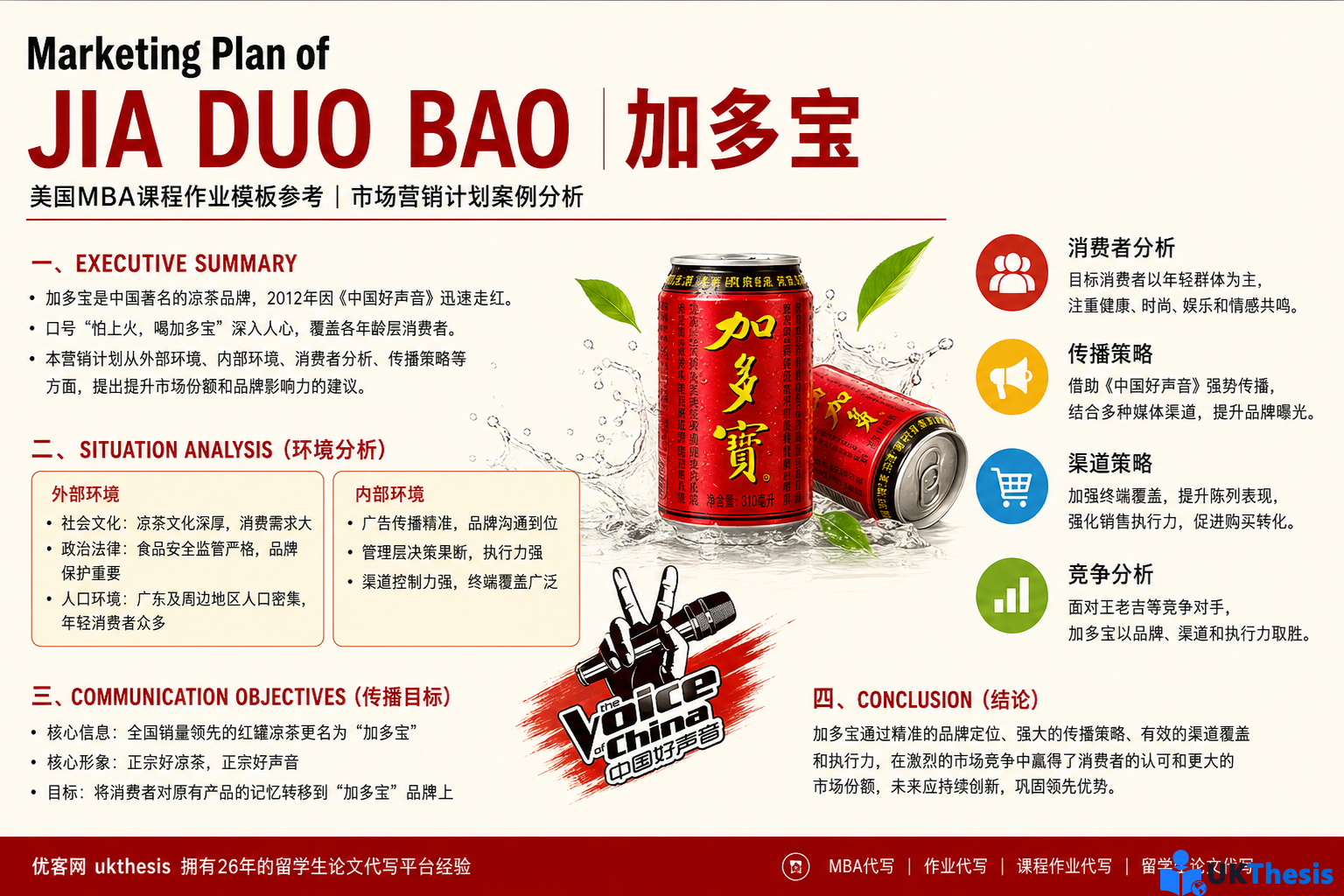
这篇文章保留原文的主要内容和分析思路,以 “JIA DUO BAO” 的营销计划为案例,整理一篇适合 MBA 课程作业参考的 Marketing Plan 模板。对于正在查找留学生论文写作辅导、MBA代写参考、作业代写范文、课程作业代写资料的同学来说,这类文章更适合用来学习结构、表达和案例分析方法,而不是简单照搬。
优客网 ukthesis 作为拥有 26 年服务经验的留学生论文写作支持平台,长期整理 MBA essay、Marketing Plan、Business Report、assignment Writing 等课程作业范文,希望通过这类案例,帮助学生更清楚地理解海外课程作业的写法和老师常看的分析重点。
Abstract
This paper focuses on a marketing plan for the famous Chinese herbal tea brand “JIA DUO BAO”. In this paper, both the external environment and internal environment are analyzed in order to understand how market conditions influence the company’s development. Based on the analysis, several suggestions are put forward to help JIA DUO BAO improve its market plan, strengthen brand control, and gain a larger market share in future competition.
I. Executive Summary
The main question of this marketing plan is simple: how can JIA DUO BAO make a wise marketing plan and win a larger market share?
As we all know, JIA DUO BAO is a well-known herbal tea brand in China. Around 2012, the brand became widely recognized because of its connection with the popular TV program The Voice of China. Since then, the slogan “Afraid to get angry, drink JDB” has become familiar to young consumers as well as people from different age groups.
However, if we want to understand the success of JIA DUO BAO clearly, we first need to look at its brand history and business background.
JDB Group is a Hong Kong-based large-scale beverage company engaged in production and sales. Its products include red canned JIA DUO BAO, bottled JIA DUO BAO, and Kunlun Mountain natural mineral water. Since 1996, the group has promoted canned herbal tea in Guangdong Province and introduced new marketing ideas to the herbal tea industry. With continuous product improvement and strong marketing communication, the brand gradually became accepted by consumers.
From this point of view, JIA DUO BAO is not only a beverage brand, but also a useful case for MBA students to study brand repositioning, consumer communication, crisis response and channel management.
II. Situation Analysis
Section A: The External Environment
The external environment of the Chinese beverage market has become increasingly competitive. Although JIA DUO BAO achieved significant success around 2012, the company also faced many challenges from market competition, brand disputes and changing consumer behavior.
A. Macroeconomic Environment: Social Culture
In Guangdong and other parts of southern China, herbal tea has a long cultural tradition. In the past, many consumers saw herbal tea more like a kind of “medicine” used to reduce internal heat, especially during hot weather. Traditional herbal tea often had a strong smell and a bitter taste, so it was not always suitable as a daily beverage.
JIA DUO BAO changed this perception. It combined the traditional concept of herbal tea with a sweeter taste and more modern packaging. This helped consumers treat herbal tea not only as something functional, but also as a drink they could enjoy in daily life. This point is important because successful marketing is often not just about selling a product; it is about changing the way people understand and use the product.
B. Political and Legal Environment
The political and legal environment also influenced the development of the herbal tea industry. Food production, quality inspection, health standards and intellectual property rights all played a role in the market competition between JIA DUO BAO and Wong Lo Kat.
For a beverage company, legal qualifications and product safety are basic requirements. At the same time, brand ownership and trademark disputes can directly affect consumer recognition. The competition between JIA DUO BAO and Wong Lo Kat is a typical example of how legal issues can become part of marketing competition.
C. Population Environment
In Guangdong Province and southern Zhejiang, the weather is hot in summer, and consumers often have a stronger demand for herbal tea. These areas are also densely populated and include many young consumers. For JIA DUO BAO, this provided a natural market foundation.
Young consumers are especially important because they are more likely to be influenced by television programs, online media, social discussions and brand campaigns. Therefore, JIA DUO BAO’s cooperation with The Voice of China was not accidental. It matched the media habits and emotional pReferences of young audiences.
III. Micro-Environmental Analysis
The internal environment of JIA DUO BAO can be summarized from several aspects.
First, the company had accurate advertising communication. Its slogan and brand message were easy to remember. In marketing, a simple and repeated message is often more powerful than a complicated one.
Second, the decision-makers of the company showed strong judgment and courage. After the brand dispute with Wong Lo Kat, JIA DUO BAO needed to make consumers remember the new brand name quickly. This required fast decision-making and strong investment.
Third, the company had excellent execution ability, especially in channel control. In the beverage market, price differences are often not very large, so brand awareness and terminal visibility become very important. If consumers can see the product in supermarkets, restaurants and convenience stores, they are more likely to choose it. JIA DUO BAO understood this very well.
In the whole beverage market, the competition was not only a product competition, but also a brand war. If JIA DUO BAO wanted to win this battle, it needed consumers to recognize, accept and trust the brand again.
IV. Political, Legal and Regulatory Issues
The long dispute between JIA DUO BAO and Wong Lo Kat made the market environment more complicated. The brand conflict did not only affect the two companies; it also attracted public attention and became a widely discussed business case.
Wong Lo Kat herbal tea has a long history. Its formula, name and related interests have gone through many historical changes. The relationship between the Hong Kong side, the mainland side and later business operators made the brand ownership issue very complex. Because of this background, the competition between JIA DUO BAO and Wong Lo Kat was not a simple competition between two products. It was also a competition about brand history, legal rights, consumer memory and market control.
For MBA course writing, this part is very useful. It shows that marketing plans cannot be separated from the legal environment. When a company faces trademark or brand ownership disputes, marketing strategy must respond quickly and carefully.
V. The Customer Environment
There is a common saying in business: “the customer is the god.” This is especially true for the JIA DUO BAO case.
Before 2012, not every consumer clearly knew the JIA DUO BAO brand. However, after the cooperation with The Voice of China, the brand quickly entered the public eye. The program gave JIA DUO BAO strong national exposure, while JIA DUO BAO also helped the program gain commercial influence. This was a typical case of brand and media cooperation.
As a company, profit is an important goal of any marketing plan. But profit does not come only from advertising. It comes from consumer trust, brand recognition and repeated purchase behavior.
JIA DUO BAO and The Voice of China used a combination of television, print media, outdoor advertising, radio, online media and offline roadshows. This created a wide communication network. The campaign did not rely on one channel only; instead, it built a full marketing system.
At the same time, JIA DUO BAO had to face Wong Lo Kat as a strong competitor. Wong Lo Kat had a long history and a large consumer base. This was an obvious advantage. However, in a fast-changing market, old brand history is not always enough. Marketing execution, brand communication and channel coverage can also decide the final result.
VI. Communication Objectives and Strategy
The communication objective of JIA DUO BAO was to make consumers understand that the red canned herbal tea they knew had been renamed JIA DUO BAO. The company needed to transfer consumers’ old memory to the new brand name.
The key image was: “authentic good herbal tea, authentic good voice.” Through this message, JIA DUO BAO connected the idea of authentic herbal tea with the popularity of The Voice of China.
Target Audience
The target audience included television viewers, online users, young consumers and people who paid attention to The Voice of China. These people were active in media consumption and more likely to participate in brand interaction.
Communication Strategy
The communication strategy can be summarized as one core message, two marketing channels and three interactive activities.
The core message was that the national sales-leading red canned herbal tea had been renamed JIA DUO BAO. Around this message, media promotion, interactive activities and content marketing were repeatedly used to strengthen consumer memory.
The two marketing channels included the program’s own media channel and activity promotion channels. Through the program sponsorship, JIA DUO BAO gained strong brand exposure. Through online and offline activities, the brand expanded user participation and attracted more public attention.
This strategy worked because it did not only tell consumers a fact; it repeated the fact in many familiar situations until consumers remembered it naturally.
VII. Internal Organizational Environment
The success of Wong Lo Kat in the market was partly connected with the marketing ability of JIA DUO BAO. This showed that JIA DUO BAO had strong brand-building capability. If the company had the ability to make Wong Lo Kat well known, it also had the chance to build a new brand name after separating from the old brand.
The dispute between JIA DUO BAO and Wong Lo Kat showed that speed and execution are very important in marketing. When JIA DUO BAO’s advertisements appeared everywhere and its products entered supermarkets, restaurants and other sales terminals, Wong Lo Kat seemed slower in response. In a competitive market, this delay can easily lead to lost opportunities.
So, how did JIA DUO BAO take advantage of its strengths?
First: Market Positioning
JIA DUO BAO positioned itself as an authentic herbal tea leader. By using messages such as “the national sales-leading red canned herbal tea has been renamed JIA DUO BAO,” the brand tried to keep the old customer base and help consumers understand the brand transition.
This was a smart positioning strategy. It did not ask consumers to forget the past immediately. Instead, it guided consumers to connect their previous product memory with the new brand name.
Second: Brand Communication
JIA DUO BAO invested heavily in The Voice of China, and this decision brought strong market attention. The success of the program helped Zhejiang TV gain influence, and at the same time, JIA DUO BAO’s brand name was spread widely.
However, title sponsorship was only one part of the communication strategy. JIA DUO BAO also appeared in many television programs, outdoor advertisements and terminal promotions. This made the brand highly visible in both media space and daily consumption scenes.
Third: Channel Coverage
Advertising can attract attention, but terminal coverage helps turn attention into purchases. JIA DUO BAO understood this clearly. In many places, consumers could see JIA DUO BAO products and advertisements at the same time. This strengthened consumer memory.
The company also had a strong channel team. Sales staff not only had sales targets, but also needed to complete terminal promotion tasks. For example, daily promotional materials and in-store displays were part of the execution process. This strong execution supported the whole marketing strategy.
Fourth: Public Opinion Campaign
JIA DUO BAO was also good at using public opinion and consumer sympathy. In the brand dispute, the company tried to explain its position and win support from loyal consumers. In brand wars, public emotion sometimes becomes as important as product facts.
Whoever can stand at the higher point of public opinion may gain more consumer support. This was one reason why JIA DUO BAO could maintain strong market attention.
Fifth: Attention to Consumers, Terminals and Channels
Advertising has advantages, but advertising alone is not enough. If a company ignores consumers and channel partners, it may lose the real market foundation. JIA DUO BAO’s case shows that a successful marketing plan needs media exposure, terminal execution, consumer communication and product differentiation at the same time.
In other words, marketing cannot only stay on television. It must reach the supermarket shelf, restaurant table, online discussion and consumer mind.
VIII. Conclusion
JIA DUO BAO’s marketing success came from several factors: strong advertising investment, clear brand positioning, wide channel coverage, fast execution and effective use of public opinion. The company did not only promote a beverage; it trained consumer habits and rebuilt brand recognition after a difficult brand dispute.
At the same time, this case also reminds us that simply increasing advertising is not always wise. If a company ignores channels, terminals, consumers and product differentiation, advertising may become expensive but ineffective. A real marketing plan must connect brand message, media communication, consumer behavior and sales execution.
For MBA students, the JIA DUO BAO case is a practical example of how a brand responds to market competition. It shows that marketing strategy is not just theory from textbooks. It is about making decisions under pressure, using limited time to rebuild recognition, and turning consumer attention into real market share.
This is why the case can be used as a useful Marketing Plan template for American MBA coursework. Students who are preparing MBA assignments, business essays, marketing reports or course papers can study this structure: start from the background, analyze the external and internal environment, identify the customer and competitor situation, explain the communication strategy, and finally give a clear conclusion.
For students searching for 留学生论文写作辅导、MBA代写参考、作业代写范文、课程作业代写资料,the real value of this article is not copying the text directly, but learning how a complete business case should be organized and argued. A good assignment does not need empty words. It needs a clear structure, real analysis and a logical conclusion.
References
Chen Feng. On the SWOT Analysis Methods in the Application of Competitive Intelligence Practice. December, 2001.
Zeng Zhong. Winning Intelligence: How to Collect, Analyze and Utilize Competitive Intelligence. Beijing: Enterprise Management Publishing House, 1999.
Gao Jianhua. Win Without War: Marketing Strategy and Competitive Advantage. Beijing: Enterprise Management Publishing House, 2001.
Thomson. Strategic Management: Concepts and Cases. Beijing: Peking University Press, 2000.
Bateman. Management: Build a Good Potential Competition. Beijing: Peking University Press, 2001.
Zhang Dianyao. Competitive Intelligence Review and Thinking Demonstration Project Consulting Herald, 2000.
Ma Jianzhong and Hou Rezhi. The Battle Between Guangzhou Pharmaceutical and JDB. China SME.