经济学Essay作业:How Price Discrimination Affects Consumers and Producers - 优客网UKThesis

一、文章导读:这篇essay主要写什么?
本文是一篇经济学和工商管理方向都可以参考的Essay范例,题目是 How Price Discrimination Affects Consumers and Producers,中文可以理解为“价格歧视如何影响消费者和生产者”。
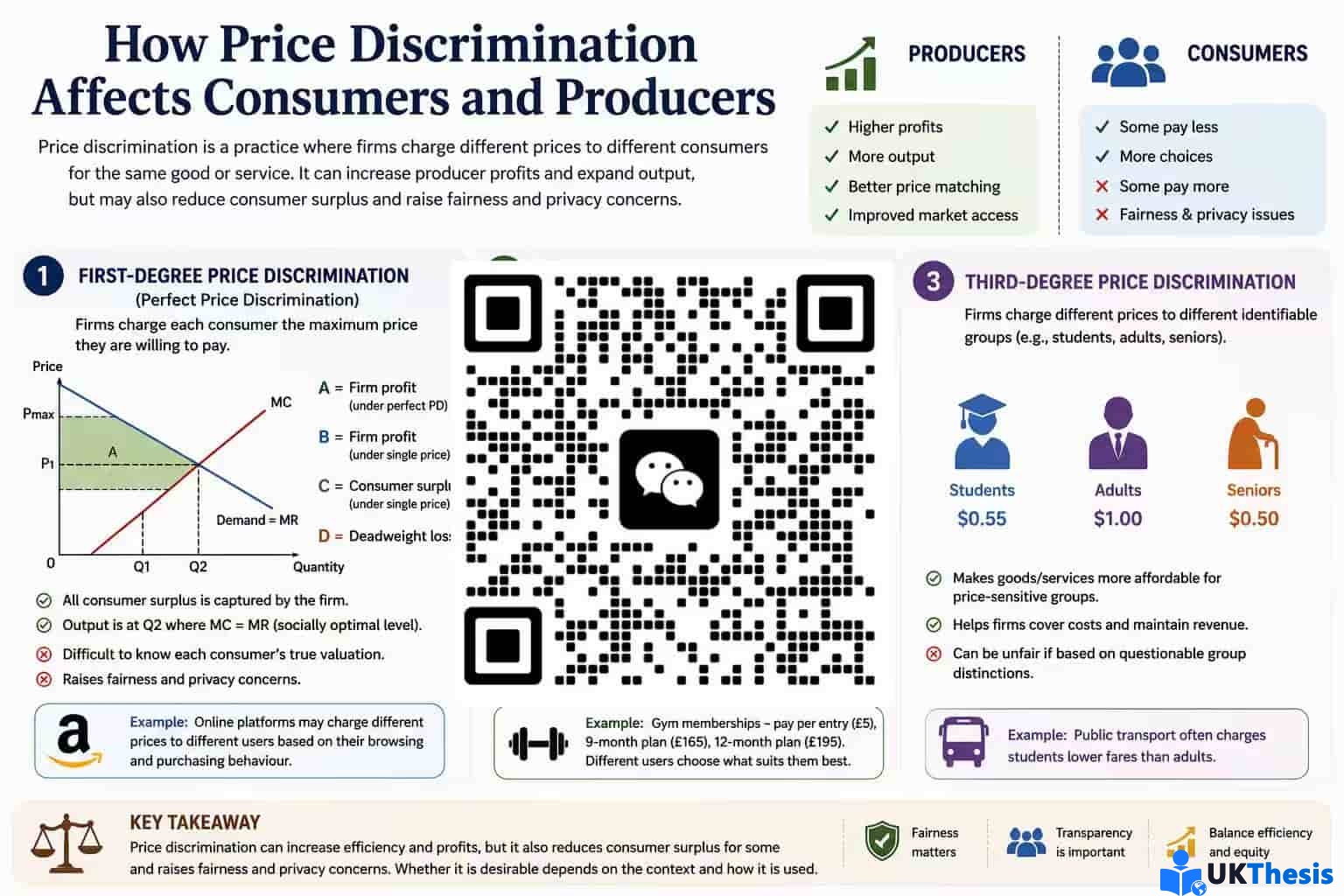
价格歧视是微观经济学里一个很常见的题目。简单说,就是企业对相同或相近的商品、服务,向不同消费者收取不同价格。它之所以能发生,是因为不同消费者的支付意愿不同,需求价格弹性也不同。企业如果能够识别这些差异,就可能通过差别定价获得更高利润。
原文主要分析三类价格歧视:
First-degree price discrimination,也就是一级价格歧视或完全价格歧视;
Second-degree price discrimination,也就是根据购买数量或套餐设置不同单位价格;
Third-degree price discrimination,也就是根据不同消费者群体收取不同价格,比如学生票、成人票、老人票等。
这篇Essay的重点不只是解释定义,而是讨论价格歧视对消费者和生产者分别有什么影响。对于生产者来说,价格歧视通常能增加收入和利润;对于消费者来说,有些群体可能因为低价进入市场,但另一些群体可能会失去消费者剩余,甚至感到不公平。也就是说,价格歧视不是简单的“好”或“坏”,它是一把双刃剑。
如果你正在查找代写论文、essay代写、MBA论文代写、毕业论文代写或工商管理课程作业参考资料,这篇文章可以作为微观经济学、商业经济学和MBA定价策略类Essay的写作结构参考。
二、经济学Essay写作结构参考
这篇文章可以按照以下结构来写:
Introduction
解释什么是价格歧视,说明它为什么会发生,并引出三种价格歧视类型。
First-degree Price Discrimination
讨论企业如何根据每个消费者的支付意愿收费,以及它如何影响消费者剩余和企业利润。
Second-degree Price Discrimination
分析套餐、会员价、数量折扣等定价方式如何影响不同消费群体。
Third-degree Price Discrimination
讨论企业如何根据年龄、身份、收入或群体特征进行差别定价。
Evaluation
分析价格歧视的公平性、效率、隐私和道德问题。
Conclusion
总结价格歧视对消费者和生产者的影响,并说明是否应该允许企业采用这类定价方式。
写这类Essay时,不要只背定义。老师更想看到的是:你能不能解释为什么企业能进行价格歧视、消费者受到什么影响、生产者得到什么好处、社会福利是否提高,以及这种定价策略是否公平。
How Price Discrimination Affects Consumers and Producers
Introduction
Price discrimination is a practice firms employ when they charge consumers different prices for the same good or service in order to earn higher profits. Price discrimination is made possible because consumers derive different levels of utility from the consumption of the same good, and because different consumers have different price elasticities of demand.
There are three main types of price discrimination: first-degree price discrimination, also known as perfect price discrimination; second-degree price discrimination; and third-degree price discrimination. In this essay, we will look at how the different types of price discrimination affect both consumers and producers, and whether firms are justified in using this pricing strategy.
Price discrimination is an important topic because it sits between efficiency and fairness. From the producer's point of view, it can increase revenue, reduce unused capacity and allow firms to serve more consumers. From the consumer's point of view, however, it can reduce consumer surplus, create feelings of unfairness and raise concerns about privacy, especially when firms use consumer data to estimate willingness to pay.
First-degree Price Discrimination
A firm is said to have practised first-degree price discrimination when it charges each consumer a different price. Each price corresponds to the value that each individual consumer places on the good.
Under perfect price discrimination, the firm charges different prices to different consumers according to how much each consumer values the product. In theory, the marginal revenue curve becomes equal to the demand curve. This means that all consumer surplus is captured by the firm. The firm produces where marginal cost is equal to marginal revenue, and output can reach a socially efficient level.
In simple terms, the firm tries to charge every consumer the maximum amount that consumer is willing to pay. If one consumer is willing to pay £100 and another is willing to pay £60, the firm charges them differently, even though the good is the same.
In reality, however, it is difficult to know the exact value that each consumer places on a good. Firms rarely have perfect information. The closest real-world examples appear in online markets, where companies may track consumers' online behaviour, previous purchases, search history and browsing habits to estimate price sensitivity. For consumers who are assessed to have relatively high price sensitivity, a firm may offer lower prices or discounts. For consumers with lower price sensitivity, the same firm may charge a higher price.
Firms may argue that perfect price discrimination is justified because it can increase output to a socially optimum level. It can also allow more consumers, including those who were previously priced out of the market, to consume the good. From this perspective, price discrimination can improve access.
When a firm does not practise perfect price discrimination, it usually fixes one price for all consumers and produces a lower level of output. In that case, some consumers who would have bought the good at a lower price are excluded from the market. Compared with uniform pricing, perfect price discrimination can increase producer profit and increase the quantity produced.
However, the downside is obvious. When firms practise perfect price discrimination, consumer surplus may fall to zero because the firm captures the entire difference between what consumers are willing to pay and what they actually pay. This raises questions about fairness. Some consumers may pay more for the same product simply because the firm has identified them as less price-sensitive.
There is also a moral issue when firms rely heavily on personal data to estimate willingness to pay. How far should a firm go in assessing consumers' online behaviour? Is it fair for one consumer to pay more just because their shopping pattern suggests they can afford it? At this point, price discrimination becomes not only an economic issue but also a social and ethical one.
While there are arguments on both sides, one must pause to consider the privacy and fairness concerns that arise. Perfect price discrimination may improve efficiency in theory, but in practice it can feel intrusive and unequal.
Second-degree Price Discrimination
Second-degree price discrimination occurs when firms charge lower per-unit prices as the quantity purchased by consumers increases. This often appears in the form of bulk discounts, memberships, subscriptions, loyalty schemes or different pricing packages.
A simple example can be seen in gym membership pricing. Suppose a sports centre charges students £165 for a 9-month gym membership, £195 for a 12-month gym membership and £5 per entry for students without membership.
If a student wants to use the gym frequently, for example twice a week for the whole year, the 12-month membership is clearly the best choice because:
£195 is less than £5 × 2 × 4 × 12 = £480.
If another student, such as an overseas student, only stays for the 9-month academic year and also wants to use the gym twice a week, the 9-month membership is better because:
£165 is less than £5 × 2 × 4 × 9 = £360.
Lastly, if another student only goes to the gym twice a month and is not committed to regular exercise, it is better not to buy any membership and simply pay per entry.
This example shows how second-degree price discrimination allows different groups of consumers to choose the pricing plan that best fits their usage. If the sports centre sets only one price, such as £195 for a 12-month membership, overseas students and infrequent users may not sign up. The firm would lose potential revenue. On the other hand, if the sports centre only charges £5 per entry and does not offer memberships, frequent users may decide the gym is too expensive and go elsewhere.
By offering different prices to consumers who purchase different quantities of the service, the sports centre allows different groups of students to use the gym. Instead of obtaining revenue from only one group of consumers, the firm can now obtain revenue from several groups, thereby increasing total revenue and potentially maximising profits.
Second-degree price discrimination can also benefit consumers. Frequent users receive a lower per-visit price. Less frequent users are not forced to commit to a membership they do not need. This makes the service more flexible and accessible.
However, there can still be problems. In some cases, a monopoly may charge a very high price for the first few units of a good and then present larger quantities as a better deal. This can mislead consumers into buying more than they actually need. In that situation, second-degree price discrimination may become unfair or manipulative.
Overall, second-degree price discrimination is often easier to justify than perfect price discrimination because consumers choose the option themselves. Still, it depends on whether the pricing structure is transparent and whether consumers can understand the real cost of each option.
Third-degree Price Discrimination
Third-degree price discrimination occurs when a firm charges different prices to different identifiable groups for the same good or service. These groups may be identified based on age, income, student status, location, occupation or other characteristics.
There are three main requirements before a firm can practise third-degree price discrimination:
Different groups must have different price sensitivities.
The firm must be able to identify the different groups clearly.
Resale between groups must not be possible.
A common example is public transport pricing. In Singapore, for instance, a typical bus ride may cost a student a fixed fare of S$0.55, while an adult may pay S$1.00. The bus company is able to charge different prices because the required conditions are met.
Students are usually more price-sensitive than adults because adults are more likely to earn income and have higher purchasing power. Students and adults are also easily identifiable through identification cards. Finally, a student bus ticket cannot be resold or used by an adult.
In this case, third-degree price discrimination may be justifiable. The higher fare paid by adults may help cover part of the cost of charging students a lower price. This makes transport more affordable for students while allowing the provider to maintain revenue.
However, third-degree price discrimination becomes more controversial in other cases. For example, some events or nightclubs may charge men an entry fee while allowing women to enter for free. Whether this is acceptable is much more subjective. Some people may see it as a marketing strategy, while others may see it as unfair discrimination.
The key issue is that third-degree price discrimination depends heavily on how the groups are defined and whether the price difference has a reasonable justification. Charging students lower prices for public transport or education-related services is often seen as socially acceptable. Charging different groups based on questionable assumptions may be much harder to defend.
Evaluation: Is Price Discrimination Good or Bad?
The practice of price discrimination remains a double-edged sword. On one hand, it can be beneficial because more consumers who might have been priced out at a higher uniform price can now consume the good. This can increase total output, improve access and allow firms to serve different market segments.
For producers, price discrimination can increase profit, reduce unused capacity and make pricing more flexible. It can also help firms recover fixed costs, especially in industries such as transport, entertainment, education, telecommunications and digital services.
For consumers, the effect is mixed. Some consumers benefit from lower prices, discounts, memberships or student rates. Others may lose out because they are charged higher prices or because their consumer surplus is captured by the firm.
There are also fairness and moral issues. Consumers may feel that it is unfair to pay different prices for the same product. This is especially true when the price difference is hidden or based on personal data. Privacy becomes a major concern when firms use online behaviour, purchase history or location data to estimate willingness to pay.
Another issue is market power. Price discrimination is more concerning when it is practised by monopolies or firms with strong market power. In such cases, consumers may have little choice but to accept the pricing structure. If competition exists, consumers can switch to other providers, which limits the firm's ability to exploit them.
Therefore, whether firms should practise price discrimination is highly subjective and varies from case to case. It depends on the type of price discrimination, the level of competition, the transparency of pricing, the impact on consumer welfare and the fairness of the method used.
Conclusion
Price discrimination affects consumers and producers in different ways. For producers, it can increase revenue and profit by allowing firms to charge different prices according to consumers' willingness to pay, quantity purchased or group identity. For consumers, it can either improve access to goods and services or reduce consumer surplus, depending on the type of price discrimination and the consumer group involved.
First-degree price discrimination allows firms to capture consumer surplus and may increase output, but it raises serious concerns about fairness and privacy. Second-degree price discrimination, such as memberships and bulk discounts, can create a more flexible pricing structure and may benefit both firms and consumers. Third-degree price discrimination, such as student fares or adult fares, can be justified when it supports access for more price-sensitive groups, but it becomes controversial when the group distinction is unfair or arbitrary.
Overall, price discrimination cannot be judged as simply good or bad. It may improve efficiency and access in some cases, but it can also create inequality, reduce consumer surplus and raise ethical concerns. The most reasonable conclusion is that price discrimination should be evaluated case by case, with attention to market power, transparency, consumer welfare and social fairness.
三、这篇Essay可以怎么借鉴?
这篇Essay适合经济学、工商管理、MBA商业策略和微观经济学课程参考。它的主题比较实用,因为价格歧视不仅是考试里的理论点,也是现实商业定价中经常出现的策略。
写这类Essay时,最重要的是不要只解释三个定义。定义只是基础,真正能拿分的是分析影响。比如:
一级价格歧视要写消费者剩余如何被企业拿走;
二级价格歧视要写套餐和数量折扣如何影响不同消费者;
三级价格歧视要写不同群体为什么会被收取不同价格;
最后还要讨论公平、隐私、道德和社会福利。
如果文章里只有“一级、二级、三级价格歧视分别是什么”,那更像课堂笔记。如果能写出“为什么企业这样做、消费者是否受益、社会是否更有效率、有没有不公平”,文章就更像真正的大学Essay。
对于代写论文、essay代写、MBA论文代写、毕业论文代写相关页面来说,这种文章也适合作为范文内容。它既有理论,也有例子,还能自然承接工商管理和MBA定价策略方向的写作需求。
四、优客网UKThesis写作服务说明
优客网UKThesis是1999年创立的论文代写平台,长期整理经济学essay范文、工商管理Essay案例、MBA论文写作参考、毕业论文结构分析和留学生课程作业资料。
对于经济学、工商管理和MBA方向的同学来说,常见写作需求包括:
经济学Essay结构分析
微观经济学作业写作参考
价格歧视Essay写作思路
工商管理定价策略案例分析
essay代写与英文润色服务说明
mba论文代写相关资料整理
毕业论文代写选题与章节规划参考
留学生论文代写写作框架建议
需要注意的是,范文主要是帮助同学理解文章结构、理论应用和案例分析方式,不建议直接复制提交。真正好的Essay,还是要结合课程要求、评分标准、图表和自己的分析来写。
如果你正在写 How Price Discrimination Affects Consumers and Producers 这类题目,可以参考本文结构:先定义价格歧视,再分别讨论一级、二级、三级价格歧视,最后评价它对消费者、生产者和社会福利的综合影响。
五、常见的FAQ问题
1. How Price Discrimination Affects Consumers and Producers 这类Essay怎么写?
可以先解释价格歧视的定义,再分析一级、二级和三级价格歧视,最后讨论它对消费者剩余、生产者利润、市场效率、公平性和隐私的影响。
2. 价格歧视对消费者有什么影响?
有些消费者可能因为折扣或低价进入市场,从而受益;但另一些消费者可能被收取更高价格,消费者剩余减少,也可能产生不公平感。
3. 价格歧视对生产者有什么影响?
生产者通常可以获得更高收入和利润,因为他们能够根据不同消费者的支付意愿、购买数量或群体特征设置不同价格。
4. 一级、二级、三级价格歧视有什么区别?
一级价格歧视是对每个消费者收取其最高愿付价格;二级价格歧视是根据购买数量或套餐收费;三级价格歧视是对不同可识别群体收取不同价格。
5. 价格歧视一定是不公平的吗?
不一定。学生票、老人票、会员折扣等价格歧视可能提高可负担性。但如果企业利用隐私数据或市场垄断能力让消费者支付更高价格,就会引发公平和伦理争议。
6. MBA论文写价格歧视可以从哪些角度分析?
MBA论文可以从定价策略、消费者行为、市场细分、利润最大化、品牌信任、数据隐私和商业伦理等角度分析价格歧视。