AMP Fee-for-No-Service Scandal案例分析|公司治理、内部控制与商业伦理

AMP scandal是澳大利亚金融服务行业里非常典型的Corporate Governance案例。它值得分析的地方,不只是“公司多收了多少钱”,而是一个规模很大的金融机构为什么能够在已经出现客户投诉、内部人员已经发现问题的情况下,让收费和内部控制问题持续这么久。
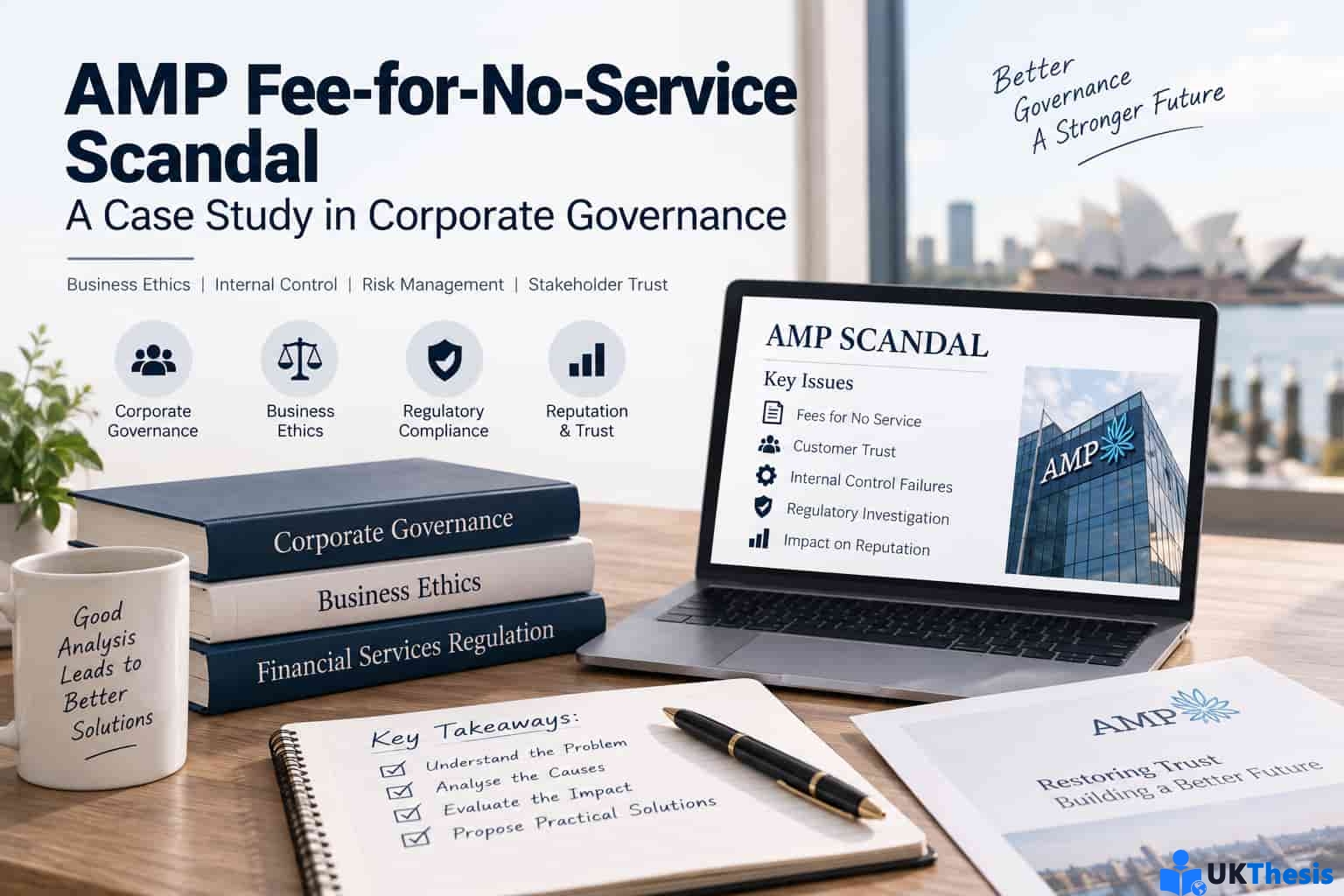
这篇案例主要围绕AMP Life的fee-for-no-service及已故客户收费问题展开,从Business Ethics、Internal Control、Risk Management、Information Flow和Stakeholder Trust几个角度分析。对于Business、Accounting、Corporate Governance或Financial Regulation课程,这类案例真正需要讨论的不是八卦式复述丑闻,而是:什么治理机制失效了?为什么失效?企业应该怎样防止相同问题再次发生?
范文类型:Business case study / Corporate Governance
核心主题:AMP Scandal / Fee for No Service / Internal Control
分析维度:Business Ethics、Risk Management、Stakeholder Trust、Financial Regulation
案例重点:金融机构在收费、投诉处理和内部治理中的系统性问题
Background:AMP Scandal发生了什么?
AMP originated in Australia in the nineteenth century and later developed into a major financial-services organisation. Its activities have included superannuation, financial advice, investment and insurance-related services.
The controversy that became highly visible during the Australian Financial Services Royal Commission involved several forms of misconduct, including fees charged where promised services had not been provided and concerns about internal controls, disclosure and communications with regulators.
Another serious issue involved premiums and advice fees continuing to be deducted from some deceased customers' superannuation accounts after the organisation had been notified of their deaths.
从管理角度看,这类问题最麻烦的地方并不是“一名员工算错了一笔钱”。如果一个错误在多个客户、多个时期反复出现,而且投诉出现后仍没有被迅速解决,那么它就已经从individual error变成了systemic control failure。
Issue 1:Business Ethics与客户公平
Financial-services firms operate in markets where customers frequently possess less technical knowledge than the institution selling or administering the product.
This information imbalance creates an important ethical responsibility.
Customers may not fully understand insurance premiums, superannuation deductions, ongoing advice arrangements or complex contractual terms. A financial institution therefore cannot rely on the argument that a customer “should have noticed” an inappropriate charge.
For AMP, the core ethical question is straightforward:
If the company knows that a customer is no longer entitled to, or capable of receiving, a service, should the organisation continue to deduct fees simply because its system still permits the transaction?
From a Business Ethics perspective, the answer should consider fairness, transparency and the responsibility created by the firm's superior knowledge.
Issue 2:Internal Control为什么没有及时阻止收费?
One of the strongest lessons from the AMP case concerns internal control.
An effective financial-services system should not depend on one employee remembering to stop a charge manually. Controls should identify relevant events—such as customer death, termination of an advice relationship or loss of eligibility for a service—and trigger appropriate action.
| Control area | Key question |
|---|---|
| Customer Status | Does the system immediately recognise death, exit or service termination? |
| Billing Control | Are fees automatically stopped when service eligibility ends? |
| Exception Reporting | Are unusual deductions flagged for review? |
| Complaint Escalation | Do repeated complaints trigger a systemic investigation? |
| Management Oversight | Who is responsible for fixing the root cause? |
这张表其实就是这篇Case Study最有价值的地方。学生写Corporate Governance时,很容易把结论写成“公司应该加强管理”。但老师真正想看到的是:到底加强哪一个Control?谁负责?什么事件应该触发调查?
Issue 3:Information Flow与Risk Management
A problem can exist inside an organisation for years when information does not move effectively from frontline employees to senior decision makers.
Customer complaints, unusual transactions and operational errors are all forms of risk information.
If individual employees recognise a problem but management treats each complaint as an isolated incident, the organisation may fail to identify a broader pattern.
This creates a distinction between:
Operational problem:one incorrect transaction.
Systemic problem:the same control weakness repeatedly affects multiple customers.
Good risk management therefore requires both data and escalation. Managers need systems capable of asking: “Have we seen this problem before?” rather than simply closing one complaint at a time.
Issue 4:Corporate Governance与Organisational Culture
Corporate Governance is concerned with how organisations are directed, monitored and held accountable.
In a regulated financial business, governance includes more than the board of directors. It also involves senior management, compliance functions, risk teams, internal audit and reporting processes.
The AMP case is particularly useful because it demonstrates that an organisation can have formal policies while still experiencing governance failure.
Policies on paper do not guarantee that people will challenge an existing process.
If employees repeatedly observe complaints but nobody asks whether the underlying system is defective, this may indicate a cultural problem as much as a technical one.
这里可以用一句比较接地气的话理解:有制度,不等于有人真的敢问“这个制度是不是出了问题”。
Issue 5:Regulator Relationship与Transparency
Financial institutions operate under significant regulatory oversight because customers entrust them with savings, insurance and long-term financial security.
For this reason, communication with regulators must be accurate and transparent.
The AMP controversy became more serious because questions were also raised about information provided to ASIC and the way internal reports concerning fees-for-no-service issues were handled.
This creates a second layer of governance risk:
the original customer problem may damage trust, but an inadequate response to the regulator can create an additional credibility crisis.
A company therefore needs to ask two separate questions:
Did we make a mistake?
Did we respond honestly and transparently after discovering it?
第二个问题有时候比第一个问题更致命。客户可能接受一次错误,却很难接受“发现错误以后还试图淡化它”。
Impact on Reputation and Stakeholder Trust
Reputation is especially important in financial services because customers often purchase products whose value depends on long-term trust.
A supermarket customer买错一瓶饮料,明天可以换一家店。但Superannuation、Insurance和Financial Advice通常可能持续很多年。
This means a governance scandal can affect several stakeholder groups at the same time.
| Stakeholder | Possible impact |
|---|---|
| Customers | Loss of trust and concern about charges or service quality |
| Regulators | Greater scrutiny and enforcement |
| Employees | Reduced confidence in leadership and organisational culture |
| Investors | Concerns about remediation costs, penalties and governance quality |
| Business Partners | Reassessment of relationship and reputational exposure |
Customer Complaints不是麻烦,而是Risk Signal
One of the most practical lessons from this case concerns complaints management.
Organisations sometimes treat complaints as a customer-service problem that should be resolved quickly and quietly.
But repeated complaints may provide valuable evidence of a control failure.
A stronger approach is therefore:
Complaint → Record → Categorise → Compare → Escalate → Root-cause Analysis → Corrective Action
If ten customers complain about the same type of fee, management should not simply refund ten customers individually. The more important question is whether thousands of other accounts may contain the same problem.
Recommendations:AMP类金融机构应该怎样改进?
Several improvements can be drawn from the case.
1. Strengthen automated controls.
Fee deductions should be linked to customer eligibility and service status so that inappropriate charges are prevented rather than discovered later.
2. Create stronger complaint escalation.
Repeated complaints with similar characteristics should trigger a systemic review.
3. Improve board and senior-management reporting.
Material conduct risks should be visible to senior decision makers rather than remaining inside operational teams.
4. Strengthen compliance independence.
Compliance teams need enough authority to challenge commercial decisions where customer interests or regulatory obligations may be at risk.
5. Improve transparency with regulators.
Once a problem is identified, organisations should provide clear, accurate and timely information rather than minimising the scale of the issue.
6. Treat remediation as more than repayment.
Refunding money solves the financial consequence for affected customers, but the root control failure must also be fixed.
Critical Analysis:真正的问题是员工,还是System?
It is tempting to explain corporate scandals by blaming a few managers or employees.
However, systemic misconduct usually requires a broader explanation.
In the AMP case, the more useful question is whether organisational incentives, reporting structures, systems and governance arrangements allowed inappropriate charging to continue.
This shifts the analysis from:
“Who made the mistake?”
to:
“Why did the organisation fail to identify and stop the mistake?”
这也是Case Study从普通叙事升级到Critical Analysis最关键的一步。
Conclusion
The AMP fee-for-no-service controversy demonstrates how operational weaknesses can develop into broader corporate-governance and reputational crises.
The case involved more than inappropriate charges. It raised questions about internal controls, complaint handling, risk escalation, regulatory transparency and organisational culture.
For financial institutions, customer trust is not created only through advertising or brand reputation. It depends on whether systems consistently treat customers fairly and whether management responds effectively when those systems fail.
The most important lesson is therefore not simply that AMP should have refunded affected customers. A sustainable response requires stronger controls, transparent governance and an organisational culture that treats repeated customer complaints as potential evidence of systemic risk.
FAQ
Q:这篇属于Accounting essay吗?
A:可以放在Accounting或Business课程中,但更准确属于Corporate Governance / Business Ethics / Financial Services Case Study,而不是传统财务会计计算题。
Q:Fee for No Service是什么意思?
A:通常指客户被持续收取费用,但并没有获得收费所对应的服务。具体法律判断需结合合同、客户资格和监管要求。
Q:为什么AMP Scandal适合写Corporate Governance?
A:因为它涉及Internal Control、Management Oversight、Compliance、Risk Management、Regulator Communication以及Organisational Culture等典型公司治理问题。
Q:案例分析是不是把事件经过写清楚就够了?
A:不够。Case Study真正重要的是解释事件背后的治理机制、原因、影响以及改进措施。
相关阅读
如果想继续学习Corporate Governance,可以阅读:Corporate Governance怎么分析?英国、德国与印度公司治理制度比较。
如果你的assignment更偏Australia Company Law,也可以阅读站内澳洲公司法Case Study相关文章。
对于已经有Business Case Study、Accounting Paper或Corporate Governance初稿的同学,也可以通过案例结构梳理、理论匹配、Critical Analysis和英文表达修改等方式完善已有内容。
```