Will Bitcoin Become a Global Currency? 比特币全球货币金融Paper范文

Bitcoin从诞生开始,就一直伴随着一个非常大胆的问题:它会不会有一天成为真正的全球货币?
这个问题听起来有点像科幻,但放到Finance、Economics或Digital Currency课程里,其实是一个非常适合做Critical Analysis的题目。因为它同时涉及货币功能、跨境支付、波动性、金融监管、技术效率以及货币主权。
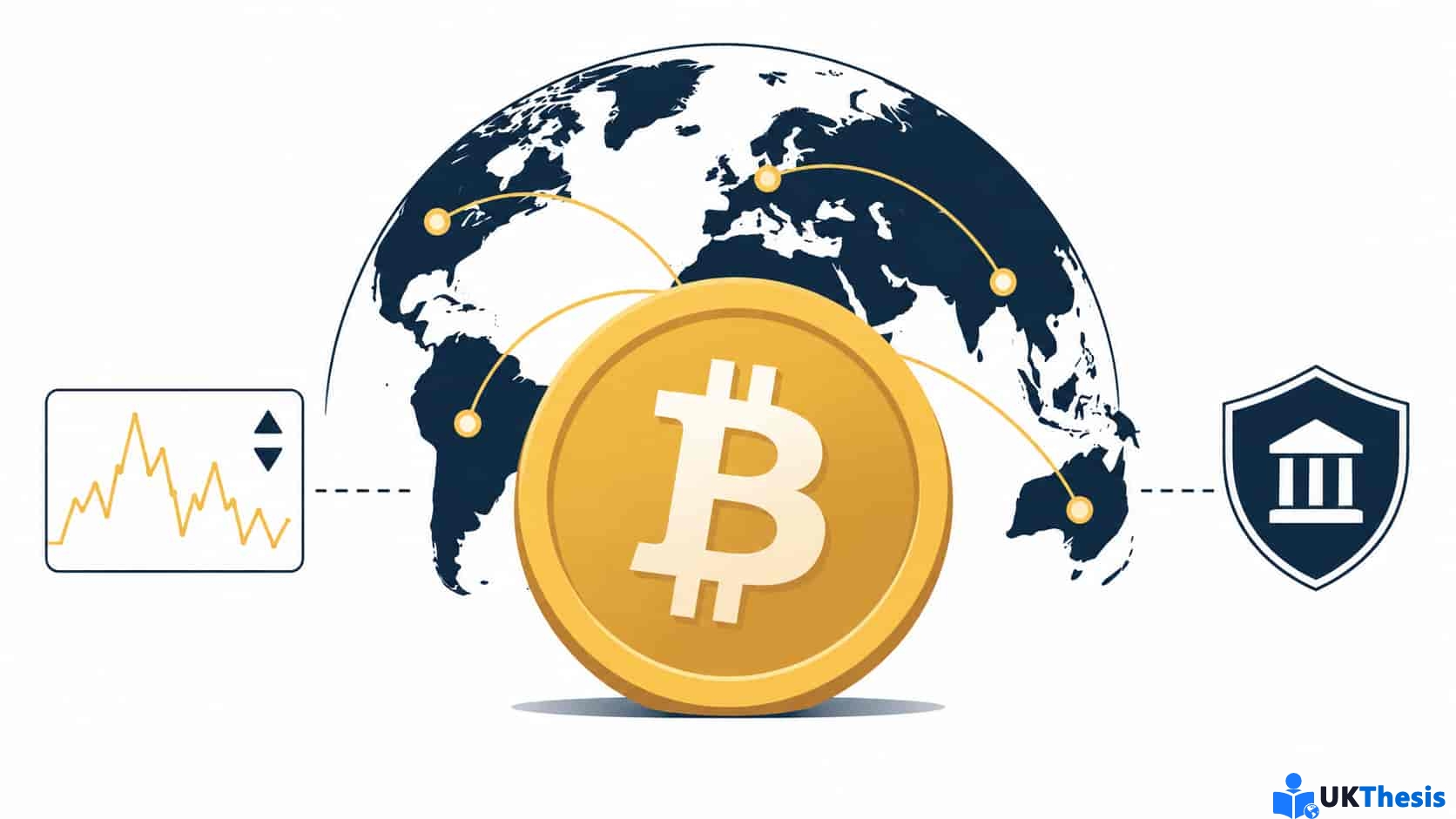
下面这篇Finance Paper围绕“Will Bitcoin Become a Sustainable Global Currency?”展开。文章不会简单地回答Yes或No,而是从Bitcoin本身的货币属性、Global Impact、Volatility、Regulation和Sustainability几个角度分析。
范文类型:Finance Paper / Economics Paper
核心主题:Bitcoin / Cryptocurrency / Global Currency
主要问题:Bitcoin能否同时承担Medium of Exchange、Store of Value和Unit of Account
延伸方向:Stablecoin、CBDC、Cross-border Payment、Monetary Sovereignty
Introduction:Bitcoin为什么会被讨论为Global Currency?
Technology has transformed finance at an extraordinary pace. Bitcoin, introduced in 2009, became the first widely recognised decentralised cryptocurrency and created a new way to transfer value without relying on a traditional central bank or commercial bank as the core intermediary.
That alone makes Bitcoin different from conventional national currencies.
A pound, dollar or euro is embedded within a monetary system supported by central banks, financial institutions, taxation systems and legal frameworks. Bitcoin, by contrast, operates through a decentralised protocol and does not belong to a single country.
这也是为什么Bitcoin从一开始就很容易让人产生一个想象:既然它没有国界,那它是不是天然适合成为全球货币?
但“没有国界”和“能够成为全球货币”其实是两回事。
What Makes Bitcoin Different?
Bitcoin has several characteristics that distinguish it from traditional fiat currencies.
| Feature | Bitcoin |
|---|---|
| Issuer | No central issuer |
| Maximum Supply | 21 million BTC |
| Settlement | Peer-to-peer blockchain network |
| Geographical Limit | No direct national boundary |
| Monetary Policy | Rule-based issuance rather than central-bank discretion |
Bitcoin's fixed maximum supply is often presented as one of its main strengths. The protocol is designed so that no more than 21 million bitcoins will ultimately exist.
Supporters argue that this scarcity protects Bitcoin from discretionary monetary expansion. Critics respond that scarcity alone does not automatically create a stable currency.
黄金也稀缺,但我们今天不会拿一克黄金去便利店买咖啡。货币真正难的地方,不只是“稀缺”,而是能不能稳定、方便、广泛地使用。
Can Bitcoin Perform the Three Functions of Money?
Economics commonly describes money through three basic functions:
Medium of Exchange — can it be used to buy and sell goods?
Store of Value — can purchasing power be preserved over time?
Unit of Account — can prices, wages and contracts be expressed in it?
Bitcoin performs these functions unevenly.
It can clearly be transferred between individuals and used for some transactions. It is also widely held as an asset.
However, relatively few everyday goods and services are priced directly in BTC. Even when Bitcoin is accepted, the underlying price is often still calculated in dollars, euros or another national currency.
This weakens its role as a true Unit of Account.
Global Impact and Cross-border Payments
One area where cryptocurrencies have attracted serious attention is cross-border finance.
Traditional international transfers can involve several banks, payment networks, currency conversions and compliance processes.
Bitcoin can move across borders without requiring the same correspondent-banking structure.
This creates a potential advantage for international transfers, particularly where traditional remittance systems are costly or slow.
However, cross-border use does not automatically mean Bitcoin is becoming the world's main payment currency.
Recent research on global crypto flows shows that speculative motives remain important for native cryptoassets such as Bitcoin, while stablecoins tend to display stronger transactional use in some cross-border contexts.
Critical Analysis:
Bitcoin能够跨境流动 ≠ Bitcoin一定会成为全球结算货币。
关键还要比较成本、稳定性、速度、监管接受度和用户需求。
Volatility:Bitcoin最大的货币障碍之一
Volatility remains one of the strongest arguments against Bitcoin becoming a mainstream global currency.
A useful everyday currency should allow households and firms to make relatively predictable decisions.
If the purchasing power of a currency changes dramatically over short periods, pricing becomes difficult.
Imagine a company signing a six-month contract denominated entirely in Bitcoin. If BTC moves sharply during that period, the real economic value of the payment may change substantially for both parties.
This does not prevent Bitcoin from functioning as an investment or speculative asset, but it makes everyday monetary use more complicated.
Bitcoin vs Inflation
Bitcoin is sometimes described as an inflation hedge because its supply cannot be expanded in the same way as fiat money.
However, this argument needs careful treatment.
A fixed supply does not guarantee stable purchasing power. Bitcoin's market price is influenced by demand, investor expectations, liquidity conditions, regulation and broader financial-market sentiment.
Therefore, Bitcoin may protect against one form of monetary expansion while still exposing holders to substantial market-price volatility.
这也是Finance Paper里很适合写Critical Thinking的地方:“不会被央行增发”不等于“不会贬值”。
Regulation and Legal Acceptance
Regulation is another major factor affecting Bitcoin's future as a currency.
National governments remain responsible for taxation, financial stability, consumer protection, anti-money-laundering rules and monetary policy.
A truly global private currency would therefore operate across many different legal systems.
This creates a difficult tension: Bitcoin was designed to operate without central monetary control, but widespread commercial adoption usually requires legal certainty and regulatory infrastructure.
El Salvador provided one of the most important real-world experiments when Bitcoin was given legal-tender status. However, legal reforms approved in 2025 removed its essential compulsory legal-tender features. Private acceptance became voluntary and tax obligations remained payable in US dollars.
This experience shows that government adoption alone does not automatically create widespread everyday monetary use.
Bitcoin, Stablecoins and CBDCs不是一回事
One major weakness in older cryptocurrency discussions is treating every form of digital money as if it were Bitcoin.
| Digital Money Type | Main characteristic |
|---|---|
| Bitcoin | Decentralised native cryptoasset with fixed issuance rules |
| Stablecoin | Usually designed to track a fiat currency such as the US dollar |
| CBDC | Digital money issued or backed by a central bank |
| ICO Token | Token issued through a fundraising mechanism, not necessarily money |
This distinction matters because the future of global digital payments may not necessarily be dominated by Bitcoin.
Stablecoins currently attract considerable attention because they attempt to combine blockchain-based transfer with a more stable Reference value.
CBDCs, meanwhile, preserve a direct connection with sovereign monetary systems.
Sustainability:Bitcoin能长期作为货币存在吗?
The sustainability question can be divided into several dimensions.
| Dimension | Main question |
|---|---|
| Economic | Can Bitcoin maintain sufficiently stable purchasing power? |
| Technical | Can payment infrastructure support large-scale usage? |
| Regulatory | Will governments permit broad monetary use? |
| Commercial | Will firms and households actually choose to use it? |
| Monetary | Can it coexist with national currencies and monetary policy? |
Bitcoin has clearly demonstrated that decentralised digital assets can survive and attract global participation.
But surviving as an asset is different from becoming the dominant global currency.
Why Stablecoins May Matter More for Global Payments
Recent developments suggest that stablecoins may currently be more relevant than Bitcoin to the question of global digital payments.
Most major stablecoins are denominated in US dollars, which means they often extend the existing role of the dollar rather than replace national currency systems.
This creates an interesting possibility: digital finance could become more global without creating a completely new global currency.
In other words, the technological form of money may change faster than the underlying currency hierarchy.
Critical Evaluation
Bitcoin has several qualities that support its global use:
borderless transfer;
decentralised settlement;
limited supply;
global recognition;
large and persistent network participation.
However, several factors still limit its ability to function as a sustainable global currency:
significant price volatility;
limited use as a unit of account;
regulatory fragmentation;
competition from stablecoins and CBDCs;
uncertain integration with existing monetary systems;
continued dominance of national currencies in wages, taxes and contracts.
所以如果这是一篇Finance essay,我不会把结论写成:
“Bitcoin will replace the dollar.”
也不会写:
“Bitcoin can never become money.”
这两个结论都太简单。
Conclusion
Bitcoin has already demonstrated that a decentralised digital asset can operate globally without belonging to a single country.
It has also changed how economists, regulators and financial institutions think about digital money, cross-border transfer and financial infrastructure.
However, becoming a sustainable global currency requires more than scarcity and global recognition.
A global currency must also function reliably as a medium of exchange, store of value and unit of account while operating within complex legal and monetary systems.
Bitcoin currently performs some of these roles better than others.
For this reason, the most defensible conclusion is that Bitcoin may remain an important global digital asset and payment instrument, but whether it becomes a dominant global currency remains uncertain.
In fact, the future monetary system may involve several forms of digital money—Bitcoin, stablecoins, tokenised bank money and possibly CBDCs—rather than one digital currency replacing every national currency.
FAQ
Q:Bitcoin总量是21 billion吗?
A:不是。Bitcoin协议设定的最大总供应量是21 million,也就是2100万枚。
Q:这篇属于Finance还是Economics?
A:两者都可以,但更适合Finance / Monetary Economics,因为核心问题涉及货币功能、资产波动、金融监管和国际支付。
Q:Bitcoin和Stablecoin有什么不同?
A:Bitcoin没有固定锚定某种法币,而主流Stablecoin通常以美元等法币作为参考价值,因此价格稳定机制完全不同。
Q:Bitcoin未来一定会成为Global Currency吗?
A:目前没有足够依据得出确定结论。Bitcoin具有全球流通和去中心化优势,但波动性、监管和货币功能仍然是明显限制。
相关阅读
如果想了解Finance Paper的整体写作方式,可以继续阅读站内金融论文和Finance assignment写作指南。
如果研究重点是Digital Finance,可以进一步阅读Cryptocurrency、Blockchain、FinTech和Cross-border Payment相关范文。
对于已经有Finance Paper题目或初稿的同学,也可以通过选题梳理、literature review、Critical Analysis、金融理论分析和英文表达修改等方式完善结构,让文章真正回答research Question,而不是单纯介绍Bitcoin历史。
```