市场学Paper范例:Licensing and Franchising Strategies for Five Guys in the Chinese Market

很多同学写市场学、国际商务或者 MBA 类 essay 时,一看到 market entry strategy、licensing、franchising 这类题目就有点头大。其实这类作业并不是让你简单介绍一个品牌,而是考察你能不能把企业背景、目标市场、进入模式、风险控制和战略建议放在同一个逻辑框架里分析。
本文以 Five Guys Fast-Foods in the Chinese Market 为案例,讨论企业如何通过 licensing 和 franchising 两种方式进入中国市场。相比普通翻译版内容,这里更建议保留完整英文范文,再配合中文导读,让读者先看懂文章逻辑,再参考英文表达。
优客网 UKThesis 自 1999 年建立以来,一直专注于留学生论文写作辅导、essay范文参考、论文修改润色和各类商科作业指导。对于正在准备市场学Paper、国际商务Essay或者品牌战略分析的同学来说,这类文章非常适合用来学习写作结构。

一、文章导读:这篇 Essay 主要写什么?
这篇 Essay 的核心问题是:
Five Guys 如果想进入中国市场,应该选择 licensing 还是 franchising?为什么?
文章的逻辑可以拆成四步:
第一,介绍 Five Guys 的企业背景和国际化动机。
第二,解释 licensing 和 franchising 的区别。
第三,从企业层面、行业层面和国家层面分析为什么 franchising 更适合 Five Guys。
第四,讨论这种进入模式可能带来的风险与限制。
这类 Essay 最重要的不是“堆资料”,而是要体现你的判断:为什么这个策略比另一个策略更合理?为什么中国市场有机会?为什么同时也有风险?
二、写作这类作业要注意什么?
写市场进入策略类 Essay,最容易犯的错误是只写概念,不写应用。比如很多同学会花很多篇幅解释什么是 franchising,但没有说明为什么它适合 Five Guys。这样文章看起来像 textbook summary,而不是 analysis。
比较好的写法是:
概念解释 + 企业情况 + 市场环境 + 风险判断 + 最终建议
例如,franchising 不是因为“它很常见”就一定适合,而是因为它能让 Five Guys 在降低投资风险的同时,保留一定的品牌和运营控制权。对于餐饮品牌来说,口味、服务标准、门店体验和品牌形象都很重要,所以完全放手的 licensing 可能会带来更大的品牌风险。
这也是本文值得参考的地方:它没有只停留在定义,而是把策略选择和企业实际情况联系起来。
三、English Essay Sample
Licensing and Franchising Strategies for Five Guys Fast-Foods in the Chinese Market
Executive Summary
Five Guys is a US-based fast-food company with strong brand recognition and a distinctive operational model. As competition in its domestic market becomes increasingly intense, international expansion may offer the company new opportunities for growth. This report critically examines how Five Guys could use licensing and franchising as internationalisation strategies to enter the Chinese fast-food market.
The analysis suggests that China presents considerable opportunities because of its large consumer base, expanding urban middle class and growing demand for international foodservice brands. However, the market also involves political, cultural, operational and competitive risks. After comparing licensing and franchising, this report recommends franchising as the more appropriate entry strategy for Five Guys.
Franchising would allow Five Guys to expand with relatively lower investment while maintaining greater control over brand standards, product quality and customer experience. Although franchising still involves risks, especially in relation to partner selection, local adaptation and regulatory complexity, it offers a better balance between control and flexibility than licensing.
1. Introduction
Internationalisation has become an important strategic option for fast-food companies seeking long-term growth beyond their domestic markets. For a brand such as Five Guys, overseas expansion can reduce dependence on the US market, strengthen global brand awareness and create new revenue opportunities.
China represents an attractive market because of its scale, consumer diversity and continuing demand for convenient dining experiences. However, entering China also requires careful consideration of local consumer pReferences, regulatory requirements, competition and operational risks.
This report focuses on two possible entry strategies: licensing and franchising. It evaluates both strategies and explains why franchising may be more suitable for Five Guys in the Chinese market.
2. Licensing and Franchising
Licensing refers to an arrangement in which a company allows another business to use its intellectual property, brand name, technology or business assets in exchange for fees or royalties. In the case of Five Guys, licensing would allow a local Chinese partner to use the Five Guys brand and possibly certain operational elements.
The main advantage of licensing is that it requires relatively low investment. It can also help the company avoid some political and operational risks because the local partner takes responsibility for many market activities. However, licensing gives the parent company less control. For a fast-food brand, this can be risky because inconsistent food quality, weak service standards or poor local management could damage the brand image.
Franchising is a more structured form of market entry. Under a franchising arrangement, the franchisee operates under the franchisor’s brand and business system, while the franchisor provides support, guidelines, training and operational standards. Compared with licensing, franchising gives the parent company more control over how the brand is presented in the market.
For Five Guys, this distinction is important. The company’s brand value is closely linked to product quality, store experience, operational consistency and customer trust. If these elements are not properly controlled, the company’s reputation could be affected not only in China but also globally.
Therefore, although both licensing and franchising can help Five Guys access the Chinese market, franchising appears to be the more suitable option.
3. Rationale for the Selected Internationalisation Strategy
The entry strategies recommended to Five Guys in the Chinese market could be analysed from three different levels, which include firm-level, industry-level, and country-level (Sanny et al., 2017). From the firm’s level, the internationalisation strategies are recommended to the organisation as it could help the organisation in expanding its geographical presence, decrease its reliance on the US market and could capture opportunities that the firm has currently left for the competitors of the firm (Guidici et al., 2018). The two major options that the firm thus held are licensing and franchising, however from the firm-level, the franchising is more suggested strategy to the organisation as it could help the organisation in avoiding international market political risk, retain some control, and capture opportunities in the market (Jayachandren et al., 2013).
At the industry-level, the internationalisation strategies are recommended to the firm as the US market has already passing through maturity stage (Euromonitor International, 2017). The shifting market opportunities in turn stressed that the firm should be seeking international market opportunities where the firm could effectively leverage its resources and competencies (Guidici et al., 2018). The Chinese fast-food industry emerged as a natural choice as the market is still witnessing healthy market growth in the recent past. An idea about the growth prospects within the Chinese market could be gained through the analysis of Figure 1 that exhibits the sales of Fast-foods by different categories.
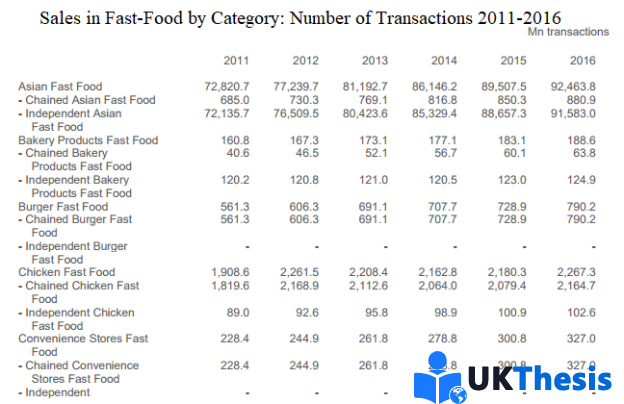
Figure 1: Sales in Fast-food by Category: Number of Transactions 2011-2016 (Euromonitor International, 2017)
While opting for the entry strategies in the market, the firm could select from franchising and licensing, where franchising is more favoured because it will provide the desired control to the organisation that the firm could use to enhance its industry-level performance (Preece, 2016). An idea about the industry level opportunities could be evaluated form the number of new fast-foods outlets opened within the market, which has been exhibited in Figure 1:
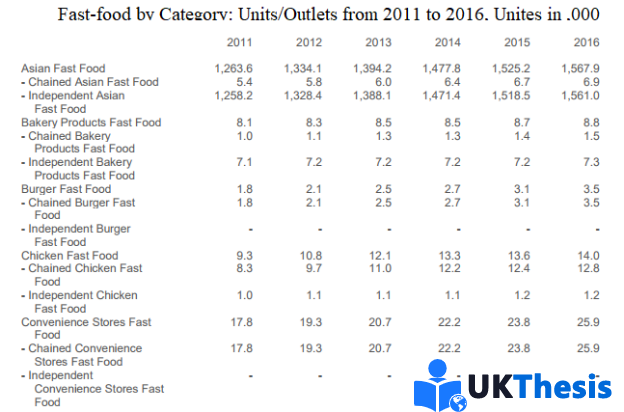
Figure 2: No. of Outlets in China, by Category 2011- 2016 (Euromonitor International, 2017)
At the country-level, the Chines market is suggested because of the favourable macro environmental factors, however as the political risks within the market is high, the firm has been suggested contractual mode of entry (Ginkonyo, Berndt and Wadawi, 2015). Resultantly, the firm could use either the franchising or licensing strategy. Both strategies could be thus used to access opportunities in the country and avoid risks; however franchising offered greater opportunities as the firm could assume some risk and could thus access the risk and return trade-off, thus having the opportunity to maximise its potentials within the Chinese market (Lowe, George and Alexy, 2012).
Considering the analysis thus presented, the franchising mode of internationalisation offered wider potential to Five Guys within the Chinese market. The strategy has been recommended to Five Guys because it is rapid internationalisation strategy that will allow the organisation to quickly access opportunities within the Chinese market (Guidici et al., 2018). If the firm opt for other entry strategies like Greenfield investment, Five Guys could be witnessing considerable time and cost, due to inherent red-tap witnessed within the Chinese market. Furthermore, the franchising will allow the organisation to overcome the political risks that the firm could be otherwise witnessing (Guidici et al., 2018). Taking into consideration the recent Sino-US trade war, the US-based companies are encountering considerable risks within the market that could be effectively avoided using the franchising strategy (Lind, 2018). Furthermore, through the franchising mode, the firm could be able to adopt the local market know-how and leverage its global brand equity within the market. The effective global and local market combination that are possible in case of franchising in turn could help the organisation in framing effective marketing mix strategies within the Chinese market that could help in the better realisation of the firm’s long-term goals and objectives (Jayachandren et al., 2013). The combination thus possible is not accessed in case of licensing strategies as in case of licensing only brand name is foreign, while the entire resources and capabilities are local.
Additionally, Kidwell and Nygaard (2017) believe that the entry strategy has been suggested to the organisation because of the control that the firm could exercise within the Chinese market. The level of control over the marketing strategies within the Chinese market thus accessed could not be available to the firm in case of licensing strategy. In addition, Five Guys could be able to ensure the desired quality standards in case of franchising strategies (Lind, 2018). The standards that the firm could thus ensure could not be safeguarded in case of licensing entry strategies as no quality control is exercise in such strategy. Furthermore, the franchising strategy could be found within the Chinese fast-food industry, as most of the rival firms like KFC, McDonald, Starbucks, and Pizza-Hut etc. have been using this strategy since (Lowe, George and Alexy, 2012). As the strategy has proven success record, Five Guys has been thus recommended to use franchising for accessing opportunities within the market (Boyen and Ogasavara, 2014).
4. Risks and Limitations
There are different risks and limitations associated with the entry strategies in the Chinese market using the franchising strategies that could be analysed at three different levels, which include firm-level, industry-level, and country-level. From the firm’s level, the organisation could experience negative repercussions as it could fail to attract the desired level of performance within the Chinese market (Boyen and Ogasavara, 2014). Particularly, as the firm will need some investment in the form of equipment and the marketing spent, as these activities will be undertaken by Five Guys, the inability of the firm to attract the desired level of customers in turn could negatively influence the firm’s profitability in the market (Euromonitor International, 2017). Thus, instead of contributing to the major goals of the firm, the firm could be confronting some risks in the market. Through franchising arrangements in the Chinese market, significant portions of the risks that the firm could be otherwise confronting could be passed on to the franchisee (Boyen and Ogasavara, 2014). However, lesser risks could be transferred to the franchisee than what the firm could have transferred in case of licensing strategy (Watson et al., 2018).
At the industry level, the firm has been also confronting risks as the health and fitness consciousness of the Chinese customers are increasing with the passage of time. In addition, there are different environmental and societal organisations that are lobbying and raising voice against the growing health and environmental problems that are associated with the rising level of fast-food usage in the country (Cui and Lui, 2001). This in turn could pose significant future risks to the organisation as the level of demand that has been projected could not be generated. Part of the risks that the firm could be thus confronting to the Chinese franchisee, however unlike licensing, franchising strategy did not completely eradicate the firm’s industry level risks (Guidici et al., 2018). This is because still the firm will be investing within the Chinese market through equipment and marketing and advertising. The recovery of such expenses depends on the smooth emergence of opportunities within the market (Sanny et al., 2017).
At the country level, Five Guys could also confront certain risks in the market. Although at present, the enterprise could confront risks because of the diverse political and cultural factors (Cui and Lui, 2001). There is significant level of differences between the US and Chinese market, both in terms of political factors and cultural factors, which in turn could pose risks to the organisation and its survival within the Chinese market (Euromonitor International, 2017). However, through the franchising strategy that have been recommended to the organisation, part of the risks that the firm could have been otherwise witnessing could be passed on to the franchisee in the Chinese market (Cui and Lui, 2001).
In addition, there are certain limitations of franchising as well that the firm could be experiencing within the Chinese market. These include the restriction in sales, the differences in culture of franchiser and franchisee, and growth challenges, all of which could negatively influence the goals that the firm has been chasing within e market (Ahsan and Musteen, 2011).
Considering the above discussions, the different risks that the firm could be confronting in the Chinese market could be minimised/ eradicated through the selection of good representatives as franchise partner (Jayachandren et al., 2013). The franchisee that the firm should select should have good reputation and resources, which in turn could provide professional wisdom to the organisation. Such professional wisdom could be used to overcome many of the risks that the firm could be otherwise confronting within the Chinese market (Sanny et al., 2017).
5. Conclusion
This report has examined licensing and franchising as possible internationalisation strategies for Five Guys in the Chinese market. Although licensing offers low investment and reduced operational responsibility, it provides limited control over brand image and service quality. For a fast-food brand, this can create serious risks.
Franchising is therefore recommended as the more suitable strategy. It allows Five Guys to enter the Chinese market with relatively lower investment while maintaining greater control over brand standards, product quality and customer experience. However, the company must carefully manage franchise partner selection, localisation, competition and regulatory risk.
In conclusion, franchising provides Five Guys with a practical and strategically balanced approach to international expansion in China. If implemented effectively, it could help the company capture market opportunities while protecting its long-term brand value.
四、留学生写作提醒:这篇范文可以怎么学?
这篇文章最值得学习的地方,是它围绕一个明确问题展开:Five Guys 进入中国市场时,为什么 franchising 比 licensing 更合适?
写类似作业时,同学们可以重点模仿这几个点:
先定义两个策略,但不要写成教科书。
每个理论点都要回到企业本身。
不要只写机会,也要写风险。
结论要明确,不要两边都说好。
引用资料要服务于分析,不要为了引用而引用。
如果你正在准备市场学Paper、国际商务Essay、MBA战略分析或者品牌进入策略类作业,可以把这篇文章当成一个结构参考。优客网 UKThesis 也提供论文代写、代写论文、代写作业以及代写市场学paper相关的写作辅导、修改润色和范文参考服务,适合需要提升论文结构、语言表达和学术逻辑的留学生。
五、FAQ
Q1: Licensing 和 Franchising 最大区别是什么?
Licensing 更偏向授权使用品牌或知识产权,而 franchising 通常包含更完整的商业模式、运营标准和品牌管理体系。对于餐饮企业来说,franchising 通常能提供更强的质量控制。
Q2: 为什么 Five Guys 进入中国市场更适合 franchising?
因为 Five Guys 的竞争力不仅来自品牌名称,还来自产品质量、门店体验和运营标准。Franchising 可以在降低投资风险的同时保留一定控制权。
Q3: 这类市场进入策略 Essay 怎么写?
可以按照“企业背景—进入模式定义—市场机会—策略比较—风险分析—最终建议”的结构展开。重点不是介绍概念,而是解释为什么某个策略更适合特定企业和市场。
Q4: 市场学Paper可以只写理论吗?
不建议。理论只是工具,真正得分的部分是你如何把理论应用到具体案例中。比如本文就把 licensing/franchising 和 Five Guys 的品牌控制、市场风险、中国消费者环境联系起来分析。