Dracula Literary Analysis Essay|Epistolary Narrative叙事分析

Literary Analysis essay最容易写成两种样子:一种是“复述剧情”,另一种是“找几个literary device然后逐个点名”。真正好写的方向,其实是把Technique和Effect连起来。
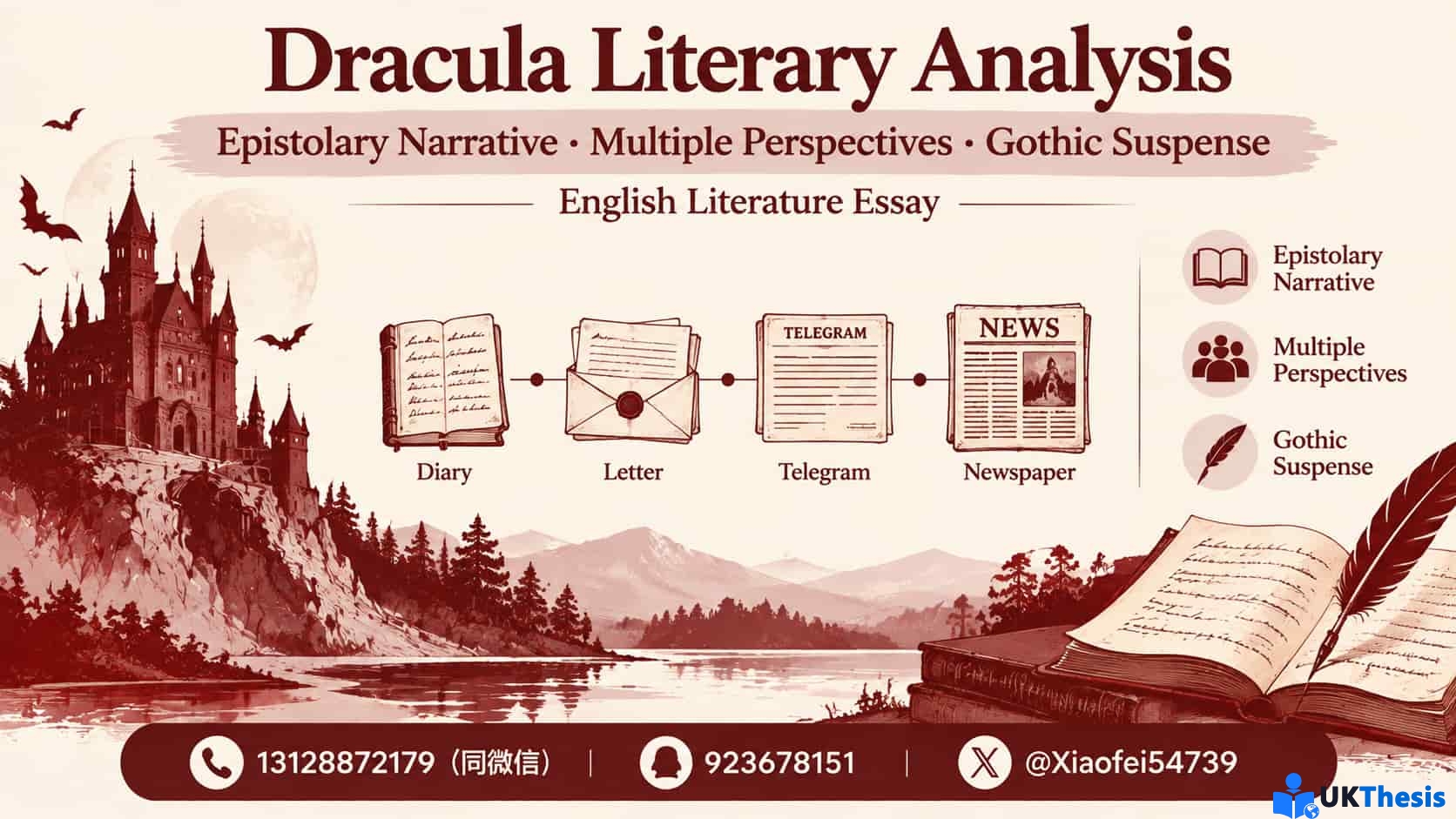
Bram Stoker的《Dracula》就是一个很典型的例子。这部小说并不是由一个全知Narrator从头讲到尾,而是通过diaries、letters、telegrams、phonograph records和newspaper reports拼起来。读者不是被直接告诉“真相”,而是一点一点从不同人物手里把故事拼完整。
下面这篇Literary Analysis Essay主要分析这种Epistolary Narrative如何增强Suspense、Reader Involvement和Victorian Gothic氛围。
Dracula’s Epistolary Narrative: Why Does It Work?
In Bram Stoker’s Dracula (1897), the story is presented through a collection of journals, letters, telegrams, newspaper reports and recorded accounts.
This structure is known as an epistolary narrative.
Instead of giving the reader one stable narrator, Stoker presents several different voices. Each character records only what he or she has personally experienced or discovered.
This creates an unusual reading experience: the reader must collect fragments of information and gradually reconstruct the larger story.
| Narrative Form | Effect on the Reader |
|---|---|
| Diary | Creates intimacy and immediacy |
| Letters | Shows relationships and changing perspectives |
| Telegrams | Speeds up information exchange |
| Phonograph Records | Adds a modern technological voice |
| Newspaper Reports | Gives supernatural events an appearance of documentary reality |
Jonathan Harker’s Diary and the First Encounter with Dracula
The first sustained encounter with Count Dracula comes through Jonathan Harker’s diary.
Harker records his journey in great detail because he is trying to understand an unfamiliar and increasingly disturbing environment.
His instinct is rational. When something appears strange, he writes it down, observes it and attempts to explain it.
This matters because the reader initially experiences Dracula through Harker’s limited perspective.
We do not receive a neutral description of the Count. We encounter him through the observations of a man who is gradually becoming frightened and uncertain.
这里特别值得学:Literary Analysis不是说“作者用了Diary”。真正要分析的是:为什么用Diary?它让Reader处在什么位置? Technique后面必须接Effect,文章才不是literary device清单。
Fragmented Narrative and Multiple Perspectives
After Harker’s early diary entries, the novel becomes increasingly fragmented.
The reader moves between letters, journals, recordings and other forms of communication.
This shift changes the narrative rhythm.
Instead of following one person continuously, the reader must move from one perspective to another and connect events that occur in different places and at different times.
The gaps between accounts create suspense because no single character possesses all the information.
At the same time, the reader often knows more than any one individual character because we have access to several accounts.
| Narrative Feature | Literary Effect |
|---|---|
| Multiple narrators | No single perspective controls the truth |
| Temporal gaps | Reader must reconstruct events |
| Private documents | Creates intimacy and voyeuristic reading |
| Collected evidence | Makes supernatural events appear more plausible |
The Reader as Investigator
One of the most effective consequences of the epistolary structure is that the reader becomes an active participant.
We read Harker’s private diary, letters between characters, medical notes and recorded conversations.
The reader therefore occupies a position similar to an investigator.
We are constantly comparing accounts, remembering earlier clues and filling in gaps between one document and another.
This active role increases suspense because understanding depends on accumulation rather than immediate explanation.
The novel does not simply present a monster and explain him. It allows the reader to discover Dracula gradually through traces, reports and personal testimony.
Evidence, Proof and Victorian Rationality
The documentary form of the novel also reflects an important tension between supernatural experience and rational explanation.
Many of the characters belong to professional or educated social groups: doctors, lawyers, professors and other representatives of respectable Victorian society.
They are accustomed to evidence, records and logical explanation.
Yet Dracula represents something that does not fit comfortably within their rational worldview.
The use of diaries, medical terminology, telegrams and recorded evidence makes this conflict more effective.
The characters are not simply frightened by the supernatural. They repeatedly try to document it.
这个角度很适合Critical Analysis:Stoker一边写Vampire,一边又大量使用特别“现代”、特别“理性”的记录工具。Supernatural和Evidence放在同一部小说里,本身就形成一种很有意思的张力。
Dracula’s Silence
Another important feature is that Dracula himself is not given the same narrative authority as his opponents.
The reader mainly encounters him through the observations and records of other characters.
This makes him both visible and inaccessible.
We know what he does, what others fear about him and how his actions affect the group, but his internal perspective remains largely unavailable.
This absence strengthens his role as an external threat.
The other characters are constantly producing documents in an attempt to understand him, while Dracula remains outside their system of rational explanation.
Suspense and Unreliable Perspective
First-person documents naturally introduce the problem of limited perspective.
A diary can only record what its writer knows. A letter reflects one person’s understanding. A witness may misinterpret what has happened.
Normally, this limitation could make a narrative less reliable.
Stoker turns that weakness into a strength by combining multiple accounts.
One perspective may be incomplete, but another document can confirm, challenge or expand it.
The result is a narrative that constantly moves between uncertainty and verification.
| Problem | Stoker’s Solution |
|---|---|
| One narrator may be unreliable | Add another perspective |
| Supernatural events seem unbelievable | Present documentary evidence |
| Time gaps create confusion | Allow reader to reconstruct chronology |
| Dracula remains mysterious | Keep his internal voice largely absent |
Victorian Anxiety and Gothic Effect
The epistolary structure also supports the novel’s wider Gothic themes.
Dracula threatens a society associated with order, professional identity, technology and social structure.
The characters repeatedly respond to disorder by recording, organising and sharing information.
In this sense, the collected documents become more than a storytelling device.
They represent an attempt to restore order.
As the characters begin combining their knowledge, Dracula becomes increasingly vulnerable because information that was once fragmented becomes shared.
This is why the narrative structure and the plot develop together: cooperation between narrators is also cooperation between characters.
Imperialism and Reverse Colonisation
The novel can also be read in relation to Victorian fears about identity, empire and social change.
Dracula travels from Eastern Europe into Britain, reversing the familiar direction of imperial expansion.
This movement has often been discussed as a form of “reverse colonisation”, in which the centre of empire becomes vulnerable to an outside force.
The epistolary form makes this fear feel increasingly plausible because Dracula’s arrival is not described through fantasy narration alone.
Instead, the reader encounters evidence through letters, reports, diaries and testimony.
The Gothic threat is therefore presented through the very rational forms Victorian society might normally trust.
Conclusion
Bram Stoker’s use of epistolary narrative is central to the effectiveness of Dracula.
The combination of journals, letters, telegrams, recordings and newspaper accounts creates a fragmented narrative in which the reader must actively reconstruct events.
This structure increases suspense, creates intimacy with the characters and makes supernatural events appear more credible through documentary form.
Multiple perspectives also allow Stoker to balance uncertainty with verification. One narrator may not understand what is happening, but another account can later confirm or reinterpret the event.
Most importantly, the form reflects the novel’s wider concern with rationality, modernity and social order.
The characters defeat Dracula not only through physical action, but also by collecting, sharing and organising knowledge.
For this reason, the epistolary structure is not simply a stylistic experiment. It is closely connected with the novel’s Gothic suspense and its representation of Victorian anxiety.
这篇Literary Analysis Essay可以学什么?
| 分析对象 | 真正要回答的问题 |
|---|---|
| Diary | 为什么第一人称记录能增加Intimacy? |
| Multiple Perspectives | 为什么Reader需要自己拼信息? |
| Documents | 为什么Documentary Form让Supernatural更可信? |
| Dracula’s Silence | 为什么不给Dracula内部声音? |
| Victorian Context | Narrative Form怎样连接Social Anxiety? |
我觉得Literature Essay里最好用的一条小规则就是:每次找到一个Technique,都多问一句“So what?”
Diary不是答案,Multiple Perspectives也不是答案。真正的答案通常在后面:它改变了Reader什么感受?怎样推动Theme?为什么作者偏偏用这种方法?
FAQ
Dracula属于Narrative Essay吗?
这篇文章不是Narrative Essay本身,而是对小说Narrative Technique的Literary Analysis。更准确的分类是Literary Analysis Essay或English Literature Essay。
什么是Epistolary Narrative?
Epistolary Narrative指通过letters、diaries、documents或其他记录形式构成故事的叙事方式。《Dracula》除了letters和journals,还使用telegrams、phonograph records和newspaper reports。
为什么Dracula的multiple perspectives很重要?
因为没有一个人物拥有完整信息。多个Narrator共同构建事实,使Reader同时体验uncertainty和verification,也增加了Suspense。
Literary Analysis Essay需要复述剧情吗?
可以提供必要Context,但不能把文章写成Plot Summary。剧情只需要服务于Analysis,重点仍然是Technique、Evidence、Effect和Interpretation。
Literature Essay不知道怎么从Quote进入分析怎么办?
可以先问Quote体现了什么Narrative Technique、Imagery或Characterisation,再继续解释这种选择如何影响Reader、Theme或Context。如果Evidence很多但不知道怎么组织,也可以通过Essay写作辅导先整理Thesis、Paragraph Structure和Close Reading路线。
相关文章阅读
Literary Analysis最怕的不是“没有高级词”,而是写了一整页以后仍然只是在告诉Reader发生了什么。真正能让文章站住的,往往是那一句:作者为什么这样写,而不是换一种更简单的方式?