Endangered Languages Essay范文:UAE阿拉伯语Language Shift与Qualitative Research分析
Language Endangerment是一个很典型的Linguistics Research essay题目。它表面上讨论“某种语言是不是正在减少使用”,真正写起来却会牵涉education、globalization、migration、social media、cultural identity以及language policy。
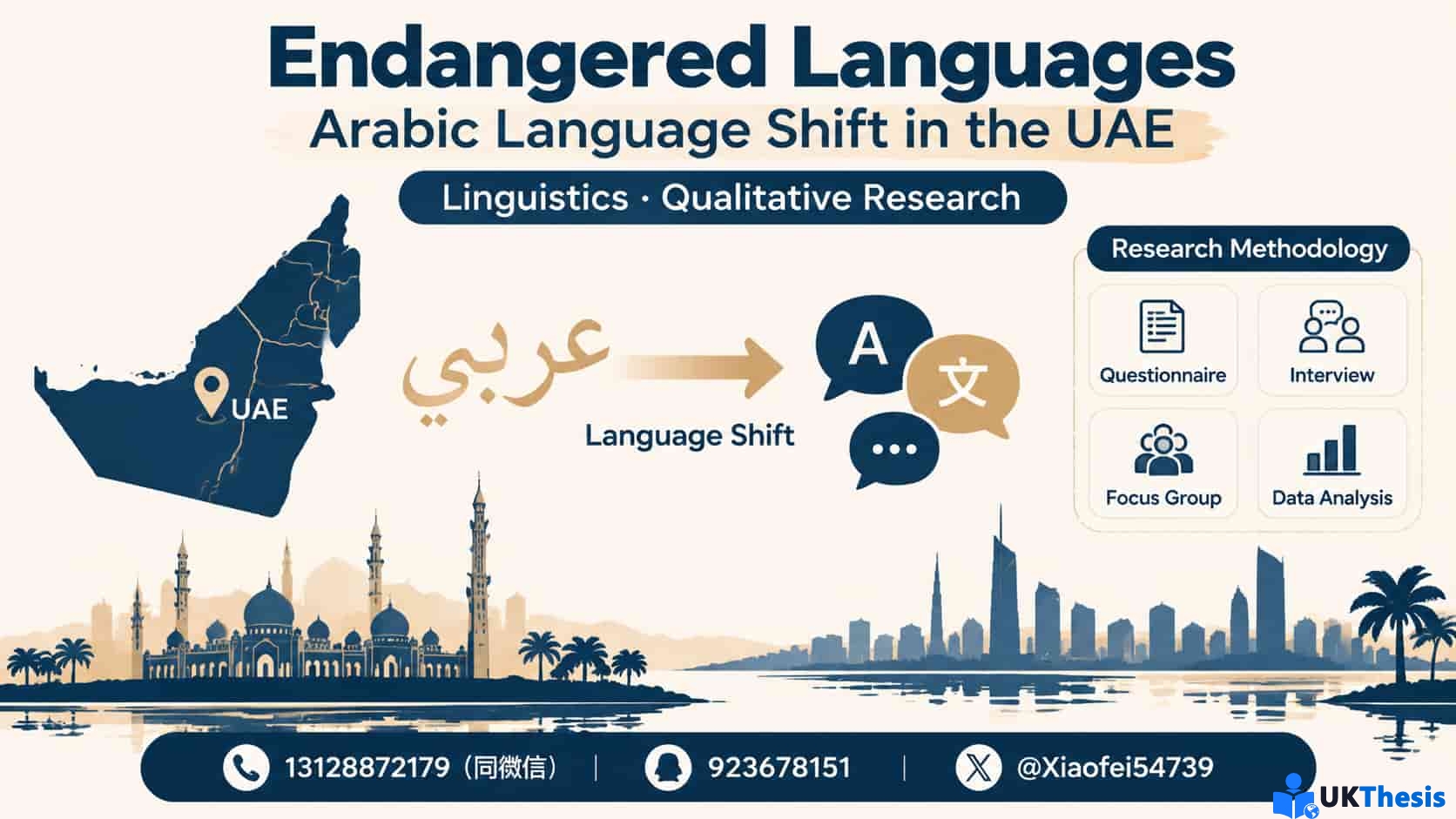
下面这篇英文研究案例以UAE的Arabic language use为背景,讨论年轻群体中的language shift以及英语和全球化环境对阿拉伯语使用习惯可能产生的影响。文章同时包含literature review、Qualitative Research Methodology、Data Analysis和Discussion,所以更适合当作Linguistics Research essay范文,而不是普通Descriptive Essay。
The Peculiarities of Endangered Languages
In the UAE, the use of Arabic among some school-age children has been influenced by the increasing presence of English in education, social media and international communication.
Globalization, international study, travel and the large expatriate population have also created a highly multilingual environment. Many children are exposed to several languages from an early age, including English and a wide range of languages spoken by expatriate communities.
This raises an important linguistic question: how does prolonged contact with globally dominant languages affect the everyday use of Arabic among younger speakers?
| Research Element | Focus |
|---|---|
| Research Topic | Arabic language use in the UAE |
| Main Issue | Language shift and changing language pReference |
| Context | Education, globalization and multilingual society |
| Method | Questionnaire, interview, focus group and observation |
| Analysis | Qualitative analysis and descriptive statistics |
Introduction
A language may become vulnerable when younger generations increasingly shift toward another language and intergenerational transmission begins to weaken.
Language shift occurs when speakers gradually adopt another language for education, employment, social communication or everyday interaction. Over time, the original language may be used in fewer contexts, particularly if younger speakers become more comfortable using the socially or economically dominant language.
Arabic is spoken across a wide geographical area and remains a major language in the Middle East and North Africa. However, multilingual societies can produce changing patterns of language use.
In parts of the Arabic-speaking world, professional and educational settings increasingly involve English or French alongside Arabic. The question is therefore not simply whether Arabic exists, but how frequently different forms of Arabic are used across school, family, work and digital communication.
写作观察:Language Endangerment Essay最容易犯的错误,就是开头直接宣布“某种语言快消失了”。Research Writing最好先界定language shift,再说明研究的是哪个国家、哪个年龄群体、哪个communication context,这样后面的Evidence才有边界。
Literature Review
Arabic has a long written and spoken tradition across the Middle East and North Africa. At the same time, researchers have discussed differences between formal written Arabic, spoken varieties and the growing role of international languages in education and professional communication.
Globalization, migration and the presence of large expatriate populations may influence everyday language practices. Social media and international education can further increase exposure to English.
Another important issue is the relationship between formal Arabic and local spoken dialects. Changes in everyday language use do not necessarily mean that an entire language disappears, but they can affect where, when and how particular varieties are used.
In the UAE, the multilingual population makes this question especially interesting. English often functions as a shared language among people from different linguistic backgrounds, while Arabic continues to hold cultural, institutional and religious importance.
The research therefore focuses on three related questions:
What factors may encourage language shift among younger Arabic speakers?
How do education and globalization influence language preference?
What measures may support continued Arabic-language use?
Research Methodology
Due to the nature of the research Question, a qualitative research methodology was adopted.
The purpose was to examine the current use of Arabic among younger participants and explore some of the social and educational factors surrounding language choice.
The study involved two broad target groups. The first consisted of school-age children approximately 4–11 years old, while the second included young people aged approximately 16–24.
A questionnaire and interview approach was used to explore participants' language practices and attitudes.
A focus group was also included, together with participation and observation methods. These approaches were intended to provide additional insight into everyday language use rather than relying exclusively on numerical data.
| Method | Purpose |
|---|---|
| Questionnaire | 了解language preference与使用情况 |
| Interview | 了解参与者选择某种语言的原因 |
| Focus Group | 观察群体中的语言态度与讨论 |
| Observation | 观察实际语言使用行为 |
| Secondary Research | 与已有language endangerment研究进行比较 |
对于Methodology来说,这里有一个特别值得学习的地方:不要只是列“Questionnaire、Interview、Focus Group”,还要解释为什么这些方法适合Research Question。
Data Analysis
The research sits within linguistics and anthropology, making it possible to examine language use not only as communication but also as part of cultural and social behaviour.
A structuralist perspective was used in the original study to consider how language may reflect broader cultural patterns.
Observation and participation data suggested differences in language use between younger school-age participants and older young adults.
The study reported that the young-adult group demonstrated a stronger understanding of Arabic than the school-age group, with a difference of approximately 11% in the collected results.
Questionnaire data were also processed using SPSS. Descriptive statistics, editing, coding, classification and tabulation were used to organise the responses.
This combination illustrates an important point aboutResearch Methodology: qualitative research and numerical analysis are not always mutually exclusive. A study can rely mainly on qualitative questions while still using descriptive statistics to summarise questionnaire results.
| Data | Analysis Approach |
|---|---|
| Interview responses | Qualitative interpretation |
| Focus-group discussion | Theme and attitude analysis |
| Observation | Language behaviour analysis |
| Questionnaire | SPSS and descriptive statistics |
Discussion: Why Does Language Shift Happen?
Language shift can occur when cultural habits, education systems and economic incentives change.
Globalization encourages people from different linguistic backgrounds to communicate through a common language. In highly international environments, English may therefore become attractive because of its role in higher education, employment, international business and digital communication.
Urbanization and intermarriage may also increase contact between different language groups.
However, language change is not simply a linguistic issue. Language is closely connected with cultural identity, traditions and social relationships.
When younger people begin using one language for school, another for work and another within the family, the social function of each language may gradually change.
This does not necessarily mean that speakers consciously reject their native language. In many cases, language preference may simply reflect convenience, education or economic opportunity.
学姐看这里:这一段才是Research Essay真正开始“有味道”的地方。前面Questionnaire和SPSS只是告诉你发生了什么,Discussion必须继续回答:Why might this be happening? 如果Data Analysis写完就结束,整篇Research Essay很容易变成一份漂亮的数据清单。
Globalization, Education and Arabic Language Use
Education is one of the most important environments in which language preference develops.
Where English is used extensively in teaching, academic materials and international programmes, students naturally receive greater exposure to English vocabulary and communication patterns.
Social media adds another layer. Younger users frequently encounter English through entertainment, online communities, games and international content.
Economic incentives may also influence language choice. People may adopt a globally dominant language because they believe it improves access to higher education, professional opportunities or international communication.
This creates a difficult balance. English may provide important practical advantages without necessarily requiring speakers to abandon Arabic.
The more useful research question is therefore how multilingual societies can maintain strong Arabic proficiency while also allowing students to develop international-language skills.
Measures to Support Arabic Language Use
Various educational and institutional measures have been used in the UAE to support Arabic-language learning.
Schools play a central role because children need opportunities not only to study Arabic formally but also to use it confidently in meaningful contexts.
Government departments and educational authorities may also reinforce Arabic through institutional communication, educational standards and language programmes.
However, language maintenance cannot rely only on formal rules. A language remains socially strong when speakers continue to find it useful, expressive and relevant in everyday life.
This means that digital content, entertainment, literature, education and family communication may all contribute to maintaining language use.
| Possible Measure | Potential Role |
|---|---|
| Arabic Education | 提高年轻群体语言能力 |
| Family Use | 保持intergenerational transmission |
| Digital Arabic Content | 增加年轻人在网络环境中的使用机会 |
| Institutional Use | 维持Arabic在公共领域的可见度 |
Conclusion
Language endangerment and language shift remain important areas of linguistic research because language is closely connected with culture, identity and social behaviour.
The UAE provides a particularly interesting environment for studying these questions because Arabic exists alongside English and many other languages spoken by a large international population.
The findings in this research sample suggest that younger speakers may experience changing patterns of Arabic use as a result of education, globalization, social media and multilingual interaction.
At the same time, language change should not automatically be interpreted as complete language loss. Researchers need to distinguish between changes in frequency of use, differences between spoken and formal varieties, and genuine disruption of intergenerational transmission.
Educational institutions, families and public bodies can all contribute to maintaining strong Arabic-language skills while allowing younger people to participate fully in a multilingual global environment.
这篇Linguistics Research Essay可以学什么?
| Section | 作用 |
|---|---|
| Introduction | 界定Language Shift研究问题 |
| Literature Review | 说明已有研究讨论什么 |
| Methodology | 解释Questionnaire、Interview与Observation |
| Data Analysis | 整理Research Findings |
| Discussion | 解释Globalization和Education等影响因素 |
| Conclusion | 回应Research Question并总结意义 |
这种文章最适合用来理解Research Essay和普通Essay最大的区别:不是标题多了一个“Methodology”就算Research,而是每一个Section之间需要真正形成关系。
Literature Review告诉你别人研究过什么,Methodology告诉你准备怎么验证问题,Data Analysis告诉你得到了什么,Discussion再解释这些结果到底意味着什么。
FAQ
这篇属于Descriptive Essay吗?
不太准确。文章虽然使用了部分descriptive statistics,但主体包含Literature Review、Research Methodology、Data Analysis与Discussion,所以更接近Linguistics Research Essay或Research Paper。
Qualitative Research可以使用Questionnaire吗?
可以,关键要看Questionnaire的问题设计和数据类型。如果主要收集开放式回答,它可以服务于Qualitative Research;如果包含结构化选择题,也可以使用descriptive statistics辅助总结。
Qualitative Research还能用SPSS吗?
可以出现混合处理。比如Interview和Focus Group采用qualitative analysis,而结构化Questionnaire结果使用SPSS进行descriptive statistics。重要的是把不同数据类型和分析方式解释清楚。
Language Shift和Language Endangerment一样吗?
不完全一样。Language Shift指群体逐渐改变语言使用习惯,而Language Endangerment通常涉及语言长期传承能力受到威胁。写Essay时最好不要把两个概念完全等同。
Linguistics Research Essay不会写怎么办?
可以先从Research Question开始,再确定Literature Review、Data Collection和Analysis之间的关系。如果Methodology、Questionnaire或Data Analysis不知道怎么组织,也可以通过Essay写作辅导先整理Research Design和Structure,再进入正式写作。
相关文章阅读
如果一篇Linguistics Research Essay只是不断说“globalization affects language”,读到最后其实还是一个很大的观点。真正让文章变扎实的,是继续追问:影响谁?在哪个场景?怎么测量?收集了什么数据?又如何解释这些结果?