FinTech Research Proposal范文:Machine Learning预测新兴市场股票Momentum与Volatility

FinTech已经不只是Mobile Banking或者网上支付。对于Finance学生来说,更有意思的一条研究路线,是把Artificial Intelligence和Machine Learning真正放进金融市场数据中:它能不能识别传统统计模型不容易捕捉的Pattern?能不能预测Momentum和Volatility?如果研究对象换成波动更明显的Emerging Markets,结果又会怎么样?
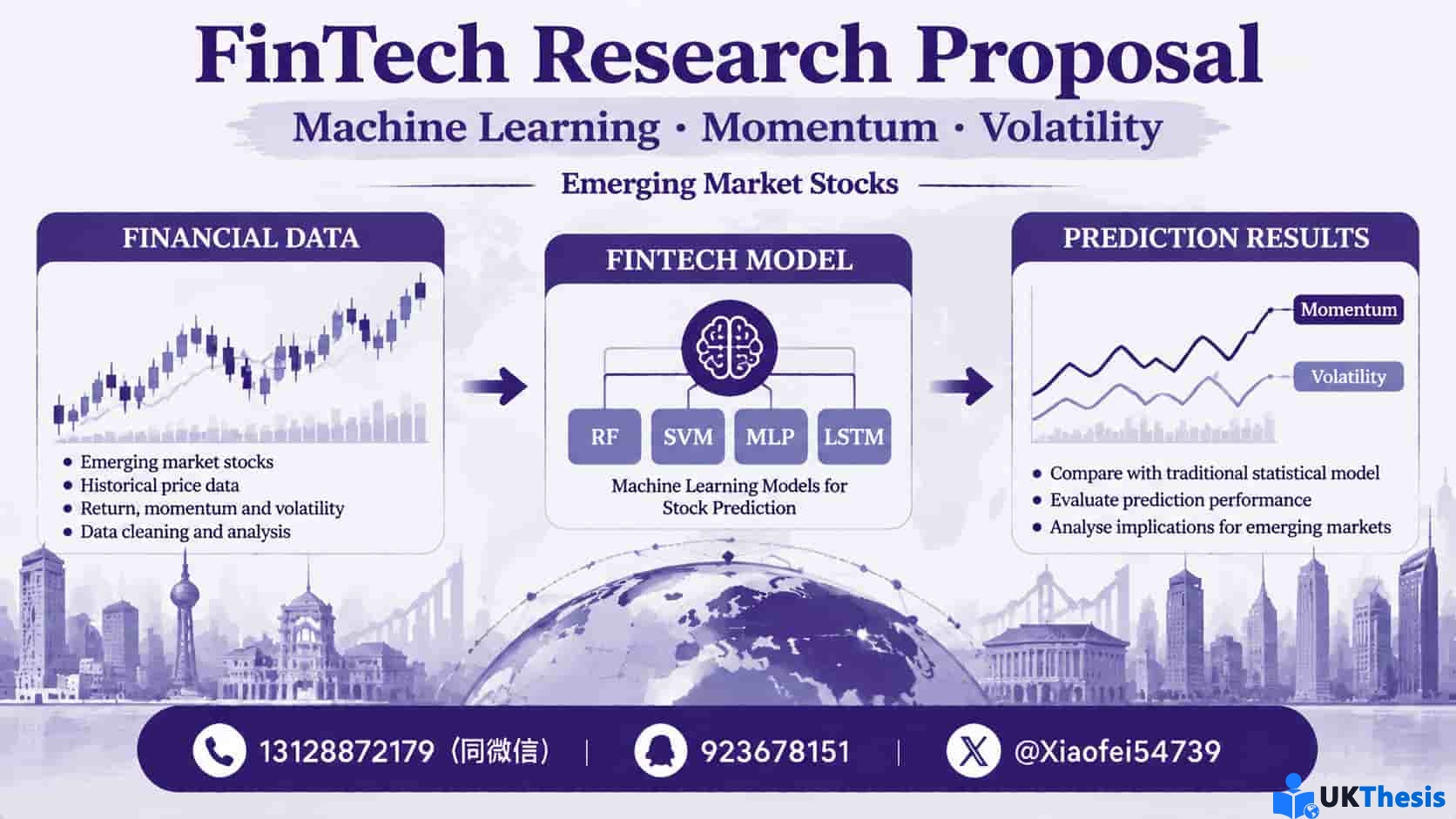
这份FinTech Research Proposal围绕一个比较具体的问题展开:利用Artificial Intelligence和Machine Learning建立新兴市场股票预测模型,并与传统统计方法进行比较,研究Momentum Effect、Volatility以及Efficient Market Hypothesis之间的关系。
它更适合作为Finance、FinTech、Quantitative Finance或Research Proposal的写作参考,而不是一篇普通的“FinTech是什么”介绍文章。
The Project: FinTech, Momentum and Volatility
Financial Technology (FinTech) describes technologies used to improve, automate or support the delivery and use of financial services. In modern finance, Artificial Intelligence (AI) and Machine Learning (ML) can also be used to identify patterns in financial data and construct predictive models.
The purpose of this research is to investigate the relationship between momentum, volatility and emerging market stocks by creating a FinTech prediction model based on Artificial Intelligence and Machine Learning, and comparing its performance with traditional statistical approaches.
The project addresses both theoretical and empirical aspects of a FinTech strategy for momentum and volatility effects in emerging markets. From a methodological point of view, the research combines statistical analysis with computational models implemented through tools such as Python and R.
An empirical analysis can then compare different prediction approaches, including Random Forest, Support Vector Machine and neural-network-based models.
学姐理解:这个题目真正有意思的地方不是“AI很先进”,而是同一批Financial Data交给传统统计模型和Machine Learning模型,谁预测得更好?一旦把问题缩到这里,Proposal就不会写成FinTech百科全书。
research Questions
The research project proposes the following questions:
How could momentum and volatility prediction in emerging market stocks challenge or contribute to the discussion surrounding the Efficient Market Hypothesis?
How effective are FinTech strategies based on Machine Learning as prediction models for momentum and volatility?
Which approach performs more effectively for emerging market stocks: traditional statistical models or the proposed FinTech prediction models?
Research Objectives
| Objective | Research Purpose |
|---|---|
| Objective 1 | To examine the indicators that drive momentum and volatility effects in emerging market stocks. |
| Objective 2 | To determine the relationship between momentum and volatility effects. |
| Objective 3 | To identify a suitable FinTech strategy and compare the best-performing Machine Learning model with a traditional statistical regression model. |
| Objective 4 | To develop a practical and robust framework for adopting FinTech prediction models within emerging market stocks. |
literature review: Market Anomalies and EMH
Market anomalies refer to patterns in financial markets that appear inconsistent with simple interpretations of market efficiency. The Efficient Market Hypothesis (EMH) provides an important theoretical background for discussing whether publicly available information can systematically be used to obtain abnormal returns.
Momentum and volatility effects are particularly interesting phenomena in stock markets.
The momentum effect refers to the tendency for assets that have performed strongly over a previous period to continue performing relatively strongly for some time, while poorly performing assets may continue to underperform.
Volatility describes the degree of variation in the price of a financial asset over a period. Larger and more frequent price movements are generally associated with higher volatility.
The existence of momentum and other market anomalies has created a long-running discussion around market efficiency. If systematic patterns can be identified and predicted, researchers naturally ask whether such predictability is consistent with the assumptions of EMH.
| Concept | Role in the Research |
|---|---|
| Momentum Effect | Tests whether previous performance contains information relevant to subsequent performance. |
| Volatility | Measures variation and uncertainty in stock-price movements. |
| Efficient Market Hypothesis | Provides a theoretical benchmark for discussing market predictability. |
| Machine Learning | Provides alternative techniques for identifying complex patterns and generating predictions. |
Why Emerging Markets?
Emerging markets provide an interesting environment for studying momentum and volatility because their market structures, liquidity, investor composition and risk characteristics may differ from those of mature developed markets.
Investors may enter emerging markets seeking higher potential returns while accepting higher levels of risk. At the same time, different emerging markets can show different degrees of momentum, reversal and volatility.
For this reason, it would be risky to assume that a prediction model performing well in one developed stock market will automatically produce the same results in every emerging market.
这里是Proposal很容易丢分的小地方:不要只写“Emerging Markets are highly volatile, therefore they are interesting”。老师通常还会追问:为什么这种市场特征会影响你的Model Performance?把Market Characteristics和Methodology连起来,研究理由才真正成立。
Research Methodology
The methodology can combine traditional statistical analysis with Machine Learning models. The aim is not simply to use as many algorithms as possible, but to compare whether alternative models improve prediction performance under the same research framework.
The original project proposes the use of stock-market data covering the period from 1 January 2015 to 31 December 2019. The dataset would be cleaned before model construction and evaluation.
| Stage | Possible Research Task |
|---|---|
| 1. Data Collection | Collect emerging market stock-price and related financial data. |
| 2. Data Cleaning | Check missing values, abnormal observations and consistency of the dataset. |
| 3. Descriptive Analysis | Examine return, momentum and volatility characteristics. |
| 4. Statistical Model | Construct a traditional benchmark model for comparison. |
| 5. Machine Learning | Train alternative FinTech prediction models. |
| 6. Model Evaluation | Compare predictive performance and robustness. |
Machine Learning Models
The proposed methodology includes several Machine Learning approaches. Each model has a different structure, so the comparison should focus on predictive performance rather than assuming that a more complicated model must automatically be better.
Random Forest
Random Forest is an ensemble Machine Learning method based on multiple decision trees. Instead of relying on a single tree, the approach combines results across many trees, which can improve predictive stability and reduce some forms of overfitting.
Support Vector Machine
Support Vector Machine (SVM) is a supervised learning approach that can be applied to classification and regression problems. Within financial prediction, it provides another way of modelling relationships between input variables and the target outcome.
Multilayer Perceptron Neural Network
A Multilayer Perceptron (MLP) is a feedforward artificial neural network. Different network structures can be tested to examine whether nonlinear relationships in financial data improve prediction performance.
Long Short-Term Memory
Long Short-Term Memory (LSTM) is a recurrent neural-network architecture designed to process sequential information. Because financial observations form time sequences, LSTM provides an interesting candidate for investigating financial prediction.
| Model | Type | Role in Proposal |
|---|---|---|
| Traditional Regression | Statistical | Benchmark model |
| Random Forest | Ensemble ML | Nonlinear prediction comparison |
| SVM | Supervised ML | Alternative predictive model |
| MLP | Neural Network | Capture nonlinear relationships |
| LSTM | Recurrent Neural Network | Model sequential financial data |
Traditional Statistics vs Machine Learning
A useful part of the project is the direct comparison between conventional statistical modelling and Machine Learning.
Traditional statistical models can provide interpretable relationships between variables and remain important for hypothesis testing. Machine Learning models may be better suited to identifying complex nonlinear patterns, but improved in-sample fit does not automatically mean stronger out-of-sample prediction.
The comparison therefore needs a consistent evaluation framework.
| Question | Why It Matters |
|---|---|
| Prediction Accuracy | Does the ML model actually predict better? |
| Out-of-Sample Performance | Can performance survive outside the training data? |
| Overfitting | Has the model learned genuine patterns or simply fitted historical noise? |
| Interpretability | Can researchers explain why the model generates its prediction? |
| Robustness | Does the model remain useful across different emerging markets? |
这也是我觉得这份Proposal最值得保留的地方。不要写成“Machine Learning比传统统计高级,所以一定更准”。如果最后Random Forest或者LSTM没有打败Benchmark,那本身也是Research Result。研究不是比赛,非得让AI赢才算成功。
Proposed Research Process
The research can be organised into several connected stages. First, the theoretical framework covers momentum, volatility, market efficiency and FinTech strategies in emerging markets. Second, the data and descriptive statistics are prepared. Third, the statistical and Machine Learning methodology is implemented. Finally, model results are compared, discussed and interpreted.
Theory → Data → Data Cleaning → Benchmark Model → Machine Learning Models → Prediction Evaluation → Results → Discussion
The proposed project was originally designed as a three-year research programme beginning in October 2020. The first year focused on theoretical development, followed by model construction and data analysis, with results and conclusions planned for the final stage.
For students using this proposal as a writing sample today, this timeline should be understood as part of the original research design rather than a current project schedule.
Research Contribution
The potential contribution of the research lies in examining whether FinTech models can improve the prediction and analysis of momentum and volatility in emerging market stocks.
The project also creates a bridge between established financial theory and newer computational techniques. Instead of treating Artificial Intelligence as a separate technology topic, the proposed research places Machine Learning inside a recognisable Finance question: market efficiency, asset-price behaviour and prediction.
If carefully designed, such a study could contribute to the discussion surrounding financial-market anomalies and provide evidence about where Machine Learning adds value—and where traditional statistical models remain competitive.
How to Write a FinTech Research Proposal
如果你的Finance Proposal也涉及AI、Machine Learning或者Stock Prediction,我建议先别急着罗列十几个Algorithms。真正应该先确定的是Research Question。
一个比较清楚的Research Proposal通常至少能回答下面几个问题:
| Proposal Element | Question to Answer |
|---|---|
| Research Problem | What exactly are you trying to explain or predict? |
| Research Gap | What remains uncertain in existing studies? |
| Research Questions | What specific questions will the study answer? |
| Data | Which market, period and variables will be studied? |
| Methodology | Why are these statistical or Machine Learning models suitable? |
| Evaluation | How will model performance be compared? |
| Contribution | What could the findings add to Finance or FinTech research? |
很多FinTech Proposal真正的问题不是技术不够高级,而是Research Question太大。我见过最典型的一种开头就是:“AI is changing the world of finance...”然后写了两页还不知道究竟要研究什么。与其这样,不如老老实实把Market、Variable、Period和Model四件事先确定下来。
如果Research Proposal已经有题目,但Research Questions、Literature Review和Methodology之间对不上,可以先进行Finance Research Proposal结构梳理和写作辅导,再决定哪些模型真正需要进入正文。
FAQ
这篇属于Finance essay还是Research Proposal?
更准确地说属于Finance / FinTech Research Proposal。它包含明确的Research Questions、Objectives、Literature Review、Methodology、Data和Research Plan,因此不应该只按普通Essay处理。
Machine Learning in Finance适合作为Research Proposal题目吗?
可以,但“Machine Learning in Finance”本身范围太大。最好进一步限定具体市场、研究变量、数据区间和预测任务,例如Emerging Market Stocks、Momentum、Volatility和Return Prediction。
为什么要把Machine Learning和传统统计模型比较?
因为复杂模型并不天然代表更好的预测能力。设置Traditional Statistical Model作为Benchmark,可以更清楚地判断Machine Learning是否真正提供额外预测价值。
Random Forest、SVM、LSTM需要全部使用吗?
不一定。Research Proposal应该根据Research Question、Data Structure和Evaluation Method选择模型,而不是单纯追求算法数量。
2015–2019的数据是不是太旧了?
这份页面定位为Research Proposal Sample,因此2015–2019属于原研究设计的一部分,可以保留。如果实际开展新的研究项目,则应根据新的Research Question重新确定Sample Period,而不是机械沿用这个时间范围。
FinTech Research Proposal最容易出现什么问题?
一个常见问题是Literature Review讲AI,Research Question讲股票收益,Methodology突然开始做LSTM,三部分没有真正连接。比较稳妥的方式是始终围绕同一条逻辑:Research Problem → Data → Model → Evaluation → Contribution。
Conclusion
This research proposal investigates whether FinTech strategies based on Artificial Intelligence and Machine Learning can improve the prediction of momentum and volatility effects in emerging market stocks.
The study connects financial-market theory, particularly momentum anomalies and the Efficient Market Hypothesis, with empirical prediction techniques including Random Forest, Support Vector Machine, Multilayer Perceptron and Long Short-Term Memory models.
The central contribution does not depend on proving that Machine Learning is always superior. Instead, the research asks whether these models provide measurable predictive improvements when compared with traditional statistical approaches, and whether those improvements remain robust across emerging market data.
相关文章阅读
如果正在准备Finance、FinTech或Quantitative Finance方向的Research Proposal,可以继续阅读本站Finance Paper、Portfolio Management、Financial Modelling、Banking与Research Methodology相关范文。选择相关文章时,建议优先围绕“金融理论—数据—模型—验证”这条研究路线展开,不必为了增加关键词把所有Finance文章都塞进推荐阅读。