Gender and Language Argumentative Essay Example: Communication Differences

Gender and Language是一个很典型的Argumentative essay题目:表面上讨论“男性和女性说话有什么不同”,真正写起来却会牵涉communication、psychology、social media、workplace甚至political rhetoric。
这种题目最容易掉进一个坑——把复杂问题写成“男人都是这样,女人都是那样”。Argumentative Writing真正需要的不是把差异说得越来越绝对,而是提出一个可以讨论的Claim,再看看Evidence究竟能支持到什么程度。
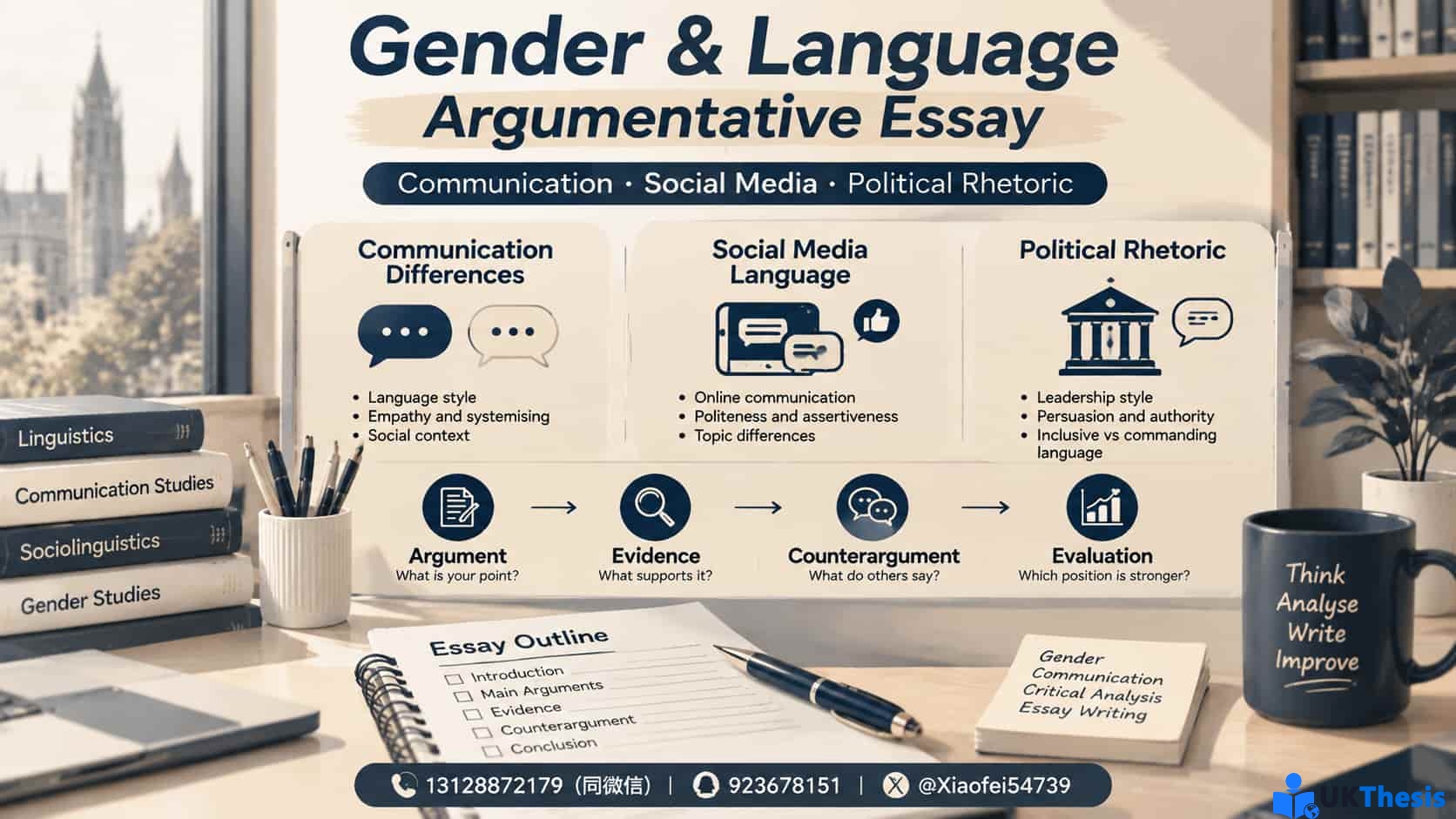
下面先用很短的篇幅整理Argumentative Essay Outline,然后保留一篇“How Differently Men And Women Use Language”英文范文作为主要案例,看看一篇Essay怎样从general claim逐渐进入social media和political communication。
Argumentative Essay Outline怎么搭?
Outline其实就是正式写Essay之前的roadmap。与其打开Word以后边写边想,不如先把Thesis、Main Arguments、Evidence和Counterargument摆在纸面上。
| Outline部分 | 准备内容 |
|---|---|
| Introduction | Hook、Background、Thesis Statement |
| Argument 1 | Claim + Evidence + Analysis |
| Argument 2 | 第二个主要论点及Evidence |
| Counterargument | Opposing View + Response |
| Conclusion | 回到Thesis并综合主要发现 |
如果老师没有指定Topic,选题的时候最好先判断自己对这个问题是否足够熟悉,以及有没有足够的Evidence。一个自己完全没兴趣、资料又很难找的题目,通常写到第三段就开始后悔。
Outline阶段不用写完整句子。Claims、Facts、Figures、Statistics、Quotations以及可能出现的Opposing Arguments,都可以先用bullet points记下来。
真正开始写Body以后,再把这些材料变成完整的Argument。
Gender and Language Argumentative Essay Example
How Differently Men And Women Use Language
It is not a new question whether men and women truly speak the same language, or whether they always understand the intentions behind each other's words. Both may physically speak the same language — English, Japanese, Spanish or Russian, for example — but patterns of communication can still differ across individuals and social contexts.
Some studies and theories have argued that men and women may display different communication patterns. Explanations have ranged from psychological and biological factors to social expectations, education and cultural norms. These claims remain open to debate, particularly when individual differences are reduced to simple gender categories.
For an argumentative essay, this makes gender and language an interesting subject: the writer can examine whether apparent communication differences should be explained primarily through biology, socialisation, context, or a combination of these factors.
Empathising and Systemising
One theory used in discussions of gender differences distinguishes between empathising and systemising. Empathising refers to identifying another person's emotions or thoughts and responding to them, while systemising involves analysing systems according to rules, inputs and outputs.
Some versions of this theory describe different cognitive profiles, including stronger empathising, stronger systemising and a more balanced profile. Earlier discussions sometimes associated these profiles with female and male brains.
However, this is exactly the kind of claim an argumentative essay should examine critically rather than simply repeat. Even when research identifies average differences between groups, an average does not describe every individual within that group.
写作观察:这里特别适合做Critical Analysis。看到一个Theory以后,不要马上写“The theory proves that...”。先问一句:这个Theory到底证明了什么?它讨论的是average tendency,还是每一个individual?这一个小区别,经常就是普通描述和Critical Writing之间的距离。
Gender and Language on Social Media
Social media provides another environment in which researchers have examined language use. Unlike a formal workplace, platforms such as Facebook allow users to communicate about family, friendships, politics, sport and personal experiences in relatively informal settings.
Research discussed in the original essay suggested differences in warmth, politeness, assertiveness and topic choice in social-media language. Women's language was described as more interpersonally warm in some datasets, while men's language was associated with different topics and styles.
At the same time, the findings were not completely straightforward. Women could also use highly assertive language while maintaining expressions of warmth and support.
This complicates the simple assumption that “women communicate emotionally while men communicate assertively.” Communication style can change depending on audience, platform, purpose and social context.
Assertiveness and Communication
Another useful distinction is between affiliation and assertiveness. Affiliation may involve statements of support and understanding, while assertiveness can include criticism, disagreement or imperative statements.
A person can be both assertive and supportive. These characteristics do not necessarily sit at opposite ends of one scale.
For argumentative writing, this is useful because it allows the discussion to move away from a simple male-versus-female comparison and toward a more interesting question: how does context influence the language people choose?
Gendered Rhetoric in Politics
Political communication provides a different environment because speakers operate within expectations concerning authority, leadership and persuasion.
Traditional discussions of political rhetoric sometimes describe a “masculine” style as commanding, instrumental, competitive and authority-oriented. Direct commands, interruption, statistics and technical terminology may be interpreted as ways of signalling leadership or control.
By contrast, a traditionally “feminine” rhetorical style has sometimes been described as more intimate, inclusive and relationship-oriented.
But these labels become less convincing if they are treated as fixed rules about how men and women actually speak.
Political speakers can change rhetorical style depending on the audience and issue. Inclusive expressions such as “we” and “us” may be used by both men and women to establish unity, while direct and authoritative language can likewise be used across genders.
The more useful question may therefore be not “Which gender owns which language style?” but “Why does a speaker choose a particular rhetorical style in a particular situation?”
| 讨论角度 | Possible Argument | 需要警惕的问题 |
|---|---|---|
| Biology | 生理或认知差异可能影响communication | 避免把group averages写成绝对规律 |
| Socialisation | 社会环境可能塑造语言习惯 | 需要Evidence说明因果关系 |
| Social Media | 不同群体可能表现不同语言模式 | Platform和sample会影响结果 |
| Politics | Rhetoric与leadership expectations有关 | Rhetorical style不等于biological sex |
Conclusion
Men and women may show different patterns of communication in particular studies and contexts, but explaining these differences requires more than simply dividing language into male and female categories.
Biological explanations, psychological theories, socialisation, workplace expectations, social media and political environments may all contribute to communication behaviour.
Styles traditionally described as masculine or feminine can also be used by people of different genders depending on purpose and context. A speaker may use direct and authoritative language in one situation and inclusive, relationship-oriented rhetoric in another.
For this reason, the more convincing conclusion is not that one gender is inherently better at communication. Instead, gender and language provide an example of how communication behaviour can be shaped by multiple interacting factors.
这篇Argumentative Essay的结构怎么看?
如果只是看题目,这篇很容易写成“男生怎么说话、女生怎么说话”的罗列。真正让它变成Argumentative Essay的,是不同Explanation之间的比较。
| 范文内容 | 写作作用 |
|---|---|
| Gender communication question | 建立Debatable Issue |
| Empathising/Systemising | 引入Theory |
| Social Media | 加入Research Context |
| Political Rhetoric | 比较不同Communication Context |
| Limitations | 避免Gender Stereotype |
| Conclusion | 形成更Balanced Evaluation |
我反而觉得这种有一点“旧时代痕迹”的Essay很适合拿来学习Critical Writing。因为你可以很明显看到:哪些句子是Claim,哪些地方Evidence还不够,哪些结论说得太满。
读范文不是为了照着写,而是练习问自己一句:If I were the marker, what would I challenge here?
FAQ
Gender and Language属于Linguistics Essay吗?
可以。Gender and Language常见于Linguistics、Sociolinguistics、Communication Studies等课程。如果题目要求建立立场、比较不同解释并处理Counterargument,也可以采用Argumentative Essay结构。
Argumentative Essay一定需要Outline吗?
正式提交时未必要求同时提交Outline,但写作之前做Outline通常很有帮助。尤其是Argumentative Essay,如果没有提前安排Argument和Counterargument,写到后半部分很容易发现自己的Evidence全部挤在一边。
Outline需要写完整句子吗?
不一定。准备阶段可以用关键词、bullet points或者短句记录Thesis、Claims、Evidence和Counterarguments。除非老师明确要求提交正式Outline,否则主要目的是帮助自己看清文章逻辑。
Gender Essay怎么避免写成刻板印象?
尽量区分group-level findings和individual differences,并关注研究的sample、context和limitations。出现“all men”“all women”这一类绝对表达时,最好停一下看看Evidence是否真的支持这么大的结论。
Argumentative Essay不会组织结构怎么办?
可以先把assignment Question拆成Thesis、Main Arguments、Evidence、Counterargument和Conclusion。如果材料很多却不知道怎样排列,也可以通过Essay写作辅导先梳理Outline和论证关系,再进入英文表达和段落修改。
相关文章阅读
Argumentative Essay Outline真正的作用并不是让文章看起来“格式正确”,而是在正式写之前提前发现逻辑漏洞。如果Outline阶段已经发现某一个观点完全没有Evidence,那反而是好事——至少不用等写了1500字以后才发现。