Management Accounting案例:Hampshire Company的CVP、JIT与ABC成本分析

Management Accounting真正难的地方,往往不是记住Contribution Margin、Break-even Point、JIT或者ABC这些名词,而是当一家公司的Sales、Costs、Inventory和Production数据摆在面前时,能够判断这些数字到底意味着什么,以及Management下一步应该怎么做。
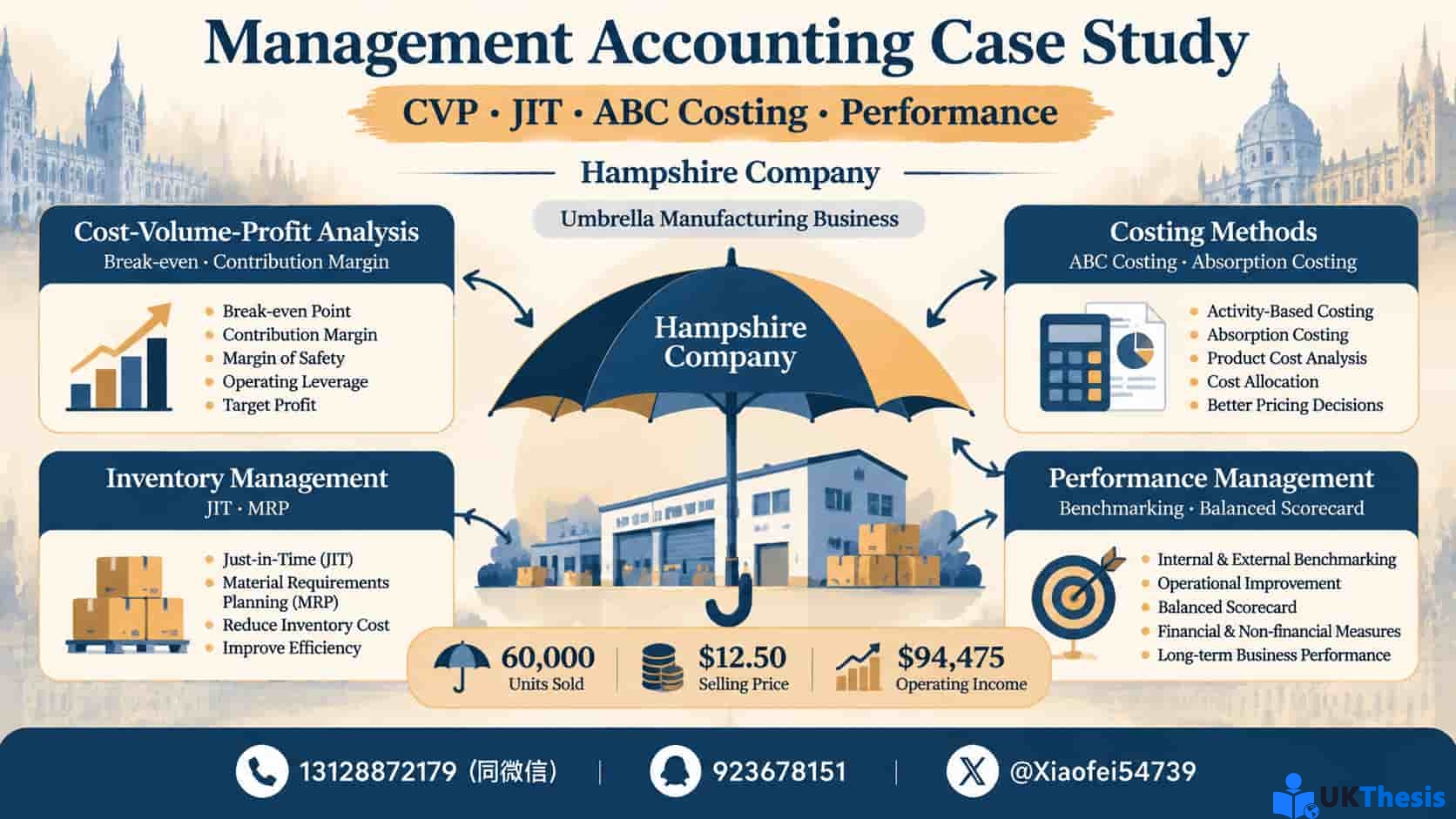
下面这个Hampshire Company案例就是一个很典型的Management Accounting Assignment。公司以Umbrella Production为主要业务,目前销售60,000把Stick Umbrellas,每把售价$12.50。我们可以从Cost-Volume-Profit(CVP)Analysis开始,计算Contribution Margin、Break-even Point、Margin of Safety和Operating Leverage,再继续讨论Variable Costing、Absorption Costing、JIT、MRP、Benchmarking和Activity-Based Costing(ABC)。
第一次碰到这种题的时候,我也很容易把它理解成“算数字”。后来做多了才发现,数字反而是比较简单的一部分。真正容易丢分的是:算出了45,465 units,却没有解释45,465到底对Management意味着什么。所以这篇案例不会只停留在Calculation,而是把Calculation和Management Decision放在一起分析。
Hampshire Company目前经营情况
Hampshire Company目前生产和销售60,000把Stick Umbrellas,每把售价$12.50,因此Sales Revenue为$750,000。公司的Total Variable Costs为$360,000,Total Fixed Costs为$295,525,由此得到Operating Income $94,475。
| Item | Hampshire Company |
|---|---|
| Sales Volume | 60,000 units |
| Selling Price | $12.50 per unit |
| Sales Revenue | $750,000 |
| Variable Costs | $360,000 |
| Variable Cost per Unit | $6.00 |
| Fixed Costs | $295,525 |
| Operating Income | $94,475 |
如果只是做Financial Reporting,到这里可能已经可以说明公司赚了多少钱。但Management Accounting还会继续追问:目前60,000 units的Sales到底安全吗?销量下降多少以后企业会开始亏损?如果Sales提高20%,Profit又会发生多大的变化?这些问题就需要Cost-Volume-Profit Analysis。
Cost-Volume-Profit Analysis:先看一把雨伞能贡献多少钱
Cost-Volume-Profit Analysis主要研究Sales Volume、Selling Price、Variable Cost、Fixed Cost和Profit之间的关系。Hampshire Company目前Variable Costs为$360,000,销售60,000 units,因此Variable Cost per Unit为$6.00。
Variable Cost per Unit = $360,000 ÷ 60,000 = $6.00
Contribution Margin per Unit = $12.50 − $6.00 = $6.50
Contribution Margin Ratio = $6.50 ÷ $12.50 = 52%
也就是说,公司每卖出一把$12.50的雨伞,扣除$6.00 Variable Cost以后,还剩$6.50 Contribution Margin。这$6.50首先用于覆盖Fixed Costs,超过Fixed Costs以后才形成Operating Profit。
这个地方看起来简单,却是后面所有CVP Calculation的基础。如果Contribution Margin算错,后面的Break-even Point、Target Profit和Margin of Safety基本会集体跟着跑偏。
Break-even Point
Break-even Point表示Total Revenue刚好等于Total Costs的位置。到了这个点,公司既没有Operating Profit,也没有Operating Loss。
Break-even Units = Fixed Costs ÷ Contribution Margin per Unit
$295,525 ÷ $6.50 ≈ 45,465 units
Break-even Sales Revenue ≈ $568,317
Hampshire Company目前Sales Volume为60,000 units,已经明显高于约45,465 units的Break-even Point,因此企业目前处于盈利状态。
Margin of Safety
知道Break-even Point以后,Management还会关心另一个问题:现在的Sales究竟可以下降多少,企业才会真正开始出现Operating Loss?这就是Margin of Safety。
Margin of Safety = Current Sales − Break-even Sales
60,000 − 45,465 ≈ 14,535 units
Margin of Safety Revenue ≈ $181,683
换句话说,目前Hampshire Company并不是刚刚踩着Break-even Line经营。公司大约还有14,535 units的Sales Cushion。
一个很实用的写法:Accounting assignment里不要写到“Break-even Point is 45,465 units”就结束。最好继续解释一句:Because current sales are 60,000 units, Hampshire Company operates above the break-even point and has a margin of safety of approximately 14,535 units. 这样Calculation才真正进入Analysis。
Operating Leverage
Hampshire Company目前Contribution Margin为:
$750,000 − $360,000 = $390,000
Degree of Operating Leverage = $390,000 ÷ $94,475 ≈ 4.13
Operating Leverage约为4.13,说明公司Profit对Sales变化比较敏感。当Sales增加时,Operating Income可能增长得更快;但这把刀有两面,如果Sales下降,Profit同样可能下降得更加明显。
如果销量增加20%,Profit会发生什么变化?
现在假设Hampshire Company能够把销量由60,000 units提高20%至72,000 units,同时Selling Price仍为$12.50,Variable Cost per Unit仍为$6.00,Fixed Costs保持$295,525不变。
| Item | Current | 20% Sales Increase |
|---|---|---|
| Units Sold | 60,000 | 72,000 |
| Revenue | $750,000 | $900,000 |
| Variable Costs | $360,000 | $432,000 |
| Contribution Margin | $390,000 | $468,000 |
| Fixed Costs | $295,525 | $295,525 |
| Operating Income | $94,475 | $172,475 |
Sales Volume增加20%,Operating Income却从$94,475提高到$172,475。原因并不神秘:在假设范围内,Fixed Costs没有随着销量同步增加,因此新增Contribution Margin能够比较明显地转化为Operating Income。
不过Management不能看到$172,475就立刻高兴。CVP Analysis告诉我们的只是如果72,000 units能够销售出去会出现什么结果,它本身并不能证明Market Demand一定能够吸收这些产品。
Variable Costing与Absorption Costing
随着分析进入Production和Inventory,另一个重要问题出现了:Fixed Manufacturing Overhead到底应该怎样处理?
| Costing Method | Treatment | Main Use |
|---|---|---|
| Variable Costing | Fixed manufacturing overhead is treated as a period cost. | Internal decision-making and CVP analysis. |
| Absorption Costing | Fixed and variable manufacturing costs are included in product cost. | Inventory valuation and financial reporting. |
当Production高于Sales时,Absorption Costing下部分Fixed Manufacturing Overhead会暂时包含在Ending Inventory中,因此当期Operating Income可能高于Variable Costing。
这里特别容易出现一个误区:Operating Income变高,并不一定意味着Business本身突然经营得更好了。如果Profit增加只是因为生产了更多还没有卖掉的Inventory,那么Management还需要继续观察Inventory Turnover和实际Market Demand。
JIT Inventory:解决Overproduction问题
Hampshire Company还面临Inventory Management问题。Just-in-Time(JIT)的基本思路,是让Materials和Production尽量靠近实际Demand,而不是提前堆积大量Inventory。
如果公司Production明显高于Sales,就可能产生Storage、Insurance、Handling以及Obsolescence等额外成本。因此JIT对Hampshire Company最直接的价值,就是减少不必要的Overproduction。
| Advantages of JIT | Risks of JIT |
|---|---|
| Reduce excess inventory | Supply disruption risk |
| Reduce storage costs | Greater dependence on suppliers |
| Reduce waste | Less safety stock |
| Improve inventory turnover | Requires reliable lead times |
| Free working capital | Implementation and training costs |
所以JIT不是一句“库存越少越好”。如果Supplier Reliability很差,或者Lead Time经常变化,把库存压得太低反而可能造成Production Interruption。
JIT与MRP怎么选择?
Material Requirements Planning(MRP)同样用于Production和Inventory Planning,但它与JIT的思路并不完全相同。
| JIT | MRP |
|---|---|
| Closely linked to actual production demand | Based on planned material requirements |
| Focuses on reducing inventory | Focuses on ensuring materials are available when required |
| Requires reliable suppliers | Relies heavily on accurate forecasts and production schedules |
| Suitable for shorter, predictable lead times | Useful for more structured materials planning |
对Hampshire Company来说,与其在essay里简单宣布“JIT比MRP好”,不如分析公司的Demand Stability、Supplier Reliability、Lead Time以及Inventory Cost,再决定哪一种系统更加适合。
Benchmarking:不能只跟自己去年比
Benchmarking是持续比较Performance和Business Processes的一种方法。对于希望改善Cost、Quality和Operational Efficiency的Hampshire Company来说,它能够帮助Management发现自己与其他Business之间的差距。
| Type | Meaning |
|---|---|
| Internal Benchmarking | Compare performance between departments, plants or internal processes. |
| External Benchmarking | Compare performance with other organisations or competitors. |
| Functional Benchmarking | Compare similar functions or operations with other organisations. |
| Generic Benchmarking | Compare useful processes even when organisations operate in different industries. |
External Benchmarking对Hampshire Company尤其有价值,因为Management可以比较Product Cost、Production Efficiency、Quality和Inventory Performance。
但Benchmarking也不能变成“别人家做什么,我家照着做”。不同企业的Scale、Technology、Product Mix和Supply Chain都可能不同,所以Benchmark应该作为Decision Support,而不是直接替代Management Judgment。
Activity-Based Costing:两种雨伞真的一样赚钱吗?
如果Hampshire Company只生产一种相对简单的产品,Traditional Costing可能已经足够。但当公司同时生产Stick Umbrellas和Collapsible Umbrellas时,使用单一Overhead Allocation Rate就可能出现Cost Distortion。
Activity-Based Costing(ABC)不是简单地把Manufacturing Overhead平均分给所有产品,而是先识别Activities以及相应的Cost Drivers,再根据每一种产品实际消耗这些Activities的程度分配成本。
| Product | Traditional Costing | ABC Costing | Difference |
|---|---|---|---|
| Stick Umbrella | $10.92 | $10.79 | ABC shows slightly lower unit cost. |
| Collapsible Umbrella | $11.12 | $13.86 | ABC reveals substantially higher unit cost. |
这组数字是整个案例里我觉得最值得仔细看的部分。
Traditional Costing下,Collapsible Umbrella的Unit Cost只有$11.12;换成ABC以后却变成$13.86。如果Selling Price只有$14.00,原来看起来还不错的Profit Margin突然就变得非常薄。
为什么会这样?复杂产品通常会使用更多Setups、Handling、Inspection或者其他Overhead Activities。Traditional Costing如果只按照一个简单Allocation Base分配Overhead,就可能让简单产品承担过多成本,同时低估复杂产品真正消耗的Resources。
因此ABC的意义不是“算得更复杂”,而是让Management更清楚地知道Product真正在哪里消耗Resources。这个结果又会进一步影响Pricing、Product Mix和Production Decision。
Management Recommendations
Hampshire Company的问题并不能靠一种Accounting Technique全部解决。CVP、JIT、ABC和Benchmarking实际上回答的是不同的问题。
| Business Question | Management Accounting Tool | Purpose |
|---|---|---|
| How many units must be sold? | CVP Analysis | Break-even and target-profit planning |
| How can excess inventory be reduced? | JIT | Reduce inventory, waste and storage cost |
| What materials will production require? | MRP | Materials planning |
| Are product costs distorted? | ABC Costing | Improve overhead allocation |
| How does the company compare with others? | Benchmarking | Compare operational performance |
| Is performance improving overall? | Balanced Scorecard | Combine financial and non-financial measures |
如果需要完成类似的Management Accounting Assignment,比较好的思路也是先判断题目究竟在问什么,再选择Accounting Tool,而不是看到案例以后把学过的所有Theory一次性全塞进去。如果在Calculation、Case Analysis或者Assignment Structure上卡住,也可以根据课程要求进一步做针对性的写作辅导和分析。
Balanced Scorecard:Profit不是唯一答案
案例最后还可以使用Balanced Scorecard把Management Analysis再向前推进一步。
传统Accounting非常容易把注意力全部放在Operating Income上,但企业长期Performance显然不能只靠一个Profit数字判断。Balanced Scorecard通常从Financial、Customer、Internal Business Processes以及Learning and Growth几个维度观察企业。
| Perspective | Possible Measure |
|---|---|
| Financial | Operating income, contribution margin, product cost |
| Customer | Customer satisfaction, returns, product quality |
| Internal Processes | Production efficiency, inventory turnover, waste |
| Learning and Growth | Employee training, process improvement, production capability |
这一步很重要,因为有些Management Decision短期看起来会提高Accounting Profit,长期却未必合理。例如为了让Absorption Costing下的Operating Income更漂亮而增加Production,最后如果产品卖不出去,仓库里只会多出一堆Umbrellas——报表看起来精神了,仓库管理员可能就没那么精神了。
FAQ
What is Cost-Volume-Profit Analysis?
Cost-Volume-Profit Analysis研究Selling Price、Sales Volume、Variable Cost、Fixed Cost和Profit之间的关系,通常用于Break-even Analysis、Target Profit Planning和短期Management Decision。
Hampshire Company的Break-even Point是多少?
根据案例中的Fixed Costs $295,525以及Contribution Margin per Unit $6.50计算,Break-even Point约为45,465 units,对应Break-even Sales Revenue约$568,317。
Contribution Margin和Operating Profit有什么区别?
Contribution Margin是Sales Revenue减去Variable Costs后的金额。Contribution Margin首先需要覆盖Fixed Costs,剩余部分才形成Operating Profit。
Margin of Safety为什么重要?
Margin of Safety反映Current Sales距离Break-even Sales还有多大的下降空间。Margin of Safety越大,一般意味着在其他条件不变的情况下,企业面对Sales下降时拥有更大的缓冲空间。
为什么Hampshire Company适合使用ABC Costing?
当公司生产Stick Umbrellas和Collapsible Umbrellas等不同产品时,各产品消耗Overhead Activities的程度可能不同。ABC能够利用Activities和Cost Drivers进行更精细的Overhead Allocation,从而减少Product Cost Distortion。
JIT一定比MRP好吗?
不一定。JIT能够减少Inventory和Storage Costs,但对Supplier Reliability和Lead Time要求较高;MRP则强调按照Production Plan安排Material Requirements。选择哪种方法需要结合企业的Production Environment。
Variable Costing和Absorption Costing为什么会产生不同Profit?
主要原因在于Fixed Manufacturing Overhead的处理方式不同。当Production和Sales数量不一致时,一部分Fixed Manufacturing Overhead可能在Absorption Costing下进入Inventory,因此两个方法报告的Operating Income可能不同。
Management Accounting Assignment只要Calculation正确就可以吗?
通常不够。Calculation只是第一步。比较完整的Assignment还应该解释Calculation背后的Management Implication,例如Break-even Point对Sales Risk意味着什么,ABC Costing为什么会改变Pricing Decision,以及JIT节省Inventory Cost的同时会带来哪些Supply Risks。
Conclusion
The Hampshire Company case demonstrates that management accounting is not simply a collection of calculations. Different accounting techniques provide different information for management decisions.
CVP Analysis shows that the current sales volume of 60,000 units is above the break-even point of approximately 45,465 units. The company therefore has a margin of safety of approximately 14,535 units. If sales increase by 20% to 72,000 units while the existing price and cost assumptions remain unchanged, operating income would increase from $94,475 to $172,475.
However, sales and profit planning are only one part of the company's management accounting problem. JIT can help reduce unnecessary inventory, while MRP can support materials planning. Benchmarking allows Hampshire Company to compare operational performance, and the Balanced Scorecard extends performance measurement beyond short-term accounting profit.
Activity-Based Costing is particularly important as Hampshire Company expands its product range. The difference between Traditional Costing and ABC suggests that the cost of the Collapsible Umbrella may have been understated. That information can directly affect Pricing, Product Mix and Profitability decisions.
The main lesson from the Hampshire Company case is therefore quite practical: there is no single accounting method that answers every management question. CVP, JIT, MRP, ABC, Benchmarking and the Balanced Scorecard become useful when each tool is matched with the business decision it is designed to support.
相关文章阅读
学习Management Accounting时,可以继续结合本站Cost-Volume-Profit Analysis、Strategic Management Accounting、Activity-Based Costing、Performance Management以及Accounting Assignment相关案例阅读。CVP专题适合进一步理解Break-even、Contribution Margin和Target Profit,本案例则更适合观察这些Accounting Tools如何共同应用于企业实际决策。