
一件产品好不好卖,当然不能只看“长得好不好看”。Product Design真正难的地方,是设计师既要考虑Customer Needs,又要考虑Function、Quality、Cost、Technology以及最后到底能不能顺利生产出来。学生第一次写Product Design assignment的时候,很容易把Design理解成外观设计,写着写着就变成“这个产品看起来更漂亮,所以消费者喜欢”。其实老师想看的通常远远不止这些。
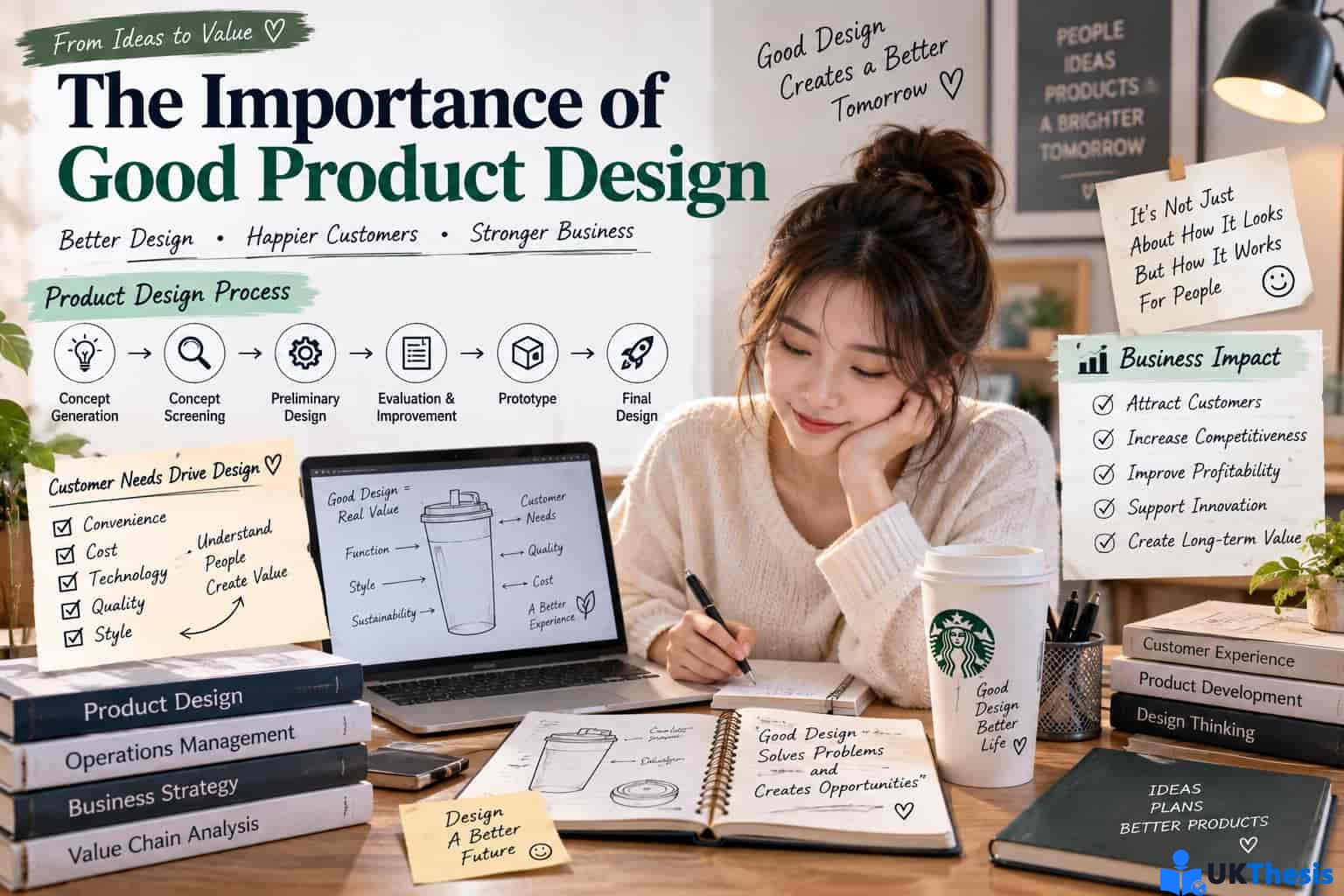
这篇Importance of Good Product Design范文主要讨论优秀产品设计为什么对企业重要、顾客怎样影响设计决策、Product Design经过哪些主要阶段,以及产品设计与Operations、Cost和Value Creation之间的关系。对于Operations Management、Product Development或Business Coursework来说,这种题目非常典型。
核心思路:Good Product Design不是单纯追求“漂亮”,而是尽可能让Customer Needs、Product Function、Quality、Cost和Manufacturing Process互相配合。
Introduction: What Is Product Design?
Every product manufactured by an organisation has certain characteristics that distinguish it from competing products and influence how customers perceive it. Product design therefore involves developing a product that is attractive, useful and capable of providing value to customers.
Because design is often one of the first things customers experience about a product, organisations need to develop products that meet customer expectations while remaining practical to manufacture and financially viable.
Product design should not be treated as the responsibility of designers alone. Operations managers, marketing teams, engineers, finance departments and customers may all influence the final design. A successful design therefore requires cooperation between different parts of the organisation.
Why Product Design Matters
Product design adds value by connecting customer requirements with product attributes. A well-designed product communicates its purpose, performs reliably and gives customers a reason to choose it instead of competing alternatives.
From an Operations Management perspective, product design is also important because decisions made during the design stage influence production requirements. Materials, dimensions, components and technical specifications all affect how a product will eventually be manufactured.
This means Product Design sits somewhere between two worlds:
What customers want ↔ What the organisation can realistically produce
我以前看学生写这种题目时,最常见的问题就是只写左边:Customer喜欢什么、外观怎么样、功能多不多。写了半天没有提生产成本和Operations。其实老师往往最想看到的是这两边怎么平衡。
Product Design and Competitive Advantage
Good design can help an organisation differentiate itself in a competitive market. When several companies provide products with similar basic functions, design can become an important source of value.
An organisation may therefore focus on a particular Core Competency. If a company has strong capabilities in engineering, user experience, materials or manufacturing, these capabilities can be used to create products that competitors find difficult to imitate.
Good design also helps organisations anticipate customer needs rather than simply responding after competitors have already introduced similar products.
| Design Area | Possible Business Value |
|---|---|
| Functionality | Makes the product more useful to customers |
| Ease of Use | Reduces customer effort and improves experience |
| Quality | Supports reliability and perceived value |
| Style | Creates differentiation and emotional appeal |
| Manufacturability | Controls production complexity and cost |
Why New Product Design Is Necessary
Most organisations cannot depend permanently on one successful product. Customer pReferences change, technologies develop and competitors introduce new alternatives. Product life cycles can also become shorter, meaning an organisation may need to revise or replace existing designs more frequently.
New Product Design therefore contributes to both survival and growth.
However, developing new products is also expensive and risky. Management should critically evaluate an idea before committing significant resources to it. Not every attractive concept will become a commercially successful product.
| Issue | Why It Matters |
|---|---|
| Development Cost | A sophisticated design may require substantial investment |
| Product Life Cycle | Existing designs may become outdated |
| Customer Demand | A technically impressive product can still fail if customers do not value it |
| Operations Capability | A design has to be realistically manufactured and delivered |
Importance of Good Product Design
Good Product Design can influence an organisation in several ways.
First, it can attract customers. A product that provides useful features, appropriate quality and an appealing design may stand out in a crowded market.
Second, good design connects the concept, package and process. The organisation has to decide what value the product is supposed to provide, what elements are included and how the final product will actually be produced.
Third, design can contribute to profitability. When customer needs are successfully translated into product value, the organisation may increase sales or support stronger customer loyalty.
Fourth, good design can improve convenience. A product that is easy to understand, operate, maintain and use creates practical value for customers.
Finally, Product Design helps replace outdated products. As technology and customer expectations change, organisations need to review whether current designs still remain relevant.
一个很好记的判断方法:Good Design不是“功能越多越好”,而是让真正需要的功能以合理成本、合理质量和合理方式呈现给目标顾客。
The Stages of Product Design
A fully developed design rarely appears immediately from a designer’s imagination. Product Design normally moves through a series of stages in which ideas are generated, screened, developed, tested and improved.
A useful simplified sequence is:
Concept Generation → Concept Screening → Preliminary Design → Evaluation & Improvement → Prototype → Final Design
1. Concept Generation
The first stage involves developing possible ideas for a product. These ideas can come from customers, employees, complaints, market observations, technological developments or existing product weaknesses.
Customer feedback is particularly useful because repeated complaints often reveal where an existing product fails to satisfy users.
2. Concept Screening
Not every idea should progress into development. Concept Screening helps the organisation compare alternatives and eliminate ideas that do not fit customer requirements, company capabilities or financial expectations.
This stage prevents the organisation from investing heavily in every interesting idea.
3. Preliminary Design
The organisation then develops a more detailed version of the chosen concept. Components, dimensions, materials, features and technical requirements begin to be specified.
This stage converts a general idea into something that Operations and Production teams can begin to evaluate.
4. Evaluation and Improvement
The preliminary design is evaluated to determine whether it can be improved before full production.
Techniques associated with this stage can include:
| Technique | Purpose |
|---|---|
| QFD | Translates customer requirements into design priorities |
| Value Engineering | Examines whether required functions can be delivered more efficiently |
| Taguchi Methods | Supports robust design and reduction of unwanted variation |
5. Prototype and Final Design
The improved concept can then be converted into a prototype. Prototype testing allows the organisation to identify practical problems before committing to full-scale production.
If performance is satisfactory, the product can move towards final design and production.
This is also why discovering a major design problem late in development can be expensive. The further a product has progressed towards production, the more costly substantial design changes may become.
Concept, Package and Process
The Product Design process can also be understood through three connected ideas: Concept, Package and Process.
The Concept
The concept describes the overall purpose, use and value of the product. It answers the basic question: What problem is this product supposed to solve for the customer?
The Package
The package includes the combination of core and supporting elements that provide the promised customer benefit.
For example, the core product may be the main physical item, while warranties, accessories or supporting features increase the overall value proposition.
The Process
The process describes how the product is created and delivered. Product Design and Process Design therefore cannot be treated as completely independent.
A complicated product may require complicated production. Conversely, redesigning a product can sometimes simplify the manufacturing process and reduce costs.
Product Design and the Value Chain
Product Design can influence several activities across an organisation’s Value Chain.
A design decision affects the types of materials suppliers must provide, the manufacturing process required by Operations, the cost structure considered by Finance, the value communicated by Marketing and ultimately the experience received by customers.
| Business Function | Relationship with Product Design |
|---|---|
| Purchasing | Sources materials and components required by the design |
| Operations | Determines how efficiently the product can be manufactured |
| Finance | Evaluates development cost and expected return |
| Marketing | Communicates product benefits and positioning |
| Customer Service | Provides feedback that can influence future redesign |
This demonstrates why a design decision made early in development can influence long-term organisational efficiency.
How Customers Influence Product Design
Customers have a major influence on Product Design because a product ultimately needs to provide value to the people expected to buy and use it.
Several customer value attributes can influence purchasing decisions:
Convenience · Cost · Technology · Quality · Style
Convenience
Customers often prefer products that are easy to understand and use. A technically advanced product can still disappoint customers if everyday operation is unnecessarily complicated.
This is why User Experience has become an important element of modern Product Design.
Cost
A well-designed product may provide high customer value, but sophisticated materials and features can also increase manufacturing costs.
From the customer perspective, an expensive design may encourage some buyers to choose a simpler alternative. From the business perspective, excessive manufacturing cost can reduce profitability.
An organisation therefore needs to consider whether redesign can deliver the required value at lower cost.
Technology
Technology can significantly influence customer perceptions of Product Design. Customers may prefer products that provide current and useful technological features, particularly when technology improves convenience, performance or reliability.
However, adding technology only because it is new does not automatically create value. The feature should solve an actual user problem.
Quality
Quality can be understood partly as fitness for purpose. Customers expect a product to perform the function for which it was purchased and to provide an acceptable level of reliability and durability.
Higher-quality materials may increase costs, but they can also improve perceived value and product life. The appropriate quality level therefore depends on the Target Market and intended Product Positioning.
Style and Fashion
Style can also influence customer perception, especially in industries such as clothing, consumer electronics, furniture and automobiles.
Fashion changes over time, so organisations operating in trend-sensitive markets need to understand how quickly customer preferences are changing.
That does not mean every product should chase every new trend. The important question is whether the design remains relevant to the expectations of its intended customer group.
Balancing Customer Value and Manufacturing Cost
One of the most difficult Product Design decisions involves balancing what customers want with what the organisation can afford to produce.
A sophisticated design might attract customers but require expensive materials, specialised labour and complex manufacturing. A cheaper design may reduce production cost but fail to provide enough customer value.
The organisation therefore needs to identify which design features customers genuinely value.
| Question | Design Consideration |
|---|---|
| Does the customer value this feature? | Customer Value |
| How much does it cost to manufacture? | Production Cost |
| Does it improve quality or reliability? | Performance |
| Can production handle the design? | Process Capability |
| Will customers pay for the added value? | Commercial Viability |
这篇Product Design范文学什么最划算?
如果把这篇文章当成Operations Management Assignment范文,我觉得最值得学的并不是“Good Design很重要”这句话,而是整个分析顺序:
Customer Needs → Product Concept → Design → Evaluation → Prototype → Production → Customer Value
这就比单纯列“设计很重要的五个原因”有深度多了。
比如老师问:
Explain how customer requirements influence product design and operations.
这时候不要只写Customer喜欢Quality、Technology和Style。
还应该继续解释这些要求怎样改变Materials、Components、Process、Cost甚至Supplier Choice。这样才能真正把Customer和Operations连起来。
如果在Product Design、Operations Management或Business Assignment中对题目理解、结构安排、Value Chain、QFD或者Critical Analysis不太确定,可以先通过课程论文写作辅导把Assignment Brief和评分要求拆清楚。理论并不是放得越多越好,真正能够解释题目才重要。
Conclusion
Good Product Design plays an important role in connecting customer expectations with organisational capabilities. A successful design should provide customer value while remaining functional, reliable, financially viable and practical to manufacture.
Product Design also influences more than the physical appearance of a product. Design decisions affect materials, production processes, cost, quality, technology and activities across the wider Value Chain.
Customers influence design through their expectations regarding convenience, price, technology, quality and style. Organisations therefore need to understand which attributes matter most to their Target Market while avoiding unnecessary features that increase cost without creating meaningful value.
The strongest Product Design is not necessarily the most complicated design. It is the design that creates the right balance between customer needs, product performance and the organisation’s ability to deliver the product efficiently.
FAQ:Product Design Assignment常见问题
1. Importance of Good Product Design属于Marketing essay吗?
不完全是。它与Marketing有关,但正文更侧重Operations Management、Product Development、Customer Needs和Production,因此Operations Management定位更准确。
2. 这篇文章属于Assignment还是Coursework?
两种叫法都可以。Assignment是较宽泛的课程作业称呼,而这篇文章本身具有Introduction、理论讨论和Conclusion,因此也可以作为Coursework或Report范文参考。
3. Product Design和Product Development有什么区别?
Product Design更关注产品本身的功能、结构、价值和用户需求,而Product Development通常涵盖从Idea到Design、Testing、Launch的更完整过程。
4. Product Design一定要使用QFD吗?
不一定。只有当Assignment需要讨论怎样把Customer Requirements转化成Design Requirements时,QFD才特别有价值。
5. Value Chain为什么和Product Design有关?
因为设计会影响Purchasing、Manufacturing、Cost、Marketing以及Customer Service等多个环节,因此不是一个孤立活动。
6. Product Design Assignment怎样增加Critical Analysis?
不要只说某个设计“好”。继续讨论它给Customer带来的Value、增加了多少Cost、Production能否实现,以及是否存在更简单的替代方案。