Knowledge Management Literature Review范文|SECI模型、知识共享与组织障碍
Knowledge Management(知识管理)是Business、Management、Human Resource Management以及Organisational Studies课程中非常常见的研究主题。这篇literature review范文主要讨论知识如何在组织中产生、传播和应用,以及People、Process、Technology和Culture为什么可能成为Knowledge Sharing的障碍。
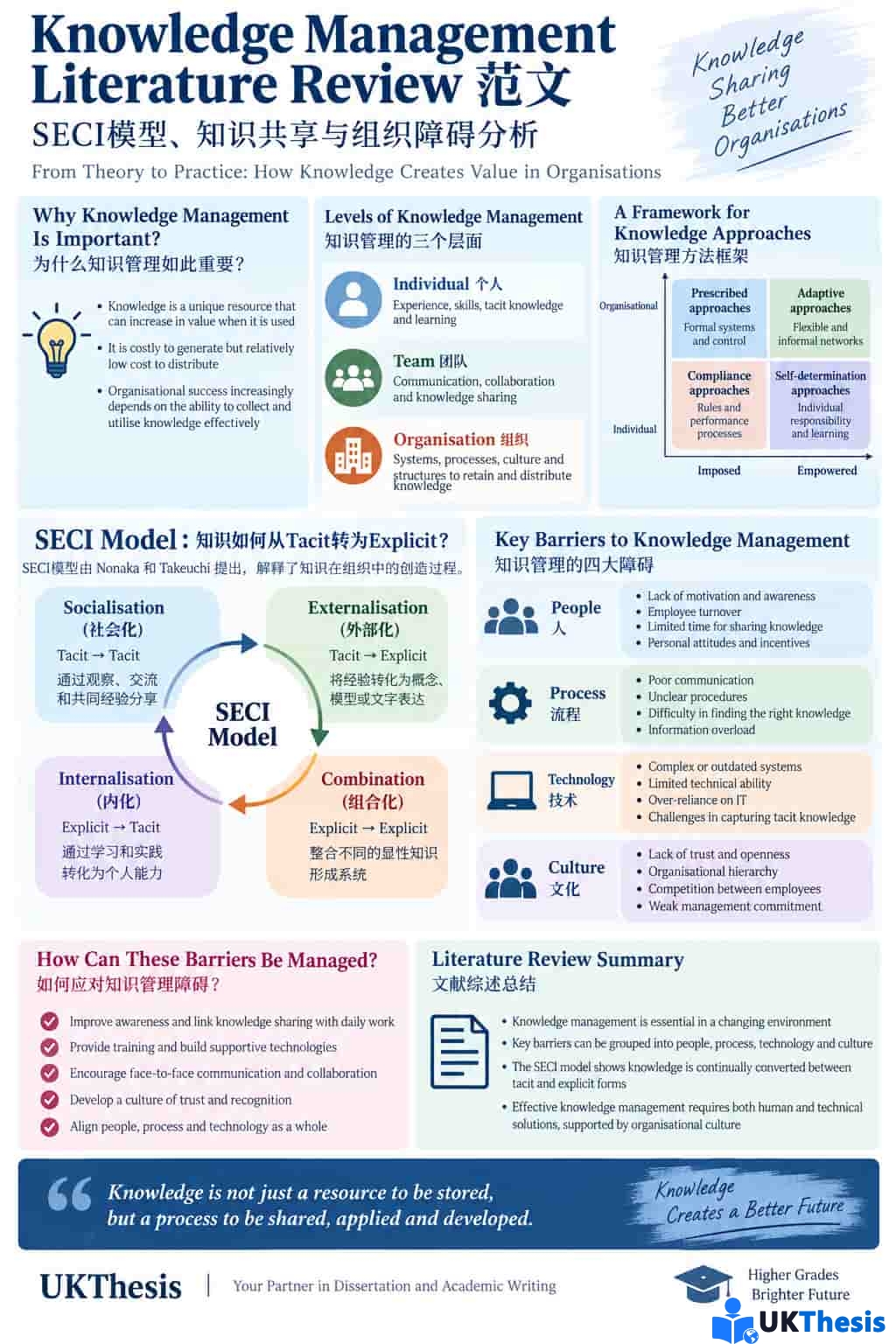
从literature review写作角度看,这篇范文比较值得参考的地方,不只是引用了多少学者,而是把大量文献按照几个主题重新组织起来,并通过不同作者之间的观点比较,逐渐形成自己的分析框架。
范文类型:Literature Review / Dissertation Literature Review
专业方向:Business Management / Knowledge Management / Organisational Studies
核心理论:SECI Model、Tacit Knowledge、Explicit Knowledge、Knowledge Sharing
主要分析维度:People、Process、Technology、Culture
Why Knowledge Management Is Important
Knowledge as a resource has long created difficulties for economists because, unlike physical commodities, knowledge does not necessarily diminish when it is used. In many situations, its value can actually increase as it is shared and applied. Knowledge may be costly to generate, but the cost of distributing it can be comparatively low.
Massa and Testa argued that the success of organisations and economies increasingly depends on their ability to collect and use knowledge effectively. Malhotra similarly viewed knowledge as an important factor of production, even though traditional accounting systems continue to focus heavily on physical assets such as buildings and machinery.
A key issue is therefore not simply whether an organisation possesses knowledge, but whether that knowledge can move to the people and locations where it is needed. Knowledge should not only flow from senior management downwards. It can move between individuals, teams and departments in different directions.
Different researchers have also interpreted the relationship between knowledge and organisational power differently. Some emphasise knowledge sharing as the real source of value, while others regard knowledge itself as a form of power. This disagreement is useful in a Literature Review because it shows that the literature is not completely unified.
Simply creating or recording knowledge does not automatically produce better organisational performance. Value is created when knowledge is distributed effectively and connected with people who are able to use it. In practice, having intelligent employees is not enough; organisations also need systems and cultures that allow employees, customers, suppliers and other stakeholders to contribute their knowledge.
Knowledge Management at Individual, Team and Organisational Levels
Knowledge management can operate at several levels. Despres and Chauvel identified three particularly important levels:
| Level | Main concern |
|---|---|
| Individual | Personal experience, skills, tacit knowledge and learning |
| Team | Communication, collaboration and knowledge sharing among members |
| Organisation | Systems, processes, culture and structures used to retain and distribute knowledge |
Knowledge management is therefore not simply the creation of a database containing everything employees know. Collison and Parcell suggested that an important task is identifying who possesses particular knowledge and developing the culture and technologies that allow people to communicate.
Knowledge can also emerge by reinterpreting previous knowledge, connecting people through relationships and connecting technologies through networks. These networks may be relatively flexible social systems or more formal technical structures.
A Framework for Knowledge Management Approaches
Armistead and Meakins proposed a framework that considers whether knowledge management is imposed or empowered, and whether its focus is primarily individual or organisational.
Prescribed approaches emphasise formal organisational systems. Technology may be used extensively to capture, store and protect knowledge.
Compliance approaches focus on individuals participating in knowledge-related activities through formal rules, contracts and performance processes.
Adaptive approaches place greater emphasis on informal relationships, communities of practice and self-managed teams.
Self-determination approaches encourage individuals to accept responsibility for their role in knowledge creation, learning and sharing.
The framework illustrates an important tension within Knowledge Management: organisations want knowledge to be structured enough to retain and control it, while knowledge creation often depends on relatively informal interaction between individuals.
SECI Model:知识如何从Tacit转为Explicit?
One of the best-known theories in Knowledge Management is the SECI Model developed by Nonaka and Takeuchi. SECI stands for Socialisation, Externalisation, Combination and Internalisation.
The model explains knowledge creation as an interaction between tacit knowledge and explicit knowledge. Instead of viewing knowledge as something static, the model presents knowledge creation as a continuing process.
| SECI Stage | Knowledge Conversion | Example |
|---|---|---|
| Socialisation | Tacit → Tacit | Sharing experience through observation, teamwork and face-to-face interaction |
| Externalisation | Tacit → Explicit | Turning experience into written concepts, models, procedures or explanations |
| Combination | Explicit → Explicit | Combining reports, databases and documents into an organised knowledge system |
| Internalisation | Explicit → Tacit | Learning from written knowledge and turning it into personal know-how through practice |
Socialisation usually occurs through shared experiences. Employees may acquire tacit knowledge by observing colleagues, participating in discussions or working alongside more experienced people.
Externalisation occurs when knowledge embedded in an individual's experience is expressed through concepts, language, models or written explanations. This process is important because tacit knowledge is difficult for an organisation to distribute until part of it becomes explicit.
Combination involves organising different forms of explicit knowledge. Reports, documents, meeting notes and databases can be collected, edited and redistributed to support organisational learning.
Internalisation completes the cycle by turning explicit knowledge back into individual understanding. Employees may read procedures or reports, apply them to their work and eventually absorb them as personal know-how.
Literature Review写作提示:
这里真正值得学习的不是把SECI四个概念背下来,而是说明这些理论为什么与研究问题有关。如果你的研究讨论Knowledge Sharing Barriers,就需要进一步分析:究竟哪个阶段最容易受到People、Process、Technology或Culture影响?
Key Barriers to Knowledge Management
Researchers commonly describe Knowledge Management as a combination of several closely connected dimensions. Du Plessis considered people, process, technology and culture to be central perspectives, while other researchers similarly emphasised the need to balance human and technical factors.
This suggests that Knowledge Management cannot be improved simply by purchasing better software. A company may possess advanced systems but still experience poor knowledge sharing if employees do not trust each other, processes are unclear or the organisational culture discourages communication.
People:知识管理最复杂的因素
One common misunderstanding is that Knowledge Management is primarily a technology problem. In reality, people remain the central element because individuals create, interpret and share knowledge.
Tacit knowledge is often stored in individual experience. Organisations therefore need mechanisms that allow employees to communicate what they know to others. This can be difficult because employee behaviour is influenced by beliefs, attitudes, organisational culture and personal incentives.
Some employees may not realise that the knowledge they possess is valuable to colleagues. Others may regard Knowledge Management as an additional task rather than a natural part of daily work.
Employee turnover creates another problem. When experienced members are transferred, promoted, retire or leave an organisation, both tacit and explicit knowledge may disappear unless there has been a deliberate effort to retain and share it.
Time can also become a barrier. For professionals whose performance is closely connected to billable hours or specific deadlines, spending additional time documenting and sharing knowledge can appear to reduce short-term productivity even when it produces longer-term benefits.
Process:有知识,但不知道去哪里找
Knowledge Management should be understood as a process rather than simply an asset. Organisations need environments that allow knowledge to move between people and departments.
Researchers have described several important activities including knowledge identification, acquisition, development, sharing, utilisation and preservation.
A variety of processes can support these activities, such as communities of practice, workshops, training, knowledge repositories, storytelling, e-learning platforms and professional networks.
However, ineffective processes can themselves become barriers. Employees may not know where useful knowledge is stored, communication systems may be fragmented, and information may be collected without being meaningfully connected to actual business needs.
Another danger is attempting to collect everything. When an organisation stores excessive information without distinguishing what is useful, the knowledge system can become a huge electronic filing cabinet rather than a practical learning tool.
Technology:工具很重要,但不是Knowledge Management本身
Technology plays an important supporting role. Information systems can improve the speed at which employees search, access, retrieve and communicate explicit knowledge.
Common tools include document systems, intranets, email, knowledge repositories, collaboration platforms and video conferencing.
Technology may support several functions:
• acquiring knowledge;
• classifying and storing digital knowledge;
• searching and identifying related content;
• communicating information to people in different contexts.
Nevertheless, technology does not automatically solve Knowledge Management problems. Not all employees have the same technical ability, complex platforms may discourage participation and outdated systems may create additional barriers.
There is also a danger that organisations rely too heavily on digital systems. Tacit knowledge is particularly difficult to capture completely because much of it develops through experience and social interaction.
Culture:为什么员工有知识却不愿意分享?
Organisational culture includes shared values, beliefs, working practices and assumptions that influence employee behaviour.
Several researchers have argued that Knowledge Management is therefore not simply a technical problem but also a cultural problem.
Trust and honesty are especially important. Employees may ask themselves whether other people will misuse their knowledge, whether they can trust information created by colleagues, or whether sharing expertise will weaken their own position in the organisation.
This creates an interesting contradiction. Organisations want employees to share knowledge, but employees may perceive specialised knowledge as a source of authority or job security.
Hierarchical divisions can create similar barriers. Employees may assume that people in senior positions automatically possess greater expertise, while useful knowledge from junior staff can be ignored. Managers may also hesitate to seek advice from subordinates if they believe doing so could undermine their authority.
Competition between employees, limited recognition, weak management commitment and poorly designed reward systems may further reduce the willingness to share knowledge.
四类Knowledge Management障碍总结
| Dimension | Typical barriers |
|---|---|
| People | Lack of motivation, employee turnover, limited awareness, lack of time |
| Process | Poor communication, unclear procedures, information overload, weak knowledge-location systems |
| Technology | Complex systems, outdated tools, training difficulties, over-reliance on IT |
| Culture | Lack of trust, organisational hierarchy, competition, knowledge hoarding |
How Can Knowledge Management Barriers Be Managed?
Knowledge Management is usually a gradual and iterative process. There is rarely a single quick solution to organisational barriers.
Senior management can play an important role by improving awareness of knowledge sharing and connecting it with daily work. Employees also need to understand how Knowledge Management benefits their own tasks rather than seeing it as an additional administrative burden.
Training is important, but technology should not become the sole driver. Knowledge-sharing systems need to be supported by interpersonal communication, organisational trust and suitable incentives.
Face-to-face interaction remains especially valuable where tacit knowledge is involved because it allows individuals not only to exchange information but also to judge context, experience and credibility.
The People, Process and Technology elements therefore need to develop together. An organisation that invests heavily in technology but ignores employee motivation or culture is unlikely to obtain the full benefits of Knowledge Management.
Literature Review Summary
Organisations possess knowledge in many forms, including human capital, intellectual capital, individual experience and formal information systems. Effective Knowledge Management is important because organisations operate in environments where information, skills and experience can quickly change.
The literature reviewed above identifies several recurring barriers to Knowledge Management. These barriers can broadly be organised into four areas: People, Process, Technology and Culture.
People remain central because knowledge originates from human experience and interpretation. Processes determine whether knowledge can be located and moved efficiently. Technology supports storage, retrieval and communication, while culture influences whether employees actually want to share what they know.
The SECI Model further illustrates that organisational knowledge is continually converted between tacit and explicit forms. Knowledge Management should therefore not be understood as simply storing information. It is a social and organisational process involving the creation, interpretation, communication and application of knowledge.
From a Literature Review写作角度看,这篇范文最大的参考价值,是把几十篇研究按照理论模型—People—Process—Technology—Culture—解决方法重新组织。真正的Literature Review不是把A作者、B作者、C作者依次介绍一遍,而是找到不同文献之间的联系、分歧和共同主题。
常见问题 FAQ
Q:这篇属于essay还是Literature Review?
A:更准确地说是一篇Knowledge Management Literature Review。如果放在Dissertation中,可以作为Literature Review Chapter的一部分,而不是普通议论型Essay。
Q:SECI Model在Literature Review中有什么作用?
A:它可以作为理论框架,用于解释Tacit Knowledge和Explicit Knowledge之间的转换,并进一步分析组织为什么会在知识创造与分享过程中遇到障碍。
Q:Literature Review是不是引用越多越好?
A:不是。引用数量不是核心,真正重要的是Synthesis和Critical Analysis,也就是不同研究之间有什么共同点、分歧、方法差异和研究局限。
Q:Knowledge Management还可以从哪些角度写?
A:可以继续研究Knowledge Sharing、Organisational Learning、Tacit Knowledge、Innovation、Employee Behaviour、Digital Knowledge Management以及AI对知识管理的影响等方向。
相关阅读
如果你还没有弄清楚Literature Review应该怎样组织,可以先阅读:Literature Review怎么写?高分文献综述格式与写作指南。
如果想继续了解SECI与企业知识管理的应用,也可以阅读:企业知识在获取平衡中的作用。
对于正在准备Dissertation的同学,这类Knowledge Management Literature Review也可以作为主题划分、理论框架和Critical Analysis写法的参考。UKThesis提供Literature Review结构梳理、文献筛选、Critical Analysis、语言修改以及dissertation写作辅导,可根据已有初稿和导师Feedback针对性调整。
```