Macroprudential Regulation金融Paper范文|宏观审慎监管、Basel III与系统性风险

Macroprudential Regulation(宏观审慎监管)是Finance、Banking、Financial Regulation以及Financial Stability课程中非常常见的研究主题。它真正难写的地方,不是把Basel III、capital buffer这些术语背下来,而是要回答一个更现实的问题:为什么单独监管一家银行还不够,还需要从整个金融系统的角度控制风险?
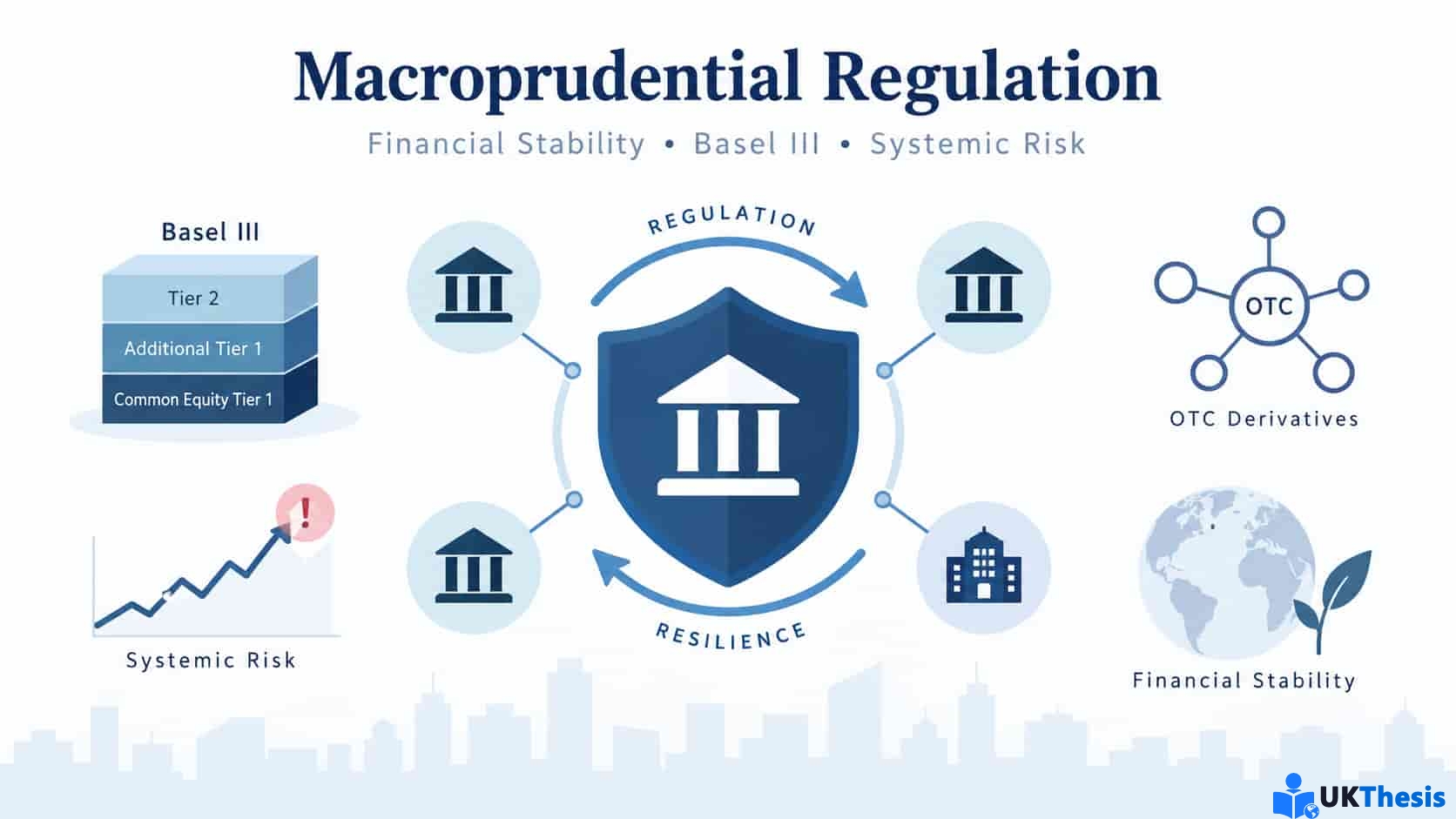
下面这篇Finance Paper围绕宏观审慎监管展开,重点讨论OTC derivatives、Central Counterparties、银行薪酬激励、Credit Rating Agencies、Market Discipline以及Basel III相关工具。对于准备金融Paper或Banking Regulation assignment的同学,这类文章比较值得参考的是它的分析逻辑,而不只是专业名词。
范文类型:Finance Paper / Banking Regulation essay
核心主题:Macroprudential Regulation / Financial Stability
相关概念:Systemic Risk、Basel III、CCyB、CCP、Market Discipline
写作重点:监管工具是否真正降低系统性风险,以及不同工具之间的局限
What Is Macroprudential Regulation?
Macroprudential regulation can be understood as a framework designed to increase the resilience of the financial system as a whole rather than focusing only on the safety of individual institutions.
Its objectives normally include reducing systemic risk, strengthening the ability of banks and financial markets to absorb shocks, and limiting the possibility that problems in one part of the financial system spread rapidly to other institutions or markets.
这也是macroprudential和microprudential最容易混淆的地方。Microprudential regulation更关注“这一家银行安全吗”,而macroprudential policy更关心“很多银行同时做同一件事,会不会把整个系统推向风险”。
| Approach | Main focus |
|---|---|
| Microprudential | Safety and soundness of individual financial institutions |
| Macroprudential | System-wide vulnerabilities, contagion and financial stability |
Why Is Macroprudential Regulation Necessary?
The global financial crisis showed that monitoring individual institutions alone may not be sufficient to maintain financial stability.
A bank can appear healthy on its own balance sheet while the financial system as a whole is becoming increasingly fragile. Similar institutions may hold the same assets, rely on similar sources of funding or react to market stress in similar ways. When these behaviours occur simultaneously, relatively small shocks can become systemic events.
Macroprudential policy therefore attempts to identify risks that emerge from interconnectedness, leverage, liquidity mismatch and collective behaviour.
OTC Derivatives and Systemic Risk
One important area of post-crisis reform involved over-the-counter derivatives.
Before the global financial crisis, the OTC derivatives market had expanded enormously. The scale and interconnected nature of these contracts created concerns about transparency, counterparty exposure and the possibility that the failure of one important participant could transmit losses across the financial system.
The historical size of the OTC derivatives market around 2008 is useful as background, but the more important analytical point is why regulators subsequently placed greater emphasis on trade reporting, central clearing and risk management.
From a Finance Paper perspective, simply writing “OTC derivatives were risky” is not enough. A stronger argument explains the mechanism:
Interconnected derivatives exposure → counterparty failure → liquidity pressure → asset sales → further market losses → systemic stress
这一条风险传导链写清楚以后,文章就从“介绍监管制度”变成了真正的Financial Analysis。
Central Counterparties:降低风险还是集中风险?
Central Counterparties(CCPs)became an important part of derivatives-market reform because they can reduce bilateral counterparty exposures and improve transparency.
However, CCPs also create an interesting macroprudential problem. By standing between many buyers and sellers, a CCP can reduce risk in one part of the system while simultaneously concentrating significant credit and liquidity exposure inside the clearing institution itself.
If margining, collateral management or recovery arrangements are inadequate, stress at a CCP could potentially become a system-wide problem.
因此,Critical Analysis不能写成:
“CCP降低了风险,所以CCP很好。”
更好的分析应该是:
CCP重新分配并集中了一部分风险,因此监管重点从单纯推广central clearing进一步延伸到CCP本身的resilience、recovery和resolution。
Bank Remuneration and Risk-Taking Incentives
Another issue highlighted by the financial crisis was the relationship between remuneration structures and risk-taking behaviour.
High bonuses attracted public attention, but from a regulatory perspective the more important question is not simply how much executives or traders are paid. The key issue is whether compensation structures encourage short-term returns while transferring long-term downside risk to shareholders, creditors or taxpayers.
Risk-sensitive remuneration policies therefore attempt to connect incentives more closely with long-term risk management and accountability.
| Weak approach | Stronger analysis |
|---|---|
| Bank bonuses were too high. | Short-term remuneration structures may create incentives for excessive risk-taking. |
| Regulators should reduce salaries. | Regulation should align remuneration with risk management, accountability and long-term performance. |
Credit Rating Agencies and Procyclicality
Credit Rating Agencies also became part of the macroprudential debate because ratings influence investment decisions, regulatory treatment and market perceptions of credit quality.
A downgrade can raise borrowing costs for an already stressed issuer. If many institutions respond to the same rating change by selling similar assets, the result may reinforce market pressure and contribute to procyclicality.
The issue becomes more complicated because the rating industry has historically been highly concentrated and the issuer-pays model can create potential conflicts of interest.
This does not mean that credit ratings have no value. They continue to provide useful information to investors. The policy question is whether financial institutions and regulatory systems become excessively dependent on external ratings.
Why Market Discipline Alone May Not Be Enough
Market discipline can encourage financial institutions to manage risk because investors, creditors and counterparties may demand higher returns or withdraw funding from firms they consider unsafe.
However, relying only on market discipline has important limitations.
Individual institutions may have incentives to increase leverage or take risks when private gains remain with shareholders and managers while part of the wider cost of failure is transferred to the financial system or public sector.
This is one reason external regulation remains important. Deposit guarantees, lender-of-last-resort arrangements and expectations of intervention during severe crises can create moral-hazard concerns if market participants believe downside losses will ultimately be socialised.
Basel III and the Countercyclical Capital Buffer
Basel III strengthened the macroprudential dimension of bank regulation through several tools, one of the best known being the Countercyclical Capital Buffer(CCyB).
The basic idea is relatively intuitive: when excessive credit growth is associated with increasing system-wide risk, banks can be required to build an additional capital buffer. During a downturn, that buffer can be released so that regulatory capital requirements do not unnecessarily restrict lending.
In other words, instead of waiting until a crisis happens and then asking banks to find more capital, the framework attempts to build resilience earlier in the financial cycle.
一个简单理解:
经济和信贷扩张过快时——多准备一点资本;
经济进入压力期时——允许部分buffer释放。
这就是为什么CCyB具有明显的countercyclical特征。
Macroprudential Toolkit:并不存在一个万能工具
One of the major challenges in macroprudential policy is deciding which instruments should be used, when they should be activated and how strongly they should be calibrated.
Possible tools can include:
| Tool | Purpose |
|---|---|
| Countercyclical Capital Buffer | Build banking-sector resilience during periods of elevated systemic risk. |
| Capital requirements | Increase loss-absorbing capacity. |
| Liquidity requirements | Reduce vulnerability to funding and liquidity stress. |
| Systemic institution measures | Address risks created by large or highly interconnected institutions. |
| Borrower-based measures | Limit excessive leverage or credit expansion in specific markets. |
The difficulty is that financial systems differ significantly across jurisdictions. A policy tool that works well in one country may be less effective in another because banking structures, capital markets, housing finance systems and regulatory institutions differ.
因此,Macroprudential Regulation很适合写Critical Thinking,因为这里几乎不存在真正意义上的“one-size-fits-all”。
The Timing Problem
Another important challenge is timing.
Macroprudential supervisors may need to tighten policy while markets still appear healthy. At that moment, the benefits of intervention are difficult to observe, while the costs—such as tighter credit conditions—are immediately visible.
This can create political and industry pressure against preventive regulation.
If regulators wait until systemic risk becomes obvious, however, intervention may already be late.
这就是宏观审慎监管很“尴尬”的地方:做得成功的时候,大家可能会觉得“本来就没危机”;等大家都看出危机时,再监管又可能已经来不及。
Macroprudential vs Microprudential Regulation
Macroprudential and microprudential policies should not be treated as substitutes.
Microprudential regulation remains essential for ensuring that individual banks maintain adequate capital, liquidity and governance. Macroprudential policy adds another layer by examining common exposures, interconnectedness and system-wide feedback mechanisms.
The strongest regulatory framework therefore requires the two approaches to complement each other.
Critical Evaluation
Macroprudential regulation provides regulators with tools that can reduce the probability and impact of systemic financial crises, but it cannot create a financial system in which no institution ever fails.
Nor should that necessarily be the objective.
A zero-failure system could create excessive protection and weaken market discipline. A more realistic objective is to ensure that institutional failure can occur without threatening the stability of the financial system as a whole.
Several limitations remain:
systemic risk is difficult to measure in real time;
financial activity may move toward less regulated sectors;
different jurisdictions may apply tools differently;
regulatory arbitrage can reduce policy effectiveness;
political pressure may influence the timing of intervention;
new financial products can create risks that existing regulation did not anticipate.
所以一篇好的Finance Paper,结论通常不会写成“Macroprudential Regulation成功解决了金融危机风险”。这种说法太满。
更合理的结论是:它提高了金融体系处理系统性风险的能力,但监管效果依赖工具选择、实施时点、国际协调以及市场参与者如何回应监管措施。
Conclusion
Macroprudential policy complements microprudential regulation and interacts with monetary, fiscal and other public policies that influence financial stability.
The post-crisis regulatory framework has placed greater emphasis on capital resilience, central clearing, systemic institutions, market transparency and countercyclical tools such as the CCyB.
However, effective macroprudential regulation remains difficult because financial systems are complex and constantly changing. Regulation can reduce vulnerabilities, but it can also change incentives and push risk into new areas.
The central policy challenge is therefore not to eliminate financial failure completely, but to create a system in which failures can be absorbed and resolved without creating widespread financial instability.
FAQ
Q:这篇属于Finance Essay还是Finance Paper?
A:更适合归类为Finance Paper或Banking Regulation Essay。它包含较强的政策分析和Critical Evaluation,不是单纯的金融概念介绍。
Q:Macroprudential Regulation和Basel III是什么关系?
A:Basel III包含明显的宏观审慎元素,例如Countercyclical Capital Buffer以及针对系统重要性银行的附加资本要求等。
Q:写这类Finance Paper需要大量计算吗?
A:不一定。这类题目更偏Financial Regulation与Policy Analysis,重点通常是制度机制、系统性风险、监管工具和Critical Analysis。如果题目要求empirical analysis,再加入数据模型。
Q:可以把2008金融危机作为案例吗?
A:可以,而且非常合适,但应该明确它是历史背景,用来解释为什么Macroprudential Regulation在危机后受到重视,而不是把2008年的数据当成当前数据。
相关阅读
如果需要了解Finance Paper整体写作,可以阅读站内金融论文与Finance Assignment写作指南。
如果研究方向更偏Systemic Risk,也可以阅读站内关于系统性金融风险传染、金融稳定与监管政策的相关论文范文。
对于已经有Finance Paper题目或初稿的同学,也可以通过选题梳理、literature review、金融监管理论分析、Critical Evaluation以及英文表达修改等方式完善文章结构,让论证更集中,而不是单纯增加专业术语。
```