Management Accounting Systems范文|Costing、Budget与Break-even分析

Management Accounting(管理会计)在Accounting和Business课程里经常被误解成“内部记账”。其实真正做起来,它更像是把企业内部的Cost、Budget、Sales、Performance和Operational Data整理成可以帮助Manager做决定的信息。
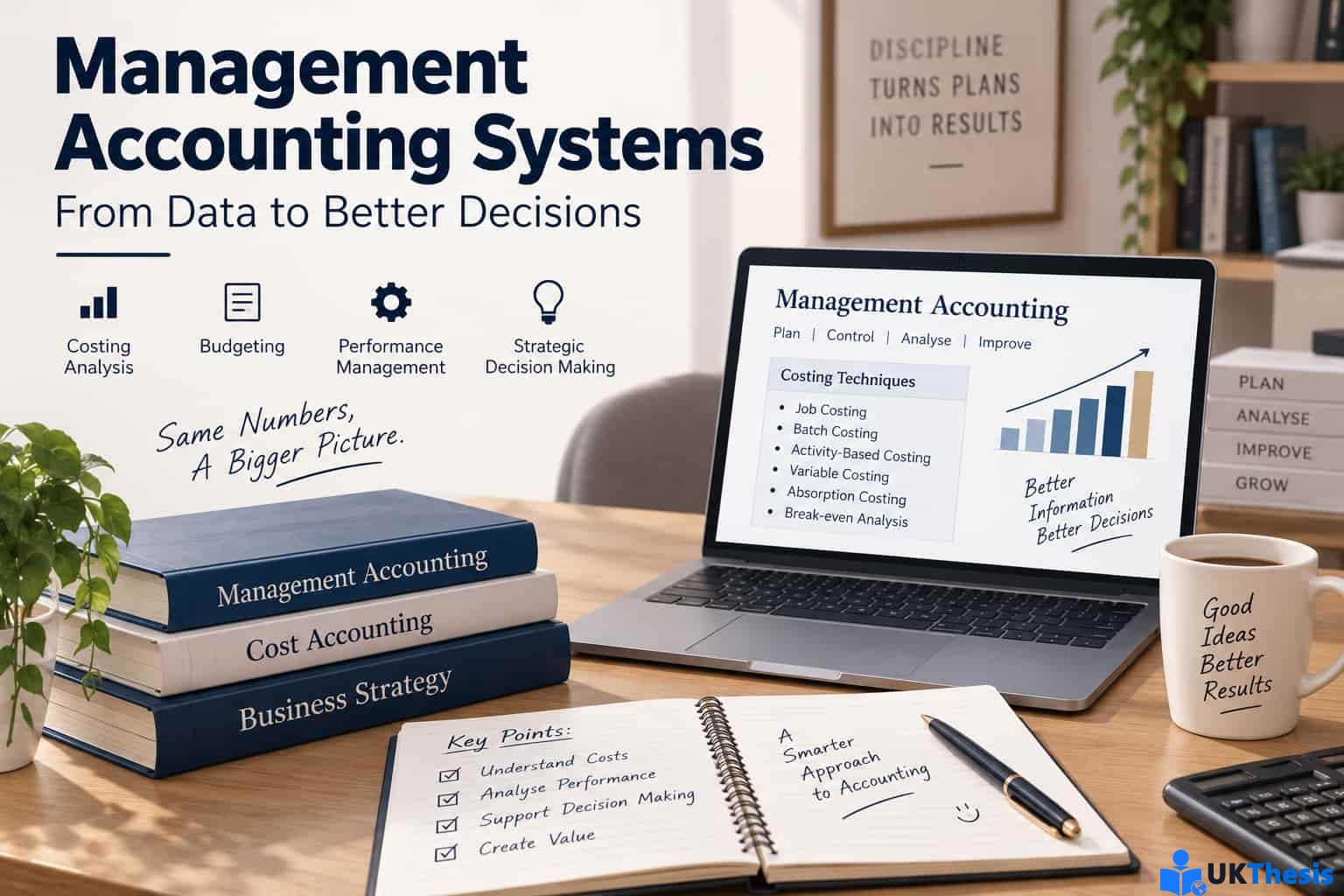
简单说,Financial Accounting更偏向回答“企业过去发生了什么”,而Management Accounting更关心:为什么会这样、下一步应该怎么做。
这篇Management Accounting Paper围绕管理会计的作用、Management Accountant职责、Costing Techniques、Variable与Absorption Costing以及Break-even Analysis展开,适合作为Accounting Assignment或Business Report的结构参考。
范文类型:Management Accounting / Accounting assignment
核心内容:Costing、Budgeting、Decision Making、Break-even
主要技术:Job Costing、Batch Costing、ABC、Variable Costing、Absorption Costing
What Is Management Accounting?
Management accounting provides financial and non-financial information to managers so that they can plan, control operations and make better business decisions.
Unlike external Financial Reporting, management accounting is primarily designed for internal users. The information may focus on individual products, departments, customers, projects or geographic areas rather than only the organisation as a whole.
我第一次接触Management Accounting的时候,也觉得它和Financial Accounting差不多,无非都是Revenue、Cost、Profit。后来才发现,两者真正的区别不是“有没有数字”,而是数字给谁看、拿来做什么。
Role of a Management Accountant
Management accountants support a wide range of business activities, including:
budgeting and forecasting;
cost analysis;
performance measurement;
decision support;
planning and strategy;
investment appraisal;
risk and profitability analysis.
Their role is therefore broader than simply preparing accounting records. A management accountant may analyse why costs have increased, evaluate whether a new project is financially attractive or help managers understand why actual performance differs from budget.
| Task | Management question |
|---|---|
| Budgeting | How much resource will the business need? |
| Cost Analysis | Which products or activities consume the most resources? |
| Performance Analysis | Why is Actual different from Budget? |
| Decision Analysis | Which alternative creates greater value? |
Scope of Management Accounting
The scope of management accounting is wide because managers need information about more than final profit.
Management accounting can provide information about:
customers;
product lines;
departments;
production activities;
cost drivers;
regions;
budgets and forecasts;
operational efficiency.
Much of this information involves estimates and assumptions because managers often need to make decisions about the future.
因此,Management Accounting的信息不能简单理解成“不准确”,更准确的说法是:它经常包含Forecast、Estimate和Scenario,因此需要结合Assumptions去解释。
Management Accounting vs Financial Accounting
| Area | Management Accounting | Financial Accounting |
|---|---|---|
| Primary users | Internal managers | External and internal stakeholders |
| Time focus | Past, present and future | Primarily historical reporting |
| Rules | Flexible internal formats | Formal accounting standards and reporting rules |
| Level of detail | Product, department, customer or activity level | Whole entity financial statements |
| Main purpose | Planning, control and decision making | External reporting and accountability |
两者不是谁取代谁,而是用途不同。Financial Accounting告诉我们结果,Management Accounting更多是在解释和改善结果。
Job Costing
Job Costing is used when costs need to be traced to an individual job, project or customer order.
Each job can be assigned its own identification number, allowing direct material, direct labour and relevant overhead costs to be recorded separately.
This method is particularly useful where products or services differ significantly from each other.
For example:
construction projects;
consulting assignments;
custom manufacturing;
professional services.
The main benefit is that management can evaluate the profitability of each individual job rather than only total company profit.
Batch Costing
Batch Costing is similar to Job Costing, but costs are accumulated for a batch of similar units.
The cost per unit can be calculated as:
Cost per Unit = Total Cost of Batch ÷ Number of Units in Batch
This method can be useful where products are manufactured in identifiable groups rather than one continuous production process.
不过这里还要继续问一个Management问题:Batch越大一定越好吗?
不一定。较大Batch可能降低Setup Cost per Unit,但同时增加Inventory和Storage Cost。
Activity-Based Costing(ABC)
Activity-Based Costing allocates overhead costs according to the activities that cause those costs to arise.
Traditional costing systems may allocate overhead using one broad measure such as labour hours. ABC attempts to identify more specific cost drivers.
| Activity | Possible Cost Driver |
|---|---|
| Machine setup | Number of setups |
| Quality inspection | Number of inspections |
| Purchase processing | Number of purchase orders |
ABC can provide more detailed cost information, especially where overhead is significant.
But it is also more complex to design and maintain. So a Critical Analysis should not say “ABC is always better than traditional costing”.
Variable Costing vs Absorption Costing
Variable Costing and Absorption Costing differ mainly in how fixed manufacturing overhead is treated.
| Method | Fixed Manufacturing Overhead |
|---|---|
| Variable Costing | Treated as a period cost for internal analysis |
| Absorption Costing | Included in product cost |
Variable Costing can be useful for internal decision making because it highlights Contribution Margin and cost behaviour.
Absorption Costing, meanwhile, includes both variable and fixed manufacturing costs in inventory and product cost.
这里最重要的是不要把两种方法写成“一个正确,一个错误”。它们的用途不同。
Break-even Analysis
Break-even Analysis estimates the level of sales at which Total Revenue equals Total Cost.
At the break-even point, the business earns neither profit nor loss.
A basic unit formula is:
Break-even Units = Fixed Cost ÷ Contribution Margin per Unit
This information can help managers plan sales targets and evaluate the financial effect of changes in price or cost.
但真正完整的CVP Analysis还应该继续讨论Target Profit、Margin of Safety、Sensitivity Analysis和模型假设。
这部分你站内已经有完整专题,所以这里不需要重复写成另一篇CVP长文。
How Management Accounting Supports Decision Making
The real value of management accounting appears when several techniques are used together.
For example, management may use:
ABC to understand overhead consumption;
Budgeting to set financial targets;
Variance Analysis to identify performance gaps;
CVP to analyse price, cost and volume relationships;
Forecasting to estimate future outcomes.
这几个工具如果单独背公式,其实很容易学得特别碎。
真正把它们串起来以后就会发现,它们都在回答同一件事:
Management下一步应该怎么做?
Limitations of Management Accounting
Management accounting is useful, but its information is not perfect.
Several limitations should be considered:
forecasts depend on assumptions;
cost allocation methods involve judgement;
future prices and demand may change;
complex systems can be expensive to maintain;
financial measures may ignore important non-financial factors.
For this reason, management accounting information should support managerial judgement rather than replace it.
Conclusion
Management Accounting provides managers with financial and non-financial information for planning, cost control, performance management and decision making.
Techniques such as Job Costing, Batch Costing, Activity-Based Costing, Variable Costing and Break-even Analysis allow organisations to understand how costs arise and how different decisions may affect profitability.
However, no single technique is suitable for every business problem.
The most effective approach is to choose the accounting method that matches the decision being made and then interpret the numbers within the real business context.
如果把这篇Management Accounting作业浓缩成一句话,就是:会计不是把数字算出来,而是让数字真正参与决策。
FAQ
Q:这篇属于Accounting还是Finance?
A:主要属于Management Accounting和Cost Accounting,不属于传统Corporate Finance。
Q:Management Accounting和Financial Accounting最大的区别是什么?
A:Management Accounting主要面向内部决策,更关注未来Planning和Operational Detail;Financial Accounting更强调正式Financial Statements与External Reporting。
Q:ABC一定比传统Costing好吗?
A:不一定。ABC可能提供更精细的Cost Information,但实施复杂度和数据要求也更高。
Q:Variable Costing可以用于外部报表吗?
A:它主要用于内部Management Analysis。外部存货成本和财务报告通常采用Absorption Costing原则。
Q:Break-even Analysis属于Management Accounting吗?
A:属于,是Cost-Volume-Profit Analysis中的核心工具之一。
相关阅读
如果想深入学习CVP与Break-even,可以阅读:CVP分析怎么写?Management Accounting Essay盈亏平衡点与案例指南。
如果题目更偏Financial Statement Analysis,可以阅读:会计Essay中的Ratio Analysis怎么写?
对于已经有Management Accounting Assignment、Costing题目或初稿的同学,也可以通过题目拆解、Calculation检查、Critical Analysis和英文表达修改等方式完善已有内容。
```