E-commerce Essay范文:Online Shopping对中国实体店与Retail Industry的影响 - UKThesis

本文是一篇工商管理与E-commerce方向的essay范文,主题是Economic Impact of Online Shopping on Stores in China's Retail Industry,主要讨论Online Shopping的发展如何影响中国传统Physical Stores,以及零售企业为什么逐渐从单纯的线上与线下竞争,转向O2O和Omnichannel融合。
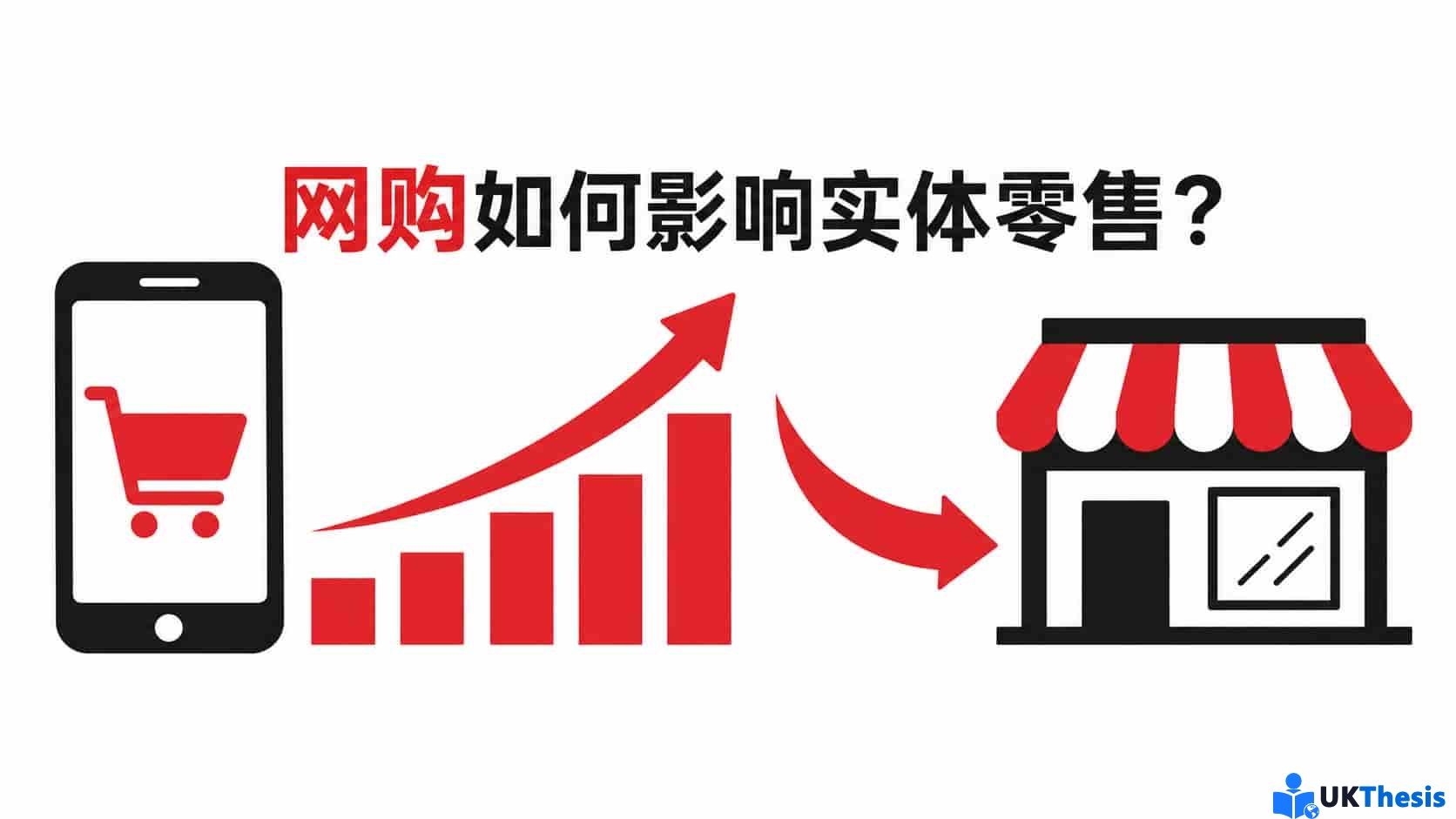
这个题目看起来是在讨论“网购会不会把实体店挤垮”,但真正写Business essay时,如果只回答“网购便宜,所以实体店受影响”,分析就会比较浅。更完整的写法,需要把消费者行为、运营成本、价格竞争、Supply and Demand以及零售模式变化连接起来。
这篇范文的核心逻辑:Online Shopping不仅改变消费者购买渠道,还会通过价格、成本、竞争和购物体验影响传统Retail Industry。
| 分析因素 | Online Shopping特点 | 对Physical Stores的影响 |
|---|---|---|
| Price | 价格透明、比较方便 | 实体店价格竞争压力增加 |
| Operating Cost | 部分线上商家减少门店成本 | 租金与人工成为实体零售的重要成本 |
| Convenience | 随时搜索、下单、配送 | 实体店需要强化体验与即时服务 |
| Choice | 产品选择范围更广 | 线下零售更依赖差异化定位 |
| Customer Experience | 数字化、个性化、数据驱动 | 推动O2O与Omnichannel发展 |
Introduction
China has experienced remarkable economic and retail development over the past several decades. At the same time, the rapid growth of e-commerce has changed how consumers search for information, compare prices and purchase products.
China's e-commerce market emerged in the 1990s and developed rapidly after the expansion of Internet access, online payment and logistics. Taobao, Tmall, JD.com and other platforms helped online shopping become an important part of the Chinese retail market.
From a historical perspective, early e-commerce growth was often discussed through three fundamental models: Business-to-Business, Business-to-Consumer and Consumer-to-Consumer. For the retail industry, B2C and C2C played especially important roles because they allowed consumers to purchase products without visiting a traditional physical store.
Today, however, the relationship between e-commerce and physical retail is more complicated than a simple “online replaces offline” story. Online retail has continued to grow, while supermarkets, convenience stores and other physical formats still play important roles in the Chinese consumer market. This makes the economic relationship between online shopping and traditional retail worth examining.
Factors Boosting Online Shopping in China
Several factors contributed to the rapid development of online shopping in China.
First, the expansion of Internet and mobile networks made online shopping more accessible. As smartphones became more common, consumers were no longer limited to shopping from desktop computers. Searching, comparing and purchasing products gradually became possible almost anywhere.
Second, urbanization and changes in lifestyle increased demand for convenience. Consumers living in large cities often face long working hours, commuting and limited time. Home delivery therefore became an attractive alternative to visiting crowded shopping areas.
Third, e-commerce reduced geographical limitations. Consumers in smaller cities and remote areas gained access to products that might not be available through local physical stores.
Finally, improvements in logistics, digital payments and platform infrastructure made online transactions easier and more reliable.
Features of Online Shopping in China
Compared with traditional physical retail, online shopping offers several important advantages, including convenience, price comparison and wider product choice.
Historically, price competition was especially important in China's online retail market. Major shopping festivals and platform promotions encouraged consumers to compare prices and wait for discounts before making purchasing decisions.
Mobile technology later strengthened this behaviour. Consumers could check prices while standing inside a physical store, read product reviews, compare competing retailers and then decide whether to purchase online or offline.
This means the boundary between “online consumer” and “offline consumer” gradually became less clear. One person may discover a product on social media, compare prices online, visit a physical store to try it and finally place the order through a mobile app.
For Retail Management, this is an important change because competition is no longer simply between an online store and a physical shop. Competition increasingly takes place across the whole Customer Journey.
Economic Impact on Physical Stores
The growth of online shopping creates significant competitive pressure for physical retailers, particularly in industries where consumers can easily compare similar products.
One reason is operating cost. Traditional stores normally need to consider rent, utilities, staff, inventory display and other location-related expenses. Online retailers may also face substantial logistics, warehousing, technology and marketing costs, but their cost structure can be different from that of physical stores.
This difference can influence pricing strategies.
If consumers perceive similar products online at lower prices, traditional retailers may find it difficult to compete only through price. Cutting prices too aggressively can reduce margins, while maintaining a large price difference may encourage consumers to purchase online.
写这部分时要注意:不能简单写成“网店没有成本”。Online retailers同样需要物流、仓储、平台、广告和技术投入。真正需要比较的是Cost Structure,而不是假设线上经营完全没有成本。
Supply and Demand:为什么价格竞争会影响实体零售?
The economic pressure created by online shopping can also be explained through basic microeconomic reasoning.
Under a simple supply-and-demand framework, consumer demand is influenced by price, income, pReferences and the availability of alternatives. When consumers can easily compare a large number of retailers online, they usually have more information about alternative prices.
This greater price transparency may increase competition.
For traditional retailers, the difficulty is that some operating costs cannot be reduced quickly. Store rent, staffing and physical facilities may remain even when customer traffic falls.
Online retailers, on the other hand, may compete through centralized inventory, large-scale logistics, platform traffic or promotional pricing.
| Economic Factor | 可能产生的Retail Effect |
|---|---|
| Lower Search Cost | 消费者更容易比较价格和产品 |
| More Competitors | 市场价格竞争增强 |
| Fixed Store Costs | 实体零售调整成本较慢 |
| Consumer Price Sensitivity | 促销与价格差异更容易改变购买渠道 |
Online Shopping并不等于Physical Stores消失
如果把Online Shopping Essay写成“电商发展,所以实体店最终都会消失”,现在看就过于简单了。
实体零售仍然具有线上渠道难以完全复制的优势。
For example, consumers can physically inspect products, try clothing, experience store environments and communicate directly with staff. Luxury products, beauty products, furniture, fresh food and experience-based retail can particularly benefit from physical interaction.
Physical stores can also provide immediate ownership. Consumers do not need to wait for delivery and can directly solve certain after-sales problems.
Therefore, the economic impact of e-commerce should not only be understood as store closure. It also encourages traditional retailers to reconsider what a physical store is actually for.
From O2O to Omnichannel Retail
One important response to e-commerce competition is the integration of online and offline channels.
Earlier discussions often used the term O2O, or Online-to-Offline. The basic idea was to use online platforms to attract consumers and connect digital activity with physical stores.
Today, a broader concept is Omnichannel Retail.
For example, a customer may:
discover a product through social media → check reviews online → visit a physical store → scan a QR code → order through an app → choose home delivery.
From the customer's point of view, these are not necessarily separate channels. They are simply different stages of one shopping journey.
This is why many retailers increasingly treat their stores not only as sales locations, but also as experience centres, fulfilment points, pickup locations and customer-service spaces.
| Traditional Retail | Omnichannel Retail |
|---|---|
| Store负责销售 | Store同时承担体验、销售、取货和服务 |
| Online与Offline分开运营 | 数据、库存和会员体系逐渐整合 |
| 竞争重点是Location | 竞争重点扩展到Customer Experience |
China Retail Industry:旧数据怎么理解?
这类Essay很容易出现一个问题:引用十年前的E-commerce数据,然后把它写成今天的市场现状。
比较稳妥的做法,是把早期数据当成Historical Evidence,用来说明中国电商为什么在2010年代快速崛起。
例如,早期研究中关于Mobile Shopping、Double 11、Taobao和Tmall的数据,可以帮助解释消费者从传统购物向Online Shopping迁移的过程。
但讨论今天的中国零售市场时,需要认识到线上和线下已经进入更加融合的阶段。Physical Stores并没有简单退出市场,而是在重新寻找自己的功能。
因此,这篇Essay更合理的结论不是“online wins, offline loses”,而是Retail Structure发生了变化。
Conclusion
Online shopping has significantly changed China's retail industry by increasing price transparency, reducing consumer search costs and creating new forms of competition.
Traditional physical stores face challenges from rent, labour costs and changing consumer expectations, especially when similar products can be found online more conveniently or at lower prices.
However, e-commerce does not necessarily mean the end of physical retail.
Physical stores continue to provide product experience, personal interaction, immediate access and other services that cannot always be reproduced online.
The more important change is the movement from a clear separation between online and offline retail toward O2O and Omnichannel models.
For traditional retailers, the question is therefore no longer simply “How can physical stores defeat online shopping?” A more useful question is: How can online convenience and offline experience be combined to create a stronger customer journey?
对于Business Essay或者E-commerce assignment来说,这也是比较值得学习的一点。分析一个商业现象时,不要急着选“谁赢谁输”,把成本、消费者行为、市场竞争和企业应对策略连起来,文章自然会更像真正的Business Analysis。
如果在E-commerce Essay、Retail Management、Business Essay结构或者案例分析思路上拿不准,也可以通过留学生论文写作辅导先梳理题目、Argument和Essay Structure,再根据课程Rubric完成自己的分析。
FAQ
Q1:这篇属于Economics Essay还是Business Essay?
两者都有,但主体更接近E-commerce与Business Essay。Supply and Demand、价格和成本属于Microeconomics分析工具,用于解释零售竞争。
Q2:Online Shopping一定会导致Physical Stores关闭吗?
不一定。不同Retail Sector受到的影响不同,实体店也可以通过体验、服务、即时提货和Omnichannel重新建立竞争优势。
Q3:O2O和Omnichannel有什么区别?
O2O更多强调Online与Offline之间的连接,而Omnichannel更强调多个消费者触点、库存、会员和服务体验的一体化。
Q4:这类Essay适合使用Supply and Demand吗?
可以,但最好不要只画一个简单供需图。还应该结合Search Cost、Operating Cost、Price Competition和Consumer Behaviour解释具体商业机制。
Q5:十年前的中国电商数据还能不能用?
可以作为Historical Background,但不要直接当成当前市场数据。正文应明确时间范围,并在需要描述现状时补充较新的数据。
Q6:这个题目可以写成case study吗?
可以。例如可以选择Alibaba、JD.com或某个传统零售企业进行案例分析,但需要明确企业、时间范围和研究问题,避免把多个案例堆在一起。
相关阅读
M-Commerce Essay:手机购物为什么改变零售业?
China E-commerce Essay:中国电子商务为什么快速崛起?
E-commerce Essay范文:Website Attributes如何影响Customer Satisfaction?