Qigong in Physical Therapy Essay范文:气功在康复训练中的应用分析
Qigong放在Physical Therapy essay里,其实是一个挺有意思的题目。它不像普通“某疾病怎么治疗”的Health Sciences作业,而是把traditional mind-body practice和现代rehabilitation放在一起讨论。
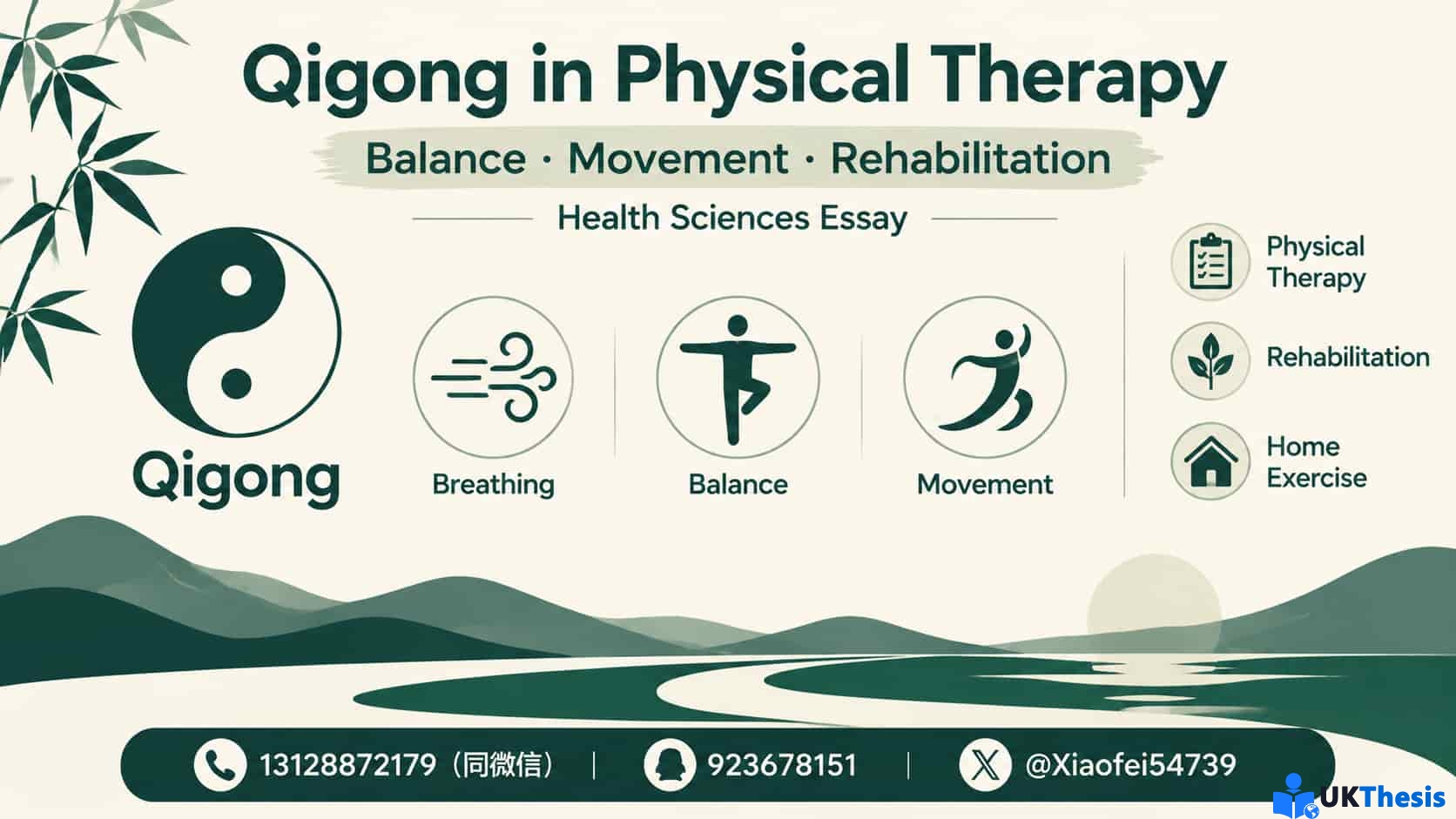
真正值得分析的并不是简单回答“气功有没有用”,而是:它有哪些特点可能适合Physical Therapy?哪些患者可能从breathing、slow movement、balance training和relaxation中受益?现有研究又能够支持到什么程度?
下面这篇英文Essay以Qigong在Physical Therapy中的潜在应用为主题,讨论其在balance、motor function、pain、stress management及home exercise方面的使用。阅读时可以重点观察Health Sciences Essay怎样从定义进入Evidence,再回到clinical application。
What Is Qigong and How Can It Be Used in Physical Therapy?
Qigong is a traditional Chinese mind-body practice that combines controlled breathing, slow physical movement, posture and mental focus.
The Chinese word Qi is commonly associated with vital energy or breath, while Gong refers to skill developed through regular practice.
Qigong is often discussed as a form of mind-body exercise and meditation. Because many forms involve slow movement and breathing rather than high-impact activity, researchers and rehabilitation professionals have explored whether certain Qigong practices may have a role in physical and psychological wellbeing.
| Qigong Element | Possible Relevance to Physical Therapy |
|---|---|
| Slow Movement | Balance、mobility与movement control |
| Breathing | Relaxation与body awareness |
| Posture | Body alignment与movement practice |
| Repetition | Home exercise与regular practice |
Qigong as a Mind-Body Exercise
Qigong can be practised by people with different levels of physical ability because many movements can be adapted in intensity and duration.
A session may involve breathing exercises, gentle movement and, in some forms, self-massage or meditative attention.
One reason Qigong has attracted interest in rehabilitation is that it does not usually require specialist equipment. Exercises may therefore be practised in a clinic or, once appropriately taught, at home.
Sessions can also vary substantially in length. Some people practise for only a few minutes, while others complete longer structured routines.
学姐看这里:Health Sciences Essay写这种传统运动疗法时,最好先说明“它是什么、包含哪些动作”,再谈potential benefits。要是一上来就说“Qigong treats many diseases”,Marker通常第一反应就是:Evidence在哪里?
Qigong and Physical Function
Research has explored Qigong in relation to several aspects of physical function, including balance, mobility and motor control.
For example, some studies involving people with Parkinson's disease have investigated whether Qigong, used alongside conventional care, may support balance or motor function.
This is potentially relevant to Physical Therapy because patients with reduced balance or movement control often require repeated, low-impact exercises that can be adjusted according to functional ability.
However, the results of individual studies should not automatically be interpreted as proof that Qigong produces the same benefit for every patient.
Age, diagnosis, disease severity, exercise frequency and the type of Qigong programme can all influence outcomes.
Balance and Motor Function
Balance is one area in which slow, controlled movement may have practical relevance.
Many Qigong routines require participants to maintain posture, shift weight gradually and coordinate movement with breathing.
For some rehabilitation programmes, these characteristics may complement exercises intended to improve movement awareness and stability.
People with reduced motor function may also benefit from activities that emphasise repeated controlled movement rather than speed or heavy resistance.
| Physical Therapy Goal | Qigong Feature | Essay Analysis Point |
|---|---|---|
| Balance | Slow weight shifting | 可能帮助练习postural control |
| Motor Function | Repeated controlled movement | 适合作为低强度movement practice讨论 |
| Relaxation | Breathing and mental focus | 可讨论stress与muscle tension |
| Home Exercise | Little or no equipment | 方便形成HEP讨论 |
Pain, Stress and Relaxation
Qigong has also been studied in relation to pain, psychological wellbeing and stress.
Breathing exercises and slow movement may encourage participants to reduce unnecessary muscular tension and focus more closely on body awareness.
This may be useful in rehabilitation settings where pain, stress or anxiety influence a patient's willingness or ability to participate in exercise.
Some research has also examined Qigong among older adults and people experiencing depressive symptoms. Findings from individual studies have suggested possible improvements in psychological measures, although such results depend heavily on study design, participant characteristics and intervention duration.
For an academic essay, this distinction matters. A study showing improvement within one participant group is Evidence, but it is not automatically a universal conclusion.
Qigong in Rehabilitation Settings
Qigong may be incorporated into rehabilitation in several different ways.
A therapist may use gentle breathing and movement activities before exercise as part of a warm-up, or after a session to encourage relaxation.
For patients working on balance or movement control, selected Qigong exercises may also provide an additional low-impact activity.
Another potential advantage is accessibility. Once a patient has learned an appropriate routine and has been advised that it is suitable for their condition, exercises may be practised outside the clinic.
This makes Qigong potentially relevant to a home exercise programme, particularly when the rehabilitation goal includes regular low-intensity movement.
Home Exercise Program
Home exercise is a major component of many Physical Therapy programmes.
Patients do not spend most of their rehabilitation time inside a clinic. What they are able and willing to practise independently can therefore influence continuity between treatment sessions.
Qigong requires little equipment, which may make selected exercises practical for home use.
However, the exercise still needs to match the patient's condition and functional ability. A movement that is easy and safe for one individual may not be suitable for another.
This is why a Health Sciences Essay should distinguish between saying an intervention is accessible and saying it is appropriate for everyone.
What Does the Evidence Actually Show?
The original discussion of Qigong refers to research involving Parkinson's disease, pain, psychological wellbeing, circulation and people undergoing cancer care.
These studies are useful because they show the range of populations in which Qigong has been investigated.
At the same time, different medical conditions cannot simply be combined into one conclusion.
A finding concerning balance in Parkinson's disease does not automatically demonstrate the same outcome in a patient with chronic pain, cancer or a cardiovascular condition.
| Evidence Question | Critical Writing Check |
|---|---|
| Who was studied? | Patient group、age、diagnosis |
| What was measured? | Balance、pain、mood还是motor function? |
| How long? | Intervention duration是否足够? |
| Compared with what? | 是否存在control或usual-care comparison? |
| How large was the effect? | Statistical significance不一定等于clinical significance |
我自己看Health Essay时,很怕看到一句:“Several studies prove that this treatment works.”
因为下一句我一定会想问:哪几个studies?研究什么人?Outcome是什么?效果有多大?
真正的Critical Analysis往往就藏在这些小问题里面。
Conclusion
Qigong is a traditional Chinese mind-body practice combining breathing, controlled movement and mental focus.
Its low-impact nature and limited equipment requirements have led researchers and rehabilitation professionals to explore possible applications in Physical Therapy.
Areas of interest include balance, motor function, relaxation, pain management and home exercise.
Some individual studies have reported potentially useful outcomes in specific patient groups, but these findings should be interpreted according to population, condition, intervention and study design.
Qigong is therefore better discussed as a possible complementary rehabilitation activity rather than as a universal treatment for physical or psychological conditions.
In a Physical Therapy setting, its value may depend on whether selected movements support a patient's rehabilitation goals and can be practised safely alongside an appropriate treatment programme.
这篇Health Sciences Essay值得学什么?
| Essay部分 | 作用 |
|---|---|
| Define Qigong | 先说明intervention是什么 |
| Physical Function | 联系rehabilitation目标 |
| Evidence | 展示Research Findings |
| Clinical Application | 解释为什么与Physical Therapy有关 |
| Critical Evaluation | 避免把单项研究变成万能结论 |
这种Essay真正拉开分数的地方,不是记住多少种Qigong动作,而是能不能把Research Evidence和Clinical Application连接起来。
看到一个study说某组participant improved,不要急着写“therefore Qigong is effective”。先看看研究对象是谁、改善的是什么Outcome、有没有Comparison Group,再决定这项Evidence能支持多大的Conclusion。
FAQ
这篇属于Descriptive Essay吗?
不太准确。正文虽然介绍Qigong是什么,但主要内容围绕health evidence、rehabilitation和Physical Therapy application展开,所以更适合定位为Health Sciences Essay或Physiotherapy Essay。
Qigong可以写成Physical Therapy assignment吗?
可以,特别是题目涉及complementary therapy、rehabilitation、balance、movement exercise或home exercise时。不过具体写法仍然应该按照Assignment Brief和Learning Outcomes来确定。
Health Sciences Essay一定要有Research Evidence吗?
大多数大学Health Sciences作业都需要可靠的Academic Evidence。特别是涉及intervention effectiveness时,不能只依赖个人体验或笼统描述。
写Qigong可以直接说“proven effective”吗?
通常不建议这么绝对。更合适的是说明具体study研究了什么population、什么outcome以及得到什么结果,再讨论Evidence的范围和limitations。
Physical Therapy Essay不知道怎么组织怎么办?
可以先按照Intervention、Patient Group、Evidence、Clinical Application和Limitations几个部分整理。如果资料很多但不知道怎么形成Structure,也可以通过Essay写作辅导先拆Assignment Brief、Outline和Evidence路线,再进入正文。
相关文章阅读
如果是一篇Health Sciences Essay,我会更建议少写几句“这个方法非常有用”,多回答几句“对谁有用、观察到了什么、Evidence有多强、有什么limitations”。这种写法看起来没那么热闹,但通常更像真正的Academic Writing。