Restaurant Income Statement Analysis范文|餐厅P&L、成本与预算差异分析

Restaurant Income Statement Analysis是Management Accounting和Hospitality Management课程里很典型的一类案例。表面上只是看一张Profit and Loss Statement,真正需要回答的问题却很实际:餐厅到底哪里赚钱、哪里超支,以及经理下一步应该怎么调整?
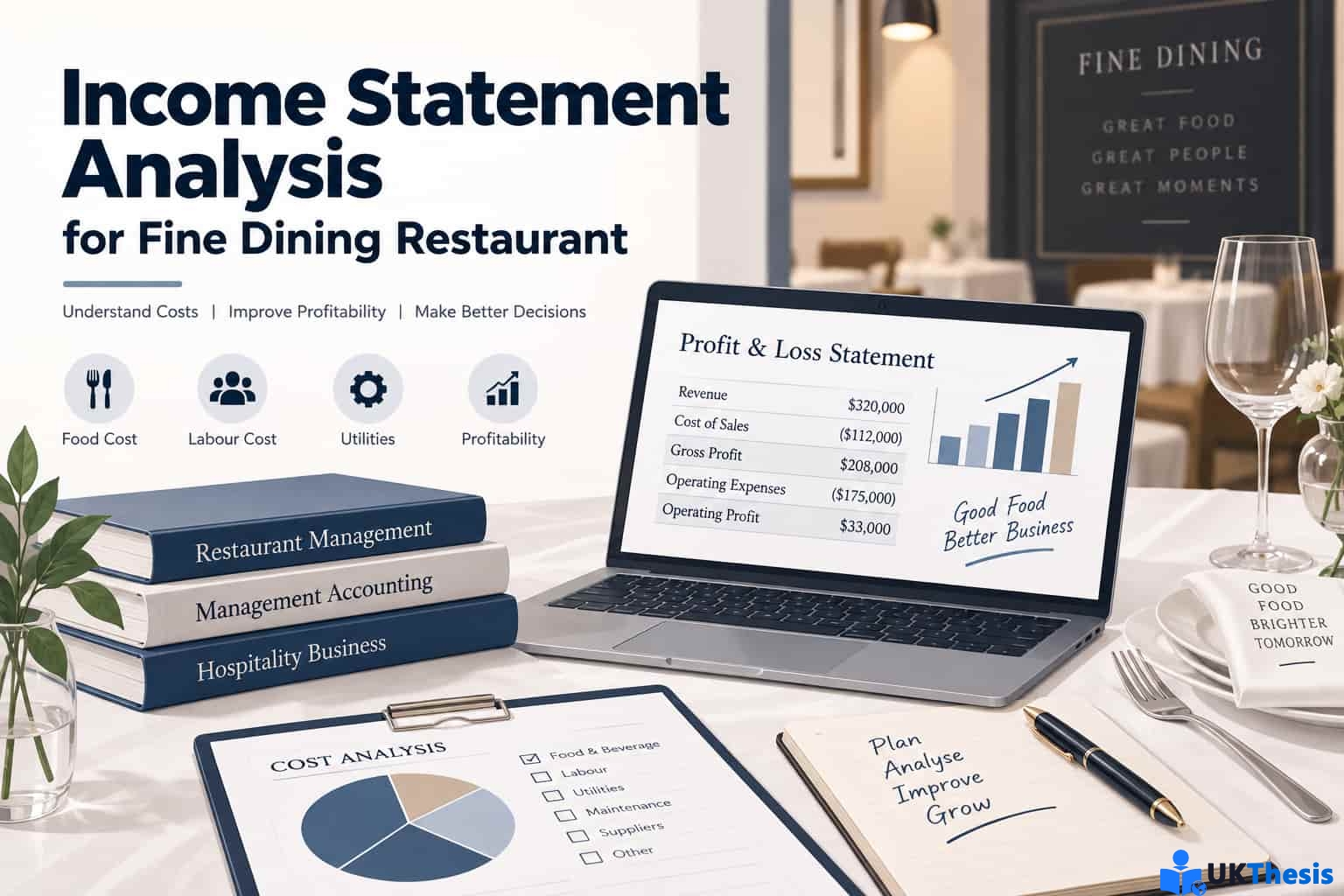
这篇案例以一家Fine Dining Restaurant为背景。餐厅原本计划,如果全年能够达到既定财务预算,就利用经营利润购买新的Wine Fridge。这个小目标看起来不起眼,却正好说明了为什么餐厅经理必须定期查看Income Statement和Budget Variance。
毕竟,营业额看起来很漂亮,不代表最后真的有钱剩下来。餐厅最容易出现的情况就是:客人坐满了,厨房忙疯了,最后Profit却被Food Cost、Labour、Utilities和Waste一点点吃掉。
范文类型:Management Accounting / Hospitality case study
核心主题:Income Statement / Profit and Loss / Budget Variance
重点成本:Food & Beverage、Labour、Utilities、Maintenance
管理目标:利用财务数据支持Restaurant Cost Control与经营决策
Introduction:为什么Restaurant Manager要看Income Statement?
An income statement summarises revenue, expenses and profit over a specific accounting period.
For a restaurant manager, the report is not simply an accounting document. It can be used to monitor whether the business is operating within budget and to identify where performance is better or worse than expected.
In this case, management planned to purchase a wine fridge using restaurant profits. Whether that investment is affordable therefore depends on whether operating performance meets the financial targets that were set at the beginning of the period.
所以看P&L真正的目的不是“会不会算”,而是决定:现在有没有能力花这笔钱。
Overview of Profit and Loss Report
The restaurant had a total cost budget of approximately $240,000, while actual expenses were approximately $225,000.
This represents an overall favourable variance of around $15,000 because actual spending was lower than the total budget.
However, the overall figure does not tell the whole story.
Some individual expense categories, including food and beverage, labour, maintenance and laundry, may still have exceeded their specific budgets.
| Item | Management question |
|---|---|
| Budget | How much did management expect to spend? |
| Actual | How much was actually spent? |
| Variance | Was the difference favourable or unfavourable? |
| Cause | Why did the difference occur? |
| Action | What should management do next? |
这也是Management Accounting里最重要的一步:Variance不是算出来以后就结束,而是要追问原因和行动。
Food and Beverage Cost:餐厅最敏感的成本之一
Food and beverage cost is one of the most important variable costs in restaurant operations.
If actual food cost exceeds budget, several possible causes should be considered:
supplier prices may have increased;
portion sizes may be inconsistent;
food waste may be higher than expected;
menu pricing may not reflect ingredient costs;
purchasing controls may be weak.
所以看到Food Cost上涨,不能只写一句“成本变高,因此利润下降”。
真正的分析应该继续区分:是采购价格问题、内部浪费问题,还是Menu Pricing问题。
Manage Suppliers
Finding reliable suppliers can take time, but supplier management is an important part of restaurant cost control.
A productive supplier relationship usually depends on regular communication, clear quality expectations, delivery reliability and transparent pricing.
Managers should monitor supplier performance rather than waiting until contract-renewal time to discover problems.
If ingredient costs repeatedly exceed budget, management can investigate whether the cause is:
market price increases;
poor purchasing terms;
inefficient ordering frequency;
excessively small or urgent orders;
quality specifications that do not match actual operational needs.
Supplier Management真正的目标不是一味压低价格,而是找到Cost、Quality和Reliability之间的平衡。
Avoid Wasteful Use of Resources
Waste can have a direct effect on restaurant profitability.
Typical sources of waste include spoilage, over-production, incorrect orders, excessive portion sizes, accidental damage and inefficient use of staff time.
For a restaurant, even small waste percentages can become significant when repeated every day.
| Waste type | Possible response |
|---|---|
| Food spoilage | Improve stock rotation and purchasing forecast |
| Over-portioning | Standardise recipes and portion control |
| Incorrect orders | Improve POS process and staff training |
| Energy waste | Monitor equipment use and operating schedules |
员工其实经常比Manager更早知道Waste发生在哪里,因为他们每天都在厨房、储藏室和Service Floor里工作。
所以改善流程时,Staff Feedback往往比在办公室里单看Excel更有用。
Labour Cost:不是单纯“少排人”
Labour is usually one of the largest controllable costs in hospitality businesses.
However, reducing labour cost does not simply mean scheduling fewer employees.
Restaurants experience peak and off-peak periods. If staffing is too high during quiet periods, labour productivity falls. But if staffing is too low during peak periods, service quality may deteriorate and customer satisfaction may suffer.
因此更合理的方法是:
Sales Forecast → Demand Pattern → Staff Roster → Labour Productivity
而不是看到Labour Cost高,就直接砍班次。
一个很实用的判断:
如果少排一名员工省了$100,但因为Waiting Time变长导致更多客人流失,这笔“节省”未必真的提高Profit。
Utilities Cost:水电费也需要管理
Electricity and gas are partly variable operating costs because usage changes with trading volume, operating hours, equipment and external energy prices.
Management cannot control global energy markets, but it can control how efficiently the restaurant uses energy.
Possible actions include:
identifying high-energy equipment;
maintaining refrigeration and kitchen systems;
reducing unnecessary operating time;
monitoring heating and cooling usage;
replacing inefficient equipment where the investment is financially justified.
这里就可以把最开始的Wine Fridge重新联系回来。
新设备不是“有钱就买”,而应该考虑:
Purchase Cost + Energy Cost + Operational Benefit + Expected Payback
这样整篇文章的Financial Decision就连起来了。
Leadership为什么会影响Profit?
Leadership itself does not appear as a separate line in the income statement, but management behaviour can influence many numbers that do.
For example, leadership may affect:
staff productivity;
employee turnover;
waste control;
service consistency;
customer satisfaction;
implementation of cost-control procedures.
Managers in restaurants often need both coordinating and guiding skills because the operating environment is fast-moving and involves several departments at the same time.
所以Leadership这一段不是跑题,只要把它和Labour Cost、Productivity和Service Performance连接起来就成立。
Employee Training:培训到底是Cost还是Investment?
Restaurant employees are often the main point of contact between the business and customers.
Training therefore creates an interesting management-accounting question.
In the short term, training increases cost because employees need time, supervision and resources.
However, better-trained staff may reduce ordering mistakes, waste, complaints and service delays.
This means training can potentially improve both operational efficiency and customer satisfaction.
| Training cost | Potential benefit |
|---|---|
| Paid training hours | Fewer service mistakes |
| Manager supervision | Higher productivity |
| Training materials | Better customer experience |
| Initial learning time | Lower long-term waste and turnover |
Budget Variance应该怎么分析?
一个完整的Restaurant Variance Analysis,建议不要只停留在Budget和Actual两个数字。
| Step | Question |
|---|---|
| 1. Identify | Which cost is above or below budget? |
| 2. Measure | How large is the variance? |
| 3. Explain | Why did it happen? |
| 4. Evaluate | Is it temporary or structural? |
| 5. Act | What should management change? |
这五步写出来以后,一篇Accounting Assignment就不会只剩下一堆数字。
Recommendation
Based on the profit-and-loss analysis, management should not focus on a single cost category in isolation.
A more balanced approach would include:
reviewing supplier prices and purchasing arrangements;
improving food-waste and portion control;
matching staff rosters to demand;
monitoring high-energy equipment;
providing targeted employee training;
reviewing monthly budget variances rather than waiting until year-end.
If these actions improve profitability while protecting service quality, the restaurant will be in a stronger position to fund future investments such as equipment upgrades.
Conclusion
Income Statement Analysis provides restaurant managers with more than a summary of revenue and expenses.
It helps identify whether actual performance is consistent with budget, which costs require attention and whether the business can afford future investment.
For a Fine Dining Restaurant, Food Cost, Labour, Utilities, Waste and Supplier Management all interact with profitability.
Most importantly, cost control should not mean blindly cutting expenditure. The real objective is to reduce unnecessary cost while maintaining the food quality and service experience that generate revenue in the first place.
如果这篇是Management Accounting作业,我觉得最值得记住的一句话就是:不是花得越少越好,而是每一块钱都要知道为什么花。
FAQ
Q:这篇属于Accounting还是Finance?
A:更准确属于Management Accounting和Hospitality Management,因为核心是Profit and Loss、Budget Variance和Cost Control。
Q:Income Statement和Profit and Loss Statement一样吗?
A:在很多实际场景中两者指的是同一类报表,都是展示特定期间Revenue、Expenses和Profit。
Q:Restaurant Cost Control最重要的是Food Cost吗?
A:Food Cost非常重要,但不能单独看。Labour、Waste、Utilities、Supplier Price和Sales Volume都会影响最终Profit。
Q:Budget低于Actual一定是不利差异吗?
A:如果讨论的是Expense,Actual低于Budget通常是Favourable Variance;如果讨论Revenue,则需要反过来判断。
相关阅读
如果想进一步学习Financial Statement Analysis,可以阅读站内会计Essay中的Ratio Analysis怎么写?
如果题目涉及Break-even、Contribution和Target Profit,可以继续阅读CVP分析怎么写?Management Accounting盈亏平衡与案例指南。
如果更偏Hospitality Operations,也可以阅读Food and Beverage Management运营与服务质量分析。
对于已经有Accounting assignment、Restaurant Case Study或Profit and Loss初稿的同学,也可以通过数据解释、Variance Analysis、Cost Control逻辑和英文表达修改等方式,把已有内容整理得更清楚。
```