Sarbanes-Oxley Act会计Essay范文:SOX内部控制、审计质量与Section 103分析
The Sarbanes-Oxley Act of 2002(SOX)对美国上市公司的Corporate Governance、Internal Control和Auditing产生了深远影响。对于Accounting和Auditing专业的留学生来说,SOX也是一个很典型的essay题目:它表面上讲的是法规,真正写起来却会涉及Management Responsibility、Fraud Risk、Internal Control、Auditor Independence以及Audit Quality。
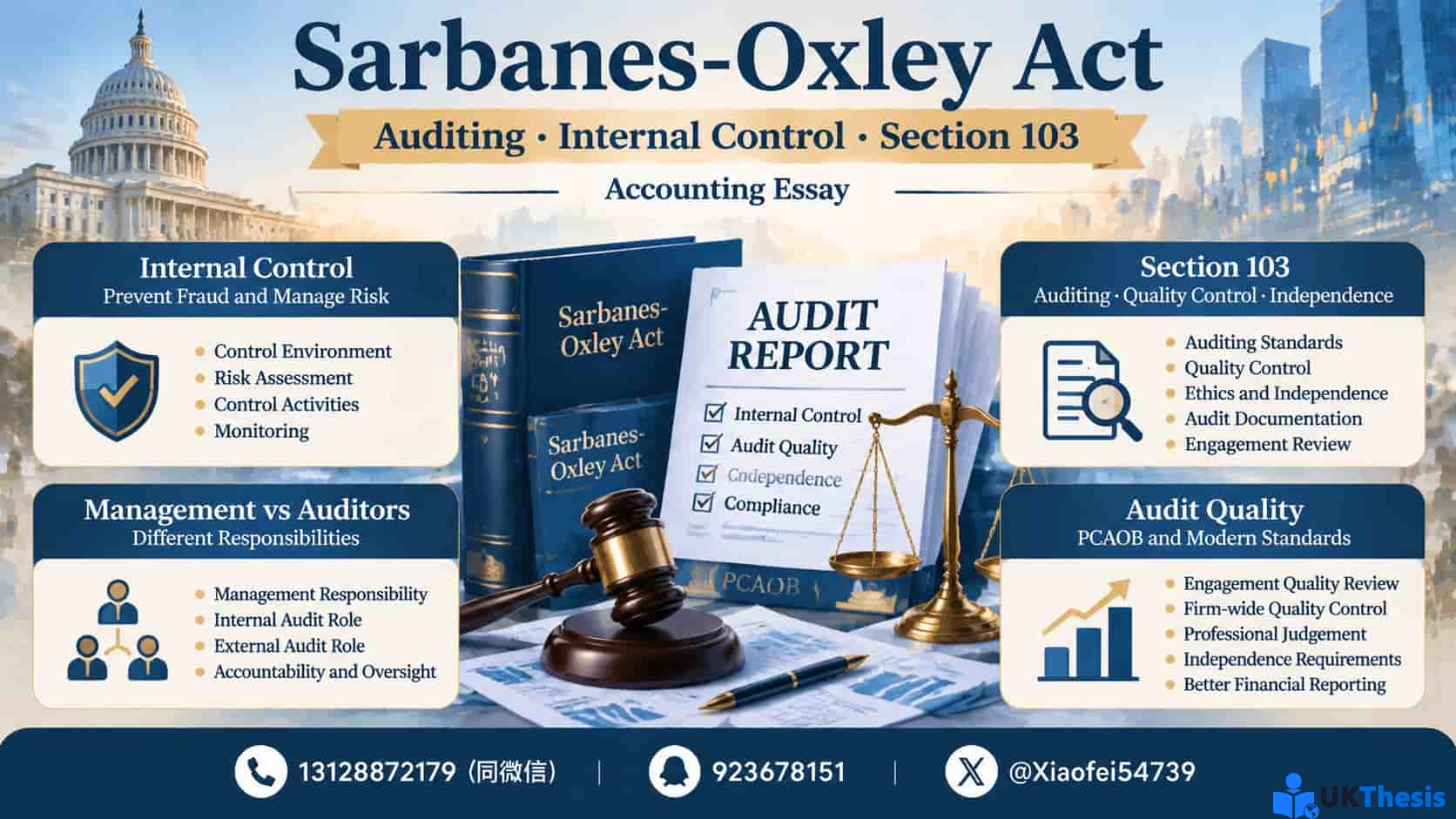
本文重点讨论Sarbanes-Oxley Act对Internal Auditors、External Auditors、Executives和Boards of Directors的影响,并进一步分析Section 103所涉及的Auditing、Quality Control和Independence。理解这类题目时,不要只背“SOX was introduced after accounting scandals”这一句话,更值得分析的是:SOX究竟怎样重新划分Management和Auditor之间的责任,以及为什么这种责任分离会影响Audit Quality。
Essay核心问题:Management负责建立和维护Internal Controls,而Auditors负责独立评价相关控制及审计证据。双方需要合作,但不能把各自的责任混在一起。这个看似简单的边界,其实贯穿了整篇SOX分析。
Why the Sarbanes-Oxley Act Changed Auditing
Business fraud has long been a major concern in the accounting profession and the wider business community. The Sarbanes-Oxley Act of 2002 was enacted following a series of highly publicised corporate failures, allegations of Financial Reporting fraud and financial statement restatements.
Cases such as Enron and WorldCom exposed weaknesses not only inCorporate Governance, but also inFinancial Reporting、Audit Oversight和Management Accountability。If management has both the opportunity and incentive to manipulate financial information, weak internal controls can make that manipulation more difficult to prevent or detect.
One important effect of SOX was therefore to make responsibility more explicit. Executives, boards, internal auditors and external auditors could no longer treat Internal Control as somebody else's problem.
| Area | Why It Matters under SOX |
|---|---|
| Management Responsibility | Management must take responsibility for internal control and financial reporting processes. |
| Internal Control | Controls help prevent or detect material errors and fraud. |
| External Audit | Auditors independently evaluate evidence and relevant control effectiveness. |
| Audit Quality | Audit firms require effective quality-control and engagement-review processes. |
| Independence | Auditor objectivity must not be compromised by conflicting commercial interests. |
The law also changed the behaviour expected from senior management. An effective control environment should not create a culture in which employees or senior officials are afraid to report bad news or potential misconduct. Controls therefore involve more than forms and signatures; they also depend on organisational behaviour, accountability and ethical expectations.
Internal Control and Fraud Risk
One of the strongest themes in the Sarbanes-Oxley Act is Internal Control. A company with insufficient internal controls can be exposed to fraud, error, misappropriation of assets and material misstatement. These problems can create substantial financial, legal and reputational costs.
Management has the primary responsibility for designing and implementing the system of internal controls. This includes identifying significant risks, documenting relevant controls, evaluating whether those controls operate effectively and determining which areas of the organisation require particular attention.
Auditors, on the other hand, evaluate relevant evidence and controls from an independent position. They may identify weaknesses and make recommendations, but the basic responsibility for the company's control system remains withManagement。
A useful distinction:
Management designs and maintains the internal control system.
Auditors independently assess relevant controls and audit evidence.
Management cannot simply transfer its responsibility to the auditor.
This distinction becomes particularly important when consideringManagement Override。Even a well-designed control system can be weakened when senior managers deliberately override procedures. Managers who intend to commit fraud may have incentives to create weaknesses or exploit gaps in the control environment.
For the auditor, this means that testing Internal Control cannot become a simple box-ticking exercise. The auditor must consider whether controls are appropriately designed, whether they have been implemented, who performs them and whether they are capable of preventing or detectingMaterial Misstatements in a timely manner.
Prevention or Detection?
Companies often prefer to prevent a material misstatement rather than discover and correct it later. In practice, however, an effective control environment normally requires a combination ofPreventive Controls and Detective Controls。
| Preventive Controls | Detective Controls |
|---|---|
| Authorisation procedures | Account reconciliations |
| Segregation of duties | Management review |
| Access controls | Exception reports |
| Policies and approval limits | Internal audit testing |
In other words, Internal Control should not be understood as one procedure. It is a system. One control may stop an error from happening, while another helps identify the problem when prevention fails.
Internal Auditors and External Auditors:职责并不一样
SOX significantly increased the attention paid to both Internal Auditing and External Auditing, but their roles should not be confused.
Internal Auditors are often in a strong position to identify process failures, operational risks and control weaknesses before they become larger problems. They may assist withRisk Assessment、Ethics Training andControl Improvement,同时向Management和Audit Committee提供信息。
External Auditors have a different responsibility. Their work is more directly connected withIndependent Audit、Financial Reporting、Material Misstatement和Audit Evidence。Maintaining this distinction is important because the value ofExternal Audit depends heavily onIndependence andObjectivity。
| Internal Audit | External Audit |
|---|---|
| Works within the organisation | Provides an independent external audit function |
| Reviews operational and control risks | Focuses strongly on financial reporting and material misstatement risks |
| Can provide continuing control feedback | Evaluates audit evidence and relevant controls independently |
| Reports to management and/or audit committee according to governance arrangements | Must comply with professional auditing and independence requirements |
| May examine a wide range of business processes | Audit scope is driven by the financial statement audit and relevant requirements |
我以前看这类Auditing Essay时,一个很常见的问题就是把Internal Auditor和External Auditor写成“一个负责公司里面,一个负责公司外面”,然后就结束了。这样不能算错,但分析太浅。
真正值得讨论的是两者的different accountability and independence relationships。Internal Audit可以深入了解Business Process,而External Audit的价值很大程度上来自其独立评价的位置。两者可以利用彼此的信息,却不能让职责边界消失。
Section 103:Auditing、Quality Control and Independence
Section 103 is particularly relevant because it connects three areas that are sometimes studied separately:Auditing Standards、Quality Control andAuditor Independence。
Audit Quality does not depend only on whether an individual auditor performs a particular test correctly. It also depends on how the accounting firm managesEngagement Performance、Review、Professional Judgement、Documentation and Independence。
| Section 103 Theme | Essay Analysis |
|---|---|
| Auditing Standards | How audit work should be planned, performed, documented and evaluated. |
| Quality Control | How audit firms maintain consistent quality across engagements. |
| Ethics | Professional behaviour and responsibilities. |
| Independence | Protection of auditor objectivity from inappropriate influence or conflicting interests. |
| Audit Documentation | Evidence supporting the work performed and conclusions reached. |
| Engagement Review | An additional quality-review mechanism before an audit is completed. |
Why Engagement Quality Review Matters
Engagement Quality Review is an important part of the audit-quality process because it provides an additional level of review over significant audit judgements and conclusions.
The original concern behind this type of review is fairly practical: an audit engagement team may spend months working closely with a client, making complex judgements along the way. A suitably qualified reviewer who is not part of those original judgements can provide another perspective before the engagement is completed.
Differences can exist between accounting firms in the assignment of reviewers, their involvement in audit planning, the scope of their review and the documentation supporting that review. For this reason, consistent quality requirements are important to the profession.
Auditor Independence:为什么不能既当裁判又当顾问?
Auditor Independence is another major issue associated with the Sarbanes-Oxley reforms. One concern is that significant revenue fromNon-Audit Services could create incentives that conflict with the auditor's independent role.
If an audit firm becomes financially dependent on lucrative consulting work from an audit client, users ofFinancial Statements may reasonably question whether the auditor is willing to challengeManagement aggressively when a seriousAccounting Issue arises.
Independence therefore has both an actual and a perceived dimension. An auditor needs to exerciseObjective Professional Judgement, but stakeholders also need confidence that inappropriate relationships are not influencing that judgement.
Critical Analysis:Stronger independence requirements can increase compliance costs and restrict some commercial relationships, but independence is also one of the foundations of audit credibility. The analytical question is therefore not simply whether regulation creates cost, but whether that cost supports greater confidence in financial reporting.
Compliance Cost与Better Internal Control之间的矛盾
One criticism of Sarbanes-Oxley has always been the cost ofCompliance、Documentation andControl Testing。Chief Financial Officers and other executives need to devote time, personnel and resources to meeting regulatory requirements.
This creates a genuineManagement Problem。CFOs may simultaneously be expected to reduce costs and maintain effective controls. AggressiveCost Cutting can improve short-term efficiency, but cutting the wrongControl Activities orCompliance Resources can increaseRisk Exposure。
A more sensible approach isRisk-Based Control Design。Not every account, transaction or business process creates the same level of risk, soManagement should identify the controls that matter most and allocate resources accordingly.
| Short-Term View | Long-Term Control View |
|---|---|
| Reduce compliance cost | Reduce fraud and reporting risk |
| Reduce control procedures | Maintain controls over high-risk processes |
| Focus on immediate efficiency | Protect financial reporting reliability |
| Treat compliance as a burden | Integrate controls into normal business processes |
所以SOX Essay如果最后只写“SOX increases compliance costs”,其实只写了一半。更好的Critical Evaluation应该继续问:这些成本换来了什么?Control Failure、Fraud、Restatement甚至Audit Failure本身又会产生多大的成本?
From Section 103 to Modern PCAOB Quality Control
Section 103的意义并没有停留在2002年。Audit Regulation后来继续发展,PCAOB也不断完善Auditing和Quality Control Standards。
进入新的Quality Control框架以后,Audit Quality越来越被理解为一个Firm-Wide System,而不仅仅是某一个Auditor或者某一次Audit Test的问题。Quality Management需要同时考虑Governance、Ethics and Independence、Engagement Performance、Resources、Information、Monitoring以及Remediation。
这使Section 103特别适合放在今天重新分析:它可以被看成SOX建立Audit Quality监管框架的重要起点之一,而现代Quality Control进一步把这种思想发展成更完整的Firm-Level Quality System。
| Earlier SOX Focus | Modern Quality-Control Perspective |
|---|---|
| Auditing standards | Firm-wide quality objectives and risks |
| Quality control requirements | Integrated quality-control system |
| Independence requirements | Ethics, independence and governance |
| Engagement review | Engagement performance plus monitoring and remediation |
How to Analyse a Sarbanes-Oxley Auditing Essay
如果课程里遇到SOX、Internal Control或者Audit Quality方向的Accounting Assignment,我不太建议从第一页开始复述法案历史,一路写到最后才终于开始Analysis。
一个比较自然的方法是先找到题目的Conflict。例如:
Management Responsibility vs Auditor Responsibility
Compliance Cost vs Control Effectiveness
Commercial Relationship vs Auditor Independence
Management Efficiency vs Fraud Prevention
然后再把SOX、Internal Control、PCAOB或者Audit Quality的知识放进去解释这个Conflict。
这种写法通常比“Definition—Advantages—Disadvantages—Conclusion”的固定模板自然很多。如果在Auditing Essay、Accounting Assignment、Case Analysis或者Structure上卡住,也可以根据课程题目、Rubric和已有资料进一步做针对性的写作分析与辅导。
FAQ
What is the Sarbanes-Oxley Act?
The Sarbanes-Oxley Act of 2002 is a major US corporate and auditing reform introduced following serious corporate and accounting failures. It strengthened requirements relating toCorporate Governance、Financial Reporting、Internal Control andAudit Oversight。
What is Section 103 of SOX?
Section 103 concernsAuditing、Quality Control andIndependence Standards and Rules。对于Auditing Essay来说,它特别适合用于讨论Audit Quality、Professional Standards、Engagement Review和Auditor Independence。
Who is responsible for a company's internal controls?
Management is responsible for designing, implementing and maintaining the company's system ofInternal Control。Auditors independently evaluate relevant evidence and controls according to their professional responsibilities; they do not take overManagement's responsibility。
Why is management override an audit risk?
Because even well-designed controls may be bypassed by senior management. Management Override therefore affectsFraud Risk and requires auditors to consider whether control procedures can be circumvented.
What is the difference between internal and external auditors?
Internal Auditors work within the organisation and may examine a broad range of operational, risk and control issues. External Auditors provide an independent audit function focused strongly onFinancial Reporting、Material Misstatement andAudit Evidence。
Why is auditor independence important?
Auditor Independence supportsObjective Professional Judgement and confidence in theAudit Opinion。Financial or commercial relationships that create conflicts of interest can undermine both actual independence and stakeholders' perception of independence.
Does stronger internal control completely prevent fraud?
No. Strong controls can make fraud more difficult to commit and more likely to be detected, but noInternal Control System can eliminate all risk. Human error, collusion andManagement Override are among the reasons controls have limitations.
How should a SOX Accounting Essay be structured?
A strong SOX Essay normally identifies a specific auditing or control issue, explains the relevantSOX requirement, analyses the responsibilities ofManagement andAuditors, evaluates costs or limitations, and reaches a reasoned conclusion rather than simply describing the legislation.
Conclusion
The Sarbanes-Oxley Act represented a major change for internal and external auditors, executives and boards of directors. One of its most important effects was to make responsibility forInternal Control、Audit Quality andFinancial Reporting more explicit.
Internal auditors can help organisations identifyRisk、Control Weaknesses andProcess Failures before they become larger problems. External auditors provide a different form of assurance and must maintain sufficient independence to evaluateFinancial Reporting and relevantAudit Evidence objectively.
Management and auditors therefore work within the same financial reporting environment, but their responsibilities should remain distinct. Management owns the process of designing, documenting and maintaining internal controls; auditors independently evaluate matters relevant to the audit.
Section 103 is particularly important because it linksAuditing Standards、Quality Control andIndependence。Its significance extends beyond one technical section of the legislation: it reflects the broader idea thatAudit Quality depends not only on individual audit procedures, but also onProfessional Standards、Review、Documentation、Ethics andIndependence。
SOX compliance undoubtedly creates costs. Documentation, testing and stronger control procedures requireManagement Time andResources。However, the appropriate comparison is not between regulation and zero cost. Weak controls, undetected fraud, material misstatements and audit failures can themselves create substantial financial and reputational damage.
For this reason, the longer-term value of the Sarbanes-Oxley framework lies in treatingInternal Control andAudit Quality as part of the way a well-governed business operates, rather than as paperwork completed only to satisfy a regulatory requirement.
相关文章阅读
学习Auditing和Accounting时,可以继续结合本站Four Stages of the Audit Process、Internal Control、Audit Risk、Accounting Assignment以及Corporate Governance相关案例阅读。Audit Process类文章适合理解审计工作怎样开展,而本文更适合理解SOX监管环境下Management Responsibility、Internal Control、Audit Quality与Auditor Independence之间的关系。