Social and Environmental Accounting Essay范文:环境会计、CSR与Paris Agreement分析

Social and Environmental Accounting(SEA)是一个很有意思的会计概念。传统会计习惯问:“企业赚了多少钱?成本是多少?”但SEA还会继续追问一句:企业赚钱的过程中,对社会和环境产生了什么影响,而这些影响最终由谁承担?
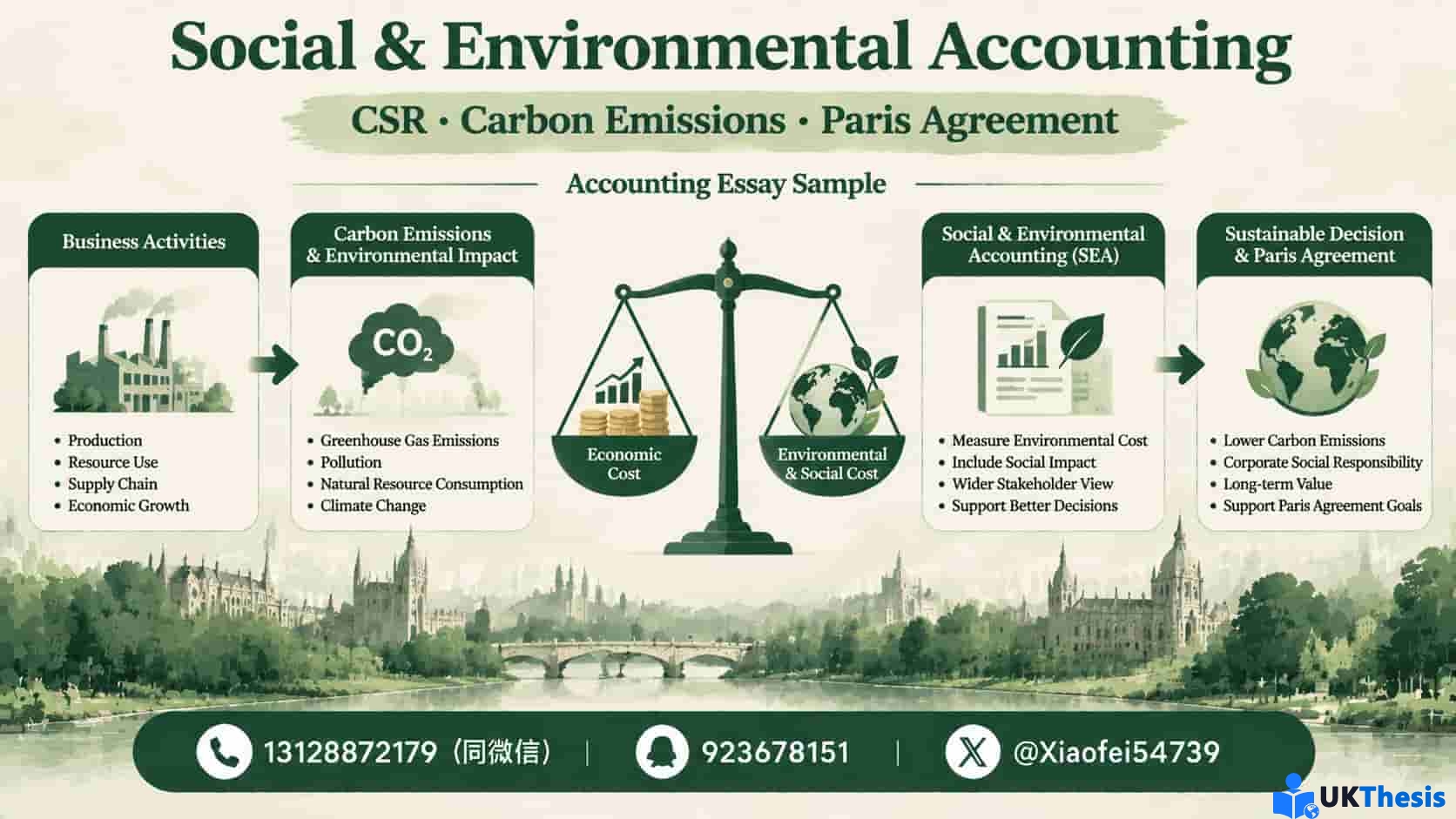
这篇Accounting essay以Paris Agreement为背景,讨论Social and Environmental Accounting如何帮助政府和企业重新认识Carbon Emissions、Environmental Costs以及Corporate Social Responsibility(CSR)。其中美国退出Paris Agreement、Shell与BMW等案例,也很好地说明了一个现实问题:经济利益和环境责任并不总是站在同一边。
案例时间说明:本文部分讨论以2017年前后的Paris Agreement争议为历史背景。美国在此后曾重新加入Paris Agreement;2025年再次通知退出,并于2026年1月27日生效。因此,2017年的讨论更适合作为Historical Case理解,而不是当成今天刚发生的新闻。
Social and Environmental Accounting是什么?
Social and Environmental Accounting关注企业经营活动产生的社会与环境影响。它并不否定传统Financial Accounting,而是在财务数字之外增加一个更宽的观察角度。
比如一家制造企业今年利润增长10%,单看Income Statement当然挺漂亮。但如果利润增长同时伴随着更高的Carbon Emissions、污染处理成本或者其他Environmental Externalities,只看Profit显然不能完整说明企业创造的真实价值。
| Accounting Perspective | Main Question | Typical Information |
|---|---|---|
| Financial Accounting | How did the company perform financially? | Revenue, cost, profit, assets and liabilities |
| Management Accounting | How can managers improve decisions? | Budgets, costs, variance and performance |
| Environmental Accounting | What environmental impacts and costs are created? | Energy, emissions, waste and environmental costs |
| Social and Environmental Accounting | How does business affect wider stakeholders and society? | Environmental and social impacts alongside economic performance |
Paris Agreement与经济利益之间的矛盾
The Paris Agreement represents international cooperation aimed at addressing climate change and reducing greenhouse gas emissions. However, environmental targets can create difficult economic choices, particularly for economies and industries that remain dependent on fossil fuels.
美国2017年宣布退出Paris Agreement时,这种矛盾表现得非常明显。对于Coal、Oil以及其他传统能源行业来说,更严格的Carbon Reduction要求可能意味着增加成本、调整产业结构甚至减少部分传统岗位。
从短期经济利益看,降低环境约束可能给某些产业带来利益;但从长期社会成本看,Climate Change、Pollution以及Environmental Damage又可能产生更大的成本。
这也是为什么这个问题特别适合放进Social and Environmental Accounting Essay:它本质上并不是一句“保护环境好不好”就能回答的问题,而是哪些成本被记录了,哪些成本没有进入传统会计数字。
| Short-Term Economic Consideration | Long-Term SEA Consideration |
|---|---|
| Protect fossil-fuel employment | Climate and pollution costs |
| Lower compliance cost | Long-term environmental liability |
| Support domestic production | Transition towards cleaner industries |
| Immediate GDP and output effects | Wider social welfare and sustainability |
原来的讨论里有一个观点我一直觉得挺值得留意:经济增长和Environmental Governance看起来经常互相拉扯,但二者并不一定永远站在对立面。问题更多在于,我们到底用多长的时间尺度去计算“成本”和“收益”。
Accounting for the Environment:环境成本怎么算?
Environmental Governance已经成为经济活动中的重要考虑因素。对于快速工业化经济体来说,“Green Growth”之所以出现,就是希望在Economic Development和Environmental Protection之间找到一个相对可持续的平衡。
短期来看,减少排放、更新生产设备或者采用Cleaner Technology都可能增加成本。但如果把时间拉长,污染治理、资源消耗、气候风险和环境损害本身同样具有经济成本。
Traditional Financial Accounting通常围绕一个Reporting Entity进行衡量,而Social and Environmental Accounting会进一步考虑企业活动影响到的其他Stakeholders。
这里其实是整篇Essay最值得写深的地方:一家企业把污染处理成本转移给社会,并不意味着这个成本真的“消失”了,只意味着它没有完整出现在企业自己的账上。SEA真正有意思的地方,就是试图让这些被忽略的Externalities重新进入决策视野。
如果采用SEA的思路,Pollution和Climate Change产生的长期成本可能超过部分Fossil Fuel Industries带来的短期经济收益。不过现实中最大的问题也在这里:Environmental Cost不像买一台机器那样容易给出一个确定价格,因此实际Measurement往往存在争议。
SEA如何支持Paris Agreement目标?
SEA可以帮助政府、企业和其他机构在决策过程中同时考虑Economic、Social和Environmental Outcomes。
在企业层面,一个比较直接的实践就是Corporate Social Responsibility(CSR)。CSR要求企业在追求自身利益之外,也考虑经营行为对Employees、Communities、Consumers以及Environment产生的影响。
企业生产过程中产生的Negative Externalities通常不会自动完整进入产品价格,因此单靠传统市场机制未必能够完全反映这些社会成本。这也是Government Regulation和Corporate Responsibility会同时存在的原因。
| SEA / CSR Area | Possible Business Response |
|---|---|
| Carbon Emissions | Measure emissions and set reduction targets |
| Energy Consumption | Improve efficiency and increase renewable-energy use |
| Environmental Externalities | Include wider environmental consequences in decision-making |
| Corporate Responsibility | Develop internal environmental and ethical policies |
| Disclosure | Communicate environmental and social performance to stakeholders |
CSR Case:Shell与能源转型
Royal Dutch Shell是一个很典型的案例,因为Oil and Gas本身就是与Carbon Emissions高度相关的行业。
早期CSR资料显示,Shell开始增加对Renewable Energy、Wind Power和Lower-Carbon Fuels等领域的投资。对于传统能源企业来说,这种转型并不只是Public Relations,它同时关系到企业未来的Business Model。
从Social and Environmental Accounting角度分析,这类投资至少包含两个层面的意义:
第一,企业开始把Environmental Impact纳入长期战略;
第二,传统能源公司可以通过Diversification降低未来过度依赖Fossil Fuels的风险。
不过在Accounting Essay里也不能看到“公司说自己绿色”就马上鼓掌。CSR Disclosure是否真正代表Environmental Performance,还要结合实际投入、Emissions和长期经营变化进行判断。
CSR Case:BMW与汽车行业
BMW Group提供了另一个不同类型的案例。传统汽车依赖Fossil Fuel,因此汽车制造商同样面对Climate Change和Carbon Reduction压力。
企业可以通过提高Fuel Efficiency、改进Manufacturing Processes以及逐渐发展Lower-Emission Technologies降低Environmental Impact。
从CSR角度看,这些活动可以体现企业承担环境责任;从战略角度看,它们同时可以帮助企业适应未来消费者偏好、技术变化和监管要求。
这也说明CSR并不一定只有“做好事”这一层含义。Environmental Strategy有时候同时也是Long-Term Business Strategy。
| Case | Environmental Issue | SEA / CSR Interpretation |
|---|---|---|
| Shell | Dependence on fossil energy | Energy transition and diversification |
| BMW | Vehicle emissions and fuel consumption | Efficiency, technology and sustainable production |
| Government | National carbon emissions | Policy evaluation beyond short-term financial cost |
为什么企业愿意披露CSR信息?
Companies may disclose CSR information for several reasons. Environmental and social programmes can strengthen corporate reputation when stakeholders believe that the activities are genuine.
但是CSR也存在一个很现实的问题:如果消费者认为企业只是为了改善Public Image,而实际经营行为并没有改变,那么CSR Communication反而可能失去可信度。
所以分析CSR不能只写:
CSR → Better Reputation → More Profit
这种写法太直了。更好的Critical Analysis应该继续问:
Is the environmental commitment measurable? Is it consistent with the company's core business? Does the disclosure reflect real operational change?
这三个问题一问出来,Essay基本就从“介绍CSR”进入“分析CSR”了。
Economic Growth与Environmental Governance一定冲突吗?
Not necessarily.
Short-term environmental regulation can increase costs for some industries. However, environmental investment can also encourage technological change, renewable-energy development, efficiency improvements and new business models.
因此,一个Social and Environmental Accounting分析不应该简单得出“经济增长重要”或者“环境保护更重要”这样的二选一结论。
更值得讨论的是:
How should economic, environmental and social costs be measured across different time horizons?
这也是SEA相比普通Financial Accounting更适合分析Climate Change问题的地方。
Social and Environmental Accounting Essay怎么分析?
如果拿到类似Accounting Assignment,我一般不建议一上来就堆一串CSR、ESG、Sustainability名词。先把题目的因果关系理顺,反而比较好写。
| Step | Analysis Question |
|---|---|
| 1. Identify the Issue | What social or environmental problem is being discussed? |
| 2. Identify the Externality | Which costs or benefits are not fully reflected in traditional accounting? |
| 3. Apply SEA | How could broader accounting information improve the decision? |
| 4. Add a Business Case | How does a real company respond to the issue? |
| 5. Critical Evaluation | What are the limitations, conflicts and measurement problems? |
例如本文的逻辑就很清楚:
Climate Change → Carbon Externalities → Paris Agreement → Economic Cost Conflict → SEA → CSR → Corporate Response.
如果正在准备Environmental Accounting、Sustainability Accounting或CSR方向的Accounting assignment,也可以先把题目要求、案例材料和Accounting Concepts拆开,再判断哪些理论真正需要使用。这样通常比见到一个关键词就往正文里塞理论自然得多。
FAQ
What is Social and Environmental Accounting?
Social and Environmental Accounting是一种把企业经营产生的社会与环境影响纳入信息披露和决策分析的会计思路。它关注的不只是Profit和Cost,也包括Environmental Impact、Social Responsibility以及Stakeholder Effects。
Environmental Accounting和Financial Accounting有什么区别?
Financial Accounting主要反映企业的财务状况和经营结果;Environmental Accounting则进一步关注能源、排放、资源消耗、污染和相关环境成本。
SEA和CSR是什么关系?
SEA是更广泛的Accounting和Accountability概念,而CSR是企业履行社会与环境责任的一种实践方式。CSR活动及其披露可以成为SEA分析的重要资料。
Paris Agreement可以写进Accounting Essay吗?
可以。如果题目涉及Environmental Accounting、Carbon Accounting、Sustainability或CSR,Paris Agreement可以作为Environmental Policy背景,但正文仍应围绕Accounting Question展开,而不是写成纯Climate Politics Essay。
Social and Environmental Accounting属于Management Accounting吗?
两者存在交集,但并不完全相同。Management Accounting主要服务内部决策,而SEA更广泛地考虑社会、环境和Stakeholder Accountability。
为什么这类Essay一定要写Critical Analysis?
因为Environmental Costs和Social Benefits往往很难准确货币化,而且CSR Disclosure也不一定完全等于真实Environmental Performance。讨论这些Measurement和Credibility问题,通常比单纯介绍定义更有分析价值。
Conclusion
Social and Environmental Accounting provides a broader framework for evaluating economic activities by considering environmental and social consequences alongside traditional financial outcomes.
The debate surrounding the Paris Agreement demonstrates the difficulty of balancing short-term economic incentives with long-term environmental costs. Industries that depend heavily on fossil fuels may face immediate adjustment costs, while society may bear much larger costs if environmental externalities remain outside economic decision-making.
CSR can contribute to this process by encouraging companies to consider environmental responsibility within their business strategies. The Shell and BMW cases show how companies in carbon-intensive industries can respond through changes in energy use, technology and long-term business planning.
SEA is not a perfect solution. Measuring environmental and social impacts remains difficult, and corporate disclosure should always be examined critically. However, it gives governments, businesses and other stakeholders a more complete way to think about the relationship between accounting, economic activity and the environment.
相关文章阅读
准备Accounting Essay或Assignment时,可以继续阅读本站关于Management Accounting、Strategic Management Accounting、CSR、Sustainability以及Accounting case study的相关案例。相关文章最好围绕同一Accounting学习路径建立内链,而不是简单堆放大量“会计Essay”链接。