Social Work Reflective Essay范文:从Covid-19案例看反思性Essay怎么写

How to start a reflective essay?第一次碰到Reflective Essay的时候,很多同学会觉得它应该比普通Academic Essay容易:毕竟写的是自己的experience,好像不需要找那么多复杂的数据。
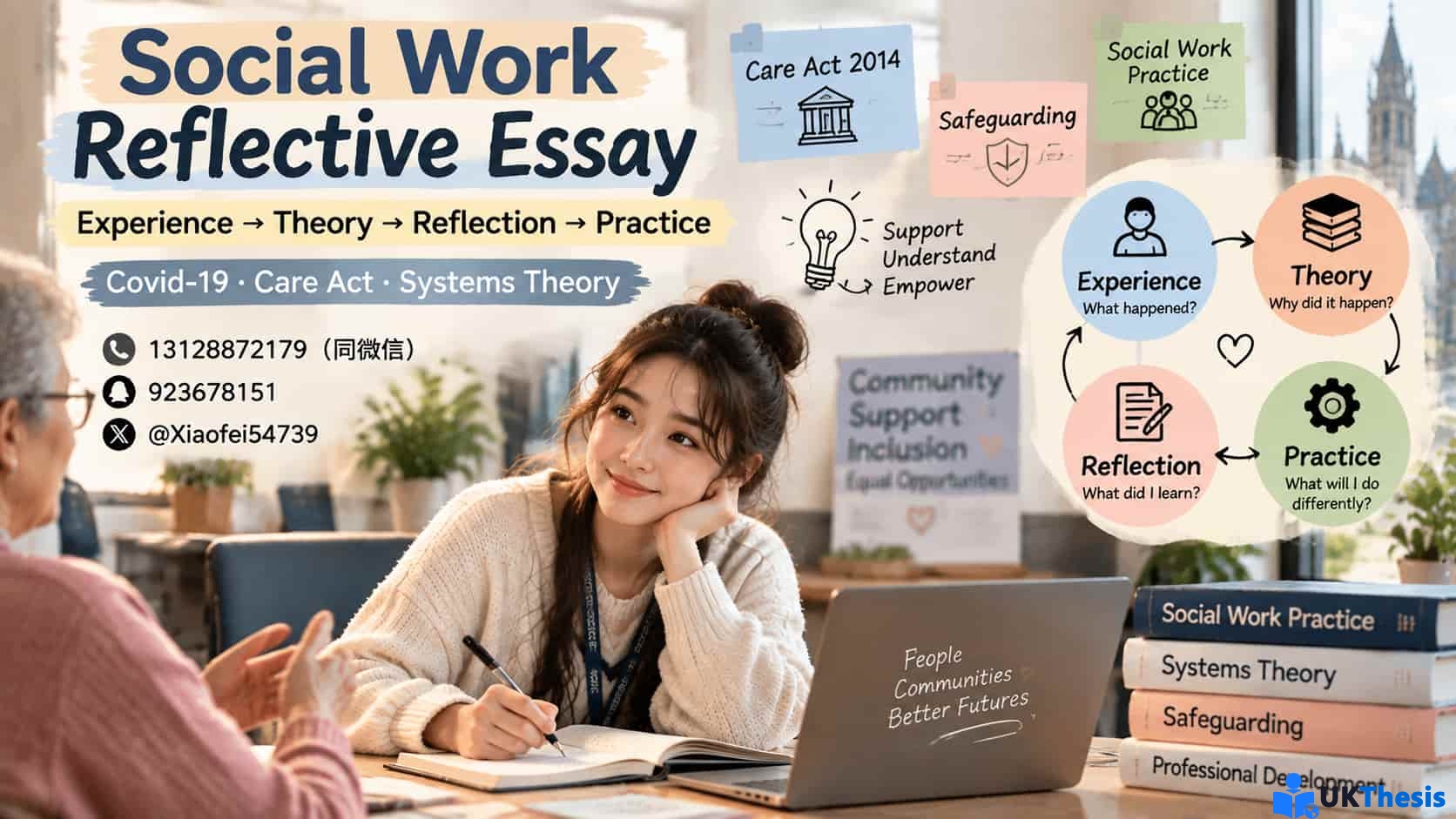
但真正开始写以后,经常卡在第一步。Reflective Essay并不是简单地把生活经历重新讲一遍。尤其在Social Work、Nursing、Education这类专业里,个人经历只是起点,后面通常还需要进入reflection、theory以及professional practice。
这篇文章用一个Social Work Reflective Essay作为主要案例。案例讨论Covid-19时期Social Work Practice受到的影响,包括Care Act、Systems Theory、Social Learning Theory、BASW PCF、domestic abuse以及safeguarding等内容。与其背一个万能开头,不如直接看看一篇Reflective assignment是怎样从现实问题一步步进入专业反思的。
What Is a Reflective Essay?
A reflective essay is a piece of writing revolving around you — namely, around your identity, experiences or personal growth. It is not simply a retelling of your life.
In an academic setting, reflective writing normally requires a deeper analysis of personal changes, experiences and the reasons behind them. Depending on the subject, students may also need to consider who or what influenced their thinking, why their understanding changed, and how the experience may affect future practice.
这也是Reflective Essay和普通“讲故事”最大的区别。故事本身当然重要,但老师真正想看的通常是:What happened? Why did it matter? What did you learn? What will you do differently?
| Reflection层次 | 需要思考的问题 | Social Work中的表现 |
|---|---|---|
| Experience | What happened? | Placement、client interaction、policy change |
| Reflection | How did I understand it? | 自己的判断、困难和认识变化 |
| Theory | Why did it happen? | Systems Theory、Social Learning Theory等 |
| Practice | What will I do differently? | Professional development与future practice |
How to Start a Reflective Essay?
To write a reflective paper, something more than knowledge of writing strategies is needed. Psychological approaches can sometimes help students analyse situations more deeply and take subtle factors into account. Narrative skills are also useful because they help the writer explain a self-development story without turning the assignment into a diary.
So, where should you start?
先想清楚自己真正准备讨论什么。Brainstorm以后,把最值得分析的experience、problem或者change写下来。如果某个理论能够解释你经历中的变化,也可以做必要的research。
比如Social Work学生碰到的题目,往往不能停留在“I felt this was difficult”。更有价值的问题可能是:为什么困难?政策改变了什么?理论怎样解释service user的处境?这次经历又改变了自己对professional practice的哪些认识?
| 开始写之前 | 可以先写下什么 |
|---|---|
| Theme | 这篇Reflection真正讨论的核心问题 |
| Experience | 哪一段经历最值得分析 |
| Change | 自己的认识发生了什么变化 |
| Theory | 哪些理论、政策或课程知识可以解释它 |
| Future Practice | 以后遇到类似问题会怎样处理 |
我自己看Reflective Assignment时有一个很简单的判断方法:把所有“I think”和“I feel”暂时遮住,如果剩下的文章完全没有analysis、theory和professional learning,那大概率还没有真正进入Academic Reflection。
Social Work Reflective Essay Example: Covid-19 Pandemic and Social Work Practice
下面这个案例围绕Covid-19时期的Social Work Practice展开。虽然疫情背景具有明显的时代性,但它非常适合观察Social Work Reflective Essay怎样把个人认识、legislation、theory和professional practice放到同一篇Assignment里。
Reflective Essay on Covid-19 Pandemic and Social Work Practice
Before the pandemic, life was advancing and moving on faster than ever. There was a time and place for everything, whether it was attending university lectures or visiting placement. Now that the pandemic has arrived, life changed drastically and it became limiting.
Everything outside our homes came to a standstill and it completely changed the way society would work and operate. I have realised because of this pandemic that it will never be the same, and that social distancing has to become a new normal. This new normal is not only to be safe from Covid-19, but also to operate effectively and safely within social institutions of our society.
Many frontline workers have had to re-assess how they work in practice when out on visits to minimise the risk of catching Covid-19 and spreading it. Under the Care Act 2014, Social Workers have a duty to provide care, make assessments, meet needs and provide care plans. The Coronavirus Act 2020 included significant changes to how local authorities operated under the Care Act 2014 during the crisis.
The Coronavirus Act responded to difficulties within the health sector caused by rising demand and reduced capacity. As more individuals became ill, there were fewer people available to care for them and potentially fewer Social Workers available to fill essential roles. This had a direct impact on Social Work practice.
Under section 9 of the Care Act 2014, local authorities must assess an adult who appears to have needs for care and support. Many Social Workers may struggle with this when physical visits are restricted. Assessing a client’s mental and physical state and wellbeing can become more difficult without face-to-face communication.
Electronic communication may rely more heavily on information provided verbally by service users. This could negatively affect some clients if they struggle to speak honestly and openly about their wellbeing, safety, health, mental or physical state. Something important could be missed that a Social Worker might otherwise have noticed during a physical visit.
This could affect the reliability of assessments and the flexibility to conduct follow-ups. It may also be difficult for Social Workers to determine whether clients are being looked after properly and whether their basic needs are being met. As a result, some Social Workers may feel limited or unable to give the same level of attention and support to their clients.
As part of section 18 under the Care Act 2014, local authorities have duties relating to eligible needs and care and support planning. Care plans also need to be reviewed and adapted if an individual’s care and support needs change.
As Social Workers work for Local Authorities, they may be greatly affected when applying these duties during a rapidly changing situation. Some practitioners may experience fear or uncertainty because information and working arrangements are changing quickly. Social Work practitioners therefore need to adapt assessment arrangements and prioritise care so that urgent needs can be met effectively and safely.
This has made me realise that professional practice during an emergency may involve difficult decisions about what is necessary, what is possible and which needs must receive priority.
Some Social Workers may feel pressure and stress because they are unable to go as deeply into their work as before. This could lead to a lack of fulfilment when attempting to help clients while complying with assessments, government changes and public health restrictions.
Social distancing is important, but Social Workers must also consider what is in the best interests of communities and individual clients. The challenge is to support people sufficiently so that they continue to feel secure and connected even when ordinary forms of face-to-face practice become difficult.
Connecting Social Work Theory with Reflection
Social Work uses theory to recognise the complexity of human interaction and the environments surrounding individuals. As a profession, Social Work relies on theories of human behaviour, development and social structure to evaluate complex situations and support individual, social, cultural and organisational change.
Systems Theory describes how behaviour can be influenced by a range of factors working together as a system. An individual’s friends, school, parents, home environment, social class and other factors can influence how that individual acts, thinks and behaves.
In a school setting, for example, a Social Worker may work with a child to understand how different systems interact, observing what needs to change, what could improve and what is already working well. School may provide a safe space for a child to discuss how home life, education and other systems affect their situation.
Targeting different elements of a child’s system, including learning and physical welfare needs, can reinforce positive change. Positive interactions between the child, Social Worker and social environments may also contribute to positive social stimulation and development.
Social Learning Theory explores how individuals learn and behave through observation, imitation or modelling. This can be particularly important when considering how children learn specific behaviours.
In Social Work practice, strategies may therefore be developed to encourage positive behaviour. During the pandemic, for example, parents or carers could model behaviours such as hand washing and other protective routines, while Social Workers could reinforce appropriate practices through guidance and support.
This relates to professional knowledge in Social Work. Studying theory can help develop a core understanding of purpose, ethics and values. Specific theoretical knowledge may then be applied during placement and later professional practice.
From studying theories such as Systems Theory, I can challenge my own understanding of how different influences relate to one another and consider how theoretical knowledge might be applied during placement.
Domestic Abuse, Safeguarding and Professional Reflection
Covid-19 also created serious concerns for vulnerable victims of domestic abuse because social isolation and stay-at-home measures could leave some people in unsafe environments for longer periods.
Isolation may reduce access to ordinary sources of support such as schools, workplaces and healthcare services. This can make it more difficult for Social Workers and other professionals to identify warning signs and share important safeguarding information.
As a result, there may be risks of miscommunication and weaker partnership working. Social Workers need to consider privacy, confidentiality, information sharing and safeguarding when dealing with complicated and potentially unsafe situations.
The experience also highlights the importance of human rights and social justice within professional decision-making. Social Workers have responsibilities toward vulnerable individuals, whether children or adults, and emergency conditions do not remove the need to consider safety and wellbeing.
I can imagine that managing the impact of domestic abuse becomes especially difficult when ordinary visits and face-to-face contact are restricted. This creates a tension between infection control and the professional responsibility to protect and safeguard people who may already be vulnerable.
这个Social Work范文值得观察什么?
这篇Example并不完美,反而因为这一点很适合作为学习材料。它有一些段落偏长,也有一些地方从reflection进入了policy discussion,但它至少展示了一个很真实的Social Work Assignment特点:个人反思不是孤立存在的,而是不断与legislation、theory和practice发生联系。
| 案例中的内容 | 写作作用 |
|---|---|
| Covid-19 | 提供真实Professional Context |
| Care Act | 把Reflection连接到Legislation |
| Systems Theory | 解释个人与环境之间的相互影响 |
| Social Learning Theory | 连接Theory与Practice |
| Domestic Abuse | 进入Safeguarding与Ethics问题 |
| Personal Reflection | 说明学习与Professional Development |
如果让我给第一次写Social Work Reflective Essay的同学一个提醒,我会说:别急着把文章写得特别“像论文”。先找到一个真正值得reflection的问题,再问自己为什么会这样理解它。Theory不是装饰品,引用也不是为了显得专业,它们应该帮助你解释自己的experience。
Reflective Essay Thesis应该怎么处理?
In a reflective assignment, the central statement should tell your audience what problem or question you have chosen and indicate the direction of your reflection. By reading it, the audience should be able to understand what the essay is mainly about.
这里的Thesis不一定要写成Argumentative Essay那种非常强硬的立场。对于Social Work Reflection,更重要的是明确:你准备反思什么experience、它涉及什么professional issue,以及这段经历最终怎样影响了你的understanding或practice。
FAQ
Social Work Reflective Essay属于Essay还是Assignment?
两种说法都可能出现。Reflective Essay描述的是具体写作形式,而Assignment是更大的课程作业概念。老师可能把一篇Reflective Essay作为某个Module的Assessment或Assignment布置下来,因此后台分类可以放Essay Writing,Tag则使用Reflective Essay和Social Work。
Reflective Essay必须使用理论吗?
并不是所有Reflective Essay都必须大量使用理论,但Social Work、Nursing、Education等专业的Reflective Assignment经常需要把experience与theory、policy或professional framework联系起来。具体要求仍然应该以Assessment Brief和Marking Rubric为准。
Social Work Reflection可以使用第一人称吗?
Reflective Writing中第一人称非常常见,因为文章需要讨论个人experience、understanding和professional development。不过第一人称不代表整篇都只写个人感受,仍然需要根据作业要求加入analysis和academic evidence。
不知道Reflective Essay怎么开头怎么办?
可以先不要急着写漂亮的第一句话。把Theme、Experience、Change、Theory和Future Practice分别写下来,再判断哪一段经历最值得作为文章入口。如果Assessment Brief比较复杂,也可以通过Essay写作辅导先梳理题目、结构和Reflection逻辑,再进入正文写作。
相关文章阅读
Reflective Essay真正难的地方,从来不是把“I”写进去,而是让读者看到这个“I”发生了什么变化。对于Social Work学生尤其如此:experience只是故事开始的地方,能够把experience、theory、ethics和future practice连起来,Reflection才真正有了内容。