Strategic Management Accounting案例:奥克兰大学商业环境、战略与管理会计分析

Strategic Management Accounting并不只是“算成本”。真正放到组织战略里,它更关心的是:外部环境发生变化时,管理者应该看哪些信息?资源应该投到哪里?哪些项目值得继续?又怎样判断一个战略到底有没有执行出效果?
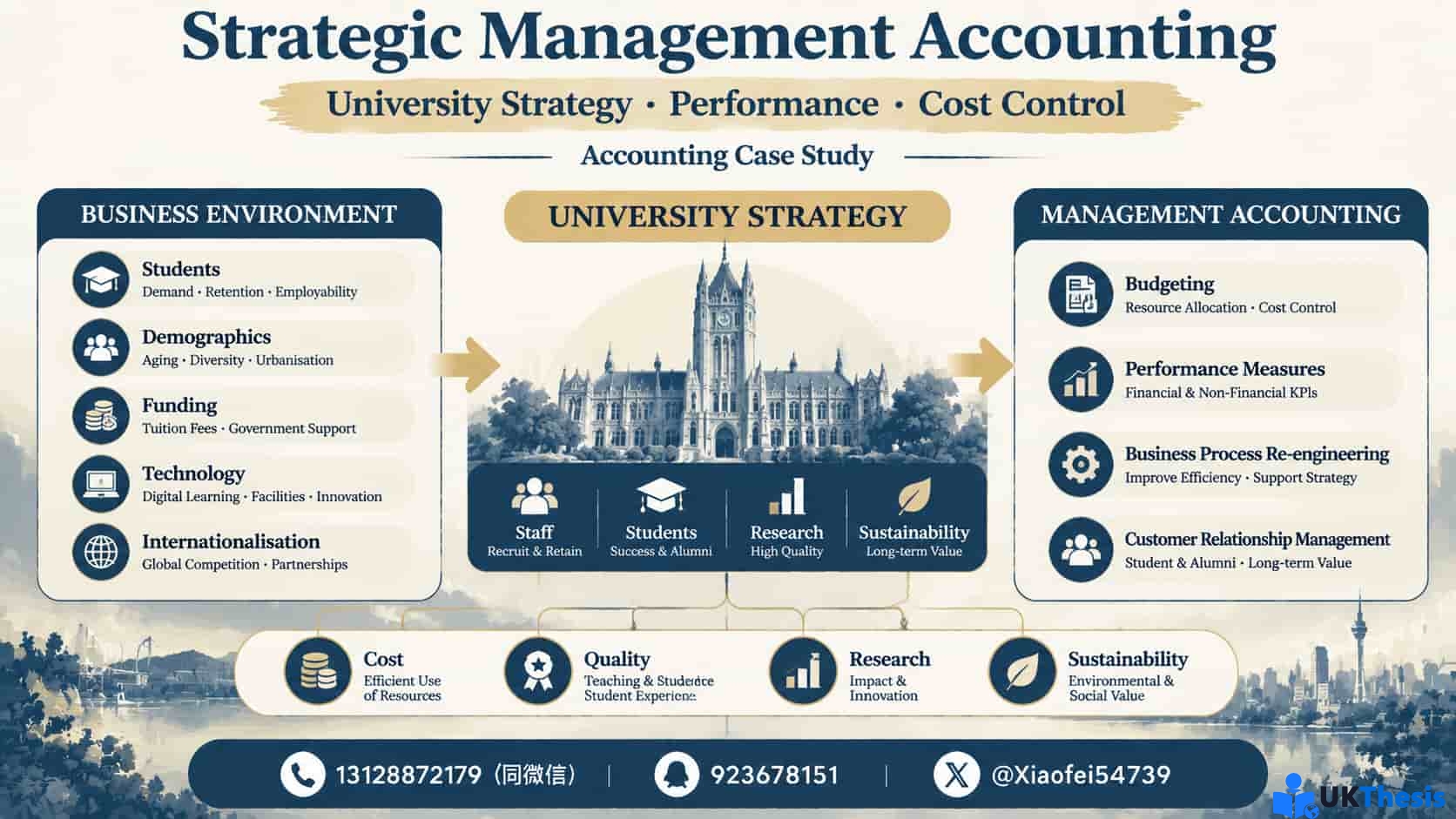
这篇案例以University of Auckland为背景,讨论高等教育机构面对学生需求、人口变化、学费压力、Technology和Internationalisation时,Strategic Management Accounting怎样支持资源配置、成本控制、绩效衡量和长期战略。
案例最初建立在University of Auckland 2013–2020战略框架及当时的行业资料上。现在学校已经进入Taumata Teitei – Vision 2030 and Strategic Plan 2028阶段,因此文中的具体战略和数字更适合作为Historical Case进行分析,而不是视为当前政策状态。
Changing Business Environment of the University
The tertiary education sector operates in a dynamic environment. Changes in labour-market demand, demographics, funding, technology and international competition can all influence how universities allocate resources and design programmes.
| External Change | Possible Impact on University Operations |
|---|---|
| Student and Employer Demand | Changes in programme demand, employability expectations and student retention requirements. |
| Demographic Change | Changes in student composition and the need to design services for more diverse communities. |
| Tuition and Funding Pressure | Pressure on income per student, programme costs and allocation of public resources. |
| Technology | Need for digital learning systems, facilities investment and new delivery models. |
| Internationalisation | Competition for international students, research partnerships and global reputation. |
学姐提醒:这种题目很容易一看到“business environment”就硬塞PESTEL。其实原案例已经按真实大学经营问题分好了Student Demand、Demographics、Funding、Technology和Internationalisation。与其重新套模板,不如顺着这些具体问题分析,更像真正的case study。
Student and Employer Demand
Changes in labour-market requirements can influence the type of tertiary qualifications students choose. As economic activity becomes more specialised and service-based, universities may face greater pressure to ensure that programmes remain relevant to employer needs.
For the University of Auckland, this means that student demand, programme retention and employability should form part of resource-allocation decisions. Programmes with declining demand may require review, while programmes connected with stronger research pathways or employment outcomes may justify additional investment.
Strategic management accounting can support these decisions by comparing programme cost, student demand, completion rates and longer-term outcomes rather than looking only at enrolment numbers.
Demographic Change
New Zealand has experienced long-term demographic change, including increased diversity, urbanisation and changes in the age and ethnic composition of the population.
For a university, demographic change affects far more than student recruitment. It can influence academic support, communication, programme design, campus services and the allocation of financial resources.
Strategic planning therefore needs information that shows not only how many students are enrolled, but also who those students are, what support they require and how successfully different student groups progress through the institution.
Tuition Costs and Funding
Funding tertiary education involves a combination of tuition fees, government support, research funding and other revenue streams.
Universities therefore face a difficult balance. Increasing the quality of teaching and research often requires greater expenditure, while tuition and public funding may be constrained.
This is where management accounting becomes useful. Instead of treating every programme as equally costly or equally valuable, managers can examine cost structures, resource utilisation and financial contribution more carefully.
| Management Question | Useful Information |
|---|---|
| Which programmes are financially sustainable? | Programme cost, enrolment, completion and resource usage. |
| Where should additional resources be allocated? | Demand, strategic importance, research value and student outcomes. |
| Which costs can be controlled? | Budget variance, staffing cost, facility cost and operational efficiency. |
Technology and International Competition
Technology has changed both the delivery of education and the skills required in the labour market. Digital platforms can improve the student experience, but they also create new investment requirements.
Universities may need to invest in information systems, digital learning tools, specialist facilities and staff capability. These investments create a classic management-accounting problem: the organisation must consider both immediate cost and long-term strategic value.
Internationalisation adds another layer. Universities compete not only with domestic institutions but also with overseas providers for students, staff, research partnerships and reputation.
As a result, strategic decisions increasingly require both internal financial information and external market information.
What Is Strategic Management Accounting?
Strategic Management Accounting extends traditional management accounting beyond internal cost information. It considers information about customers, competitors, markets and long-term strategic positioning.
For a university, this can include student demand, competitor programmes, research performance, staff capability, funding trends and the long-term cost of delivering academic services.
| Traditional Management Accounting | Strategic Management Accounting |
|---|---|
| Budgets and cost control | Long-term resource allocation and strategic positioning |
| Internal cost information | Internal plus competitor and market information |
| Short-term financial performance | Financial and non-financial performance over time |
| Operational efficiency | Strategy implementation and competitive position |
Strategy One: Recruit and Retain High-Quality Staff
The quality of academic and professional staff directly affects teaching, research and the overall student experience.
Recruitment therefore should not be analysed only as a salary cost. Skilled staff can contribute to teaching quality, research output, reputation and student outcomes.
At the same time, performance needs to be monitored. Possible measures include teaching quality, student engagement, research performance, professional development and contribution to strategic objectives.
Business Process Re-engineering (BPR) can support this strategy by reviewing how work is organised. Processes involving staffing, administration, teaching support and student services can be examined to identify unnecessary activities and improve resource utilisation.
Strategy Two: Successful Students and Alumni
A university's impact is strongly connected with the outcomes achieved by its students and graduates.
Relevant performance information can include student retention, qualification completion, student engagement, graduate outcomes and alumni relationships.
A Customer Relationship Management (CRM) system can support this strategy by collecting and analysing information about current students, prospective students and alumni.
Although the word “customer” sometimes sounds a little commercial in a university context, the underlying idea is useful: managers need consistent information about how students interact with the institution across the whole student journey.
| Metric | What It Can Indicate |
|---|---|
| Student Retention | Whether students continue successfully through their programmes. |
| Completion Rate | Effectiveness of academic and support systems. |
| Student Satisfaction | Quality of student experience. |
| Graduate Outcomes | Connection between education and longer-term student outcomes. |
| Alumni Engagement | Strength of long-term relationships with graduates. |
Strategy Three: High-Quality Research
High-quality research supports academic reputation, staff recruitment, student attraction and relationships with government, industry and communities.
Strategic management accounting can help managers balance research quality with the financial resources required to support it.
Budget planning can establish expected research costs, while cost variance analysis can compare planned and actual expenditure. Performance measures can also examine research quality, productivity, funding and impact.
这个地方不要只写“控制成本”。大学研究并不是成本越低越好。如果为了压Budget把真正有价值的研究也砍掉,那财务数字可能好看,战略反而失败。Strategic Management Accounting真正要做的是把Cost和Strategic Value放在一起判断。
Strategy Four: Sustainable University
Sustainability requires organisations to consider longer-term environmental, social and financial consequences rather than focusing only on short-term expenditure.
For a university, sustainability may involve energy use, waste reduction, building efficiency, procurement and the long-term cost of campus operations.
Measures such as improved lighting efficiency, waste reduction and better resource management may involve an initial investment but can reduce operating costs over time.
Strategic management accounting can therefore support sustainability by connecting resource consumption, cost and long-term organisational value.
Management Accounting Tools for the Case
| Tool | Possible Application at a University |
|---|---|
| Budgeting | Allocate resources across programmes, research and operations. |
| Variance Analysis | Compare planned and actual cost or performance. |
| Performance Measures | Track teaching, research, student and strategic outcomes. |
| BPR | Redesign inefficient administrative or service processes. |
| CRM | Analyse student and alumni relationships and communication. |
| Sustainability Accounting | Consider environmental and resource costs alongside financial performance. |
Financial and Non-Financial Performance
A university cannot be evaluated in exactly the same way as a profit-maximising commercial company.
Financial sustainability remains important, but strategic performance also includes educational quality, research impact, student outcomes, staff capability, reputation and social contribution.
This means that a purely financial measure such as annual surplus or cost reduction cannot provide a complete picture.
| Financial Measures | Non-Financial Measures |
|---|---|
| Cost per programme | Student completion |
| Budget variance | Student satisfaction |
| Research expenditure | Research impact |
| Facility operating cost | Staff quality and retention |
| Revenue per student | Graduate outcomes |
这也是Management Accounting essay里特别值得写的一点:大学不是工厂,学生也不是一件“产品”。所以不能拿一个成本数字就判断战略成功或失败。真正好的分析,会把Financial Measures和Non-Financial Measures放在一起。
How to Analyse a Strategic Management Accounting Case
如果遇到类似题目,我一般会先把内容分成三层,而不是一上来就罗列十个Accounting Tools。
| Step | Question |
|---|---|
| 1. Environment | What external change is affecting the organisation? |
| 2. Strategy | What is the organisation trying to achieve? |
| 3. Accounting Response | What information, measure or management tool can support that strategy? |
比如:
Technology changes student expectations → University invests in digital delivery → Management accounting evaluates cost, utilisation and student outcomes.
这样写就比“BPR的优点有三个、CRM的优点有四个”自然得多。
如果Accounting Assignment的题目涉及Business Environment、Strategy和Management Accounting,但不确定怎样把三者连起来,可以先梳理Case Structure、Accounting Tools和Critical Analysis,再进入完整正文。
FAQ
Strategic Management Accounting是什么?
Strategic Management Accounting是在传统内部成本和预算信息之外,进一步考虑市场、竞争者、客户以及长期战略的信息,用于支持组织的战略决策和绩效管理。
这篇属于Accounting Essay还是Case Study?
两者都有,但从内容看更接近Management Accounting assignment / Case Study,因为它围绕University of Auckland这一具体组织分析环境、战略和管理会计工具。
Business Environment一定要用PESTEL吗?
不一定。如果题目没有明确要求PESTEL,可以直接根据案例真正存在的外部变化分类。本案例中的Student Demand、Demographics、Funding、Technology和Internationalisation已经足以构成有逻辑的环境分析。
BPR属于Management Accounting吗?
BPR更准确地说是一种业务流程改进与管理工具,但可以和Management Accounting结合,用于分析流程成本、资源使用和运营效率。
CRM为什么会出现在Management Accounting案例里?
CRM本身不是传统会计工具,但其数据可以支持学生关系、服务质量、Retention和长期价值分析,因此能够为战略管理和绩效管理提供信息。
大学的绩效是不是看利润就可以?
不可以。大学需要考虑财务可持续性,但Student Outcomes、Research Quality、Staff Capability、Reputation和社会影响同样重要,因此Financial和Non-Financial Measures都需要使用。
University of Auckland 2013–2020战略现在还能作为案例吗?
可以,但应该明确把它作为Historical Case进行分析。现在University of Auckland已经采用新的Vision 2030和Strategic Plan 2028,因此不应把2013–2020计划描述成当前战略。
Conclusion
The University of Auckland case demonstrates that strategic management accounting can support organisational decisions far beyond traditional cost calculation.
Changes in student demand, demographics, funding, technology and international competition create both strategic opportunities and financial pressures.
Tools such as budgeting, performance measurement, variance analysis, Business Process Re-engineering and CRM can help managers connect strategic objectives with resource allocation and operational performance.
However, the value of strategic management accounting depends on selecting measures that reflect the organisation's real objectives. For a university, financial sustainability matters, but educational quality, research impact, student outcomes, staff capability and long-term social value must also be considered.
相关文章阅读
如果正在准备Accounting、Management Accounting或Business Strategy方向Assignment,可以继续阅读本站Performance Management、Strategic Management、Cost Management以及Accounting Case Study相关范文。建议内链围绕同一学习主题展开,不需要为了SEO把所有Accounting文章都放进一个页面。