DR-Transformer是什么?从稀疏注意力到SCI论文发表的完整研究案例解析

Transformer如何在保持较高分类准确率的同时降低计算成本,并让注意力结果更容易观察?本文以DR-Transformer为核心案例,完整介绍其在社交媒体压力检测中的研究思路,包括稀疏注意力、监督对比学习、Dreaddit数据集、模型训练、消融实验、可解释性分析以及计算效率比较。对于正在进行人工智能、自然语言处理、机器学习或数字健康方向研究的硕士、博士研究者来说,这也是一个很典型的SCI论文发表研究案例:真正影响SCI论文质量的并不是模型名称有多复杂,而是研究问题、创新点、实验设计、统计验证和Discussion能不能形成完整证据链。如果已经完成实验,但在论文结构、英文表达、目标期刊选择或投稿过程中遇到问题,我们也提供SCI发表辅导,从研究方案梳理、论文修改到期刊匹配和投稿流程提供持续支持,并可根据具体项目提供投稿无限期服务直到见刊。下面从DR-Transformer的研究设计开始,逐步拆解这项研究。
DR-Transformer研究概述
Automatic detection of stress in social media text holds promise for supporting digital mental health, but most existing Transformer-based approaches are opaque and computationally demanding. This work presents DR-Transformer, a Dual-Regularized Transformer that combines two complementary mechanisms: (i) a group sparsity penalty (L2,1/L2 elastic net) applied to the query and key projection matrices of every attention head, which encourages whole-row sparsity, producing more concentrated and inspectable attention patterns; (ii) a supervised contrastive loss on the [CLS] projection, which organizes the latent space according to the stress label.
The architecture is intentionally lightweight: six layers, eight heads, 256-dimensional embeddings and approximately 9.5 million parameters. It runs entirely on consumer-grade hardware using an NVIDIA GTX 1660 with 6 GB memory.
Experiments on the publicly available Dreaddit dataset compare DR-Transformer against Logistic Regression, BiLSTM, a Standard Transformer of identical architecture and MentalBERT. Across five seeded runs, DR-Transformer (Full) reaches F1 = 0.876 with a bootstrap 95% CI of 0.852–0.898, outperforming the Standard Transformer (F1 = 0.842) and performing comparably to the much larger MentalBERT (F1 = 0.879).
Sparse regularization increases the fraction of near-zero attention weights below 0.01 from 0.215 to 0.682, while supervised contrastive loss improves the silhouette score of [CLS] embeddings from 0.312 to 0.483. Dual regularization therefore combines accuracy, efficiency and structurally induced attention concentration in one model that can be trained without specialized infrastructure.
这里需要特别注意“interpretable”的使用范围。本研究所说的可解释性主要指更加集中、能够被观察的注意力结构,而不能直接等同于已经建立因果或机制层面的可解释性。Token deletion analysis只能为这一点提供部分、间接的支持。
1. Introduction:为什么要研究社交媒体压力检测?
Reddit、Twitter、Facebook等社交媒体平台上与心理健康有关的讨论不断增加,使这些文本逐渐成为公共健康研究中值得关注的实时数据来源。自然语言处理(NLP)和深度学习已经被用于从文本中识别压力、抑郁、焦虑以及自杀意念等信号。
Stress尤其值得研究,因为它是一种非常普遍的体验。如果能够进行大规模自动检测,在合理的伦理和隐私边界内,这类技术可能被应用于wellbeing intervention、content moderation以及epidemiological monitoring。
但真正落到实际应用时,目前的Transformer方法存在两个比较现实的问题。
第一是模型透明度。大型Transformer模型通常比较难解释。在临床或内容审核环境中,仅仅给出“有压力”或者“无压力”的分类结果是不够的,实际使用者还需要知道模型为什么做出这个判断。
第二是计算成本。从MentalBERT到MentaLLaMA,一些性能较强的模型拥有较大的参数规模,对训练和部署设备要求较高,这会限制资源有限环境中的使用。
DR-Transformer就是从这两个问题出发设计的。
1.1 DR-Transformer的四个主要研究贡献
Group-sparse attention regularizer:在query和key projection matrices上加入L2,1/L2 elastic-net penalty,使整个输入维度趋近于零,从而形成更加集中、容易检查的attention pattern。
Supervised contrastive loss:在[CLS] projection上加入监督对比学习,让同类别样本在latent space中更加接近,不同类别更加分离。
Lightweight architecture:模型采用6层、8个attention heads,总参数约9.5M,可以直接在单张NVIDIA GTX 1660 6GB显卡上完成训练和测试。
完整实验验证:在Dreaddit数据集上进行5次不同seed实验,并通过bootstrap confidence interval、McNemar significance tests和ablation study验证结果。
Group sparsity penalty和supervised contrastive loss本身都不是全新的技术,因此这项工作的创新点不能简单写成“提出了稀疏正则化”或者“提出了对比学习”。更准确地说,创新主要集中在三个方面。
第一,将L2,1/L2 group elastic-net penalty直接作用于query和key projection matrices(WQ、WK),而不是activation或者classifier output,从而在input dimensions上产生row-level sparsity,并进一步影响token-level attention weights。
第二,将两种regularization放入一个轻量级encoder中联合优化,而且整个模型从零开始训练,不依赖pretrained weights。
第三,通过统计检验和消融实验验证这种组合在mental health stress detection任务上能够取得accuracy、efficiency和attention inspectability之间比较好的平衡。
2. Related Work
2.1 Mental Health Detection from Social Media
早期的social media mental health detection主要依靠lexicon-based features以及传统分类器。之后CLPsych shared tasks和Dreaddit benchmark逐渐建立起用于区分distressed users和control users的数据基础。
近年来出现了time-aware attention、dual-context language models以及knowledge-aware attention等深度学习方法。MentalBERT这样的domain-adapted pretrained encoder通过在mental health subreddit文本上继续预训练,可以明显改善下游任务表现。
进一步发展之后,大语言模型也开始被应用到mental health analysis中,例如MentaLLaMA。不过multi-billion-parameter模型很难直接在普通consumer hardware上训练和部署。
近期研究仍然面临一个核心问题:怎样在model capacity、interpretability和deployment feasibility之间取得平衡。一些multimodal framework会把视觉表示和文本进行融合,在Dreaddit上可以获得较好的结果,但计算成本明显高于text-only approach。
也有研究将LDA topic features与BERT contextual embeddings结合,用于social media psychological stress detection。相比之下,DR-Transformer更关注一个相对不同的问题:能否在一个轻量模型中同时改善attention concentration和computational efficiency。
2.2 Sparse and Efficient Attention
Efficient-attention研究通常试图降低self-attention的O(N²)计算成本。例如Longformer和BigBird采用structured sparsity,Reformer则利用locality-sensitive hashing替代传统dot-product attention。
这些方法主要解决的是computational sparsity。DR-Transformer的思路不同,它在WQ和WK projection matrices上施加group L2,1 penalty,目标主要是产生更加集中的attention pattern,便于inspection。
因此,这两类方法并不是相互排斥的,理论上可以进一步结合。
2.3 Contrastive Learning for Text
Self-supervised contrastive learning可以在没有标签的情况下获得质量较好的sentence embeddings。Supervised contrastive learning进一步利用label信息,使same-class samples相互靠近、different-class samples相互远离。
DR-Transformer将这一objective应用于Transformer的[CLS] projection,为sparse attention regularizer提供互补信号。
3. Materials and Methods
3.1 Overall Architecture
DR-Transformer是encoder-only Transformer。模型利用同一个[CLS] representation同时产生class logit和normalized contrastive embedding。
整个pipeline可以分为四个阶段:首先使用BERT WordPiece进行tokenization;随后将embedding与learned positional encoding相加;再经过L=6层Transformer,每一层attention中的WQ和WK都受到group elastic-net penalty约束;最后的[CLS] embedding分别进入binary classifier和用于supervised contrastive loss的2-layer MLP projection。
| Architecture Item | Configuration |
|---|---|
| Embedding dimension | 256 |
| Attention heads | 8 |
| Transformer layers | 6 |
| Contrastive projection | 128 dimensions |
| Total parameters | Approximately 9.48M |
3.2 Input Representation
每一条post首先被处理为WordPiece token sequence。在序列开头加入[CLS],末尾加入[SEP],然后padding或者truncation到N=128,这一长度对应Dreaddit segment lengths的95th percentile。
X = [e[CLS], e1, …, eN, e[SEP]] + P
其中ei∈Rdmodel表示token embedding,P表示learned positional encoding matrix。
Token embeddings从N(0,0.02)随机初始化,然后与其他模型参数一起从头训练。DR-Transformer并没有使用BERT或者其他外部模型的pretrained embeddings。它只是为了兼容性继续使用BERT的WordPiece vocabulary(30,522 tokens)以及tokenizer。
这一点也是DR-Transformer和MentalBERT等fine-tuning approach的重要区别。约9.48M总参数中,embedding matrix约占7.8M,encoder layers约1.5M,classifier和projection heads约0.18M。
3.3 Transformer Encoder with Sparse Attention
对于layer l中的attention head h,queries、keys和values通过独立linear projections获得:
Q(l,h)=H(l−1)WQ(l,h), K(l,h)=H(l−1)WK(l,h), V(l,h)=H(l−1)WV(l,h)
Attention weights为:
A(l,h)=softmax(Q(l,h)K(l,h)ᵀ / √dk)
DR-Transformer的关键设计之一,是对WQ和WK加入group elastic-net regularizer。
||W||2,1 = Σ ||Wi,·||2
L2,1 norm计算每一行L2 norm之和,从而鼓励整个row逐渐接近0,相当于弱化特定input dimensions。Row-level sparsity随后进一步传播到attention weights,形成更加集中的token-level patterns。
Frobenius term则承担标准weight decay的作用。每个attention head的regularization由L2,1项和Frobenius项共同组成,所有layer和head的regularization进一步相加形成总sparse loss。
3.4 Supervised Contrastive Learning
模型在[CLS] embedding后连接2-layer MLP projection head g(·),生成128维L2-normalized vector zi。
对于batch size B=16、label yi∈{0,1}的样本,positive set定义为:
P(i)={j≠i : yj=yi}
Temperature τ设置为0.07。Loss计算只包含batch中至少存在一个positive example的anchor。
Dreaddit训练数据的label distribution大约为53.5% stress、46.5% non-stress,因此batch size为16时,一个anchor平均可以获得7–8个positive samples。训练过程中empty-positive情况低于2%的mini-batches。
与依赖user chronology的temporal contrastive loss不同,这种objective只使用batch-level class labels,因此理论上可以推广到其他labeled datasets。
3.5 Total Objective
最终训练目标由三个部分构成:
Ltotal = Ltask + β1Lsparse + β2Lsupcon
其中Ltask为classification cross-entropy,Lsparse控制projection matrix sparsity,Lsupcon负责优化class-aware latent representation,β1和β2控制两个regularization components的权重。
3.6 Training Procedure
初始化encoder、classifier head、projection head以及AdamW optimizer。
对每一个epoch进行dataset shuffle。
对每个mini-batch执行tokenization和embedding。
计算Transformer encoder output。
提取[CLS] embeddings。
计算contrastive projections并进行normalization。
通过classifier计算class logits。
分别计算task loss、sparse loss以及supervised contrastive loss。
组合得到total loss并进行gradient update。
在validation set上进行评估,如果F1提高则保存checkpoint。
最终返回validation F1最高的checkpoint。
实验使用多个随机种子重复运行,并采用独立split seed 7,以保证train、validation和test partitions在不同实验之间保持一致。
3.7 Dreaddit Dataset
研究使用公开的Dreaddit dataset。该数据集包含来自Abuse、Anxiety、Financial、PTSD和Social五类subreddit的大约190K Reddit posts,其中3553个segments经过binary stress labeling。
每个segment由5名Amazon Mechanical Turk workers进行标注,并通过majority vote确定最终label。
| Dataset Split | Samples | Stress Distribution |
|---|---|---|
| Train | 2554 | 53.5% |
| Validation | 284 | Stratified split |
| Test | 715 | 54.0% |
3.8 Experimental Setup
模型采用PyTorch 2.0.1、Hugging Face Transformers v4.35以及CUDA 11.8实现。
DR-Transformer以及Logistic Regression、BiLSTM、Standard Transformer等lightweight baselines运行于普通PC:Intel Core i7-10700、32GB DDR4 RAM、NVIDIA GeForce GTX 1660 6GB GDDR5以及1TB NVMe SSD。
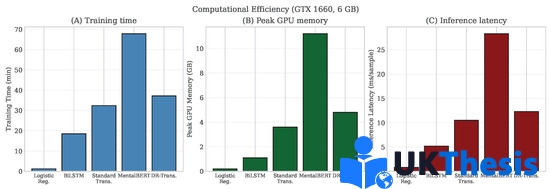
MentalBERT拥有约110M parameters,peak GPU memory达到11.2GB,超过GTX 1660的6GB容量,因此MentalBERT实验使用Google Colaboratory T4 GPU(15GB VRAM)完成。
这一实验环境差异本身也体现了DR-Transformer希望解决的问题:一个模型如果可以在普通6GB GPU上训练,其研究和部署门槛显然低于必须依赖high-memory GPU的模型。
3.9 Hyperparameter Selection
Hyperparameter selection在validation set上通过grid search完成。搜索范围包括λ1∈{10−3,10−2,10−1}、λ2∈{10−4,10−3,10−2}、β1∈{0.05,0.10,0.20}、β2∈{0.01,0.05,0.10}以及learning rate η∈{1×10−5,2×10−5,5×10⁻⁵}。
Temperature τ=0.07根据supervised contrastive learning中的常见设置提前固定,因此并不是自由搜索参数。最终选择validation F1最高的configuration。
3.10 Baselines
实验比较以下模型:
Logistic Regression (BoW):TF-IDF weighted unigrams和bigrams,C=1。
BiLSTM:2 layers,每个direction 128 hidden units,200-dimensional learned embeddings。
Standard Transformer:architecture与DR-Transformer一致,但是β1=β2=0。
MentalBERT:mental/mental-bert-base-uncased,fine-tuned 4 epochs,learning rate 2×10⁻⁵。
DR-Transformer (Sparse Only):β2=0。
DR-Transformer (SupCon Only):β1=0。
实验没有加入DistilBERT或RoBERTa-base这样的compact pretrained encoder。原因是这些模型已经从billions of tokens的pretraining中获得representation,而DR-Transformer完全从Dreaddit上从零开始训练,直接比较会同时混入pretraining advantage。
不过这也是当前研究的一个局限。未来如果要更加完整地证明DR-Transformer的实际优势,需要在matching initialization conditions下加入compact pretrained encoders进行controlled comparison。
3.11 Evaluation Metrics and Statistical Testing
Classification evaluation包括binary F1、accuracy、precision、recall以及AUC-ROC,并报告5次seeded runs的mean ± standard deviation。F1同时计算10,000次resamples的bootstrap 95% confidence interval。
McNemar tests分成两个层次。第一种是per-seed test,即每个seed分别在test predictions上计算McNemar test,再进行Bonferroni correction。第二种是pooled test,即把5个seed的prediction合并。
需要注意的是,pooled predictions实际上重复使用了相同的715个test instances,因此并不完全满足independence。相应的pooled p-value只能作为secondary Reference,而不能脱离这一限制进行解释。
Interpretability evaluation包括attention sparsity、[CLS] embeddings的silhouette score以及token deletion confidence drop。
Efficiency evaluation则考察training time、peak GPU memory以及200次single-sample forward passes后的inference latency。
4. Results
4.1 Classification Performance
DR-Transformer (Full)最终达到F1=0.876,bootstrap 95% CI为0.852–0.898,AUC-ROC达到0.922。
Standard Transformer的F1为0.842,因此DR-Transformer获得了比较明显的提升,McNemar test在Bonferroni correction之后达到p<0.001。
MentalBERT的F1为0.879,与DR-Transformer的比较没有达到statistical significance(p=0.421)。也就是说,从现有实验结果来看,不能简单宣称DR-Transformer优于MentalBERT,更合理的结论是两者表现相近。
值得关注的是,DR-Transformer参数量大约只有MentalBERT的十二分之一,而且训练时间不到后者的一半。
4.2 Training Dynamics
在代表性seed的training dynamics中,cross-entropy、sparse loss和contrastive loss都会随着训练逐渐下降。Sparse和contrastive components始终小于cross-entropy component,说明regularization并没有明显破坏模型优化过程。
4.3 Interpretability
DR-Transformer (Full)的attention sparsity达到0.682,Standard Transformer只有0.215。这说明L2,1/L2 penalty确实产生了更加集中的attention distribution。
Supervised contrastive loss同样改善了[CLS] embedding separability。Silhouette score从Standard Transformer的0.312提高到DR-Transformer Full的0.483。
| Metric | Standard Transformer | DR-Transformer Full |
|---|---|---|
| F1 | 0.842 | 0.876 |
| Attention sparsity | 0.215 | 0.682 |
| Silhouette score | 0.312 | 0.483 |
| Attention entropy | 3.84 nats | 2.43 nats |
Attention entropy进一步支持这一观察:DR-Transformer将mean attention entropy从3.84 nats降低到2.43 nats,说明attention distribution更加集中。
但attention concentration并不能自动证明causal faithfulness。因此研究进一步进行了token deletion analysis。
4.4 Token Deletion Analysis
研究在完整test set上进行token deletion analysis。对于每个example,首先找到DR-Transformer最后一层中获得最高[CLS] attention weight的top-1 token,然后将其替换为[MASK],重新运行模型,并观察original predicted class confidence下降多少。
同样的procedure也应用于Standard Transformer。
DR-Transformer在top-attended token被mask之后,mean confidence drop达到Δp=0.187±0.093;Standard Transformer只有Δp=0.092±0.071。在715个test examples上的t-test结果为p<0.001。
这一结果说明DR-Transformer重点关注的tokens平均而言具有更强的predictive relevance,为concentrated attention patterns的有效性提供了部分支持。但这依然不能替代完整的comprehensiveness和sufficiency faithfulness evaluation。
4.5 Qualitative Attention Analysis
研究还检查了true positive、true negative、false positive以及false negative四类prediction outcomes。
例如在“I just cannot sleep at night anymore. Every day feels like the same struggle.”这个example中,Standard Transformer的attention相对分散,而DR-Transformer更集中于“ca not”“sleep”“struggle”等具有情绪和压力含义的tokens。
True positive cases中,模型通常关注negations、affect words以及表示hopelessness的temporal markers,例如“anymore”“never”“struggle”。
True negative cases的attention则更多分布于factual或neutral tokens。
False positive cases暴露出模型容易过度关注negative-valence words的问题,即使整段文本实际并不代表distress。
False negative cases则经常包含implicit或indirect stress expressions,因为缺乏明显lexical markers,两种模型的attention都会更加分散。
4.6 Computational Efficiency
DR-Transformer相对于Standard Transformer只增加了比较有限的computational overhead,因为regularizers本身并不会增加模型参数,只增加backward-pass中的计算项。
MentalBERT则明显更大、更慢,需要接近12倍的parameters、约3倍training time以及约2.3倍GPU memory。
因此,这项工作的价值并不仅体现在F1提高。如果研究场景受到hardware限制,一个可以在GTX 1660 6GB GPU上从零训练的模型,本身就具有比较明显的accessibility优势。
5. Discussion
5.1 Principal Findings
实验表明,将group-sparse attention与supervised contrastive loss结合之后,可以得到一个在accuracy、efficiency以及structural transparency之间相对平衡的Transformer。
Ablation results进一步说明两个regularizer承担的作用并不完全一样。
Sparse Only主要提高attention concentration,但会产生一定accuracy cost;SupCon Only能够改善accuracy以及embedding separability,但是attention仍然比较分散;Full model则同时保留两者的优势。
Full model在binary stress classification上的表现与规模明显更大的MentalBERT相近,而且能够直接在6GB consumer GPU上完成end-to-end training。
5.2 Comparison with Existing Approaches
DR-Transformer没有依赖MentalBERT的domain-specific pretrained knowledge,而是通过两个architectural priors进行补偿:一个负责structurally concentrated attention,一个负责class-aware geometry。
与Longformer、BigBird和Reformer相比,DR-Transformer解决的是不同方向的问题。前者主要解决long sequence下的computational efficiency,DR-Transformer主要通过projection matrix sparsity提高attention concentration,因此未来存在结合两种思路的可能。
与multimodal stress detection方法相比,DR-Transformer保持text-only structure,并以更低computational cost获得有竞争力的表现,更适合resource-constrained deployment scenarios。
5.3 Ethical Considerations
Automated stress detection涉及真实用户的心理健康文本,因此任何实际部署都必须考虑false positives、privacy、bias以及crisis routing。
模型预测不能单独触发干预,应保留human-in-the-loop review。Passive monitoring涉及用户consent,实际应用需要遵守平台规则以及GDPR等适用的数据保护要求。
Dreaddit主要是English-language data,并存在demographic bias风险,因此模型推广到不同language、age和gender群体之前仍需要fairness audit。
同时必须区分stress和mental health crisis。Stress classification model不能替代经过验证的clinical screening。
5.4 Limitations
Dataset:Dreaddit只有3553个labeled segments,而且仅包含English-language data。未来需要multilingual和cross-platform validation。
Binary task:当前只进行binary stress classification,未来可以研究multi-class或者continuous severity prediction。
No temporal modeling:模型将每个segment作为independent example,没有处理longitudinal user data。
Limited interpretability evaluation:虽然研究进行了attention sparsity、attention entropy、token deletion以及qualitative attention maps分析,但没有clinical-expert evaluation,也没有完成全面的comprehensiveness/sufficiency tests。
Baseline scope:实验没有纳入DistilBERT、RoBERTa-base等compact pretrained encoders,因此现有结果不能回答DR-Transformer在realistic fine-tuning conditions下是否优于这些模型。
5.5 Implications
这项研究至少带来三个值得继续讨论的方向。
第一是accessibility。并不是所有有竞争力的NLP模型都必须依赖高端GPU,在architecture和training objective设计合理的情况下,consumer hardware依然能够完成有价值的实验。
第二是structural transparency。Structurally induced attention concentration可以成为post-hoc explanations之外的另一种思路。当然,attention sparsity仍然不能直接等同于完整faithfulness。
第三是methodological reuse。Structured sparsity加supervised contrastive learning的组合并不局限于stress detection,也可能迁移到其他healthcare text classification problems。
6. Conclusions
DR-Transformer是一种面向social media stress detection的Dual-Regularized Transformer。Group-sparse attention能够形成更加集中、便于检查的token-level attention patterns;supervised contrastive learning则改善class-aware latent geometry。
在Dreaddit上,combined model达到F1=0.876,表现与MentalBERT接近,同时参数数量约少12倍,并且能够直接在单张GTX 1660上完成end-to-end training。
Token deletion analysis为concentrated attention patterns的predictive relevance提供了部分证据,不过完整faithfulness evaluation以及expert user studies仍然是未来需要解决的问题。
后续研究可以继续探索multi-class severity prediction、structured sparse attention与long-document classification的结合、cross-lingual transfer、clinical expert user studies、structured clinical lexicons,以及与compact pretrained encoders在equivalent conditions下的controlled comparison。
从这篇研究看,AI与NLP方向SCI论文投稿真正应该准备什么?
如果把DR-Transformer当作一个完整的SCI论文发表案例来看,会发现论文能不能投稿并不只是看“模型准确率提高了多少”。研究问题、创新点、baseline选择、ablation study、statistical significance、limitations以及结果解释实际上是连在一起的。
尤其是人工智能、机器学习、Transformer、NLP等方向,审稿人通常不会只接受一句“我们的模型效果更好”。为什么选择这个regularizer?为什么使用这些baseline?提升来自哪一个component?结果是否具有statistical significance?模型增加了多少computational cost?所谓interpretability到底证明到了什么程度?这些问题都需要在正文中找到对应证据。
这也是不少作者在SCI期刊投稿阶段容易遇到的问题:实验本身可能已经做了很多,但论文没有把research Question、method、results和discussion组织成一条清楚的证据链。
| 投稿前检查 | AI/NLP论文重点 | 常见问题 |
|---|---|---|
| Research Gap | 是否明确现有方法缺什么 | 只介绍模型,没有真正的问题 |
| Innovation | 创新是否具体到method level | 把已有技术组合直接称为全新方法 |
| Baselines | 比较对象是否合理 | 只与较弱模型比较 |
| Ablation | 证明每个module贡献 | 只有Full Model结果 |
| Statistics | CI、显著性和多seed结果 | 只报告单次最高accuracy |
| Discussion | 解释结果而不是重复结果 | Discussion写成Results复述 |
SCI发表辅导与投稿支持
对于已经完成研究,但卡在论文结构、实验呈现、英文修改、期刊选择或者投稿流程的作者,我们提供SCI发表辅导。不同论文遇到的问题并不一样,因此实际处理时会先判断稿件目前处于研究设计、初稿、返修还是重新投稿阶段,再决定后续需要处理的内容。
人工智能、计算机科学、机器学习、自然语言处理等论文,比较常见的问题包括创新点表达不够准确、baseline不足、实验表格逻辑混乱、Discussion深度不足、英文表达与目标期刊风格不一致等。对于有进一步需求的作者,也可以根据研究方向和稿件情况咨询SCI论文代写、论文修改、润色、投稿以及SCI期刊代发相关支持。
对于需要长期处理投稿流程的项目,我们可提供投稿无限期服务直到见刊,包括期刊匹配、投稿材料检查、投稿流程跟进、审稿意见分析、返修阶段支持以及被拒后的重新选刊等。具体期刊和周期仍需要根据论文质量、研究方向以及期刊审稿情况判断。
FAQ:SCI论文与DR-Transformer研究常见问题
Q1:DR-Transformer是什么?
DR-Transformer是一种Dual-Regularized Transformer,通过group-sparse attention regularization和supervised contrastive learning,同时改善attention concentration以及class representation。该模型主要用于本文的social media stress detection任务。
Q2:DR-Transformer比MentalBERT好吗?
不能根据当前实验直接这样判断。DR-Transformer的F1为0.876,MentalBERT为0.879,两者差异没有达到统计显著性。DR-Transformer更明显的优势是参数规模和硬件需求较低。
Q3:Sparse Attention有什么作用?
本文通过对WQ和WK加入group sparsity penalty,使attention更加集中。实验中attention sparsity从Standard Transformer的0.215提高到了0.682。
Q4:AI方向SCI论文投稿只看模型准确率吗?
不是。除了accuracy或F1,研究问题、创新性、baseline、ablation、statistical testing、computational cost、limitations以及结果解释通常都会影响论文整体说服力。
Q5:SCI发表辅导一般可以解决哪些问题?
通常可以围绕研究结构梳理、论文修改、英文表达、目标期刊匹配、投稿材料、审稿意见分析和返修等环节展开。对于AI和NLP论文,还需要重点检查实验设计、baseline、ablation以及结果解释是否完整。
Q6:投稿无限期服务直到见刊是什么意思?
主要针对需要持续投稿支持的作者,在稿件条件允许的情况下,从选刊、投稿到审稿意见处理、返修以及必要时重新选刊持续跟进。SCI审稿结果和见刊时间由期刊编辑部及审稿流程决定,因此具体周期需要结合目标期刊和稿件情况判断。