The Influence of Exchange Rate Risk on Chinese Commercial Service Trade---A Study on China Exports t

04-04, 2014
The Influence of Exchange Rate Risk on Chinese Commercial Service Trade---A Study on China Exports to U.S.
汇率风险对中国商业服务贸易的影响---对中国出口美国的研究
汇率风险对中国商业服务贸易的影响---对中国出口美国的研究
1.0 introduction 引言
During the Asian Financial Crisis in 2007, the Chinese government was keeping the exchange rate of RMB under the huge pressure so that gaining the praise from all over the world. But, the Chinese government was facing with the international pressure about increasing in value. After July 2005, the Chinese government began to implement floating exchange rate system based on the supply and demand of the financial market, so that the economic impact of exchange rate appreciation has already emerged.
2007年亚洲金融危机期间,中国政府在巨大的压力下保持人民币汇率的稳定,获得了来自世界各地的一致好评。但是,中国政府正面临着与对价值增加的国际压力。 2005年7月后,中国政府开始根据金融市场的供给和需求来实现的浮动汇率制度,汇率升值对经济的影响已经出现了。
There are two modes on the influence of exchange rate for the export, which include the appreciation or depreciation of the exchange rate or the exchange rate risk. The depreciation of exchange rate can reduce the price of export product, which may stimulate the capacity of export for increasing so that it can enhance the foreign income of export country. On the other hand, the export country can maintain the international market quotient by reducing the price of export product using the pricing right. For the exchange rate risk, it may beat the enthusiasm of the export traders; as a result of the exchange rate risk can bring the negative effect for export by increasing the venture profit. Therefore, there are two research Questions of this study for indicating the economic impact of exchange rate risk on Chinese commercial service trade.
有两种出口模式对汇率有影响,其中包括汇率的升值或贬值或汇率风险。汇率的贬值可以降低出口产品的价格,这可能会刺激出口能力增加,以便它可以提高出口国的国外收入。在另一方面,出口国可以通过降低出口产品的价格使用定价权保持国际市场商。对于汇率风险,它可能会击败出口贸易商的积极性;作为汇率风险的结果可以通过增加企业利润带来负面影响。因此,本研究的用于指示的汇率风险对中国商业服务贸易对经济的影响的两个问题的研究。
2.0 literature review 文献回顾
Until now, there are lots of achievements on the study of the relationship between the exchange rate changing and the international trade all over the world.
2.1 The Impact of Exchange Rate Changing on Export
The relationship between the exchange rate changing and export is fine-spun. Guittian (1976) has already pointed out that the exchange rate floating can blaze a way in the direction and number of the supply and demand, so that it can accelerate the success of international business by satisfying the of the ability of domestic increasing production overseas excess demand. And, Megda, et al (2007) indicated that the combination of supply and demand decides that the final impact on the number and price, which caused by the exchanging rate floating. In addition, Junz & Rhomberg (1973) has shown the result of their study, which is the exchange rate depreciation, is good for the improving the export income of implementing fixed exchange rate system in the developed countries. Athukorala & Menon also got the same result on this topic in 1994. Therefore, it shows that the there is closed relationship between the exchange rate changing and export.#p#分页标题#e#
2.2 The Relationship between the Exchange Rate Risk and International Trade
The exchange rate floating is a kind of risk, which can bring the impact for the international trade. The microcosmic thinks that the uncertainty of price can bring in the competitive companies reducing their output level. The researcher Ethier (1973) pointed out that abiding the increasing of uncertainty can reflect on the farther cut down of the export. In addition, Sercu and Vanhulle (1992) brought forward that the international trade may get profit from the increasing of the exchange rate risk, so that it shows the trade price is the gain-function of the risks. In addition, some empirical study got that the relationship between the exchange rate risk and export is negative on impact. From above, it can get that the exchange rate risk can give the foreclose on the international trade nowadays.
2.3 The Influence of RMB Appreciation
Chou (2000) indicated that the exchanging rate floating on RMB has the long-term negative impact for the total export, manufacturing export and mineral fuel export, after studying the impact of RMB exchange rate. On the other hand, Jan, et al (2006) got that the negative effect of RMB appreciation on export can dilute by the actual export impact of exchange rate across. For studying the reasons why the Chinese government would not like to appreciation currency, Bowles and Baotai (2006) shows that the Chinese government is use tax refund to adjust the negative effect of exchange rate, as a result of the Chinese government don’t want to partake the financial deficit of American.
3.0 Methodology 方法
For most study of exchange rate risk and export, Chou & Shih (1998) pointed out that the variables included lagged import demand, the GDP of the import country or replaced variable, the actual exchange rate, the actual exchange rate fluctuating, and so forth. This paper will use the four former variables which used more frequently. Due to the literatures, this paper has two hypotheses for studying the economic impact of exchange rate risk on commercial service trade. The first hypothesis is that the RMB appreciation has the positive effect on the China export to U.S., while the second hypothesis is that the relationship between the exchange rate risk and the export trade is positive correlation.
3.1 The Autoregressive Garch Model
The function of the autoregressive garch model is to indicate the impact of the exchange rate changing on export. Due to the research of Chou (2000), the equation for this study is:
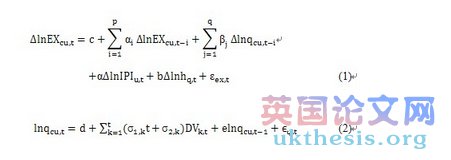
stands for the actual export to U.S. in the month t, c is the constant, is the actual exchange rate of RMB and dollar, stands for the American Industrial Production Exponent, and is the conditioned fluctuating of RMB exchanged to dollar. In the model (2), is the time dumb variable which used to hold the exchange rate characteristic. About model (1) and (2), and are supposed to be the normal school, and fit the GARCH models which are shown as below:#p#分页标题#e#
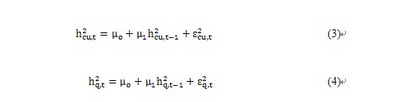
stands for the actual export to U.S. in the month t, c is the constant, is the actual exchange rate of RMB and dollar, stands for the American Industrial Production Exponent, and is the conditioned fluctuating of RMB exchanged to dollar. In the model (2), is the time dumb variable which used to hold the exchange rate characteristic. About model (1) and (2), and are supposed to be the normal school, and fit the GARCH models which are shown as below:#p#分页标题#e#
From above, the model (1) will be used in this study to indicate the demand of import between China and America.
3.2 Selection of Data
Firstly, the data for this study will use the data from the 1992 to 2009, because the economic frameworks of these 18 years are similar in China which supple a steady environment for the study. In addition, the data of which stands for the export from China to U.S., stands for the exchange rate between RMB and dollars, stands for the American
Industrial Production Exponent, which means the American inflation are comes from the CCER Database.
4.0 Limitation 局限性
The results of the study are just can indicate the impact of the Chinese RMB for China exports to U.S. and the relationship between the exchange rate risk and the export trade. It’s better to study the dynamic condition of the Chinese RMB exchange rate and the China export to U.S. which can be used DCC model to prove, so that it can give a better understanding about the exchange rate risk in the Chinese commercial service trade.
Reference 参考文献:
Ethier, W., 1973, International trade and the forward exchange market, American Economic Review, Vol. 63, pp.494—503
Guittian, M., 1976, The effects of changes in the exchange rate on output,prices,and the balance of payments, Journal of International Economics, Vol. 6, pp.65-74
Magda, K., Berument, H. & Dincer, N.N., 2007, The effects of exchange rate fluctuations on economic activity in Turkey, Journal of Asian Economics,Vol. 18(3), pp.466-483
Junz, H.B. & Rhomberg, R., 1973, Price Competitiveness in Export Trade among Industrial Countries, American Economic Review, Vol. 63(2), pp.412-418
Athukorala, P. and Menon, J., 1994, Pricing to market behavior and exchange rate pass through in Japanese exports, The Economic Journal, Vol.104, pp.271—281
Sercu, P. & Vanhulle, C., 1992, Exchange Rate Volatility,Exposure and the Value of Exporting Firms, Journal of Banking and Finance, Vol. 16, pp.155
Chou, W.L., 2000, Exchange Rate Variability and China’s Exports, Journal of Comparative Economics, Vol. 28, pp.61-79
Jan, P.V., Guangzhong, L. & Jimmy, R., 2006, Does China Really Lose from RMB Revaluation? Evidence from Some Export Industries, Applied Economics, Vol.38, pp.1715—1723#p#分页标题#e#
Bowles, P. & Baotai, W., 2006, Flowers and Criticism: The Political Economy of the Renminbi Debate, Review of International Political Economy,Vol.13 (2), pp.233-257
Chou, W.L. & Shih, Y.C., 1998, The equilibrium exchange rate of the Chinese Renminbi, Journal of Comparative Economics,Vol. 26, pp.165-174