project 代写:基于重力势能转换的投石机动力学建模与弹道优化分析 (A Kinetic Modeling and Ballistic Optimization Analysis of a Counterweight Trebuchet)

The Trebuchet Challenge
本课题聚焦于古典机械工程中的经典物理问题,要求学生设计、建造并校准一台由重力驱动的配重式投石机,核心目标是通过最大化利用下落配重物的重力势能,来提升弹丸的平动动能与射程。作为多学科交叉的复杂工程项目,其力学推导、材料选择与数据校准极具挑战。如果您在完成此类物理/机械类课题时感到力不从心,我们作为专业的留学生代写平台,提供一站式的 project 代写 服务。无论是机械结构设计、MATLAB仿真还是完整的留学生论文代写,我们的名校工程专家团队都能为您量身打造高分方案,确保您的学术作业严谨合规、按时交付。
Challenging the pinnacle of AP Physics Mechanics: Technical Report on “Gravity-Driven Siege Warfare”
(Technical Brief) High-score completion guide.
Why is this program considered a “grade-point-killer” for international students?
In AP Physics (Mechanics) or university engineering mechanics courses taught abroad, “The Gravity-Powered Siege” is a highly valuable summative project. The core objective of this project is to seaMLessly transition abstract theoretical mechanics models into real-world engineering applications.
Many students mistakenly believe that this exercise is merely a straightforward hands-on activity. However, the true core assessment lies in scientific practices. Each student must submit a comprehensive technical brief independently. Given the stringent grading criteria and tight timelines, effectively presenting intricate diagrams, energy dissipation under non-ideal conditions, and efficiency formulas in a seamless manner is crucial for achieving an A grade.
If you’re feeling anxious about creating a physical model or writing a report for this project, as a professional platform specializing in academic support and project guidance for international students, we offer comprehensive guidance on writing projects and experimental reports, helping you overcome challenges with ease.
Technical Challenges and Writing Solutions for Core Deliverables: Our team of top-tier engineering experts will provide precise academic assistance to address the three critical metrics required for this project:
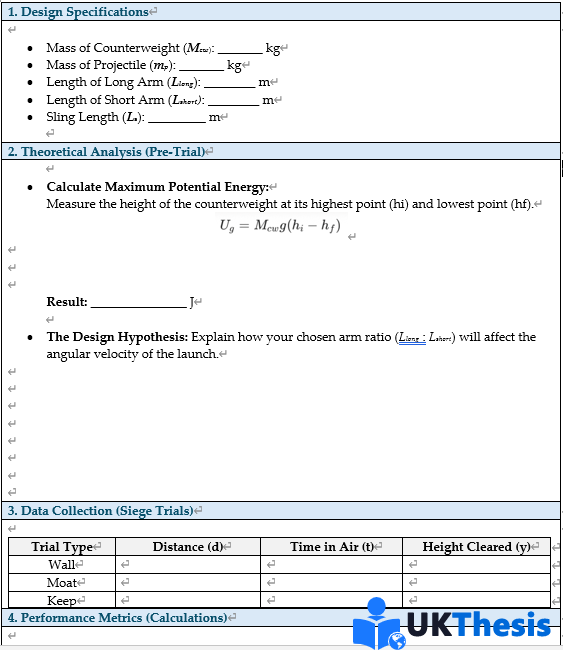
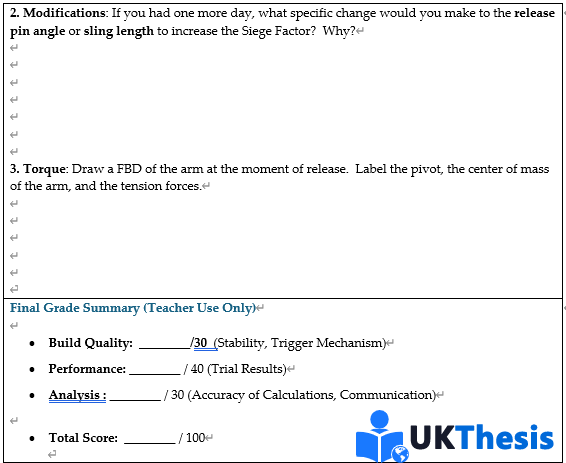
1. Dynamic torque and center of mass spatial modeling (TorqueAnalysis)
Technical Requirements: It is essential to conduct a quantitative analysis of the forces acting on the throwing arm of the catapult during its critical state of “Moment of Release.”
Coaching/Writing Highlights: We will meticulously create a Force Balance Diagram (FBD) for you, accurately pinpointing the mass center of the composite system consisting of the pendulum arm, movable counterweights, and suspended projectiles. This is achieved through rigorous equations of rotational motion:

2. Energy dissipation and ballistics prediction under non-ideal conditions (Energy Transformation).
Technical requirements: Compare the theoretical range predicted by theory with the actual range tested.
Highlight of tutoring/writing assistance: Simple.
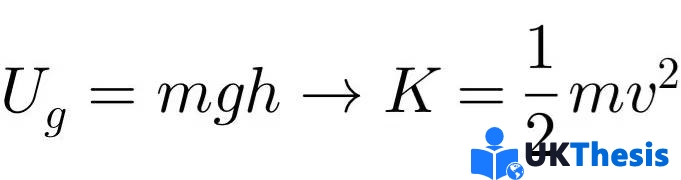
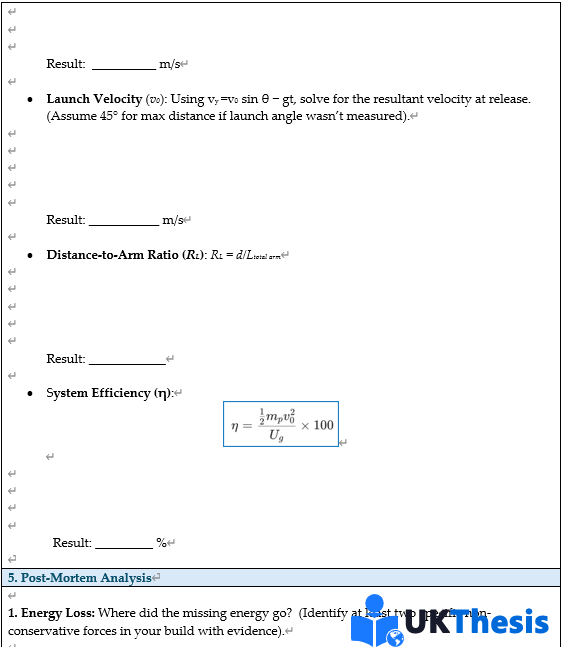
Ug = mgh → K = 5mu² is an idealized scenario. In actual engineering applications, it is essential to consider the rotational inertia of the armature and the friction of the bearings. We can assist you in constructing a comprehensive model that accounts for energy conservation corrections.

Additionally, we perform error quantification analysis based on projectile kinematics to ensure that your theoretical calculations align perfectly with experimental data.
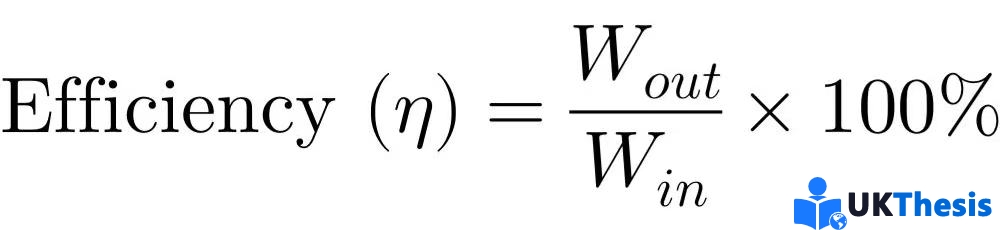
3. In-depth assessment of the system’s mechanical efficiency (Efficiency Calculation).
Technical Requirements: Accurately quantify and evaluate the ratio of work output (WorkOut) to work input (WorkIn).
, Tutoring/Essay Writing Highlights:
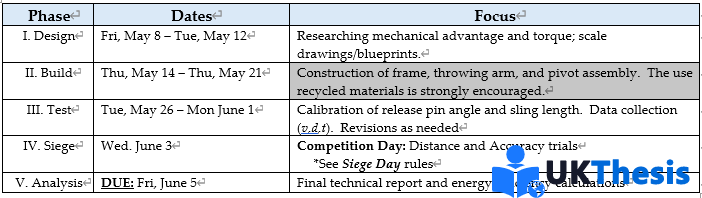
Timeline
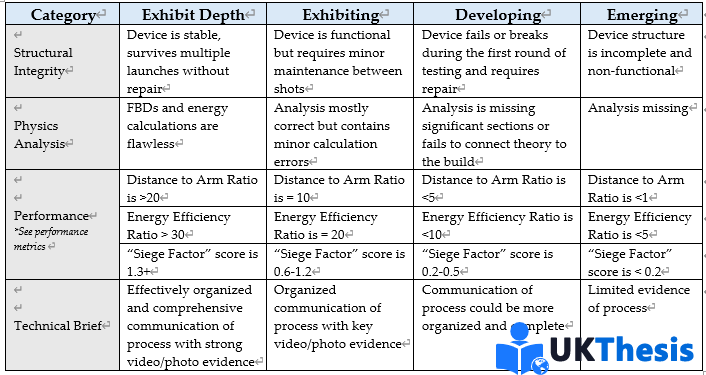
Grading Rubric
Design Criteria
1. Energy Transduction Efficiency
Quantify the efficiency of the conversion of kinetic energy from the initial state of the weighted object falling to the moment when the projectile separates from the sling. Conduct an in-depth analysis of the impact of bearing friction and the mass of the pendulum arm on mechanical energy losses.
Wioss = AUg -AK
2. Ballistic Consistency
Multiple rounds of launch tests were conducted under identical gravity-balancing conditions, with the introduction of standard deviation (SD) and confidence interval (CI) to assess the precision of landing points within a 3-6 meter target area.
3. Dynamic torque output optimization (Dynamic Torque Optimization)
Design Requirements
Projectile Selection
The launching object is limited to either a standard squash ball or a large marshmallow. The chosen projectile must possess sufficient mass to sustain stable flight trajectories while remaining lightweight and soft enough to prevent property damage such as broken glass.
Counterweight Limitation
The gravitational counterweight shall use standard laboratory weights with a restricted mass range of 1.0 kilogram to 1.5 kilograms. No overweight or underweight counterweight configurations are permitted.
Structural Frame Dimensions
The assembled trebuchet frame has a maximum vertical height limit of 50 centimeters. Its base structure must fit entirely within a 50 cm × 50 cm square footprint. This dimensional constraint ensures the device can operate safely on laboratory bench surfaces or floor spaces without vertical clearance issues.
Construction & Mechanical Requirements
Construction materials are flexible and include common options such as timber, PVC piping, and metal components. A functional sling launching system is mandatory to satisfy the structural definition of a legitimate trebuchet device.
Energy Source Regulation
The entire launching mechanism must rely exclusively on gravitational potential energy for propulsion. The use of any auxiliary power sources, including mechanical springs, electric motors, and compressed air systems, is strictly prohibited.
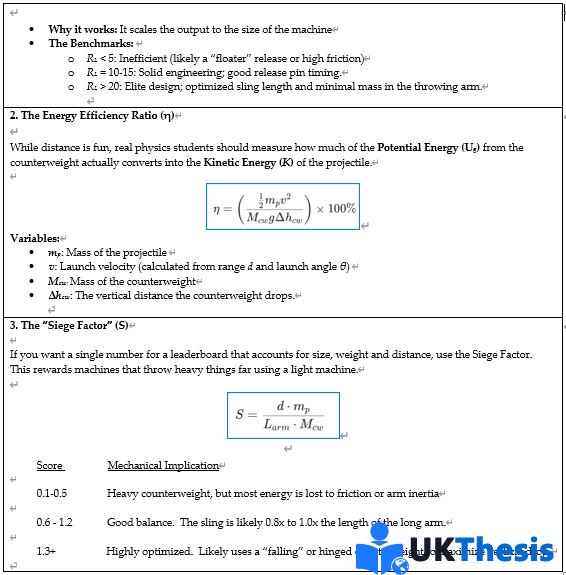
Normalized Performance Metrics For Trebuchets

Siege Tournament Event Arrangements (Three Rounds of Competition)
Round 1: Barrier Crossing Challenge (Vertical Launch Ability)
Participants need to launch objects to pass over a simulated fortress barrier, which is set as a horizontal rod or PVC pipeline 5 meters away from the launching spot.
• Competition Rules: The initial height of the barrier is set at 2 meters, and each group is granted two launching attempts. Once participants successfully clear the obstacle, the barrier height will be raised by 0.5 meters accordingly.
• Physical Principle: This event examines students’ mastery of projectile launch angles. Compared with long-distance launching, this challenge demands a larger launch inclination angle to complete the task.
Round 2: Ditch Range Contest (Horizontal Flight Capability)
It is a traditional long-distance launching match, and a baseline effective flight distance is set to rule out unreasonably simple device designs.
• Competition Rules: The final result is confirmed by recording the farthest landing rebound position of the thrown item.
• Physical Principle: This round focuses on verifying the most reasonable length proportion between the sling and the throwing arm. In general, matching the sling length with the long throwing arm length can generate the best acceleration flinging effect.
Round 3: Fort Target Strike (Launching Precision)
A fixed target such as a hula hoop or storage bucket is placed within the range of 3 to 6 meters. Competitors gain scores when the projectile lands fully inside the target area or touches the target edge.
• Physical Principle: This assessment checks the operational stability of the launching device, testing whether participants can restore the equipment to the identical initial state for every launch.
Detailed Scoring Standards
1. Barrier Crossing Challenge
Earn 10 points for every 0.5-meter increase in cleared height
Knowledge application: Calculation of vertical component of launch velocity
2. Ditch Range Contest
Total score equals actual flight distance divided by 2, with a full score cap of 50 points
Knowledge application: Convert gravitational potential energy into maximum kinetic energy based on work-energy theorem
3. Fort Target Strike
Obtain 15 points for each accurate full-target hit
Knowledge application: Distinguish precision and accuracy, analyze various experimental error sources
Technical Report: Trebuchet Engineering Lab
Name: ______________________________________ Block: ______
Group member’s name: ___________________________________