经济学Essay参考案例:Comparison of Smith's and Marx's Views on Capitalism - 优客网ukthesis

一、文章导读:这篇经济学essay主要讨论什么?
本文是一篇经济学专业的留学生essay参考案例,题目是 Comparison of Smith's and Marx's Views on Capitalism,中文可以理解为“斯密与马克思资本主义观之比较”。
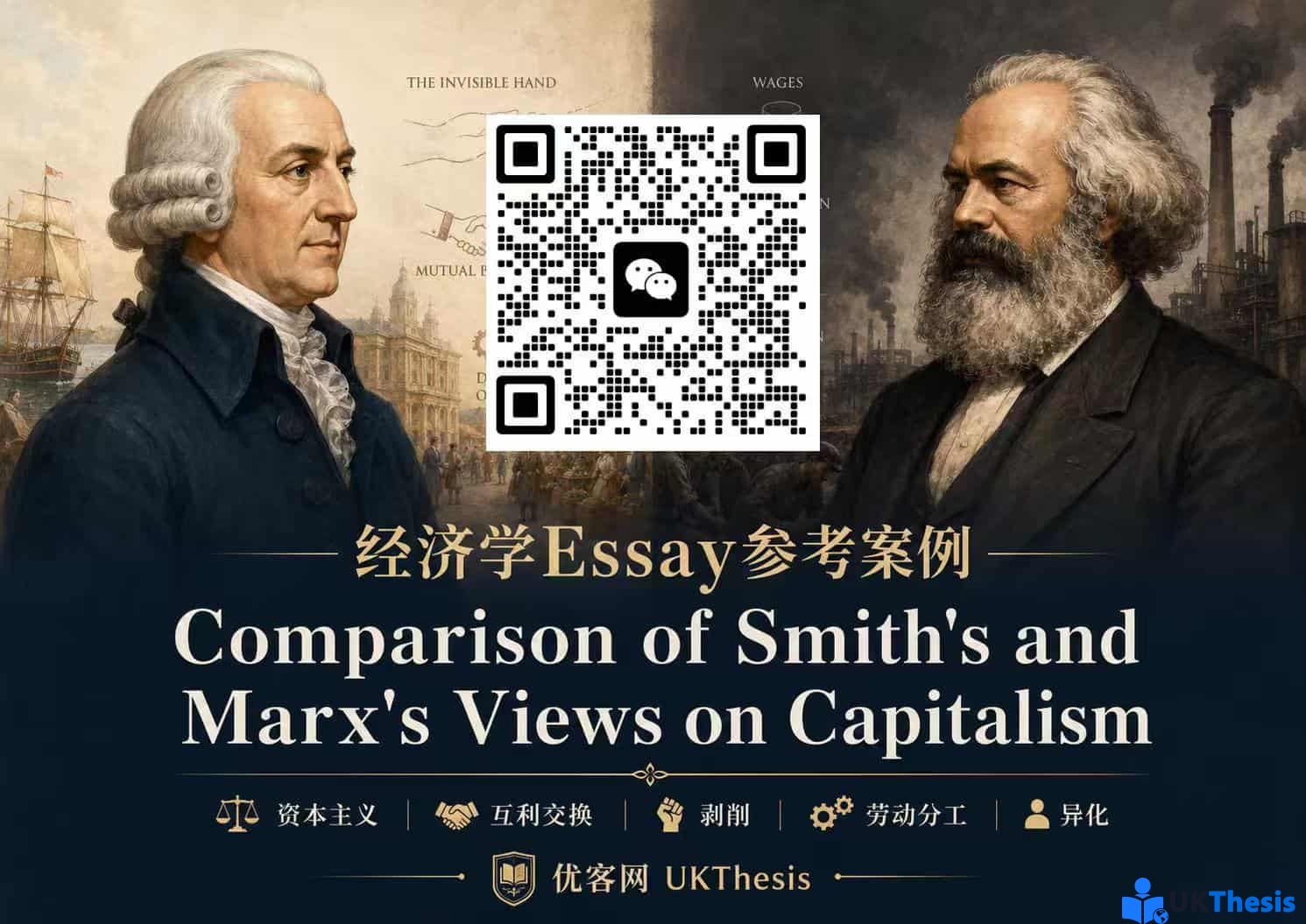
这类题目在经济学、政治经济学、经济思想史和社会理论课程中都很常见。它不是简单问“斯密对不对”或“马克思对不对”,而是要求学生比较两位思想家如何理解资本主义的基础:斯密更强调市场交换、劳动分工、自利行为与互利结果;马克思则更关注工资劳动、剩余价值、剥削关系与劳动异化。
原题中的判断是:
“Marx has a very different view of capitalism to Smith: he believes it is founded on exploitation and Smith believes that it is founded on mutual benefit.”
也就是说,马克思认为资本主义建立在剥削基础上,而斯密认为资本主义建立在互利基础上。文章的核心任务,就是判断这个说法是否成立,并结合两位作者的理论进行讨论。
这篇Essay的写法比较适合留学生参考。它没有一上来就完全否定或完全接受题目,而是采取了一个更稳妥的立场:基本同意这个判断,但也承认两位思想家的观点并不是完全没有交集。
对于正在查找留学生论文代写、essay代写、经济学论文代写或毕业论文代写相关资料的同学来说,这篇文章可以作为经济学Essay结构参考:先表明观点,再比较理论,再分析例外情况,最后回到题目判断。
二、经济学Essay写作结构参考
这篇Essay可以按照以下逻辑来理解:
Introduction
表明自己对题目判断的态度:基本同意,但有一定保留。
Smith's View of Capitalism
讨论斯密如何理解市场交换、劳动分工、看不见的手、自利与互利。
Marx's View of Capitalism
分析马克思如何理解工资劳动、利润来源、剥削和剩余劳动。
Alienation and Division of Labour
比较两人对劳动分工和异化问题的不同看法。
Partial Overlap Between Smith and Marx
说明斯密也承认工资议价不平等,马克思也承认资本主义在生产力发展中的革命性作用。
Conclusion
回到题目:整体来看,斯密和马克思的资本主义观确实存在根本差异,但不能把两人的观点简化成完全对立。
写这类经济学Essay时,最忌讳的是只写“Smith thinks capitalism is good, Marx thinks capitalism is bad”。这种写法太浅。更好的写法是具体分析:斯密讲的是交换机制如何产生互利,马克思讲的是生产关系如何产生剥削。二者关注的问题不同,所以结论自然也不同。
Comparison of Smith's and Marx's Views on Capitalism
Essay Question:
“Marx has a very different view of capitalism to Smith: he believes it is founded on exploitation and Smith believes that it is founded on mutual benefit.”
Do you agree with this assessment of the relationship between Smith's and Marx's views of capitalism?
Introduction
In this essay, I will discuss my opinion on the relationship between Smith's and Marx's views of capitalism. I agree to an extent with the assessment given. However, there are also instances in the respective authors' works where this assessment does not hold completely.
Adam Smith defines capitalism as a system of operation that naturally engages in mutually beneficial exchanges without state intervention through the help of the “invisible hand”. Smith believes that this mechanism helps determine the supply and demand of goods and services in a free market efficiently, “as which would have been made, had the earth been divided into equal portions among all its inhabitants, and thus without intending it, without knowing it, advance the interest of the society” (Smith, 1982, p.5).
Marx defined capitalism as an evolutionary process and “by nature a form or method of economic change and not only never is but can never be stationary” (Elliott, 1980, p.46). To engage properly with the views of Adam Smith and Karl Marx on capitalism, one must first understand the prominent role that Smith believes the division of labour plays in a capitalist economy.
Smith, Division of Labour and Mutual Benefit
Smith states that the source of productivity growth comes from the effects of the division of labour (Smith, 1981, p.4). This is also acknowledged by Marx to be a major source of growth in productivity by the capitalist, “producing more cheaply, and new division of labour in place of the old... one capitalist [increases productivity and creates extraordinary profits]” (Elliott, 1980, p.48).
Adam Smith states that the division of labour occurs as an unintended consequence of our propensity to barter and exchange. Human beings are constantly looking for opportunities to mutually benefit in different forms of transaction (Smith, 1981, p.5). Under capitalism, the division of labour becomes a major source of productivity growth. It can benefit both parties in an economic transaction through the exchange of a good or service.
This mutual benefit occurs when one individual, who is naturally better at producing a certain good or service, specialises in its production and exchanges with another individual who has also specialised in the production of another good or service. This characteristic of certain individuals being better at certain tasks than others is mentioned by Adam Smith in The Wealth of Nations: “In a tribe of hunters or shepherds a particular person makes bows and arrows, for example, with more readiness and dexterity than any other” (Smith, 1981, p.5).
This process of barter and exchange allows people in a market economy to attain the products they require. Through the division of labour, it also opens greater opportunities for mutual benefit. However, despite Adam Smith's discussion of mutually beneficial exchanges under capitalism, there is still a sense of persuasion involved. People need to obtain the product they want in exchange for a product someone else wants. This idea originates from Smith's concept of self-love.
Smith acknowledges that a transaction cannot occur solely based on the benevolence of one party. Instead, it occurs as a result of persuading the other party that they will benefit from the transaction by receiving what they want (Smith, 1981, p.5).
This mutual benefit may not even be fully known to both parties involved in the transaction. Each individual is motivated by “self-love” to obtain the things they want. Therefore, the process of truck, barter and exchange can be seen as a partly subconscious affair that leads to mutual benefit under a capitalist economy. This viewpoint of Smith aligns with the assessment that capitalism is founded upon mutual benefit.
Marx, Exploitation and the Wage System
Karl Marx states that under capitalism the working class is exploited by capitalists because the origin of profit lies in the performance of unpaid labour. Marx argues that capitalists dominate the labour market and that “The will of the capitalist is certainly to take as much as possible” (Marx, 1898, p.6).
The disguise of workers feeling that unpaid labour is paid labour under the wage structure of a capitalist economy is the basis of what capitalists receive as profit (Marx, 1898, p.20). This profit originates from the capitalist selling a commodity at its “real value”, which is determined by the total quantity of labour required to produce the commodity (Marx, 1898, p.17).
However, this “real value” creates a separation between the worker's actual value and the wage paid to the worker. As a result, wages may be manipulated and undervalued in order to increase profits for the capitalist. Marx also strongly voices his view that the wage system under capitalism is unfair towards the working class, as there is constant tension between workers and capitalists regarding profits and wages: “If wages fall, profits will rise; and if wages rise, profits will fall” (Marx, 1898, p.23).
Marx also states:
“The general tendency of capitalist production is not to raise, but to sink the average standard of wages” (Marx, 1898, p.30).
This shows that Marx believed capitalists would find ways to exploit workers under capitalism. He even goes as far as to argue that the wage system should be abolished. This indicates that the unjust and exploitative wage structure under capitalism would not be tolerated by Marx (Marx, 1898, p.29).
My opinion on this view presented by Karl Marx strongly agrees with the assessment in the question, as it contrasts with Smith's view of mutually beneficial exchanges under capitalism.
Marx's Concept of Alienation
Karl Marx mentions the “alienation” of workers and capitalists under the system of private property capitalism. He regards alienation as a product of the division of labour, and it can certainly be interpreted as a form of exploitation because of its harmful impact on the economic and personal well-being of individuals (West, 1969, pp.1-2).
The alienation felt by workers is argued by Marx to originate from the fact that workers have no ownership or say in the means of production. They also have little influence over the decisions made by managers (West, 1969, p.2). This powerlessness faced by workers is highly relevant to the capitalist system because capitalists own the industrial property used in production. Workers are therefore left with little or no power, which leaves room for poor working conditions and vulnerability to being “hired and fired at will” (West, 1969, p.3).
The feeling of isolation is also stated by Marx to be felt by both workers and capitalists. From the perspective of workers, the division of labour means that each worker is just another component of a wider group performing the same task. This suppresses the expression of free thought and spontaneity that an individual should possess (West, 1969, p.4).
Marx also states that “capitalists become isolated from workers and from other capitalists” (West, 1969, p.4). This can be due to the complete ownership of private property in production, allowing capitalists to dominate their workers and treat them as “a piece of industrial raw material” (West, 1969, p.3), rather than as human beings.
This treatment of workers creates rifts between workers and capitalists, producing a sense of isolation for both groups. The severe competition to produce new inventions and acquire new capital to generate greater profits can create a capitalist culture that is more rivalrous than cohesive.
Marx argues that another aspect of alienation comes from the loss of fulfilment from working. Under capitalism, the fruits of labour flow out to others but not to the worker himself (West, 1969, p.5). The loss of entitlement and satisfaction felt by workers when performing their jobs suggests that Marx believed workers suffered greatly under the division of labour. The worker is constrained to a specific task that improves dexterity but at the cost of “having been rendered incapable of following his natural bent to make something independently” (West, 1969, p.6). In this sense, capitalism turns the human worker into something closer to a machine rather than a free-willed human being.
This expression of alienation by Marx suggests that capitalism is ultimately built upon the exploitation of workers, and partly also affects capitalists themselves. I believe this agrees with the assessment presented in the essay question.
Smith's More Limited Concern with Alienation
Adam Smith also acknowledged the dangers of alienation under the division of labour in a capitalist economy, but to a lesser extent than Marx. Alienation is given less importance by Smith because he believed that the innate human nature to barter and exchange, which leads to the division of labour, encouraged social interaction (West, 1969, p.10).
Furthermore, the benefits of the division of labour, such as increased productivity, trickle down to all classes in society (West, 1969, p.8), not just to capitalists in the form of greater profit margins. Smith believes that the working class under the division of labour “seems to be the happiest and most comfortable”. This suggests that workers also receive benefits from engaging in the specialised tasks encouraged by capitalism.
Smith also mentions that deserved wages are given to workers under capitalism because of competitive bidding among employers guided by the invisible hand. This would counter the idea of powerlessness, because the upward trend of wages indicates that capitalists valued workers and their human capital (West, 1969, p.9).
However, Smith did acknowledge that there was room for wage exploitation under capitalism because employers could make use of their greater bargaining power in comparison to workers (West, 1969, p.9). This indicates that exploitation can occur under capitalism without a legal framework that protects worker rights. This goes against the assessment that Smith solely believed capitalism was founded on mutual benefit, and it aligns somewhat with Marx's view of alienation under capitalism.
Marx's Recognition of Capitalism's Revolutionary Role
Marx does believe that “the bourgeoisie, historically, has played a most revolutionary part” (Marx and Engels, 1969, p.15). Through the rapid improvement of production instruments, capitalism converts even less developed societies into modern civilisation (Elliott, 1980, p.47).
To explain the revolutionary role of the bourgeoisie, Marx's crisis theory can be discussed. The expansion of productive forces depends on capitalists investing their profits in new capital. This demonstrates the prominent role that capitalists play. Capitalists will only invest in new machines if there is a sufficient rate of profit to purchase these new capital goods. When the rate of profit is not sufficient, capitalists may hoard profits and aggregate demand may fall due to lower investment.
This is described by Marx as the law of the tendency of the rate of profit to fall over time, because surplus value, or profits, is reinvested into the production process in the form of new capital in order to stay ahead of competitors.
The crisis theory, when applied to the immense success of capitalism and the rapid technological advancements still seen today, can be viewed as a situation where the rate of consumption matches the rate at which capital goods are demanded. This leads capitalists not to hoard profits, but to reinvest them into the economy.
This means there can be a mutually beneficial exchange of newly innovated products for consumers and surplus profits for the capitalists who invest through the process of innovation (Elliott, 1980, p.51).
Marx's view that surplus profits can be generated through innovation contradicts the idea that he believes capitalism is solely founded on exploitation. It also partly agrees with Smith's concept of self-love, where individuals engage in exchanges initially because of their own interests, but the result may still lead to mutual benefits.
Conclusion
To conclude, my view on the assessment is that the relationship between Marx's and Smith's views on capitalism does tend to be oppositional. Marx strongly shows the exploitation of workers by stating that the origin of profits lies in unpaid labour. He also develops the concept of alienation, where the well-being of workers is harmed under the capitalist system through the widespread use of the division of labour.
Smith, on the other hand, demonstrates that the fundamentals of capitalism are founded upon the human propensity to barter and exchange. This leads to the division of labour and generates more opportunities for mutual benefit by exchanging goods and services that are valuable to both parties.
Despite this, there are instances where Smith and Marx partly agree. Smith does recognise the possibility of wage exploitation and unequal bargaining power, while Marx recognises the revolutionary role of capitalism in developing production and innovation. Therefore, the relationship between their views is not a simple black-and-white opposition.
Overall, the evidence presented supports my view that the assessment is largely correct. Smith generally sees capitalism as a system that can create mutual benefit through exchange and the division of labour, while Marx sees capitalism as a system based on exploitation, unpaid labour and alienation. However, a stronger answer should also recognise the limits of this contrast and explain the small areas of overlap between the two thinkers.
三、这篇经济学Essay可以怎么借鉴?
这篇Essay适合经济学专业、政治经济学课程和经济思想史课程的同学参考。它的好处是观点比较清楚:作者不是完全照搬题目判断,而是说“我基本同意,但也有一些地方需要补充”。
写这类比较型Essay时,可以注意三个点。
第一,不能只写人物介绍。很多同学写斯密和马克思,容易写成两段百科式介绍:斯密是谁,马克思是谁。这样不够。老师更想看的是你能不能围绕题目中的关键词进行分析,比如 mutual benefit、exploitation、division of labour、alienation、wage system。
第二,比较要有来有回。不要前半篇只写Smith,后半篇只写Marx,中间完全没有对话。更好的写法是,写完Smith的互利交换之后,马上用Marx的剥削理论来回应;写完Marx的异化之后,再补充Smith其实也意识到劳动分工有负面影响。
第三,结论要有判断。比较型Essay最怕最后变成“两个人都很重要”。这篇文章的结论是:题目判断大体成立,但不能说Smith完全不关心剥削,也不能说Marx完全否定资本主义的历史作用。这样的结论更像大学Essay,而不是简单站队。
四、优客网ukthesis写作服务说明
优客网ukthesis是1999年创立的论文代写平台,长期整理经济学essay范文、政治经济学论文参考、毕业论文写作结构、Research paper写作方法和留学生课程作业资料。
对于经济学专业的同学来说,常见写作需求包括:
经济学Essay结构分析
Adam Smith与Karl Marx理论比较
政治经济学Essay写作参考
经济思想史论文写作辅导
留学生论文代写相关资料整理
essay代写与英文润色服务说明
经济学论文代写写作框架建议
毕业论文代写选题与章节规划参考
需要注意的是,范文的主要作用是帮助同学看清楚文章结构、论证方式和引用思路,而不是直接复制提交。真正高质量的经济学Essay,还是要结合课程要求、老师评分标准和自己的理解来写。
如果你正在准备“Comparison of Smith's and Marx's Views on Capitalism”类似题目,可以参考本文结构:先表明立场,再分别分析Smith和Marx的核心观点,然后讨论二者的差异与交集,最后给出自己的判断。
五、FAQ常见的问题
1. 经济学Essay参考案例应该怎么用?
经济学Essay参考案例主要用于学习结构、论点和论证方式。不要直接照搬范文内容,而应结合自己的课程要求和阅读材料重新组织表达。
2. Smith和Marx对资本主义的最大区别是什么?
Smith更强调市场交换、劳动分工和互利结果;Marx更关注工资劳动、剥削关系、剩余价值和劳动异化。
3. 这篇Essay的核心关键词有哪些?
核心关键词包括 capitalism、mutual benefit、exploitation、division of labour、alienation、wage system、invisible hand 和 surplus value。
4. 写比较型经济学Essay要注意什么?
比较型Essay不能只分别介绍两个思想家,而要围绕同一个问题进行对比。比如本文就围绕“资本主义是建立在互利还是剥削之上”展开。