经济学Essay要求:Critical Discussion of Regional Resources in Industry - 优客网UKThesis

一、文章导读:这篇essay主要讨论什么?
本文是一篇经济学与工商管理方向都可以参考的留学生essay范例,题目是 Critical Discussion of Regional Resources in Industry,中文可以理解为“产业中的区域资源批判性探讨”。
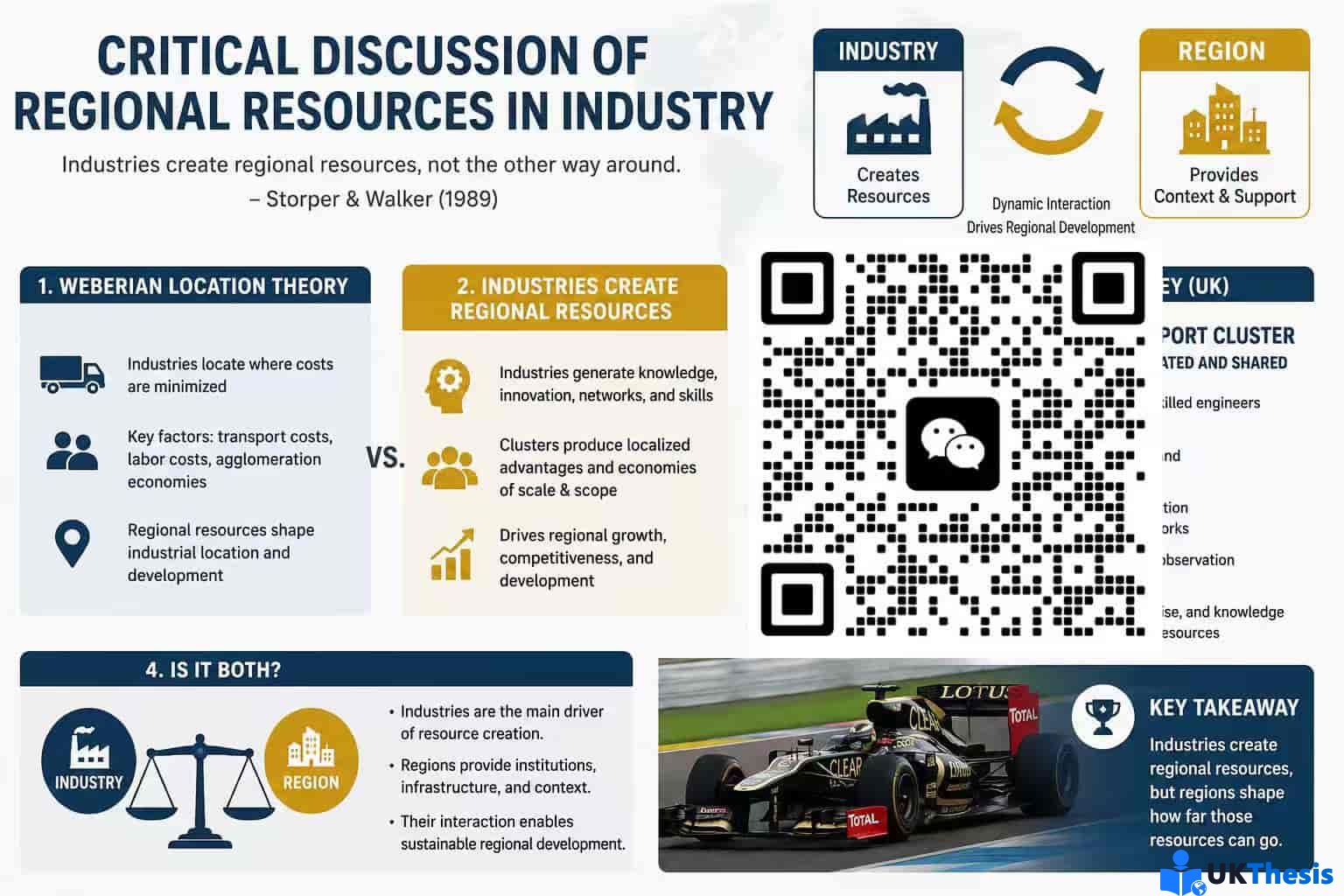
这篇文章的核心问题来自 Storper and Walker 的观点:“industries create regional resources and not the other way around.” 也就是说,真正推动区域资源形成的,不一定是某个地区天然拥有的煤炭、港口、劳动力或交通条件,而是产业本身在发展过程中创造出的知识、技术、网络、供应链、人才流动和创新能力。
这类题目看起来比较理论化,但其实很适合写成一篇有案例支撑的Essay。文章先用 Weberian Location Theory 说明传统区位理论如何强调运输成本、劳动力成本和聚集经济,然后再引出 Storper and Walker 的观点,说明现代产业尤其是知识密集型产业,并不只是被动依赖区域资源,而是在集群发展过程中创造新的区域资源。
原文中用英国 Motor Sport Valley 作为案例,说明赛车产业集群如何通过工程师流动、供应商网络、企业生灭、非正式交流、赛道观察和知识溢出,形成独特的区域竞争优势。
对于正在查找论文代写、essay代写、mba代写或MBA Essay代写相关资料的同学来说,这篇文章可以作为经济学、区域发展、产业集群、MBA产业分析类Essay的结构参考。重点不是照搬范文,而是学习它如何围绕一个理论判断展开批判性讨论。
二、Essay写作结构参考
这篇文章可以按照以下结构来理解:
Introduction
引出 Storper and Walker 的观点,说明文章将通过区域发展理论、集群理论和Weberian区位理论展开讨论。
Weberian Location Theory
介绍与 Storper and Walker 观点相反的传统理论:区域资源决定产业区位。
Industries Create Regional Resources
说明现代产业如何通过创新、组织、技术和集群创造区域资源。
Motor Sport Valley case study
用英国赛车产业集群解释知识资源如何在区域内部形成和传播。
Is It Both?
加入批判性判断:产业确实创造资源,但地方和区域条件仍然重要。
Conclusion
总结产业、区域、地方资源之间的关系,强调不能把问题简单理解为单向决定。
写这类Essay时,老师通常比较看重“critical discussion”。也就是说,不能只说“Storper and Walker是对的”,也不能只说“Weber是对的”。更好的写法是承认两边都有道理:传统产业可能更依赖天然资源和运输条件,而现代知识产业、服务产业和高技术制造业,则更容易通过集群创造新的区域资源。
Critical Discussion of Regional Resources in Industry
1. Introduction
Storper and Walker (1989) attest that it is “industries that create regional resources and not the other way around”. This statement suggests that the locational patterns of industry, regional growth and development are the product of capitalist industrialisation and its intrinsic processes, rather than the “natural” placement of resources.
This essay aims to critically discuss this statement through the framework of regional development theory and the formation of clusters. The discussion will begin with Weberian location theory and its role in explaining industrial location, resource use and regional development. The essay will then move towards an argument in support of Storper and Walker's statement by exploring the Motor Sport Valley cluster in England and its role in knowledge creation.
The essay will culminate in a more balanced point: while the process of regional resource creation and regional development is ultimately driven by industry, the region or place still has an important role in facilitating this process. In other words, industries may create regional resources, but they do not do so in a completely empty space.
2. Weberian Location Theory
A theory that contradicts Storper and Walker's statement is Weberian location theory. According to Weber (1969), regional resources dictate the location of industries, clusters and subsequent regional development. This is mainly the result of three factors: the cost of product transport, the cost of labour and the potential for agglomeration economies.
Weber explores the factors influencing the locational distribution of industry through a least-cost model. This model seemed particularly fitting during a period when dominant industries located close to energy sources, raw material sources and transport networks, such as docks and major canal systems. Weber and Weberian location theorists suggest that former industrial centres such as Manchester and Liverpool were partly conceived and developed due to pre-existing regional resources.
Weber argued that manufacturing plants and industries were located where transport costs were minimised. This suggests that industries cluster around regional advantages, rather than industries producing regional resources. Transportation costs were shaped by two main factors: the weight of material to be shipped and the distance it had to travel. These factors produced a locational triangle, which became fundamental in Weber's formation of the industrial location problem.
Storper (1997), however, argues that this model functions on an unsubstantiated interface, removed from reality. It wrongly assumes that industry leaders and firms have all-encompassing knowledge and use that knowledge to act in a completely logical manner. Weber's theory, argues Storper, ignores the inputs from an industry into a region. These inputs are extremely powerful in creating regional resources and developing the region.
Such inputs consist of product innovation, process innovation and organisational innovation. These, in turn, generate competitive advantage, a dynamic economy and high rates of accumulation. The injection of capital should not be forgotten either. All of these elements can ultimately create regional resources and development.
That being said, industrial location is undeniably shaped by a trade-off between varying production costs. This still has contemporary relevance, particularly in relation to the new international division of labour. For example, many firms still consider labour costs, logistics, market access and supply chain efficiency when choosing where to locate production. Therefore, Weberian theory should not simply be dismissed, even if it is not sufficient to explain more modern knowledge-based clusters.
3. Industries Create Regional Resources
In contrast to Weber, Storper and Walker (1989) argue that “industries create regional resources”, and this can be seen clearly in the formation of clusters. This argument suggests that the driving force of regional resource creation is not prior resource endowment or the “natural” advantageous properties of a location, but geographical industrialisation and the location of firms as a process of resource creation.
Patterns of resource creation and regional development are produced by capitalist industrialisation and its endogenous activity. This results in economic clustering, rather than the exogenous location of resources. In short, industries produce economic space and regional resources.
Of course, locational factors are important, but they are insufficient in generating regional growth, especially in an era in which competition is increasingly global. A region must possess economies of scale and scope for regional development and resource creation to take place. Storper (1997) argues that these are derived from the “Holy Trinity of technology-organisation-territory”.
Highly localised clusters based on specific knowledge, skills and expertise can form economies of scale. The concentration of advantages held by actors located in specific regions creates an exploitable economy of scale. If these regions are able to utilise the benefits of learning and embed themselves into a collaborative agglomeration environment, economies of scope can exist and the spillover effect can be reproduced.
This argument is especially relevant to knowledge-based industries. In such industries, regional resources are not only physical resources such as land, minerals or transport routes. They can also be knowledge, skilled labour, supplier networks, reputation, institutional trust, informal communication and shared technical culture. These resources are often created through the daily activities of firms and workers within the cluster.
This point can be examined through the knowledge cluster of Motor Sport Valley in England.
4. Motor Sport Valley and Knowledge Creation
The Motor Sport Valley cluster in the South of England is a region that can be understood not simply as a space within boundaries, but as a porous territory that benefits from a broad range of network connections (Amin, 2002). Porter (1998) defines a cluster as a concentration of connected firms, specialised suppliers, service providers and institutions.
There is a dynamic strategic coupling of firms and regional assets in the form of a knowledge economy. Motor Sport Valley is a region that has experienced industry creating regional resources through the formation of a knowledge-based cluster.
There are many benefits to clustering, and regional resources can take the form of untraded interdependencies. In Motor Sport Valley, there is a dense agglomeration of motorsport activity. This has created an economy of specialist knowledge, which circulates between the firms that make up the cluster.
The regional resource of knowledge is spread in several interacting ways (Pinch and Henry, 1999).
The first form of knowledge creation and distribution is the high level of staff movement. In this industry, engineers, designers, mechanics and drivers often move between different motorsport companies. The persistent circulation of employees means that critical information about technology, methods, tactics and strategy is transferred and shared across the cluster.
The second form is shared suppliers. This acts as a regional resource through linkages between teams. Although suppliers may be formally contracted to secrecy, the large number of component and service suppliers still creates channels through which knowledge and information can circulate. This adds to the cluster's knowledge economy.
The high number of firm births and deaths also creates opportunities for staff to mix and diffuse knowledge as they change employers. In this way, instability in the industry can paradoxically support knowledge circulation.
Informal collaboration is another industry-created regional resource in the Motor Sport Valley cluster. Although this is a competitive cluster, regulated working groups are in place. These groups require interaction and involvement, and collective discussion provides another mode of inter-firm knowledge transfer.
Informal industry gossip is also a regional resource created by the clustering of the industry. There is extensive networking in the Valley, and this crosses firms and teams. It often facilitates staff recruitment, advice and knowledge acquisition.
The final form of knowledge transfer is observation at the trackside. When technology is tested on the track, imitation can occur. Firms can observe competitors' performance, design choices and technical adjustments. This type of learning is not always written down or formally exchanged, but it still becomes part of the regional knowledge system.
It is therefore clear that the decision for firms and the industry to cluster in this region has created regional resources that are extremely valuable to the high-tech, design-centred motorsport industry.
5. Is It Both?
It could be argued that Storper and Walker's 1989 argument is somewhat misleading if it is interpreted as a complete reduction of the role of geography and distance. Such an interpretation might suggest that the hyper-mobile nature of capital is leading to the complete deterritorialisation of production. This is not the case.
It is important to consider that while industries ultimately create regional resources, place remains fundamental. Every component of the production network is grounded in some way. This grounding is physical in terms of fixed investments, factories, offices, testing sites and infrastructure. It is also less visible in terms of localised relationships, labour markets, trust and knowledge transfer.
Globalisation presents a paradox. On the one hand, firms are increasingly connected to global markets, global suppliers and global flows of capital. On the other hand, regions remain highly significant as sub-national centres of economic activity. This suggests that while industries feed regional resources in terms of growth, some regional conditions must firstly exist, or at least be capable of supporting industrial activity.
In other words, industries may create resources, but they still need a place in which those resources can be developed. The region provides the institutional setting, labour pool, infrastructure, social networks and cultural environment in which industrial activity can take root. The industry then transforms these initial conditions into more advanced regional resources.
This is why the strongest answer is not simply “industry creates region” or “region creates industry”. The better answer is that the relationship is dynamic. Initial regional conditions may attract or support industry, but once the industry develops, it can create new regional resources that did not exist before.
6. Conclusion
This essay has critically discussed the statement that “industries create regional resources and not the other way around”. The statement is mostly reflective of the truth, particularly when applied to modern industrial clusters and knowledge-based industries.
It is true that industries are key producers of regional resources. Inputs from an industry into a region are extremely powerful in the creation of regional resources and in the development of the region itself. Such inputs include product innovation, process innovation and organisational innovation. It is industry and its firms that create competitive advantage, a dynamic economy and high rates of accumulation, particularly in twenty-first-century manufacturing, service and knowledge-based industries.
Industries cluster, and it is through this locational process that regional resources are created. Their inputs are invaluable. The case of Motor Sport Valley shows that regional resources can emerge from knowledge flows, labour mobility, shared suppliers, informal collaboration, industrial gossip and observation. These resources are not simply given by nature; they are produced through industrial interaction.
Nonetheless, it is also important to consider that place remains fundamental to the location of industries. Industry may ultimately unleash the potential of a region through regional resource creation, but it still needs a place that can facilitate investment, learning, networks and collaboration.
Therefore, the strongest conclusion is that Storper and Walker's statement is largely correct, but it should not be understood in an absolute sense. Industries do create regional resources, but regional conditions also shape how easily and successfully this process can occur. Regional development is therefore best understood as a relationship between industry, place, knowledge and institutional support.
三、这篇Essay可以怎么借鉴?
这篇Essay适合经济学、工商管理、MBA产业分析、区域经济学、产业集群和经济地理相关课程参考。它最值得借鉴的一点是:文章没有只写一个理论,而是把两个方向放在一起讨论。
一边是 Weberian Location Theory,强调区域资源、运输成本、劳动力成本和区位优势对产业选址的影响。另一边是 Storper and Walker 的观点,强调产业本身通过集群、创新和知识流动创造区域资源。
这种写法比较适合“critical discussion”类题目。因为所谓批判性讨论,不是非黑即白,也不是把某个理论完全推翻,而是要说明不同理论在不同历史时期、不同产业环境中各自解释了什么,又遗漏了什么。
写这类Essay时,建议同学们注意三个点。
第一,要先解释题目中的核心判断。比如本文的核心判断是“产业创造区域资源,而不是区域资源创造产业”。这句话不能直接跳过,必须先解释清楚。
第二,要设置对立理论。Weberian Location Theory在这里就起到了很好的作用,因为它代表了“区域资源决定产业区位”的传统思路。
第三,要用案例支撑观点。Motor Sport Valley这个案例很好,因为它不是单纯讲自然资源,而是讲知识、人才、供应商和非正式网络如何成为区域资源。
对于论文代写、essay代写、mba代写或mba essay代写相关页面来说,这类文章最好不要只堆关键词,而要让用户看到真实的写作结构和分析方法。这样页面更像有用的范文参考,而不是简单的广告页。
四、优客网UKThesis写作服务说明
优客网UKThesis是1999年创立的论文代写平台,长期整理经济学essay范文、工商管理Essay案例、MBA Essay写作参考、产业分析论文结构和留学生课程作业资料。
对于经济学、工商管理和MBA方向的同学来说,常见写作需求包括:
经济学Essay结构分析
区域经济学Essay写作参考
产业集群案例分析
MBA Essay写作思路
mba代写相关资料整理
mba essay代写范文参考
essay代写与英文润色服务说明
论文代写写作框架建议
需要注意的是,范文更适合作为结构和思路参考,不建议直接复制提交。真正好的Essay,应该结合课程要求、老师评分标准、理论阅读和案例材料重新组织。
如果你正在写 Critical Discussion of Regional Resources in Industry 这类题目,可以参考本文结构:先提出理论争议,再分析Weberian区位理论,然后讨论产业如何创造区域资源,接着用Motor Sport Valley案例支撑,最后给出平衡结论。
五、常见FAQ的问题
1. Critical Discussion of Regional Resources in Industry 这类Essay怎么写?
这类Essay可以先解释区域资源和产业区位之间的关系,再引入不同理论进行对比。比如可以先写Weberian Location Theory,再写Storper and Walker关于产业创造区域资源的观点,最后用产业集群案例进行分析。
2. “Industries create regional resources”是什么意思?
这句话的意思是,区域资源不一定只是天然存在的。产业发展本身也可以创造资源,例如专业人才、供应商网络、知识流动、技术能力、产业声誉和创新环境。
3. Weberian Location Theory和Storper and Walker观点有什么不同?
Weberian Location Theory更强调产业会根据运输成本、劳动力成本和资源条件选择区位。Storper and Walker则强调产业不是简单依赖现有资源,而是在发展过程中创造新的区域资源。
4. Motor Sport Valley案例有什么作用?
Motor Sport Valley说明,高技术产业集群可以通过员工流动、供应商网络、企业互动、非正式交流和知识溢出创造区域资源。这是支持“产业创造区域资源”观点的重要案例。
5. MBA Essay写产业集群要注意什么?
MBA Essay不能只介绍概念,还要说明产业集群如何影响企业竞争优势、创新能力、供应链效率、人才流动和区域发展。最好结合具体行业案例分析。