Accounting Ethics Assignment范文|CA ANZ Code of Ethics案例 - UKThesis

会计师每天面对的并不只是数字。
当Accountant掌握客户财务资料、参与Business Decision、处理Confidential Information甚至面对利益冲突时,一个很现实的问题就出现了:如果“对客户有利”“对公司有利”和“专业上应该做的事情”并不完全一致,会计师应该怎么选择?
这也是Accounting Ethics存在的重要原因。
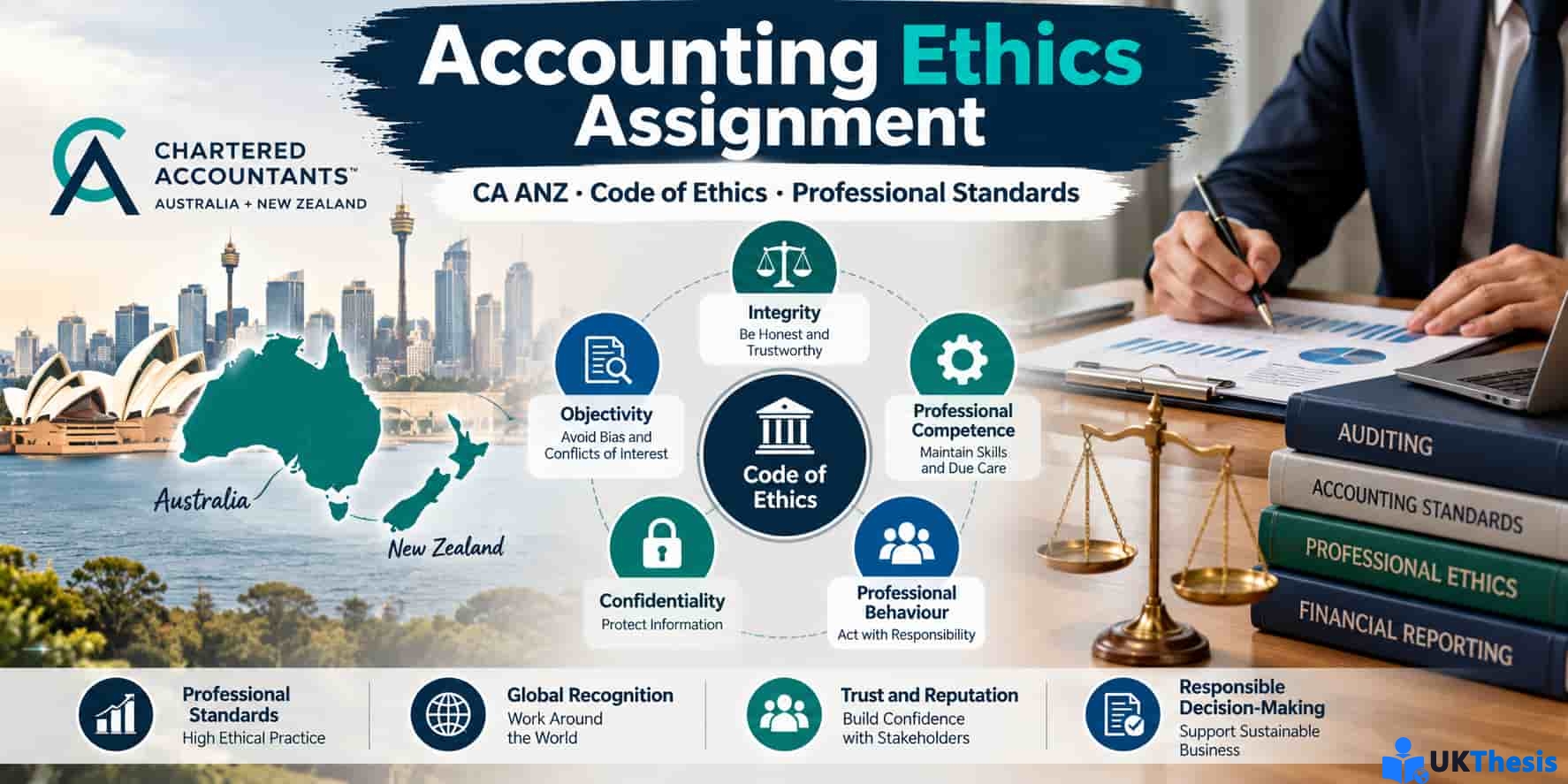
下面这篇Accounting Ethics Assignment范文以Chartered Accountants Australia and New Zealand(CA ANZ)为主要案例,讨论Professional Accounting Body、Code of Ethics以及Integrity、Objectivity、Professional Competence、Confidentiality和Professional Behaviour等职业伦理原则,并进一步延伸到GAA和ACCA。
范文定位:本文适合作为Accounting Assignment、Accounting Ethics、Professional Ethics及Business Ethics相关essay学习参考。重点不是简单介绍“会计师协会是什么”,而是分析Professional Standards如何影响Accountants的Professional Conduct。
Chartered Accountants Australia and New Zealand(CA ANZ)
Chartered Accountants Australia and New Zealand is a professional accounting body serving members in Australia, New Zealand and internationally.
For an Accounting Ethics assignment, the importance of a professional body lies not only in qualifications or membership services. Professional organisations also establish expectations concerning professional behaviour, competence, ethics and accountability.
In other words, becoming a professional accountant is not simply about knowing how to prepare financial information. Members are also expected to follow professional and ethical standards.
Mission, Vision and Professional Purpose
The original case describes the vision of CA ANZ as empowering its members to become leaders and contributors in finance and business, both within Australia and New Zealand and internationally.
The case also identifies several organisational objectives, including maintaining the prestige and relevance of the Chartered Accountant designation and extending the influence of members.
From an Assignment perspective, these goals can be connected to a broader issue:
A professional designation has value only when the public continues to trust the competence and behaviour of the professionals using it.
所以Professional Ethics并不是CA名字后面附带的一页规则。职业道德本身就是Professional Reputation的一部分。
Code of Ethics and Professional Standards
Professional accountants are expected to comply with applicable professional and ethical requirements.
Codes of Ethics provide principles that guide professional behaviour and can also form part of the framework used when concerns or complaints arise regarding a member's conduct.
The key ethical principles commonly discussed in professional accountancy include:
| Principle | Meaning | Example in Accounting |
|---|---|---|
| Integrity | Being straightforward and honest | Not deliberately presenting misleading financial information |
| Objectivity | Avoiding inappropriate bias or conflicts of interest | Maintaining professional judgement despite commercial pressure |
| Professional Competence & Due Care | Maintaining appropriate knowledge and professional skill | Keeping knowledge current before advising clients |
| Confidentiality | Protecting information obtained through professional relationships | Not improperly disclosing client financial information |
| Professional Behaviour | Acting consistently with professional obligations | Avoiding conduct that damages trust in the profession |
Integrity:为什么诚信是Accounting Ethics的核心?
Integrity is often described as doing the right thing even when nobody is watching.
Within professional accounting, however, Integrity needs to go beyond a personal definition of being a “good person”. It involves being straightforward and honest in professional and business relationships.
Accounting depends heavily on trust. Clients, employers, investors and other stakeholders may make decisions using information prepared or reviewed by accounting professionals.
If that trust disappears, the technical accuracy of accounting work alone may not be sufficient to protect professional reputation.
Essay写作提醒:不要把Integrity只解释成“诚实”。继续分析为什么Accounting Profession特别依赖Integrity——因为Accountants经常接触别人无法直接验证的Financial Information,这样就自然从Definition进入Analysis。
Objectivity and Conflicts of Interest
Objectivity requires accounting professionals to exercise professional judgement without allowing inappropriate bias, conflicts of interest or external pressure to override that judgement.
Imagine an accountant discovering information that senior management would prefer not to disclose. The ethical difficulty is no longer simply whether the accountant knows the relevant accounting rule.
The question becomes whether professional judgement can remain objective when commercial or personal pressure exists.
因此Accounting Ethics最有价值的Assignment往往不是:
“What is Objectivity?”
而是:
“What threatens Objectivity, and how should an accountant respond?”
Professional Competence and Due Care
Professional ethics also requires competence.
An accountant may be completely honest but still create serious problems if professional advice is provided without sufficient knowledge or care.
Professional Competence and Due Care therefore connects ethics with technical capability.
This is particularly relevant in a profession affected by changes in accounting standards, regulation, technology and business practice.
Confidentiality
Accountants frequently have access to financial and commercial information that is not publicly available.
Confidentiality requires professionals to protect information obtained through professional and business relationships and not use or disclose such information improperly.
This creates an important relationship:
Access to Sensitive Information → Professional Responsibility → Confidentiality → Stakeholder Trust
Professional Behaviour
Professional Behaviour concerns conduct consistent with the responsibilities and reputation of the profession.
The behaviour of an individual accountant can potentially influence trust not only in that person but also in the organisation and professional designation associated with them.
This helps explain why professional accounting bodies establish ethical requirements and disciplinary processes rather than leaving ethical behaviour entirely to individual pReference.
Fairness and Accountability
The original case also discusses Fairness and Accountability.
These concepts remain useful for Business Ethics analysis, although they should be distinguished from the formal fundamental principles listed above.
Fairness concerns equitable treatment and the moral quality of decisions affecting other people.
Accountability concerns the responsibility of individuals and organisations for their decisions, conduct and outcomes.
Within professional accounting, both concepts can support discussion of relationships with members, clients, regulators and the wider public.
| Concept | Key Question |
|---|---|
| Integrity | Am I being honest and straightforward? |
| Objectivity | Is my judgement being improperly influenced? |
| Confidentiality | Am I protecting information appropriately? |
| Fairness | Are affected parties being treated equitably? |
| Accountability | Who is responsible for this decision or outcome? |
Enterprise and Efficiency
The original assignment further discusses Enterprise and Efficiency.
Enterprise can be understood as the willingness and capability to undertake projects, initiatives or business activities in pursuit of organisational objectives.
Efficiency concerns achieving desired results while avoiding unnecessary waste of time, money, materials and effort.
These concepts are useful when analysing organisational performance, but they should not be confused with the fundamental ethical principles of professional accountants.
实际上,这里正好可以产生一个不错的Critical Thinking问题:
What happens when Efficiency conflicts with Professional Ethics?
例如,为了更快完成工作而减少必要的Professional Review,看起来提高了Efficiency,却可能降低Due Care。这样的冲突才是Business Ethics真正值得讨论的地方。
Global Accounting Alliance(GAA)
The original case also introduces the Global Accounting Alliance as an international alliance of professional accountancy bodies.
Its relevance to this Assignment is the international nature of the accounting profession.
Accounting professionals increasingly work across borders, while professional bodies need to exchange knowledge and cooperate on issues affecting the profession internationally.
Rather than focusing on historical membership statistics, the important Assignment point is that international collaboration can support professional quality, information exchange and the public interest.
ACCA and Global Professional Ethics
The Association of Chartered Certified Accountants (ACCA) is another international professional accountancy body.
The original case uses ACCA to demonstrate that professional ethical obligations are not unique to Australia and New Zealand.
Professional accountants working internationally face similar questions concerning Integrity, Objectivity, Professional Competence, Confidentiality and Professional Behaviour.
This creates a useful comparison:
| Area | CA ANZ Case | ACCA Case |
|---|---|---|
| Professional Focus | Chartered accountants and professional standards | Global professional accountancy membership and qualifications |
| Ethical Importance | Professional conduct and public trust | Professional conduct and public trust |
| International Dimension | Australia, New Zealand and international members | International professional community |
Why Does Accounting Ethics Matter?
Accounting Ethics matters because accounting professionals occupy positions of trust.
They may prepare, review or advise on information used by managers, clients, investors, regulators and other stakeholders.
Ethical failure can therefore produce consequences beyond an individual accountant.
A useful analytical chain is:
Professional Conduct → Quality of Information → Stakeholder Trust → Professional Reputation
This explains why Professional Ethics should not be treated as an optional addition to technical accounting knowledge.
Accounting Ethics Assignment怎么写出Critical Analysis?
很多同学写到这里会变成:
Integrity很重要。Objectivity也很重要。Confidentiality同样很重要。
然后五个Definition排下来,Essay就结束了。
这样虽然没有明显错误,但Analysis会比较薄。
更好的办法是给每个Principle增加一个Ethical Threat或者Conflict:
| Ethical Principle | Possible Threat | Critical Question |
|---|---|---|
| Integrity | Pressure to present favourable information | Can honesty be maintained under commercial pressure? |
| Objectivity | Conflict of interest | Is professional judgement independent? |
| Competence | Outdated professional knowledge | Should the accountant accept work beyond current expertise? |
| Confidentiality | Sensitive client information | When can information legitimately be disclosed? |
这么一改,就从“背Code of Ethics”变成了真正的Accounting Ethics Analysis。
FAQ:Accounting Ethics Assignment常见问题
What is Accounting Ethics?
Accounting Ethics concerns the professional principles and responsibilities that guide accountants when making judgements, handling information and conducting professional relationships.
What are the fundamental principles of professional ethics for accountants?
Commonly recognised principles include Integrity, Objectivity, Professional Competence and Due Care, Confidentiality and Professional Behaviour.
Why is Integrity important in accounting?
Accounting professionals frequently provide information that other stakeholders rely upon when making decisions. Integrity supports confidence that this information and related professional conduct are honest and trustworthy.
What is the difference between Integrity and Objectivity?
Integrity concerns being straightforward and honest. Objectivity focuses on ensuring that professional judgement is not improperly influenced by bias, conflicts of interest or external pressure.
Fairness和Accountability也是五项Fundamental Principles吗?
它们可以用于Business Ethics和Professional Responsibility分析,但不应该与Integrity、Objectivity、Professional Competence and Due Care、Confidentiality以及Professional Behaviour这组Professional Accounting Ethics基本原则混为一谈。
Accounting Ethics Essay怎样避免只写定义?
可以在每个Ethical Principle后面增加Threat、Conflict或Professional Dilemma,再讨论Accountant应该如何处理。这样文章就会从Definition进入Application和Critical Analysis。UKThesis可围绕已有Assessment Brief或Draft提供Accounting Assignment结构梳理、案例分析、语言润色及Essay写作辅导。
Conclusion
Professional ethics plays an important role in maintaining trust in the accounting profession.
The CA ANZ case demonstrates that professional accounting bodies are concerned not only with qualifications and technical competence but also with the conduct expected of their members.
Integrity, Objectivity, Professional Competence and Due Care, Confidentiality and Professional Behaviour provide a useful framework for understanding the responsibilities of accounting professionals.
The wider discussion of Fairness, Accountability, Enterprise and Efficiency also demonstrates that accountants operate within broader organisational and stakeholder relationships.
However, efficiency and commercial objectives should not automatically override professional obligations.
The comparison with international professional organisations such as ACCA and alliances such as GAA further demonstrates that Accounting Ethics is increasingly international in scope.
Ultimately, technical accounting knowledge explains how professional work can be performed, while Professional Ethics helps determine how that knowledge should be used responsibly.