Accrual Accounting and Stakeholders范文|权责发生制、财务报告与内部控制

Accounting information并不是只给Accountant自己看的。一份Financial Statement背后,其实站着很多不同的人:Investors想知道值不值得继续投资,Lenders担心借出去的钱能不能回来,Managers需要做预算,Employees也会关心公司还能不能稳定经营。
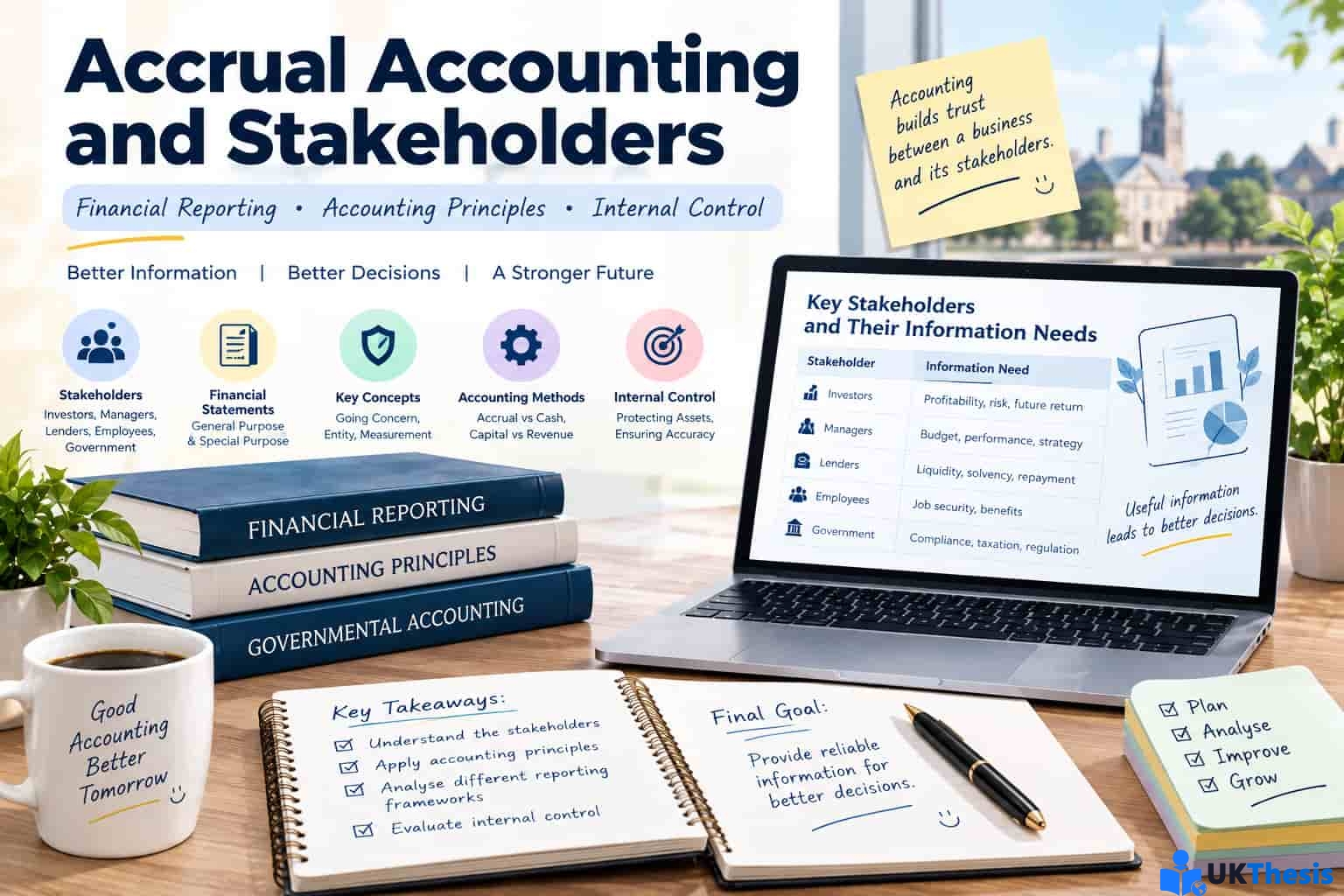
这篇Accounting Assignment围绕Accrual Accounting与Stakeholders展开,同时讨论General Purpose Financial Statements、会计信息质量、Going Concern、Accounting Entity、Internal Control以及Cash和Accrual Basis的区别。
我第一次学这些概念的时候,感觉每一条都像单独的定义题。后来真正做assignment才发现,它们其实都在回答同一个问题:怎样让会计信息真实、有用,而且能够帮助不同的人作出判断?
范文类型:Accounting Assignment / Financial Accounting
核心主题:Accrual Accounting / Stakeholders
相关概念:Financial Reporting、Internal Control、Going Concern、Accounting Entity
适用课程:Accounting Fundamentals / Introduction to Accounting
Stakeholders为什么需要Accounting Information?
A stakeholder is an individual or organisation that has an interest in the activities, financial condition or performance of a business.
Different stakeholders use accounting information for different purposes. That means the same Income Statement or Statement of Financial Position may answer completely different questions depending on who is reading it.
| Stakeholder | Main information need |
|---|---|
| Owners & Investors | Profitability, financial position, risk and future return |
| Managers | Budgeting, planning, monitoring and strategic decisions |
| Creditors & Lenders | Liquidity, solvency and ability to repay debt |
| Employees | Business stability, profitability and employment security |
| Government & Regulators | Compliance, taxation and regulated reporting |
Owners and Investors
Owners use accounting information to evaluate whether additional resources should remain in the business or be invested elsewhere.
Current and prospective investors are particularly interested in profitability, risk, financial position and expected future returns.
The Income Statement can provide information about financial performance, while the Statement of Financial Position provides information about assets, liabilities and equity.
不过只看Profit还不够。一家公司今年利润很好,但负债突然很高、Cash Flow很弱,Investor看到的故事可能完全不一样。
Managers
Managers require accounting information for three closely related activities: planning, monitoring and decision making.
Planning involves allocating resources to achieve business objectives. Monitoring compares actual performance with expectations, while strategic decision making requires management to consider possible future outcomes.
Budgets, cash-flow information, cost data and financial statements therefore all contribute to managerial decisions.
Creditors、Lenders与Solvency
Before extending credit, lenders usually consider whether the borrower will be able to repay its obligations.
Solvency generally concerns the ability of a business to meet its longer-term financial obligations.
Lenders may also consider the availability and value of assets that could provide security for a loan.
简单区分:
Liquidity更关心短期有没有足够资源付款;
Solvency更关心长期还能不能承受自己的债务。
General Purpose与Special Purpose Financial Statements
General Purpose Financial Statements are intended to provide financial information to a broad range of users who cannot require an entity to prepare reports specifically for their individual needs.
Special Purpose Financial Statements, where permitted under the relevant reporting framework, are prepared for a more limited purpose or user group.
两者真正的区别不是“一个比较正式、一个比较随便”,而是使用者范围和Reporting Purpose不同。
具体哪些企业能够编制Special Purpose Financial Statements,还要结合所在国家、实体类型和适用会计准则判断,不能用一条规则套所有企业。
什么样的Financial Information才算有用?
Useful financial information is not simply information that contains no typing mistakes.
Modern financial reporting frameworks emphasise several qualitative characteristics.
| Characteristic | Meaning |
|---|---|
| Relevance | Information can make a difference to users' decisions |
| Faithful Representation | Information represents the economic substance as completely, neutrally and accurately as reasonably possible |
| Comparability | Users can identify similarities and differences across periods or entities |
| Verifiability | Independent knowledgeable observers can reach broadly similar conclusions |
| Timeliness | Information reaches users while it can still influence decisions |
| Understandability | Information is classified and presented clearly |
这里有个很常见的误区:Understandability不意味着把所有复杂内容删掉。真正重要的是把重要信息表达清楚,而不是为了“容易懂”把实质问题藏起来。
Going Concern
The going concern assumption normally means that financial statements are prepared on the basis that the entity is expected to continue operating for the foreseeable future, unless circumstances indicate liquidation or cessation of operations, or no realistic alternative exists.
This assumption affects many accounting measurements because assets and liabilities may be treated differently when a business is expected to continue rather than being liquidated immediately.
所以Going Concern不是“企业肯定不会倒闭”,而是一个Reporting Basis。
Accrual Basis是什么?
Accrual accounting recognises the economic effects of transactions in the periods in which those effects occur rather than simply when cash is received or paid.
For example, if a business provides a service in December but receives payment in January, the transaction may belong economically to the December reporting period under accrual accounting.
The same idea applies to expenses: an expense can be recognised when incurred even if cash payment occurs later.
| Basis | When Revenue is generally recognised | When Expense is generally recognised |
|---|---|---|
| Cash Basis | When cash is received | When cash is paid |
| Accrual Basis | According to the economic event and applicable recognition requirements | According to when the obligation or expense arises under the applicable accounting requirements |
这一点也是Accrual Accounting真正的价值:Profit不再等于本期Cash In减Cash Out。
Accounting Entity Concept
The accounting entity concept treats the business as an accounting unit separate from the personal financial activities of its owners.
Transactions belonging to the business should therefore be recorded separately from personal transactions.
如果老板今天从公司账户付了一顿家庭晚餐,Accounting不能因为“公司是他的”就当正常Business Expense记进去。
这个概念看起来基础,却是保证Financial Statements有意义的前提之一。
Monetary Measurement
Accounting records generally express transactions and recognised economic phenomena using monetary measures.
This allows different types of transactions to be aggregated and compared in financial statements.
However, not everything valuable to a business can be captured neatly in one accounting number.
Employee knowledge, reputation, organisational culture and customer loyalty may be economically important while still creating difficult recognition and measurement questions.
Internal Control为什么重要?
Reliable accounting information also depends on the systems used to capture, authorise and review transactions.
Segregation of Duties
Important accounting responsibilities should be divided so that one person does not control authorisation, custody, recording and review of the same transaction.
Independent Verification
Transactions and control procedures should be reviewed by someone sufficiently independent from the person who originally performed the work.
| Weak Control | Stronger Control |
|---|---|
| One employee receives cash and records it | Custody and accounting responsibilities are separated |
| No review of accounting entries | Independent review and reconciliation |
| Complaints handled informally | Exceptions are recorded, investigated and escalated |
Internal Control真正防的不是“员工都不可信”,而是避免一个错误或一次舞弊能够在完全没人发现的情况下持续下去。
Capital Expenditure vs Revenue Expenditure
Capital and revenue expenditure differ mainly in how their economic benefits relate to accounting periods and how the relevant accounting standards require them to be recognised.
| Type | Example | Typical treatment |
|---|---|---|
| Capital Expenditure | Qualifying purchase of production equipment | Capitalised when recognition requirements are met, then allocated over relevant periods where applicable |
| Revenue Expenditure | Routine repair or current operating expense | Generally recognised as an expense in the relevant period |
分类错误会直接改变Profit和Asset Value。
比如本来应该Capitalise的一项重大资产,如果全部一次性Expensed,本期Profit就可能被明显压低;反过来,把普通Operating Expense错误资本化,又会把Profit抬高。
这些Accounting Concepts其实怎样连接在一起?
看起来这篇Assignment讲了很多不同概念,但它们并不是互相独立的。
| Concept | What it helps answer |
|---|---|
| Stakeholders | Who needs the information? |
| Financial Reporting | What information should be communicated? |
| Accrual Accounting | When should economic effects be recognised? |
| Entity Concept | Whose transactions are being reported? |
| Internal Control | How can the underlying records be protected? |
Conclusion
Accrual Accounting and financial reporting provide stakeholders with information that helps them evaluate financial performance, financial position and business risk.
Owners, managers, lenders, employees and regulators do not all use accounting information in the same way, which is why relevance and faithful representation are particularly important.
Accounting concepts such as Going Concern, the Entity Concept and Accrual Basis provide the foundations for preparing financial information, while Internal Controls help protect the processes that generate that information.
From an Accounting Assignment perspective, the important lesson is not to memorise each definition separately. The stronger answer explains how these concepts work together to produce information that stakeholders can actually use.
说得简单一点:Accounting不是为了把账做得漂亮,而是为了让正确的人看到足够可靠的信息,然后作出更好的判断。
FAQ
Q:这篇属于essay还是Assignment?
A:更准确属于Accounting Assignment / Coursework,因为原题本身由多个独立问题组成,不是单一论点型Essay。
Q:Accrual Accounting和Cash Accounting最大的区别是什么?
A:核心区别在确认时点。Cash Basis主要根据现金收付,而Accrual Basis根据经济事项发生及适用确认原则反映收入和费用。
Q:Reliability还是现在会计框架的主要术语吗?
A:在现代IFRS Conceptual Framework下,基本质量特征通常表述为Relevance和Faithful Representation;Comparability、Verifiability、Timeliness和Understandability属于增强质量特征。
Q:Stakeholders只有Investors吗?
A:不是。Investors是重要用户,但Managers、Lenders、Employees、Government等也会使用不同类型的会计信息。
Q:Internal Control为什么会出现在Financial Accounting Assignment里?
A:因为Financial Statements是否可靠,不只取决于最后的报表格式,也取决于交易在记录、授权、保管和审核过程中有没有足够控制。
相关阅读
如果想进一步学习Management Accounting,可以阅读站内Management Accounting Systems、Costing和CVP Analysis相关文章。
如果想继续学习Financial Statement Analysis,可以阅读Accounting Ratio Analysis以及Income Statement Analysis案例。
对于已经有Accounting Assignment题目、计算过程或初稿的同学,也可以通过题目拆解、概念核对、Critical Analysis和英文表达修改等方式完善已有内容。
```