ASEAN–China–US Relations Essay范文:东南亚战略自主与大国关系分析

Southeast Asia一直是International Relations课程里特别适合做case study的地区。原因并不复杂:这里连接Indian Ocean和Pacific Ocean,拥有重要的贸易航线,同时又处在China和United States两种不同战略影响之间。
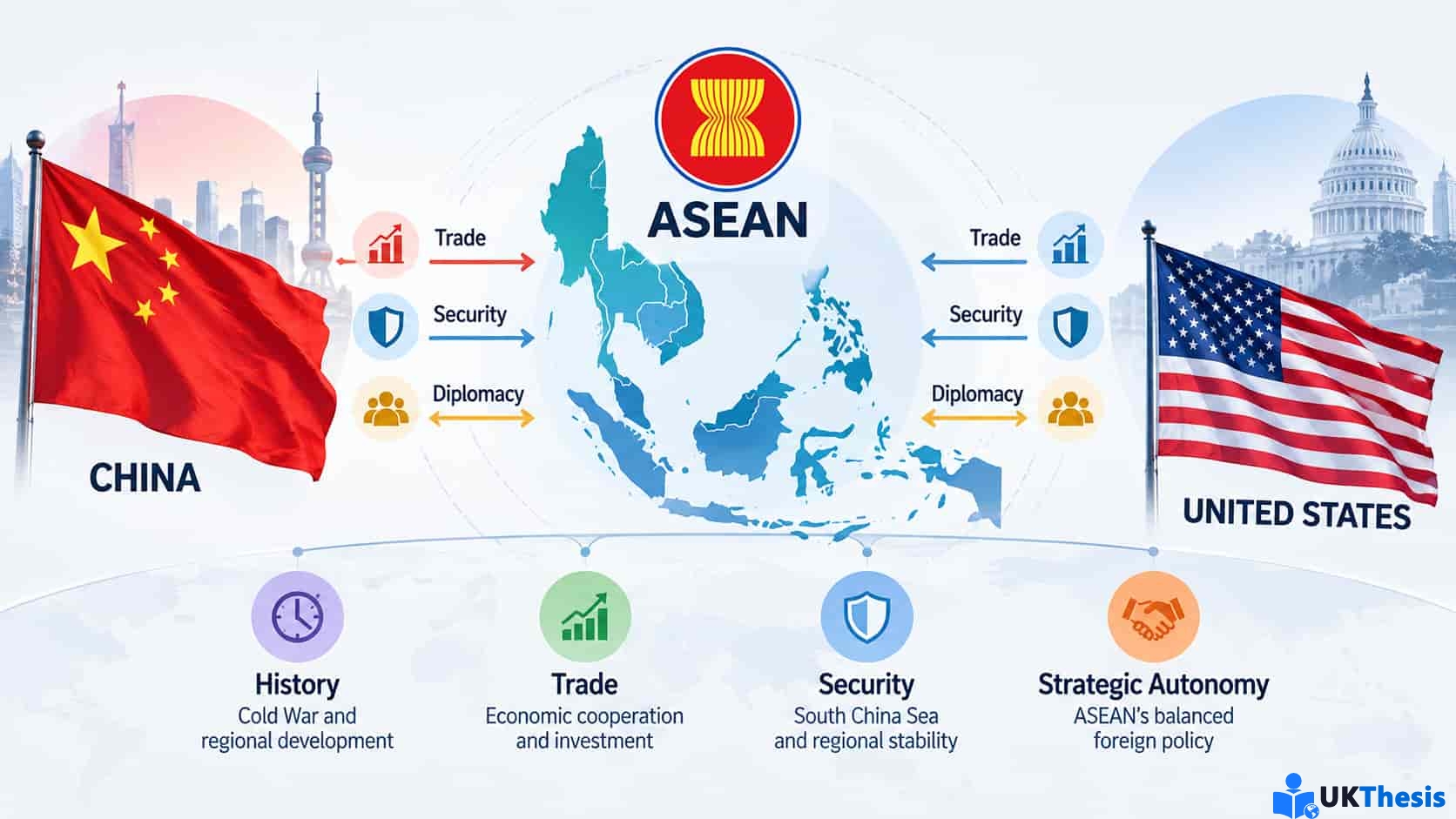
很多同学第一次写ASEAN相关essay时,很容易把题目简化成一个选择题:ASEAN究竟应该更靠近China,还是更靠近the United States?这个问题看起来很直接,但真正写下去会发现,International Relations几乎从来没有这么乖乖配合我们做单选题。
这篇Essay因此以ASEAN、China和the United States之间的关系为核心,从Cold War历史、区域合作、经济联系、South China Sea以及Strategic Autonomy几个方面分析东南亚如何在大国关系中维护自身利益。
核心问题:ASEAN是否必须在China和the United States之间选择一方,还是可以通过Regional Cooperation与Strategic Autonomy同时维持与两方的关系?
| 分析维度 | 核心问题 | Essay关注点 |
|---|---|---|
| Historical Context | 历史为什么重要? | Cold War与区域安全经验 |
| Economic Relations | 经济关系如何影响外交? | Trade、Investment与Regional Integration |
| Security | 安全利益是否与经济利益冲突? | South China Sea与地区稳定 |
| Strategic Autonomy | ASEAN必须二选一吗? | Regional Cooperation与ASEAN Centrality |
Historical Background: Southeast Asia and the Cold War
It is difficult to understand Southeast Asian international relations without considering the Cold War. During the twentieth century, the region became one of the important arenas of competition involving major powers. Vietnam and Cambodia in particular experienced conflicts strongly shaped by wider geopolitical competition.
These experiences matter because foreign policy is rarely created on a blank sheet of paper. Governments remember previous conflicts, external intervention and political dependence. Historical experience can therefore influence how states think about sovereignty, security and relations with major powers.
One of the most important developments in the region was the creation of the Association of Southeast Asian Nations, or ASEAN. Regional cooperation gave Southeast Asian states another way to manage security and political relations rather than relying entirely on outside powers.
这也是理解ASEAN特别关键的一点。它并不只是一个“东南亚国家群聊”,背后还有很明显的Regional Stability逻辑。经历过Cold War以后,加强地区内部合作本身就具有外交意义。
China, the United States and Southeast Asia
China and the United States influence Southeast Asia through different combinations of economic, diplomatic and security relationships. For ASEAN states, however, relations with major powers do not necessarily operate as a simple zero-sum choice.
A country may develop deep trade and investment links with one major power while maintaining security, diplomatic or technological relationships with another. Different ASEAN members may also place different levels of importance on these relationships.
This is why treating ASEAN as a single state can create problems in an International Relations Essay. ASEAN provides an important regional framework, but its members have different histories, economic structures, security concerns and foreign-policy priorities.
写作提醒:不要轻易写“ASEAN wants…”然后直接代表整个东南亚发言。更严谨的表达是“ASEAN as a regional organisation…”、“some ASEAN member states…”或者“member states may differ in…”。这一点非常小,但老师通常一眼就能看出你有没有意识到ASEAN不是一个国家。
Economic Relations and Regional Integration
Economic relations are one of the most important dimensions of Southeast Asia’s connections with major powers. Trade, investment, tourism, infrastructure and supply chains can all influence the incentives governments face when making foreign-policy decisions.
China’s geographical proximity gives economic relations with Southeast Asia particular significance. At the same time, the United States has long remained an important economic and political actor in the wider Asia-Pacific region.
The original debate surrounding arrangements such as the Trans-Pacific Partnership and the Regional Comprehensive Economic Partnership also demonstrated that regional economic architecture can become connected with wider strategic discussions.
However, economic interdependence should not automatically be interpreted as political alignment. A state can trade extensively with another country while still disagreeing with it on security or diplomatic issues.
| Relationship | Possible Benefit | Possible Concern |
|---|---|---|
| Trade | Market access and economic growth | Dependence on particular markets |
| Investment | Infrastructure and development | Economic and political sensitivity |
| Security Cooperation | Regional stability | Major-power competition |
| Regional Institutions | Collective dialogue | Different interests among members |
The South China Sea and Security Relations
The South China Sea represents one of the most complicated parts of relations between China and several Southeast Asian states. Its importance comes from overlapping territorial claims, maritime security concerns and the role of important international shipping routes.
For an International Relations Essay, the useful analytical point is not simply that “there is a dispute”. The more interesting question is how states manage situations in which economic cooperation and security disagreement exist at the same time.
For example, two states may have strong trade relations while disagreeing over maritime claims. This creates a situation where foreign policy becomes a process of balancing different interests rather than following one simple alliance logic.
The South China Sea therefore illustrates a wider theme in International Relations: economic interdependence does not necessarily remove security competition.
Does ASEAN Have to Choose?
A common way of framing the topic is to ask whether Southeast Asia will align with China or the United States. This produces a clear Essay Question, but it can also oversimplify how regional diplomacy works.
ASEAN members may have incentives to maintain relationships with both major powers. China may be important in areas such as regional trade, investment and geographical proximity, while the United States may remain important in security, investment, diplomacy, technology and the wider regional balance.
From this perspective, the key concept is Strategic Autonomy. Strategic autonomy does not mean refusing cooperation with major powers. Instead, it means attempting to preserve room for independent decision making.
ASEAN-led regional institutions can also provide smaller and medium-sized states with diplomatic platforms that would be difficult to reproduce individually.
| Possible Strategy | Meaning | Main Challenge |
|---|---|---|
| Alignment | Closer relationship with one major power | Reduced room for manoeuvre |
| Balancing | Using relationships to offset another power | Can increase strategic tension |
| Hedging | Maintaining several relationships simultaneously | Becomes harder as competition intensifies |
| Strategic Autonomy | Preserving independent policy space | Requires regional coordination |
A More Critical Interpretation
The idea that Southeast Asia must select one permanent partner assumes that international politics works through fixed camps. In practice, states frequently cooperate with different partners on different issues.
A government may welcome investment from one country, maintain defence cooperation with another and still support ASEAN-based regional institutions. These positions are not necessarily contradictory.
This also explains why the historical experience of Southeast Asia matters. States that experienced Cold War rivalry and external intervention have strong reasons to value sovereignty and policy flexibility.
At the same time, strategic autonomy is not easy. Greater competition between major powers can increase pressure on smaller states, while disputes involving trade, technology or security may make neutrality more difficult.
The better analytical question is therefore not simply:
China or the United States?
but rather:
How can ASEAN states maximise cooperation while preserving strategic autonomy?
Conclusion
The relationship between ASEAN, China and the United States cannot be reduced to a simple choice between two major powers. Southeast Asia’s historical experience, economic interests, security concerns and regional institutions all influence the foreign-policy options available to ASEAN members.
The Cold War helps explain why sovereignty and regional cooperation remain important themes. Economic relations show that interdependence can create strong incentives for cooperation, while the South China Sea demonstrates that economic ties do not necessarily eliminate security disputes.
For ASEAN, maintaining relationships with multiple partners can therefore be understood as part of a broader effort to preserve Strategic Autonomy. Individual member states may adopt different approaches, but regional institutions provide an additional platform for managing major-power relations.
The central International Relations lesson is not that one major power must inevitably replace another. It is that Southeast Asian states operate in a complex regional system where economic cooperation, security concerns and diplomatic independence frequently exist at the same time.
学姐的写作提醒:这种题真的不要一上来就站队。我以前看到“China还是US”这种题,也很容易下意识觉得老师一定要你选一个。后来会发现,高分往往就在那个“不急着二选一”的过程里。先拆Trade、Security、History、Regional Institutions,再判断不同国家为什么会有不同选择,Essay一下子就从新闻评论变成International Relations分析了。
FAQ
Q1:这篇属于International Relations Essay还是Politics Essay?
两者都有关,但更准确地说属于International Relations Essay,重点是ASEAN、China–US Relations、Regional Order和Foreign Policy。
Q2:ASEAN可以被当成一个国家来分析吗?
不建议。ASEAN是Regional Organisation,不同Member States拥有不同的历史、经济结构和安全利益,因此需要区分ASEAN整体机制与单个成员国政策。
Q3:China–US Relations Essay一定需要选边吗?
不一定。具体取决于Essay Question。很多International Relations题目更适合分析Balancing、Hedging、Strategic Autonomy以及Regional Institutions,而不是简单选择一方。
Q4:South China Sea为什么适合放进这篇Essay?
因为它很好地体现了Economic Cooperation与Security Competition可以同时存在,也能帮助解释为什么ASEAN成员对China关系并不是单一维度。
Q5:Cold War历史是不是已经太旧?
如果只是复述历史当然不够,但如果用Cold War解释地区国家为什么重视Sovereignty、Regional Cooperation和Major-Power Influence,它仍然具有分析价值。
Q6:怎样让International Relations Essay更Critical?
不要只描述哪个国家影响力大,而是比较不同解释。例如Economic Interdependence、Security Interests、Historical Experience和Strategic Autonomy分别能解释什么,又有哪些局限。
Q7:International Relations Essay不知道怎么组织论点怎么办?
可以按照“Historical Context → Economic Relations → Security → Regional Institutions → Critical Evaluation”的顺序建立结构。如果在Essay Structure、Theory Application或Critical Analysis上比较乱,也可以通过UKThesis的Essay辅导进一步梳理论证框架。
相关阅读
RTAs对WTO多边贸易体制的影响分析:Regional Trade Agreements Essay
Persuasive Essay怎么写?Thesis、Evidence与Counterargument写作指南
英国Essay怎么写?Essay结构与Critical Analysis写作指南