Assignment常见语法错误有哪些?Academic Writing语法检查与修改指南
assignment常见语法错误有哪些?Grammar没错不等于Academic Writing就写好了
很多留学生写完Assignment以后,第一件事就是打开Grammar Checker。红线改完、拼写检查完,看起来好像就可以提交了。
但真正的Academic Writing语法检查,并不只是把单词拼对。
大学Assignment中比较常见的问题还包括:
主谓不一致、时态混乱、冠词使用不自然、介词搭配错误、Sentence Fragment、Run-on Sentence、从句结构错误,以及中文思维直接翻译成英文。
有些错误很明显,例如:
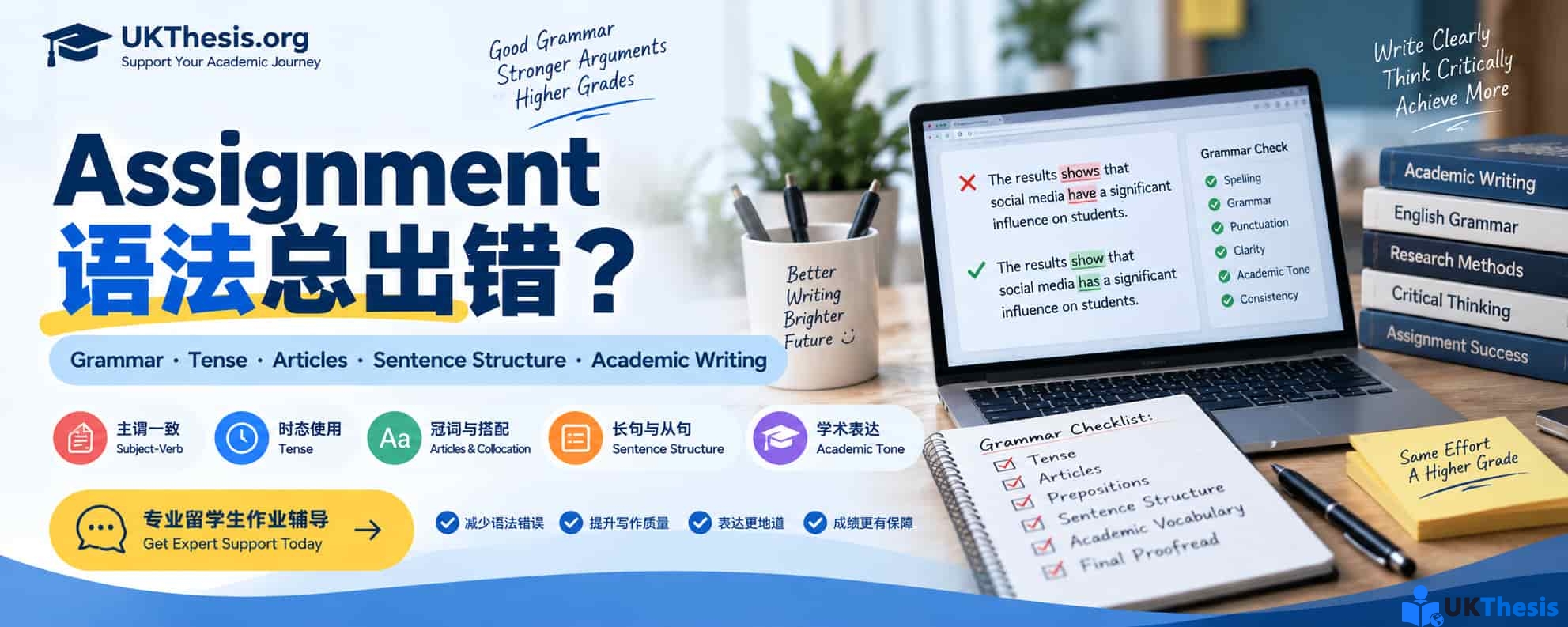
✗ The results shows that social media have a significant influence.
有些句子语法软件甚至不会标红,但读起来仍然不像自然的Academic English。
所以这篇不单纯列“错误答案”,而是从Assignment写作中比较常见的情况出发,看一看错误为什么出现,以及应该怎样修改。
一、Subject-Verb Agreement:主谓一致
主谓一致看起来是很基础的语法,但在Academic Writing里仍然很容易出错,尤其当Subject后面跟着很长的介词短语时。
例如:
错误:
✗ The impact of social media platforms have attracted considerable academic attention.
修改:
✓ The impact of social media platforms has attracted considerable academic attention.
为什么?
真正的Subject是the impact,不是离Verb最近的“platforms”。
类似结构还有:
The number of international students has increased.
而不是:
The number of international students have increased.
写长句的时候,不要只看Verb前面最近的那个Noun,而要先找到句子的真正Subject。
二、时态混乱:一段里Present和Past不断跳
Assignment里的Tense不是“全篇只能使用一种”。
真正的问题是:不同内容需要使用与语境相符的时态。
例如讨论一个已经完成的Study:
较自然:
✓ Smith (2024) conducted a survey of 500 university students and found that...
但在讨论一个理论目前仍然成立的观点时,可以出现:
✓ Social identity theory suggests that individuals define themselves partly through group membership.
因此,看到同一段里既有Past Tense又有Present Tense,并不意味着一定错误。
真正需要检查的是:
这个时态是否和你正在表达的时间、Research状态以及Argument一致?
三、冠词A、An、The:不能靠中文直觉判断
冠词对中文母语学生来说比较麻烦,因为中文里没有完全对应的系统。
最常见的问题之一,是可数单数名词前面什么都不放。
错误:
✗ This study provides useful method for analysing consumer behaviour.
修改:
✓ This study provides a useful method for analysing consumer behaviour.
另一个容易误解的问题是a和the并不是简单的“一个”和“这个”。
例如:
Can you give me a pencil?
表示“给我一支铅笔”,没有限定是哪一支。
Can you give me the pencil on the desk?
则指双方都可以识别的某一支特定铅笔。
因此,判断冠词对不对必须看Context,不能脱离上下文机械判断。
四、介词错误:很多时候不是Grammar,而是Collocation
有些介词错误并不是因为学生不知道in、on、at是什么意思,而是没有掌握英语固定搭配。
例如:
错误:
✗ Students are interested for learning about sustainability.
修改:
✓ Students are interested in learning about sustainability.
类似在Assignment里经常出现的搭配还有:
| 容易写错 | 常见正确搭配 |
|---|---|
| depend of | depend on |
| contribute in | contribute to |
| focus in | focus on |
| associated to | associated with |
| responsible of | responsible for |
这也是为什么阅读Journal Articles很重要。
很多自然的Academic Collocation,并不是背单个单词能够学会的,而是在大量阅读中逐渐熟悉。
五、Relative Clause:which、that、who后面不要重复宾语
中文母语学生很容易出现这样的句子:
✗ The article which I read it yesterday provides an interesting perspective.
正确写法是:
✓ The article which I read yesterday provides an interesting perspective.
因为这里的which已经承担了从句中Object的作用,所以后面不应该再增加一个“it”。
类似:
✓ The researcher who conducted the study interviewed 30 participants.
✓ The theory that the author discusses has several limitations.
Relative Clause本身并不难,真正容易出错的是一句话不断加从句,最后连自己都找不到Main Clause。
六、Sentence Fragment:看起来像一句话,其实缺少完整结构
例如:
✗ Because the sample size was relatively small.
单独看这一行,它只是一个Dependent Clause。
可以改成:
✓ The findings should be interpreted cautiously because the sample size was relatively small.
或者:
✓ Because the sample size was relatively small, the findings may not be generalisable to the wider population.
尤其在修改Assignment的时候,有时删除前半句后忘记重新检查后半句,就容易留下Sentence Fragment。
七、Run-on Sentence:不是句子越长越Academic
有些留学生为了让essay显得“高级”,一口气把四五个观点连接在一起:
✗ Social media has changed consumer behaviour it allows brands to communicate directly with customers this can increase engagement however it can also create privacy concerns.
信息本身没有特别复杂,但所有内容挤在一起,阅读负担很大。
可以改成:
✓ Social media has changed consumer behaviour by allowing brands to communicate directly with customers. This interaction may increase consumer engagement; however, it can also create concerns about privacy.
Academic Writing的目标不是证明自己“会写长句”,而是让Argument清楚。
Complex Sentence应该服务于逻辑,而不是为了复杂而复杂。
八、连接词使用过度:However不是Critical Thinking
有些Assignment几乎每一段都会出现:
However...
Moreover...
Furthermore...
On the other hand...
连接词本身没有问题,但如果逻辑关系并不存在,强行加入Transition反而会显得生硬。
例如:
描述补充信息:Moreover / Furthermore
表达明显转折:However / Nevertheless
表达结果:Therefore / Consequently
表达对照:In contrast / By comparison
真正重要的不是使用多少Academic Linking Words,而是前后两句话到底是什么关系。
九、单复数错误:Research、Evidence、Information尤其容易出问题
Academic Writing里有几个词特别容易被中文学生写错。
例如:
✗ These researches demonstrate that...
通常更自然的写法是:
✓ These studies demonstrate that...
或者:
✓ This research demonstrates that...
类似还包括:
evidence通常作为不可数名词使用;
information通常也是不可数;
advice通常也是不可数。
因此:
✗ many evidences
✓ considerable evidence
✗ many informations
✓ a large amount of information
十、词性用错:Analyse、Analysis、Analytical不要混用
Academic Writing经常需要在同一个词族之间切换。
例如:
| 形式 | 示例 |
|---|---|
| analyse — Verb | This section analyses the findings. |
| analysis — Noun | The analysis indicates that... |
| analytical — Adjective | An analytical framework was applied. |
常见错误例如:
✗ This section provides an analyse of the data.
✓ This section provides an analysis of the data.
检查Grammar的时候,不要只检查拼写,还要确认这个词在Sentence里承担什么语法功能。
十一、中式英语:每个单词都认识,但组合起来不像Academic English
这一类通常比基础Grammar Error更难发现。
例如中文里经常说:
“随着经济快速发展……”
直接翻译时很容易反复出现:
With the rapid development of economy...
它不一定在所有语境中都构成Grammar Error,但如果每篇Assignment都用类似模板开头,会显得非常泛。
更好的办法是直接进入与Question相关的Context。
例如研究Digital Payments:
✓ The adoption of digital payment technologies has accelerated across both developed and emerging markets.
比写一大段“The economy is developing rapidly”通常更具体。
十二、模糊表达:This、It、They到底指谁?
例如:
✗ This shows that it has an important impact on them.
Grammar Checker可能不会觉得这句话有什么问题。
但读者会问:
This是什么?It是什么?Them又是谁?
Academic Writing要尽量减少模糊指代。
可以改成:
✓ These findings suggest that flexible working arrangements may improve employee job satisfaction.
这样信息就具体很多。
十三、重复使用Very、Really、A Lot:Academic Tone不够稳定
Assignment不是聊天。
例如:
✗ The result is very very important.
可以根据真正含义改成:
✓ The finding is particularly significant.
再例如:
✗ A lot of researchers...
可以写成:
✓ Many researchers...
或者更重要的是直接量化:
✓ Several recent studies have examined...
Academic Tone并不是单纯把简单词换成复杂词,而是尽量做到准确、克制、有Evidence。
十四、绝对化语言太多:Always、Never、Prove要谨慎
Academic Research很多时候讨论的是Probability、Association、Evidence和Interpretation,而不是绝对真理。
例如:
✗ Social media always causes anxiety among university students.
如果Evidence并不能支持这种绝对结论,可以更谨慎:
✓ Social media use may be associated with higher levels of anxiety among some university students.
类似可以根据Evidence考虑:
may / might / appears to / suggests / is associated with / tends to
这种表达通常被称为Hedging。
但也不要为了“Academic”而每句话都加may。关键还是Evidence到底能够支持多强的Claim。
十五、英式英语和美式英语混用
例如:
British English:analyse, organisation, behaviour
American English:analyze, organization, behavior
两套系统本身都可以正确。
真正需要注意的是学校或课程有没有明确Style要求,以及全文尽量保持一致。
不要第一段写organisation,第三段突然全部变成organization。
十六、Grammar Checker能不能替代人工检查?
Grammar工具确实可以帮助发现:
拼写错误;
部分主谓一致问题;
重复词;
部分标点问题;
某些Sentence Structure问题。
但它通常无法替你判断:
Argument有没有回答Assignment Question;
Technical Term使用是否符合专业语境;
Reference引用是否真的支持这句话;
某个表达在具体Discipline中是否自然;
Critical Analysis是否充分。
所以Grammar Check应该是Final Editing的一部分,而不是整个Assignment Quality Check。
十七、Assignment提交前建议做三轮检查
如果时间允许,不要把所有修改一次完成。
第一轮:Content Check
Question有没有回答?Argument是否清楚?Evidence和Critical Thinking够不够?
第二轮:Grammar & Academic Language
检查Subject-Verb Agreement、Tense、Articles、Prepositions、Sentence Structure、Academic Tone和Collocation。
第三轮:Technical Check
检查Reference、Word Count、Formatting、Page Number、文件格式和Submission要求。
这样比从第一页开始一边改观点、一边改Grammar、一边调整Reference更不容易漏问题。
十八、Assignment Grammar提交前自查清单
□ Subject和Verb是否一致?
□ Tense使用是否符合语境?
□ 单数可数名词是否缺少必要的Article或Determiner?
□ Preposition和Collocation是否自然?
□ Relative Clause中是否重复Subject或Object?
□ 有没有Sentence Fragment?
□ 有没有一句话写得过长、出现Run-on Sentence?
□ Linking Words是否真正符合前后逻辑?
□ Research、Evidence、Information等不可数名词有没有误用复数?
□ Verb、Noun、Adjective词性是否正确?
□ This、It、They等Pronoun指代是否清晰?
□ 有没有过度使用Very、Really、A Lot等口语表达?
□ Claim是否过度绝对?
□ British / American English拼写是否保持一致?
□ 最后是否完整朗读或重新通读一次?
FAQ:Assignment Grammar常见问题
1. Assignment语法错误很多一定会低分吗?
不同课程的Marking Criteria不同。语言准确性通常只是Assessment的一部分,Argument、Evidence、Critical Thinking、Structure以及对Question的回应同样重要,因此应该结合自己的Rubric判断。
2. Grammar正确为什么老师还是说Academic Writing不好?
因为Grammar正确只代表Sentence在语法层面成立。Academic Writing还要求表达准确、逻辑清楚、语气合适、Evidence充分,并形成完整的Argument。
3. Assignment可以全部使用复杂长句吗?
没有必要。Simple、Compound和Complex Sentences可以搭配使用。句型复杂度应该服务于表达,而不是越长越好。
4. British English和American English哪种更适合Assignment?
首先看学校和课程Style Guide。如果没有特殊要求,重点是全文保持一致。
5. Grammar Checker显示100分是不是就可以提交?
不能只根据工具评分判断。工具无法完整评价Argument、Research Quality、Citation Accuracy以及Critical Thinking。
6. Grammar应该边写边改,还是最后一起改?
First Draft阶段可以先保证意思和Argument完整,Final Revision阶段再集中处理Language问题。过早纠结每一句Grammar,有时反而会打断整体写作思路。
7. Assignment里面可以使用第一人称I吗?
这取决于Assessment类型和Discipline。Reflective Writing中第一人称很常见,而某些Formal Report或Academic Essay可能更倾向其他表达方式,应以课程要求为准。
总结:Assignment语法检查的目标不是“零红线”,而是表达准确
语法当然重要,但高质量Assignment并不是把Grammar软件里的所有提示全部点Accept。
更值得建立的是一个完整的检查顺序:
先保证Question和Argument正确 → 再检查Sentence Structure → 再处理Grammar和Academic Tone → 最后检查Reference、Formatting和Submission。
对于留学生来说,如果英语不是母语,出现Articles、Prepositions、Tense或者Collocation方面的问题非常正常。
真正有效的方法不是背几十条所谓“万能高级句型”,而是通过阅读专业Journal Articles、记录常见Academic Collocations、修改自己的Draft,并逐渐建立属于自己的Grammar Checklist。
这样下一篇Essay或Assignment再遇到类似问题时,就不会每次都从头开始。