E-commerce Business Model案例:Babysitter Service商业计划与Revenue Model - UKThesis

本文是一篇工商管理与E-commerce方向的Business Report范文,案例主题是E-commerce Business Strategy for Babysitter Service。文章以一个虚拟的Online Babysitter Platform——Tiny & Tots Babysitter为案例,分析它如何通过在线平台提供Childcare Service,并进一步讨论Business Model、Value Proposition、Revenue Model、Competitive Advantage和Online Marketing Strategy。
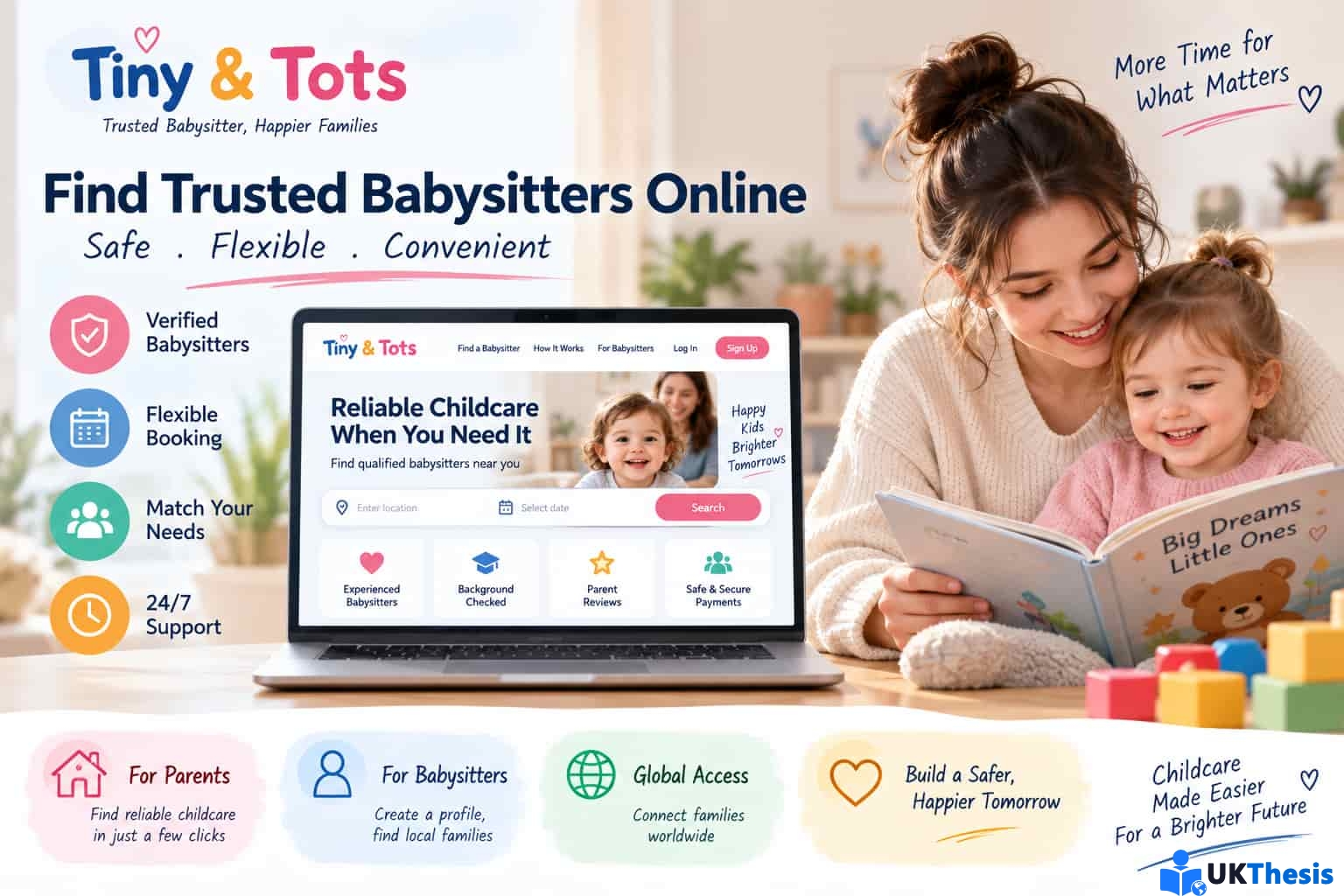
这类题和普通essay有一点不一样。它不是只让你讨论“电子商务有什么好处”,而是需要把一个Business Idea真正拆开:客户是谁?平台解决什么问题?怎么赚钱?竞争优势在哪里?怎样找到用户?如果这些问题答不清楚,文章就很容易变成“做一个网站,然后赚钱”的想象作文。
这篇案例的核心:把传统Babysitter Service从Local Offline Service转化为Online Platform Business Model,并通过On-demand Matching、24/7 Service和Digital Marketing创造新的服务方式。
| Business Model Element | Tiny & Tots案例 |
|---|---|
| Customer Need | 快速找到可靠、符合需求的Babysitter |
| Value Proposition | Online Booking、On-demand、24/7、Matching |
| Revenue Model | Membership、Booking Fee、Commission、Affiliate Revenue |
| Key Resource | Babysitter Database、Website/App、Trust System |
| Competitive Advantage | Convenience、Availability、Speed、Service Matching |
Executive Summary
This report presents an e-commerce business model for a new company called Tiny & Tots Babysitter. The company aims to connect parents with suitable babysitters through an online platform according to customer needs.
Traditional babysitting services are often local and may require customers to contact agencies directly. An online platform can make the booking process faster by allowing customers to search, compare and request childcare services remotely.
The report examines how an e-commerce model could support this service through value creation, revenue generation, online marketing and competitive positioning.
Introduction
Traditional service businesses often rely on physical locations, telephone bookings or personal recommendations. However, digital platforms have changed how consumers search for and purchase services.
Busy parents may prefer to search for childcare online rather than visit an agency during working hours. An e-commerce platform can therefore reduce the time and effort required to find a suitable babysitter.
Tiny & Tots Babysitter is designed as an online service platform. Parents can enter their requirements, review available babysitters and request a booking through a website or mobile service.
The company also gives qualified babysitters an opportunity to create profiles and offer their services through the platform.
This creates a two-sided digital marketplace: one side needs childcare, while the other side offers time and childcare skills.
E-commerce Business Strategy
A business strategy explains how a company intends to create value, compete and achieve long-term financial sustainability.
For Tiny & Tots, the basic strategy is to move babysitting services from a largely local and offline process into a digital matching platform.
Customers may need babysitting during evenings, weekends, events or unexpected situations. Traditional daycare centres normally operate according to fixed schedules, while an online booking platform can potentially provide more flexible access.
The platform can allow parents to enter pReferences such as location, required time, children's age and specific childcare needs. The system can then show babysitters who match those requirements.
This reduces search effort for parents and gives babysitters another channel through which they can find work.
E-commerce Business Model
The e-commerce model uses digital technology to connect service providers with customers.
For a babysitting platform, the website or app does not need to provide childcare itself. Its role is to organize information, facilitate matching, support booking and create trust between both sides.
In that sense, the business model has similarities with other on-demand service platforms: the company provides the digital infrastructure, while individual service providers deliver the actual service.
| 参与者 | 主要需求 | 平台提供的价值 |
|---|---|---|
| Parents | 找到合适、可靠、方便的Babysitter | Search、Matching、Booking、Payment |
| Babysitters | 寻找更多工作机会 | Profile、Visibility、Customer Access |
| Platform | 建立可持续商业模式 | Commission、Membership、Service Fee |
Value Proposition
Value Proposition explains why customers should choose one service rather than another.
For Tiny & Tots Babysitter, convenience is one of the main sources of value. Parents can search for childcare without travelling to an agency.
Another value is availability. Babysitting demand does not always occur during normal office hours. Families may require support during weekends, evenings, weddings or unexpected events.
A digital platform may also reduce search costs by allowing parents to compare multiple babysitters in one place.
However, childcare has one characteristic that makes this business model more sensitive than many ordinary online services: trust and safety.
Parents are not simply ordering a taxi or buying a product. They are choosing someone who may be responsible for their child. Therefore, background checks, qualifications, identity verification, reviews and clear safety procedures should form part of the Value Proposition.
这里是这篇case study特别值得深化的地方:Babysitter Platform的竞争优势不能只写“便宜、方便”。如果Trust & Safety没有解决,再漂亮的App也很难形成真正的Customer Value。
Revenue Model
A Revenue Model explains how the platform converts customer activity into income.
Tiny & Tots could consider several possible revenue sources.
| Revenue Source | How It Works |
|---|---|
| Membership Fee | Parents pay for access to advanced search or member services |
| Booking Commission | Platform receives a percentage from completed bookings |
| Service Fee | Small platform fee charged per transaction |
| Premium Listing | Qualified babysitters pay for additional visibility |
| Affiliate Revenue | Relevant childcare businesses may generate referral commission |
Relying on only one source of income may make an early-stage platform vulnerable. A combination of transaction fees and optional premium services can provide more flexibility.
However, the company must avoid charging so many fees that users decide to arrange future transactions privately outside the platform.
Competitive Environment
The platform would face both direct and indirect competitors.
Direct competitors include other online babysitting or childcare marketplaces.
Indirect competitors may include daycare centres, local childcare agencies, family members, personal referrals and community childcare networks.
Therefore, simply creating a website does not automatically create Competitive Advantage.
The company needs to offer something customers value more than existing alternatives.
Possible advantages include:
On-demand Matching:快速寻找附近可用的Babysitter。
Flexible Availability:覆盖Evening、Weekend和临时需求。
Digital Convenience:Search、Profile、Booking和Payment集中完成。
Trust:身份验证、Background Checks、Rating和Review机制。
Specialized Matching:根据儿童年龄、语言、经验或特殊需求寻找合适人员。
Online Marketing and Advertising
An online platform needs both parents and babysitters. This creates a typical two-sided marketplace problem.
If there are many babysitters but no parents, service providers leave. If there are many parents but too few babysitters, customers cannot find suitable services.
Marketing therefore needs to attract both groups.
Search Engine Marketing can help the business reach parents who are actively searching for childcare services.
Content and Search Engine Optimization can also help answer practical questions such as how to choose a babysitter, what parents should check before booking childcare and how online childcare services work.
Email Marketing may be useful for existing customers, for example notifying them about new services, platform updates or relevant childcare information.
Social Media can support brand awareness, but childcare is strongly trust-based, so useful content, reviews and reputation may be more important than simply posting a large number of advertisements.
| Marketing Channel | 主要目的 |
|---|---|
| SEO | 吸引正在搜索Childcare Information的用户 |
| SEM | 覆盖具有即时Booking Intent的家长 |
| Customer Retention和Repeat Booking | |
| Social Media | Brand Awareness、Trust和Community |
Trust & Safety:这个商业模式最不能省的一环
Childcare services involve a much higher level of trust than many ordinary e-commerce transactions.
The company therefore needs to establish a clear process for verifying babysitters.
This may include identity checks, qualifications, relevant experience and background screening where appropriate.
Parents should also have access to transparent profile information and a review system.
Safety procedures should be designed before rapid geographic expansion. A platform claiming to operate globally without considering different legal, regulatory and childcare requirements would face significant operational difficulties.
所以原方案里“直接服务全球”的想法可以作为Business Vision,但真正的Strategy最好是逐步扩张。先把一个区域的Matching、Verification、Booking和Customer Support做稳定,再考虑进入更多市场,会比一句“Worldwide Service”更像真实Business Plan。
Conclusion and Recommendations
The Tiny & Tots case demonstrates how an e-commerce model can be applied to a traditional local service industry.
An online babysitter platform can create value by reducing customer search effort, improving booking convenience and helping service providers reach more potential customers.
Its success, however, would depend on more than technology.
The platform needs a sustainable Revenue Model, sufficient babysitter supply, effective Digital Marketing and a strong Trust & Safety system.
Rather than expanding globally immediately, the company should first test the business model in a limited market, collect customer feedback and understand local childcare demand.
Market Research should examine what parents value most when choosing a babysitter, how much they are willing to pay and which factors create trust.
The company should also provide clear standards for babysitters and establish appropriate training, verification and complaint-handling processes.
The strongest Competitive Advantage is therefore unlikely to be simply “available 24/7”. A more defensible position would combine convenience + reliable matching + safety + trust + service quality.
从Business assignment角度看,这篇范文比较值得参考的是它怎样把一个简单的Idea慢慢拆成Business Model。Value Proposition、Revenue Model、Competition和Marketing并不是四个互不相关的小标题,而应该共同回答一个问题:这个Business Idea为什么有机会真正运行起来?
如果在E-commerce Business Model、Business Plan、Entrepreneurship Assignment或者Case Study结构上拿不准,也可以通过留学生课程作业写作辅导先整理Business Idea、Model和Argument,再根据Assignment Brief完成分析。
FAQ
Q1:这篇是Essay还是Business Report?
更接近E-commerce Business Report、Business Plan或Case Study,因为文章包含Executive Summary、Business Model、Revenue Model、Competition和Recommendations。
Q2:Babysitter Platform属于什么Business Model?
可以理解为双边Online Marketplace或Service Platform,一端是Parents,一端是Babysitters,平台负责Matching、Booking和Trust机制。
Q3:Revenue Model和Business Model有什么区别?
Business Model说明企业整体如何创造和交付价值,而Revenue Model主要解释企业通过哪些方式获得收入。
Q4:为什么Value Proposition不能只写“便宜”?
Childcare属于高度依赖Trust的服务。Safety、可靠性、匹配质量和Convenience都可能比单纯低价更加重要。
Q5:可以用Uber作为类比吗?
可以用于说明On-demand Platform和Two-sided Marketplace逻辑,但Childcare涉及更高的Safety、Verification和Trust要求,因此不能完全照搬Ride-hailing模式。
Q6:这类案例适合加入SWOT或Porter Five Forces吗?
可以,但只有在Assignment Brief要求或确实有助于分析时再加入。文章本身已经有Business Model、Competition和Marketing框架,没有必要为了显得专业而把所有战略模型都塞进去。
相关阅读
E-business Strategy怎么分析?SWOT、PEST与Porter五力案例
Uber与eBay Case Study:P2P平台Quality Management分析
E-commerce Essay范文:Website Attributes如何影响Customer Satisfaction?