Business Ethics Case Study范文|Ethical Dilemma与Information Disclosure - UKThesis

Business Ethics最难写的题,往往不是“什么是商业道德”,而是这种题:
如果把坏消息告诉客户,公司可能失去合同;如果暂时不告诉客户,公司又可能损害客户利益和长期信任。你会怎么选?
下面这篇Business Ethics case study正是围绕这样的Ethical Dilemma(伦理困境)展开。
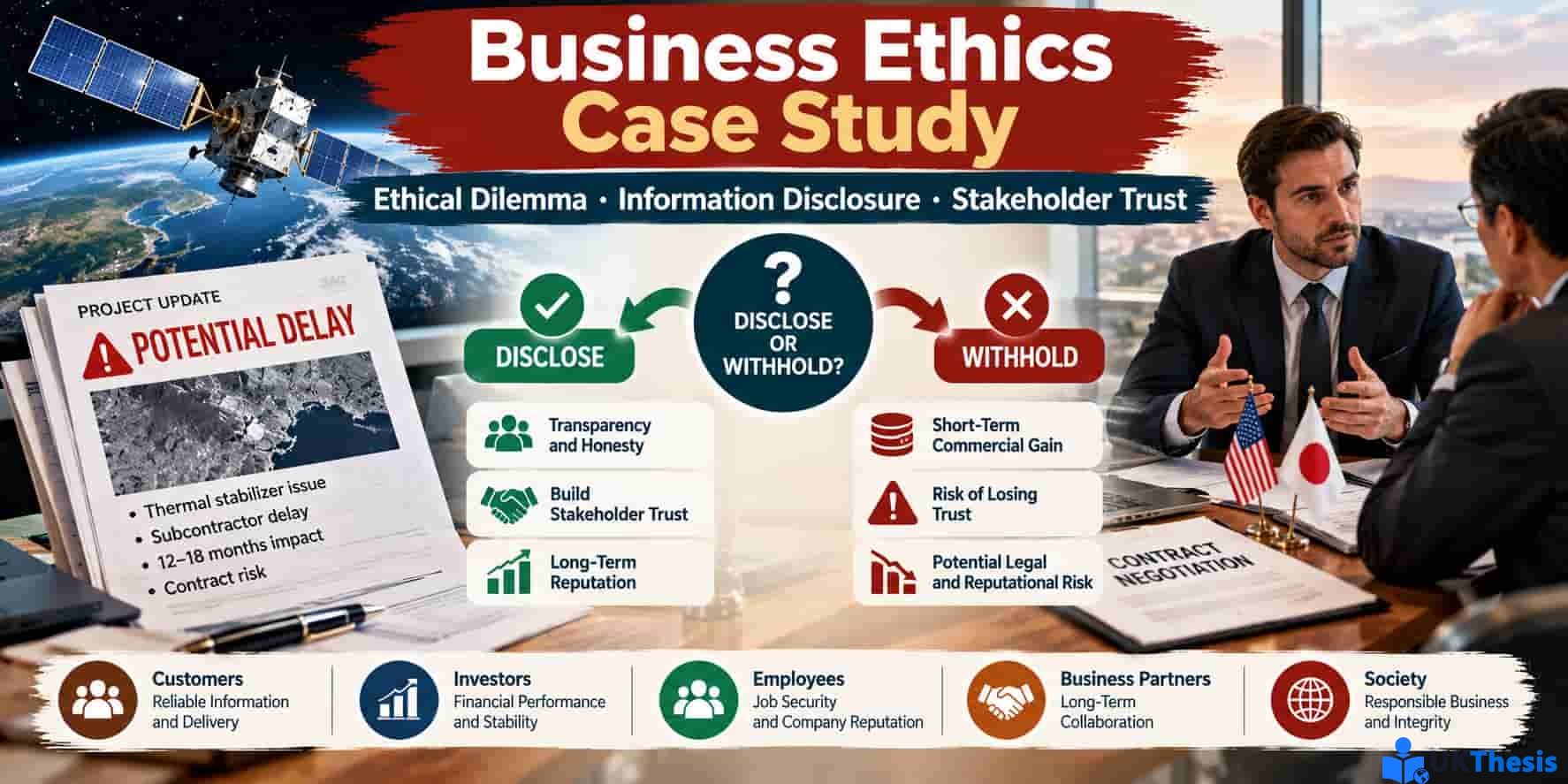
原案例中的ISI是一家虚构企业。公司在参与一项重要商业项目时发现,原定交付时间可能无法实现。与此同时,客户仍在与ISI讨论新的商业合作。
于是问题来了:ISI是否应该主动向客户披露这个可能影响交易决策的负面信息?
这个问题看起来只是“说还是不说”,实际上涉及Information Disclosure、Stakeholder Trust、Commercial Pressure、Corporate Ethics以及Short-term Interest与Long-term Reputation之间的冲突。
范文定位:本文适合作为Business Ethics、Corporate Ethics、Ethical Dilemma及Stakeholder Management相关assignment和Case Study学习参考。重点不是背诵Ethics定义,而是学习如何面对一个没有“完美答案”的商业伦理决策。
Case Background:ISI面临什么问题?
The case concerns a fictitious organisation referred to as ISI. The company operates in a technologically demanding business environment involving satellite imaging and major commercial projects.
ISI faces an important business problem when technical and project-related difficulties create the possibility of a significant delay.
At the same time, the organisation is involved in discussions concerning additional business opportunities.
This creates an ethical question for management:
Should the company disclose negative information concerning the possible delay when that information could influence the customer's willingness to continue negotiations?
这就是这篇Case Study真正值得留下来的地方。
如果公司立即披露,可能失去Business Opportunity;如果选择隐瞒或者延迟披露,短期可能保护交易,却可能把更大的Ethical Risk和Reputational Risk留到以后。
What Is the Ethical Dilemma?
An Ethical Dilemma occurs when a decision involves competing values, responsibilities or interests and no available option produces a completely desirable outcome.
In the ISI case, management is effectively balancing two competing considerations:
| Commercial Consideration | Ethical Consideration |
|---|---|
| Protect the business opportunity | Provide relevant information to the customer |
| Avoid weakening negotiations | Maintain honesty and transparency |
| Protect short-term revenue | Protect long-term stakeholder trust |
| Control negative information | Allow the customer to make an informed decision |
这也是为什么Business Ethics不能简单理解成“公司做好事”。
真正的Ethical Decision经常意味着:做符合伦理的事情,本身可能存在Commercial Cost。
Internal and External Forces
The decision facing ISI does not take place in isolation. Management decisions can be influenced by both internal and external pressures.
Internal Forces
Internal pressures may include:
Management expectations
Revenue and profitability concerns
Pressure to secure a major contract
Project performance
Technical problems
Organisational culture
External Forces
External considerations may include:
Customer expectations
Competition
Market reputation
Contractual relationships
Stakeholder expectations
Future business relationships
所以一个Ethical Dilemma很少只是某一个经理突然面对“善与恶”的选择。实际商业决策背后通常同时存在Revenue、Competition、Customer Relationship以及Career Pressure。
Should ISI Disclose the Negative Information?
The central question is whether ISI should disclose information concerning the expected delay while business negotiations are continuing.
From a narrow short-term commercial perspective, withholding negative information may appear attractive.
If the customer is unaware of the potential delay, negotiations may continue without the additional concern created by the disclosure.
However, this creates another question:
If the information could materially influence the customer's decision, is withholding it compatible with an honest business relationship?
This is where the issue moves from ordinary Business Strategy into Business Ethics.
Scenario 1:Withholding or Delaying Disclosure
The first scenario examines the consequences of withholding or delaying negative information.
In the original case, the failure to communicate important information ultimately contributes to serious problems in the business relationship. Negotiations are affected once the information becomes known, and the case later describes major financial consequences for the organisation.
The lesson is not simply:
“Hide information and the company will fail.”
That would be far too simplistic.
The more useful Business Ethics lesson is that delaying disclosure can change the nature of the risk.
| Possible Short-Term Benefit | Possible Long-Term Risk |
|---|---|
| Negotiations continue | Loss of customer trust |
| Negative information is temporarily controlled | Later disclosure may appear deceptive |
| Commercial opportunity is protected | Relationship damage may become harder to repair |
| Management avoids an immediate difficult conversation | Reputational and ethical risk increases |
Scenario 2:Honest Disclosure but Losing the Contract
The second scenario creates a more uncomfortable ethical problem.
Imagine that one supplier or bidder honestly explains that the requested deadline is unrealistic, while another competitor accepts the deadline despite knowing that delivery may be difficult.
The honest company may lose the contract.
这才是这篇essay最有意思的地方。
如果“诚实的人一定赢”,Business Ethics就太简单了。
现实中完全可能出现:
Ethical Decision → Short-Term Commercial Loss
Therefore, the ethical value of transparency cannot be evaluated only by asking whether it immediately increases revenue.
A company may choose honesty because it supports long-term trust, responsible decision-making and the quality of the customer relationship, even when the immediate commercial outcome is less attractive.
Scenario 1 vs Scenario 2
| Dimension | Scenario 1: Withhold | Scenario 2: Disclose |
|---|---|---|
| Short-Term Opportunity | Potentially protected | Potentially reduced |
| Transparency | Low | High |
| Customer Information | Incomplete | More complete |
| Immediate Commercial Risk | Lower | Potentially higher |
| Long-Term Trust Risk | Potentially higher | Potentially lower |
Stakeholder Analysis:谁会受到这个决定影响?
Business Ethics Assignment如果只站在Company角度分析,很容易写成Business Strategy。
加入Stakeholder Analysis以后,问题会清楚很多。
| Stakeholder | Main Concern | Impact of Non-Disclosure |
|---|---|---|
| Customer | Reliable information and delivery | May make decisions using incomplete information |
| Management | Revenue, contract and reputation | Short-term benefit but greater future risk |
| Employees | Organisational stability | May be affected by consequences of failed projects |
| Owners / Investors | Long-term company value | Reputational damage can affect future business |
| Business Partners | Reliable commercial relationships | Trust may decline if important information is withheld |
Information Disclosure and Stakeholder Trust
Trust is particularly important when one party possesses information that another party does not.
In the ISI case, management has information about technical and scheduling problems that may not be fully available to the customer.
This creates an information imbalance.
The ethical question is therefore not simply:
“Does ISI legally have to say something?”
A broader Business Ethics question is:
“What information should a responsible company disclose when that information could materially influence a stakeholder's decision?”
这两句话的区别很重要。
第一种只讨论最低限度的Compliance;第二种才开始讨论Corporate Ethics和Stakeholder Responsibility。
Short-Term Profit vs Long-Term Trust
One of the major tensions in the case is the relationship between short-term commercial interests and long-term stakeholder trust.
Withhold Information → Protect Negotiation → Short-Term Benefit → Higher Trust Risk
Disclose Information → Immediate Commercial Risk → Informed Customer → Stronger Basis for Long-Term Trust
Neither chain guarantees a particular commercial result.
Transparency does not guarantee that a company will win the contract, while withholding information does not guarantee that the company will lose it.
The purpose of ethical analysis is therefore not to pretend that good behaviour always produces immediate financial rewards.
Instead, it examines what responsibilities the organisation has while pursuing those rewards.
Disclosure Decision Framework
如果以后碰到类似Case Study,可以先不要急着写“应该披露”或者“不应该披露”,先用下面几个问题判断:
| Question | Why It Matters |
|---|---|
| Is the information significant? | Minor operational details and major project risks should not be treated identically. |
| Could it change the stakeholder's decision? | Material information may affect whether the customer proceeds. |
| Who may be harmed by non-disclosure? | Ethical analysis should consider affected stakeholders. |
| Why does management want to withhold it? | Commercial pressure may influence ethical judgement. |
| Can the problem be disclosed with a solution? | Transparency does not require presenting only the problem. |
| What happens if the stakeholder discovers it later? | Delayed disclosure can create additional reputational risk. |
Recommended Response in the ISI Case
The original case recommends disclosure rather than simply hiding the delay.
However, disclosure does not have to mean walking into a meeting and saying:
“Bad news. We cannot do it. Goodbye.”
A more constructive approach is to communicate both the problem and a revised plan.
The organisation could:
Explain that the original delivery schedule is no longer realistic;
Describe the technical factors contributing to the delay;
Explain relevant issues involving components or subcontractors;
Provide a revised and achievable schedule;
Discuss possible mitigation measures with the customer.
原案例特别提到技术因素以及分包商相关问题。保留这些信息很重要,因为它让Recommendation不是一句空泛的“公司应该诚实”,而是变成:
Disclose the problem + Explain the cause + Present a realistic alternative.
这就比单纯喊“Integrity很重要”专业很多。
How to Write Critical Analysis in a Business Ethics Case Study
写这种Essay最容易出现的情况,是第一段就宣布:
“ISI should disclose the information because honesty is important.”
然后全文都在证明自己第一句话。
这样其实把Ethical Dilemma写没了。
更好的结构是:
Step 1:说明为什么Non-Disclosure对公司有商业吸引力。
Step 2:分析Non-Disclosure可能影响哪些Stakeholders。
Step 3:讨论Disclosure本身的Commercial Cost。
Step 4:比较Short-Term与Long-Term Consequences。
Step 5:最后才形成Recommendation。
这样老师才能看到你是真的在Evaluate,而不是把Ethics当成一道“正确答案早就知道”的选择题。
FAQ:Business Ethics Case Study常见问题
What is an Ethical Dilemma in Business?
An Ethical Dilemma arises when a business decision involves competing responsibilities, interests or values and the available options create different ethical and commercial consequences.
Why is Information Disclosure a Business Ethics issue?
Disclosure becomes an ethical issue when one party possesses information that could materially influence another stakeholder's decision. The organisation must consider honesty, stakeholder interests and the consequences of withholding that information.
What is Stakeholder Trust?
Stakeholder Trust concerns the confidence that customers, employees, investors, partners and other stakeholders place in an organisation's behaviour and information. Trust can influence the long-term quality of business relationships.
Does ethical behaviour always increase profit?
No. An ethical decision may sometimes create an immediate commercial disadvantage. Business Ethics analysis should therefore distinguish short-term financial outcomes from longer-term issues such as trust, reputation and stakeholder relationships.
Business Ethics Case Study和普通Essay有什么区别?
Case Study更强调把Ethical Concepts应用到具体Business Situation。不能只解释Integrity、Transparency或Stakeholder Theory的定义,而应该分析具体人物面对什么选择、不同选择影响谁,以及为什么最后的Recommendation更合理。
Business Ethics Assignment怎么写得不像理论堆砌?
可以先把案例拆成Decision、Stakeholders、Competing Interests、Consequences和Recommendation,再把Ethical Concepts放进这些具体问题中。UKThesis可围绕已有Assessment Brief或Draft提供Business Ethics Assignment结构梳理、Case Study分析、语言润色及Essay写作辅导。
Conclusion
The ISI case demonstrates why Business Ethics becomes particularly difficult when ethical responsibilities conflict with commercial incentives.
Withholding information concerning a project delay may protect negotiations in the short term, but it may also prevent the customer from making a fully informed decision and create greater risks to stakeholder trust.
At the same time, honest disclosure does not guarantee an immediate commercial benefit. A competitor willing to make unrealistic promises may still win the contract.
This is precisely why the case represents a genuine Ethical Dilemma rather than a simple choice between an obviously good option and an obviously bad one.
A more responsible approach is to disclose significant information while also presenting the causes of the problem, a realistic revised schedule and possible solutions.
Ultimately, effective Business Ethics is not about ignoring commercial objectives. It is about deciding how those objectives should be pursued when the organisation's decisions affect customers and other stakeholders.