Business Ethics Assignment范文|Role of the Board & Corporate Governance - UKThesis
Business Ethics写到Corporate Governance时,有一个角色几乎绕不开:Board of Directors(董事会)。
董事会既不是每天负责安排员工工作的运营部门,也不只是开会、签字、听CEO汇报的“高级观众”。从Corporate Governance角度来看,董事会的重要任务之一,是代表股东利益,对公司的战略方向、管理层以及重大风险进行监督。
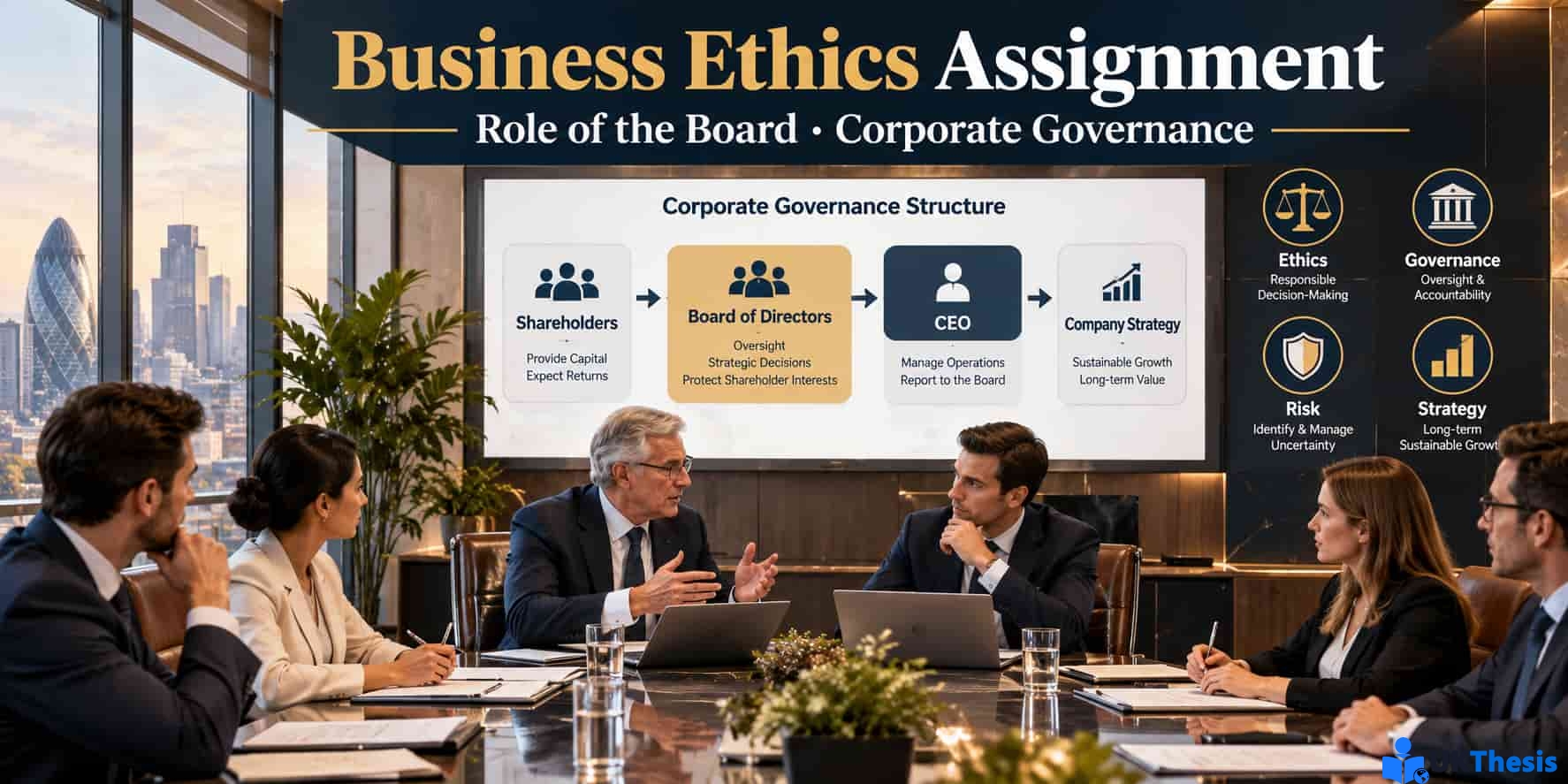
下面这篇Business Ethics Assignment范文围绕Role of the Board展开,从股东利益、CEO监督、董事会独立性、战略决策到Business Ethics进行分析,并结合Tiffany冲突钻石案例讨论一个很现实的问题:当商业利益与Ethical Risk发生冲突时,董事会应该发挥什么作用?
范文定位:本文适合作为Business Ethics、Corporate Governance及Business Management相关assignment案例参考,重点不是泛泛介绍“商业道德是什么”,而是分析Board of Directors在公司治理、战略监督及Ethical Decision-Making中的作用。
The Role of the Board:董事会的作用
Directors are individuals who represent the interests of shareholders in the overall governance of a company. Once shareholders invest their capital, directors receive high-level information concerning the performance and direction of the company through periodic board meetings. At these meetings, the CEO normally reports to the board on the company's position, performance and significant issues.
The board may approve stock grants, review major acquisitions and make other high-level decisions relating to strategic direction rather than routine operational matters.
Some directors may also be independent specialists who contribute knowledge and experience that the existing management team does not possess.
这里特别容易把Board和Management写混。简单理解:Management更接近日常“怎么把公司经营起来”,而Board更关注“管理层是不是在正确经营公司、重大方向有没有问题”。如果Assignment能把这两层区分开,后面的Corporate Governance分析就会清楚很多。
| Board Responsibility | Main Focus | Business Ethics Connection |
|---|---|---|
| Shareholder Oversight | Protect shareholder interests | Accountability and responsible governance |
| CEO Oversight | Monitor senior management | Prevent unchecked managerial power |
| Strategic Direction | Review major strategic decisions | Consider long-term consequences |
| Risk Oversight | Understand major company risks | Identify ethical and reputational risk |
| Board Independence | Provide objective judgement | Improve transparency and scrutiny |
Business Ethics Case:Tiffany与Conflict Diamonds
A useful example of the relationship between board oversight and business ethics can be seen in the Tiffany case discussed by Holstein.
A special-interest group had been established to examine the issue of conflict diamonds. The findings were subsequently brought before the board. Management responded by ceasing transactions associated with conflict diamonds in order to address an ethical issue that could potentially affect the company's reputation and sales.
This case demonstrates why ethical issues cannot always be separated from business strategy. A decision concerning sourcing may simultaneously involve ethics, reputation, stakeholder expectations and commercial risk.
case study分析重点:不要停在“Tiffany停止相关交易,所以公司很有道德”。更值得分析的是Ethical Issue如何转化成Reputational Risk,再影响Management Decision。这才是Business Ethics Case Study真正有意思的地方。
Can the Board Control the CEO?
If directors strongly disapprove of the actions of senior management, the board possesses an important governance power: it may ultimately replace the CEO.
This gives the board significant influence over senior management. For this reason, a CEO cannot simply treat board advice as irrelevant.
However, this relationship is not as simple as “the board tells the CEO what to do”. A board can become an important asset by supporting management, questioning assumptions and contributing to strategic direction. Conversely, poor board decisions may become a hindrance to the company.
The effectiveness of corporate governance therefore depends not merely on whether a board exists, but on the quality, independence and judgement of its members.
Forming and Managing a Board of Directors
There are a number of principles that may improve the effectiveness of a board of directors.
Allio argued that failures of corporate oversight can arise when insufficient attention is given to the methods through which boards fulfil their responsibilities.
Forming a board therefore requires careful consideration. For example, when a company seeks venture capital, due diligence should not focus exclusively on the business plan or management team. The suitability of a prospective venture capitalist as a future board member should also be considered.
这个观点其实很实用:企业不能只问“这个人能不能给我钱”,还应该问“如果他坐进Board Room,他能给公司带来什么?”
Knowledge and Skills on the Board
Kelly and Gennard discussed the potential value of appointing personnel directors to boards and highlighted cases in which their involvement contributed to the formation and implementation of business strategy.
This raises a broader issue concerning board composition. Directors should not necessarily possess identical backgrounds and expertise.
Cantor argued that directors are frequently selected for qualities such as judgement, leadership and business integrity. However, effective directors also need a comprehensive understanding of the risks facing the company.
A useful selection process should therefore consider:
What are the major risks facing the company?
What knowledge already exists on the board?
Where are the current knowledge or skill gaps?
Can a potential director fill one of those gaps?
| Board Quality | Why It Matters |
|---|---|
| Judgement | Supports decisions under uncertainty |
| Leadership | Helps guide strategic discussion |
| Business Integrity | Supports ethical governance and trust |
| Industry Knowledge | Improves understanding of company-specific risks |
| Independence | Allows management decisions to be questioned objectively |
Board Independence and Transparency
Hutcheson similarly argued that a board can become an asset when shareholders clearly understand its purpose. Board membership should help fill gaps in the knowledge and skills of existing management.
Ideally, the selection of board members should be objective and transparent. Directors should also possess sufficient independence from the CEO to question management when necessary.
This independence is particularly important in Business Ethics. If every director simply agrees with a dominant CEO, the formal existence of a board does not necessarily create meaningful corporate governance.
The Risk of a Passive Board
Davies and colleagues discussed debates concerning board responsibilities and questioned whether boards always give sufficient consideration to the importance of those responsibilities.
One potential problem is a passive board in which decisions are effectively pushed through by a dominant CEO or senior management team.
Under such circumstances, the board risks becoming symbolic rather than functioning as an active governance mechanism.
This is an important distinction. A company can technically have a Board of Directors and still have weak Corporate Governance.
Board Leadership and Strategic Decision-Making
Boards therefore need effective leadership and decision-making capabilities.
They should scrutinise business plans, examine the current state of the organisation and discuss the most appropriate strategic direction.
Communication is also important. Board findings and major decisions may have implications for shareholders, employees and other stakeholders, so consideration needs to be given to what information should be communicated and how.
When Is a Board an Asset or a Liability?
| Effective Board | Ineffective Board |
|---|---|
| Challenges management constructively | Automatically accepts CEO decisions |
| Fills management knowledge gaps | Directors possess highly similar knowledge |
| Considers ethical and reputational risk | Focuses narrowly on short-term outcomes |
| Maintains appropriate independence | Dominated by management |
| Actively reviews strategy and risk | Exists mainly as a formal requirement |
Business Ethics、Corporate Governance和Board是什么关系?
这三个概念放在Assignment里其实可以形成一条很清楚的逻辑线:
Business Ethics → 什么行为是负责任的?
Corporate Governance → 企业通过什么机制保证管理层受到监督?
Board of Directors → 谁承担这种监督和战略治理的重要职责?
因此,Role of the Board并不是一个孤立的Management知识点。董事会怎样处理利益冲突、风险、CEO权力、股东利益和Stakeholder Concerns,本身就是Business Ethics的重要组成部分。
FAQ:Role of the Board Assignment常见问题
What is the main role of the Board of Directors?
The board represents shareholder interests at the governance level, oversees senior management, reviews major strategic decisions and considers significant organisational risks. Its role is generally governance and oversight rather than daily operational management.
What is the difference between the Board and the CEO?
The CEO is responsible for leading the company's management and operations. The board provides oversight of senior management and major strategic direction. Although the two work closely together, effective corporate governance requires the board to retain sufficient independence to question management decisions.
Why is Board Independence important?
Independence allows directors to scrutinise management decisions more objectively. A board dominated completely by the CEO may find it more difficult to challenge decisions involving risk, ethics or conflicts of interest.
How does Business Ethics relate to Corporate Governance?
Business Ethics concerns responsible conduct and decision-making, while Corporate Governance provides structures through which organisations are directed and controlled. Board oversight connects the two because directors may need to evaluate not only financial outcomes but also ethical, reputational and stakeholder consequences.
这类题应该算essay还是Assignment?
如果Assessment Brief要求围绕Role of the Board进行连续论证,可以采用Business Ethics Essay形式;如果要求案例分析、Corporate Governance框架或分标题讨论,则更接近Business Management Assignment。最终应以课程Assessment Brief要求为准。
Business Ethics Assignment写作卡住怎么办?
Business Ethics最容易出现的问题,是全文一直在讨论“对与错”,却没有把Ethical Issue连接到Corporate Governance、Stakeholders、Risk和Management Decision。UKThesis可围绕已有Assessment Brief或Draft提供结构梳理、案例分析、语言润色及Essay写作辅导,让理论与具体Business Case之间的关系更清楚。
Conclusion
The Board of Directors can play an important role in both Corporate Governance and Business Ethics. Directors represent shareholder interests at the governance level while overseeing senior management, strategic direction and significant organisational risks.
However, the existence of a board alone does not guarantee effective governance. A board dominated by management or lacking relevant expertise may become passive and provide little meaningful oversight.
Effective boards therefore require appropriate knowledge, judgement, integrity and independence. Board composition should also reflect the risks and knowledge requirements of the organisation rather than simply filling seats.
The Tiffany conflict-diamond example illustrates why the role of the board also has an ethical dimension. Issues that initially appear ethical may quickly become strategic, reputational and commercial concerns.
Ultimately, an effective board should not merely approve decisions. Its value lies in its ability to question, advise, scrutinise risk and contribute independent judgement to the long-term direction of the organisation.