CAPM金融Essay范文:资本资产定价模型的假设、局限与Fama-French模型

Finance课程里有一些模型属于“老师知道它不完美,但考试、essay、Valuation和Corporate Finance里还是天天见”的类型,Capital Asset Pricing Model(CAPM)大概就是其中最典型的一个。
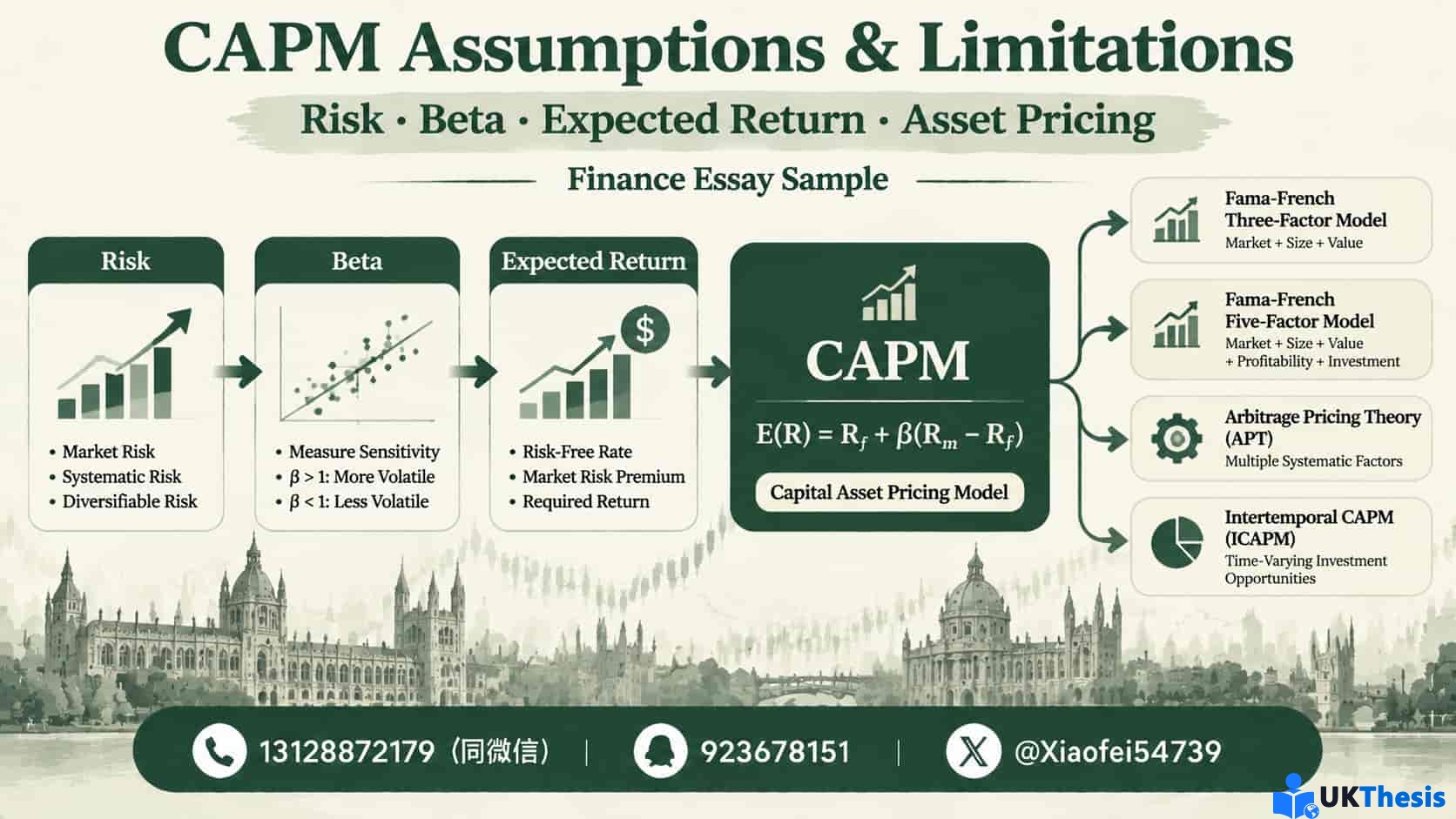
CAPM试图回答金融学中一个很基础的问题:如果投资者承担更多Systematic Risk,那么应该要求多少Expected Return作为补偿?
这个模型非常简洁,也因此非常有影响力。但问题恰恰也出在“简洁”两个字上——现实资本市场真的满足CAPM那些假设吗?Beta真的足以解释股票收益吗?如果不能,为什么CAPM至今仍然具有教学和实际应用价值?
这篇Finance Essay围绕CAPM的Assumptions、Limitations和Asset Pricing Models的发展展开,并进一步比较Fama-French、Arbitrage Pricing Theory以及其他CAPM Extensions。
CAPM and the Relationship Between Risk and Return
One of the fundamental questions in finance is how the risk of an investment affects its expected return. Developed during the 1960s, the Capital Asset Pricing Model provides a theoretical relationship between systematic risk and expected return under equilibrium market conditions.
In simple terms, the standard CAPM can be expressed as:
Expected Return = Risk-Free Rate + Beta × (Market Return − Risk-Free Rate)
The model therefore suggests that an investor should receive the risk-free return plus compensation for taking systematic market risk.
Beta is central to this relationship. A beta above 1 indicates that an asset tends to be more sensitive to market movements, while a beta below 1 indicates lower sensitivity. CAPM then uses this systematic risk measure to estimate the return investors should require.
From Modern Portfolio Theory to CAPM
Before CAPM, an important development in investment theory came from Harry Markowitz and Modern Portfolio Theory (MPT). MPT shifted attention away from examining an investment completely in isolation and toward understanding how individual assets contribute to the risk and return of an entire portfolio.
This matters because some risk can be reduced through diversification. CAPM builds on this insight and focuses particularly on systematic risk—the component of risk that cannot simply be diversified away.
| Concept | Main Question |
|---|---|
| Modern Portfolio Theory | How should investors combine assets to manage portfolio risk and return? |
| Diversification | Which risks can be reduced by holding multiple assets? |
| CAPM | What expected return should compensate investors for systematic risk? |
| Beta | How sensitive is the asset to movements in the overall market? |
学姐提醒:写CAPM Essay时最容易出现一个小毛病——从头到尾一直写“risk”。其实老师更想看到你区分Total Risk、Diversifiable Risk和Systematic Risk。CAPM真正定价的是不能通过Diversification轻易消除的Systematic Risk。
What Is the Capital Asset Pricing Model?
The Capital Asset Pricing Model was developed through the work of researchers including William Sharpe, Jack Treynor, John Lintner and Jan Mossin. It extends ideas associated with portfolio theory into a model of equilibrium asset pricing.
CAPM proposes that the expected return of an asset depends on the risk-free rate, the expected market risk premium and the asset's beta.
One important practical application is the estimation of the cost of equity. This is one reason CAPM continues to appear not only in Investment and Portfolio Management modules, but also in Corporate Finance and valuation work.
Key Assumptions of CAPM
The simplicity of CAPM depends on a number of strong assumptions. These assumptions make the theoretical model easier to derive, but they also create some of its most important practical limitations.
| CAPM Assumption | Meaning |
|---|---|
| Risk-Averse Investors | Investors prefer lower risk when two investments offer the same expected return. |
| Mean-Variance Decisions | Investment decisions are based primarily on expected return and variance or standard deviation. |
| Perfect Capital Markets | The theoretical market has no transaction costs, taxes or similar market frictions. |
| Information Available | Relevant information is assumed to be available to investors. |
| Borrowing and Lending | Investors are assumed to be able to borrow and lend at the risk-free rate. |
| Homogeneous Expectations | Investors form the same expectations concerning returns, risk and correlations. |
| Common Investment Opportunities | Investors have access to the same investment opportunity set. |
These assumptions provide a clean theoretical environment in which the relationship between beta and expected return can be derived. Real financial markets, however, contain taxes, transaction costs, information differences, borrowing constraints and investors with different expectations.
Limitations of the Capital Asset Pricing Model
CAPM is frequently criticised because several of its assumptions are difficult to reconcile with real-world capital markets.
The assumption of a perfect capital market is an obvious example. Investors do face transaction costs and taxes, information is not distributed perfectly, and individual investors generally cannot borrow unlimited amounts at exactly the same risk-free rate.
A second problem concerns the use of Beta as the central measure of priced risk. Empirical asset-pricing research has repeatedly examined whether differences in average stock returns can be explained adequately by market beta alone.
A third issue is that important CAPM inputs are not directly observable. The expected market return, expected risk premium and even the appropriate risk-free rate require assumptions or estimates.
| Problem | Why It Matters |
|---|---|
| Perfect-market assumption | Actual markets contain taxes, costs, constraints and information differences. |
| Risk-free borrowing | Most investors cannot borrow freely on the same terms as a theoretical risk-free asset. |
| Beta instability | Historical beta may change over time and depends on the estimation period. |
| Single-factor structure | Market beta alone may not explain all observed differences in returns. |
| Expected-return inputs | Future market returns and risk premiums must be estimated. |
These limitations do not automatically make CAPM useless. They instead explain why researchers developed alternative and extended asset-pricing models.
Fama-French Three-Factor Model
One of the most influential developments beyond the one-factor CAPM is the Fama-French Three-Factor Model.
Instead of explaining expected returns using only the market factor, the model adds factors associated with company size and book-to-market characteristics.
Market Factor + Size Factor + Value Factor
The importance of this development is not simply that three factors must always be better than one. Rather, empirical evidence suggested that patterns associated with size and value were not adequately captured by market beta alone.
Fama-French Five-Factor Model
The Fama-French framework was later extended by adding factors associated with profitability and investment.
Market + Size + Value + Profitability + Investment
This development illustrates a broader change in empirical asset pricing: researchers increasingly examined whether multiple systematic patterns were required to explain differences in average returns.
| Model | Main Factors |
|---|---|
| CAPM | Market risk |
| Fama-French 3-Factor | Market + Size + Value |
| Fama-French 5-Factor | Market + Size + Value + Profitability + Investment |
这里特别适合Critical Thinking:模型Factor越来越多,不代表“新模型把CAPM淘汰了”。更好的写法是讨论:增加Factors提高了解释能力,但同时也增加了Model Complexity,而且不同模型回答的问题并不完全相同。
Arbitrage Pricing Theory
Arbitrage Pricing Theory (APT) provides another alternative approach to asset pricing. Unlike the standard CAPM's reliance on a single market factor, APT allows expected returns to be related to multiple systematic risk factors.
Potential factors may include inflation, interest rates, economic activity, exchange-rate movements or other macroeconomic risks. The precise factors do not have to affect every asset in exactly the same way because different securities can have different sensitivities.
This provides a more flexible framework, although identifying and estimating the appropriate factors introduces another challenge.
Other Extensions of CAPM
The development of asset-pricing theory did not stop with Fama-French or APT. A number of extensions attempted to relax particular assumptions or redefine how risk should be measured.
| Model | Main Development |
|---|---|
| Zero-Beta CAPM | Relaxes the requirement for investors to have access to a risk-free borrowing and lending opportunity in the standard form. |
| Intertemporal CAPM | Moves beyond a simple single-period setting and considers changing investment opportunities over time. |
| Downside CAPM | Places greater emphasis on downside risk rather than treating upside and downside variation identically. |
| Consumption CAPM | Connects asset returns with consumption risk and changes in consumption. |
| Reward-Beta Approach | Represents another attempt to reconsider the relationship between risk and expected stock returns. |
Is CAPM Still Useful?
This is probably the most interesting question in the entire essay.
If CAPM has unrealistic assumptions and empirical limitations, why has it not simply disappeared?
One reason is its simplicity. CAPM translates a complicated idea—the relationship between risk and required return—into a framework that can be understood and applied relatively easily.
It also remains useful as a benchmark. A more sophisticated asset-pricing model can be compared with CAPM to determine whether additional complexity genuinely provides additional explanatory or predictive value.
In Corporate Finance, CAPM also provides a familiar method for estimating the cost of equity, which can feed into calculations such as the Weighted Average Cost of Capital.
| Why CAPM Survives | Limitation to Remember |
|---|---|
| Simple risk-return framework | Reality is more complex than a single-factor model. |
| Easy to communicate | Inputs such as beta and market risk premium require estimation. |
| Useful benchmark | Alternative models may explain additional return patterns. |
| Cost-of-equity application | Results depend heavily on assumptions and chosen inputs. |
我自己觉得CAPM特别适合拿来理解一个Finance Essay里经常被忽略的词:Model。模型不是现实世界的1:1复印件。它故意把现实简化,关键问题是:这种简化是否仍然足以帮助我们回答特定问题。
所以比较成熟的Essay结论通常不是“CAPM is wrong”,也不是“CAPM is perfect”,而是解释它在哪些情况下有用、哪些Assumptions限制了它,以及其他模型究竟解决了什么问题。
How to Structure a CAPM Finance Essay
| Essay Section | What to Discuss |
|---|---|
| Introduction | Introduce CAPM and establish the argument about usefulness versus limitations. |
| Theory | Explain MPT, systematic risk, beta and expected return. |
| Assumptions | Explain the theoretical conditions required by standard CAPM. |
| Critical Evaluation | Compare those assumptions with real financial markets. |
| Alternative Models | Discuss Fama-French, APT or selected CAPM extensions. |
| Conclusion | Evaluate where CAPM remains useful rather than simply declaring it right or wrong. |
如果课程要求写CAPM、Portfolio Theory或Asset Pricing,但不知道应该把公式、理论和Critical Evaluation怎么分配,可以先把题目的Instruction Word拆开。Explain和Critically Evaluate写出来会完全不一样;需要时也可以先做Finance Essay结构、模型选择和论证思路的写作辅导,再进入完整正文。
FAQ
What is the main assumption of CAPM?
CAPM依赖多个假设,包括风险厌恶投资者、均值—方差决策、同质预期以及理想化资本市场等,因此很难只指定一个“唯一核心假设”。这些假设共同支持Beta与Expected Return之间的理论关系。
What is the biggest limitation of CAPM?
一个核心争议是单一Market Beta是否足以解释资产收益差异。此外,Perfect Capital Market、Risk-Free Borrowing和Homogeneous Expectations等假设与现实市场存在明显距离。
CAPM和Fama-French Three-Factor Model有什么区别?
标准CAPM主要使用Market Risk Factor,而Fama-French Three-Factor Model进一步加入Size和Value相关因素,用于解释CAPM单一市场因子无法充分捕捉的一些收益模式。
CAPM和APT有什么区别?
CAPM建立在Market Beta与Expected Return之间的单因素关系上;APT允许多个Systematic Factors影响Expected Return,因此框架更加灵活,但实际应用中也需要确定哪些Factors应该进入模型。
CAPM已经过时了吗?
不能简单这样判断。CAPM存在明显理论和实证局限,但它仍然具有教学、Benchmark和Cost of Equity估计等用途。评价它时,更重要的是说明具体用途与限制。
Finance Essay需要把所有CAPM Extensions都写进去吗?
不需要。根据题目选择最相关的模型即可。与其每个模型写两句话,不如选择Fama-French、APT或ICAPM中的一两个进行真正比较。
Conclusion
The Capital Asset Pricing Model remains one of the most influential frameworks in finance because it provides a clear relationship between systematic risk and expected return.
Its simplicity is also the source of many of its limitations. Assumptions concerning perfect capital markets, homogeneous expectations, risk-free borrowing and a single systematic risk factor do not fully reflect real financial markets.
Developments including the Fama-French factor models, Arbitrage Pricing Theory, Zero-Beta CAPM, Intertemporal CAPM and other approaches demonstrate how researchers have attempted to relax assumptions or explain additional patterns in asset returns.
These developments do not erase the contribution of CAPM. Instead, they show why CAPM is best understood as a foundational benchmark in asset-pricing theory: highly useful for organising the relationship between risk and return, but not a complete description of how every asset is priced in real markets.
相关文章阅读
继续学习Asset Pricing时,可以结合本站的Portfolio Management assignment、Modern Portfolio Theory、Financial Modelling以及Finance Paper相关范文阅读。CAPM页面负责解释Asset Pricing和Beta,Portfolio Management页面负责Portfolio Construction与Risk-Return,这样两个主题既互相连接,又不会重复讨论同一个搜索问题。