Consumer Behaviour Dissertation Example:Mixed Methods与SPSS Data Analysis范文

Consumer Behaviour Dissertation Example怎么写?如果你正在做Marketing、Business Management、Consumer Behaviour或者Sustainability方向的硕士论文,最容易卡住的往往不是Introduction,而是后面的Research Methodology、Qualitative Analysis、Questionnaire Design和Dissertation Data Analysis。
我见过不少留学生前面literature review写得挺顺,一做到访谈和问卷就开始头大:Interview做完之后怎么整理Theme?问卷收到以后到底应该用Chi-square、t-test、ANOVA还是Regression?SPSS跑出了几十张表,又到底哪些数字应该写进Dissertation?说实话,我第一次接触这类研究方法时,看SPSS Output也有一种“每个数字都认识,放在一起就不认识了”的感觉。
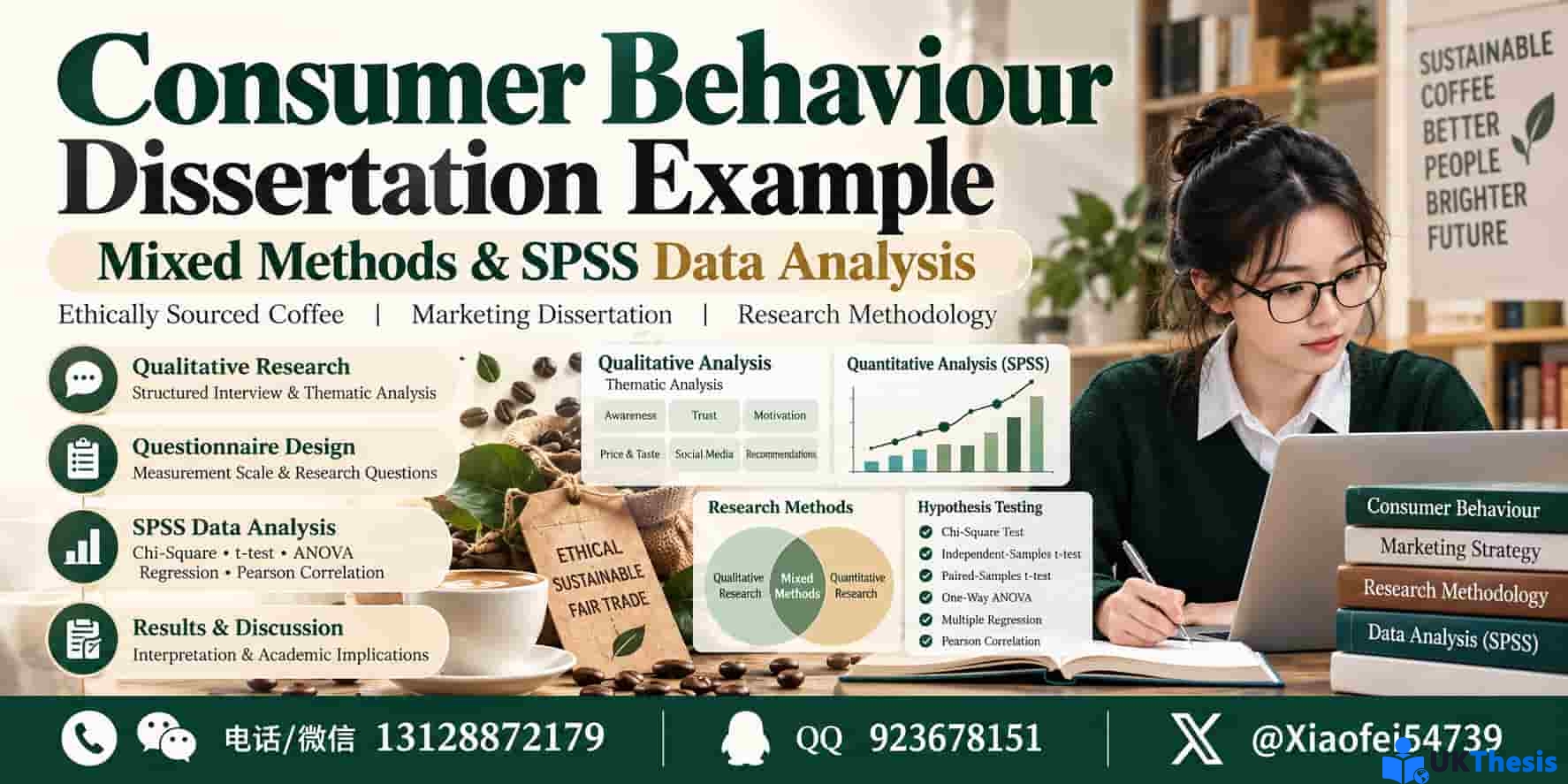
下面这篇范文比较有参考价值,因为它不是单纯的一篇Marketing essay,而是一份典型的Mixed Methods Dissertation Example。研究以消费者对ethically sourced coffee的认知、信任、购买动机和购买意愿为主题,同时使用了structured interview、thematic analysis、questionnaire survey和quantitative data analysis。
质性研究部分通过10名受访者的访谈分析消费者对ethical coffee的理解、greenwashing、价格、口味、便利性和social media等因素;定量研究部分则进一步使用问卷数据建立Research Hypotheses,并运用Chi-Square Test、Independent-Samples t-test、Paired-Samples t-test、One-Way ANOVA、Multiple Regression以及Pearson Correlation进行检验。
所以,如果你搜索的是Marketing Dissertation Example、Consumer Behaviour Dissertation、Mixed Methods Dissertation、Thematic Analysis Dissertation Example、SPSS Dissertation Data Analysis,这篇案例可以重点参考它的研究结构和Results写法,而不是简单照抄研究结论。
这篇Consumer Behaviour Dissertation属于什么类型?
| Academic Level | 适合Master's Dissertation / Final Research Project结构参考 |
| Subject | Marketing / Consumer Behaviour / Business Management |
| Research Topic | Consumer perceptions and purchasing behaviour toward ethically sourced coffee |
| Research Design | Mixed Methods Research |
| Qualitative Method | Structured Interview + Thematic Analysis |
| Quantitative Method | Questionnaire Survey + Statistical Analysis |
| Statistical Methods | Chi-Square, t-test, ANOVA, Multiple Regression, Pearson Correlation |
| 适合参考的章节 | Methodology、Findings、Results、Data Analysis、Discussion |
学姐提醒:很多同学会把所有带数据的论文都叫“SPSS Dissertation”,其实真正决定使用哪种统计方法的不是软件,而是你的research Question、变量类型和Hypothesis。SPSS只是工具,研究逻辑才是前面那根线。
Mixed Methods Dissertation Example:研究设计逻辑
这篇研究最大的特点,是将qualitative research与quantitative research放在同一个consumer behaviour研究中。
Qualitative Research主要回答消费者“为什么这样想、为什么这样购买”,而Quantitative Research进一步检验不同变量之间是否存在统计关系或显著差异。对于Marketing Dissertation来说,这种设计比较适合研究态度、信任、动机、购买意愿和实际消费行为之间的关系。
| Research Stage | Method | Purpose |
|---|---|---|
| Qualitative Research | Structured Interviews | Explore consumer perceptions, motivations and behaviours |
| Qualitative Data Analysis | Thematic Analysis | Identify recurring themes and meanings |
| Quantitative Research | Questionnaire Survey | Collect measurable consumer data |
| Hypothesis Testing | Statistical Tests | Examine relationships and group differences |
| Discussion | Interpretation + Literature | Explain the academic and practical implications |
Qualitative Research Example:Structured Interview与Thematic Analysis
The chapter of qualitative research is to address the analysis and evaluation of the qualitative data collected from structured interview. This structured interview contains 11 interviewing questions, and these interviewing questions reveal the perception, motivations and behaviours of customers toward ethically sourced coffee.
In the following, this chapter gives an overview of the qualitative analysis from sample structure to qualitative data method, addresses key themes of findings on consumer attitudes and behaviours toward ethically sourced coffee, and summarises key insights from these qualitative research findings.
Overview of Qualitative Data Analysis
There are 10 respondents participating in this structured interview. Six female respondents and four male interviewees join this interview, and they have an age range from 20 to 55.
Moreover, they have different educational and professional backgrounds, including undergraduate students, Master's students, PhD students, working professionals and a café owner. This diverse sample provides different perspectives for the qualitative analysis.
The thematic analysis method is applied to the identification and interpretation of key themes from the structured interviews. Braun and Clarke (2006) propose a six-step thematic analysis framework. This framework offers a relatively flexible approach to exploring respondents' attitudes, experiences and meanings related to ethically sourced coffee.
Thematic Analysis Findings
The thematic analysis identifies several key themes surrounding consumers' perceptions and behaviours toward ethically sourced coffee.
Theme 1: Awareness and Understanding of Ethically Sourced Coffee
This theme explains the familiarity and awareness of respondents regarding ethically sourced coffee. Respondents' familiarity and awareness underline the possibility of desired behaviours linked with purchasing more ethically sourced coffee.
90% of respondents reported familiarity or awareness of ethically sourced coffee, indicating that most interviewees had a general awareness of the term. However, respondents demonstrated different understandings of ethically sourced coffee, including fair wages, absence of exploitation, sustainable farming and environmental care.
Mia understood ethically sourced coffee in relation to fair trade, non-exploitation and environmental care. Emma stressed a fair approach to coffee production in which farmers receive appropriate payment and child labour is prohibited. Meanwhile, Josh focused on the interpretation of a fair and sustainable supply chain.
With respect to partial understanding, respondents with greater experience and knowledge appeared more likely to demonstrate a more comprehensive understanding of ethically sourced coffee than younger respondents.
Tom, as a café owner, and Linda demonstrated relatively comprehensive awareness. They considered not only fair payment and trade but also the communication of key selling points, supply-chain practices and corporate responsibility from a broader perspective.
However, Lily and Emily, as younger students, suggested that they did not completely understand ethically sourced coffee. Experienced respondents therefore appeared more likely to recognise the wider meaning of ethical sourcing.
Furthermore, female respondents frequently connected ethical sourcing with social justice, including support for women farmers, and environmental stewardship. Male interviewees tended to focus more strongly on fair payment and economic fairness.
This suggests possible differences associated with gender, age and occupation in the way respondents understand ethically sourced coffee. Different levels of awareness also suggest the existence of a knowledge and experience gap.
Theme 2: Trust and Skepticism toward Ethical Claims
Most respondents expressed skepticism about the authenticity of ethical claims made by coffee brands.
80% of interviewees considered ethical claims associated with ethically sourced coffee to be potentially influenced by marketing motives.
Emma suggested that coffee brands may use ethically sourced coffee as a marketing tool when there is insufficient evidence confirming whether the coffee beans are actually sourced ethically, particularly in the absence of recognised fair-trade certification.
Josh described himself as only “60% confident”, while Jack described his confidence as “50/50”. Linda stated that she was “not very confident” unless coffee brands or coffee shops provided clear evidence of ethical sourcing.
Respondents explained that some ethical claims may be perceived as greenwashing, where companies use sustainability-related claims to improve brand equity and reputation without taking full accountability.
Most respondents therefore believed that coffee brands should provide relevant certification labels for ethically sourced coffee, including Fair Trade and Rainforest Alliance certification.
Grace stressed the importance of recognised certification such as Rainforest Alliance. The availability of fair-trade and ethical-sourcing certifications may increase respondents' trust in coffee brands and coffee shops.
Mia also indicated greater confidence when relevant certification was displayed.
Although many respondents expressed an intention to support businesses offering ethically sourced coffee, some remained reluctant to trust these companies because of concerns surrounding greenwashing and profit-driven motivations.
Theme 3: Motivations for Selecting Ethically Sourced Coffee
Respondents demonstrated strong motivations for selecting and purchasing ethically sourced coffee despite their skepticism about some ethical claims.
Several important motivations emerged from the interviews, including moral identity, empathy and environmental responsibility.
Moral identity explains how respondents may choose ethically sourced coffee because their personal values are aligned with “doing the right thing”. Grace indicated that purchasing these products reflects personal values and lifestyle.
Ben stated that his decision to choose ethically sourced coffee was partly intended to set “an example for my kid” in relation to responsible consumption.
Another important motivation was empathy. Several participants demonstrated emotional concern for the living and working conditions of coffee farmers.
Mia stressed that one reason coffee products may remain inexpensive is that coffee farmers can be exploited. Lily explained that she watches short videos about farmers' stories on TikTok and that these stories affect her emotionally.
Empathy for coffee farmers may therefore encourage consumers to support ethically sourced coffee.
The final major motivation relates to environmental responsibility. Respondents frequently connected ethically sourced coffee with environmental protection.
Josh suggested that purchasing ethically sourced coffee could improve the welfare of coffee farmers while also reducing the destruction of forests and natural resources. Mia similarly stated that choosing ethically sourced coffee can help reduce environmental harm.
Theme 4: Factors Influencing Purchasing Decisions
When considering the actual purchase of ethically sourced coffee, respondents identified several factors affecting their decision-making, including price, taste and convenience.
First, price is an important factor. Most respondents demonstrated some degree of price sensitivity.
Lily stated that paying an additional 50 cents for ethically sourced coffee would be affordable. Emily, however, indicated that price could become a barrier because students may not be able to afford a substantially higher price.
The interviews suggested an accepted premium of approximately 10–20% above ordinary coffee prices.
Second, taste remains important. Josh described taste as a priority when making a coffee purchasing decision, while Jack focused on coffee quality.
Good taste therefore acts as an important enabler for purchasing ethically sourced coffee.
Third, convenience also influences purchasing behaviour. Emma explained that the accessibility of ethically sourced coffee on campus could encourage her to purchase it.
Strong ethical motivations therefore do not automatically result in purchases. Price, taste and convenience may become either enablers or barriers.
Theme 5: Effect of Social Media and Campaigns
Most respondents agreed that social media can be an important source of information about ethically sourced coffee, particularly TikTok, Instagram and YouTube.
80% of interviewees recognised that short-form videos on TikTok could be emotionally engaging.
Mia explained that TikTok videos sometimes show how coffee farmers and workers may be affected by low coffee prices and unfair trading practices.
Grace argued that content created by social media influencers can affect her understanding of ethically sourced coffee.
Other respondents preferred information and comments from online communities rather than influencers. Ben and Josh suggested that LinkedIn posts and Reddit discussions could sometimes offer useful user-generated information.
Social media therefore has the potential to contribute to ethical awareness and consumer education.
Theme 6: Recommendations from Respondents
Participants highlighted several expectations and recommendations for businesses offering ethically sourced coffee, including educational initiatives, customer engagement and authentic business practices.
Grace suggested that infographic content could explain how ethically sourced coffee supports farmers and workers through fair trade.
Linda emphasised that storytelling may educate customers more effectively than simple marketing slogans.
Respondents also proposed practices designed to increase customer engagement, including loyalty programmes and subscriptions for ethical products.
Ben suggested that subscription services could establish a consistent commitment to ethically sourced coffee and help transform motivation into habitual purchasing behaviour.
Participants also expressed a strong expectation of transparency and authenticity.
Jack suggested that QR codes could provide information about the origins of coffee beans, while Tom proposed the use of traceability technologies to increase supply-chain transparency.
Greater transparency may increase consumers' confidence when making ethically sourced coffee purchasing decisions.
Summary of Qualitative Research Findings
Based on the thematic analysis, several key insights emerge regarding respondents' perceptions and behaviours toward ethically sourced coffee.
1. Awareness Exists, but There Is a Trust Gap
Most participants demonstrated some understanding of ethically sourced coffee. However, concerns about greenwashing reduced trust in some ethical claims and affected confidence in purchasing decisions.
2. Values and Practical Factors Work Together
Respondents agreed that moral values contribute to their motivation to purchase ethically sourced coffee. However, practical considerations such as price and taste still have a strong influence on the final purchasing decision.
3. Emotional and Digital Factors Matter
Participants reported that social-media storytelling can contribute to an emotional connection with ethically sourced coffee. User-generated content on social platforms and online communities may also be viewed as credible by some consumers.
4. Transparency and Authenticity Are Important
Respondents questioned whether some ethical claims accurately reflect actual sourcing practices. Traceability technologies and certification may therefore help demonstrate ethical sourcing more clearly.
5. Demographic Differences Exist
Age, gender and occupation appeared to be associated with different understandings and priorities regarding ethically sourced coffee. Respondents with greater experience tended to demonstrate broader understanding.
6. Barriers to Ethical Purchasing Remain
Price, taste and convenience were repeatedly identified as factors affecting ethically sourced coffee purchasing decisions.
Questionnaire Design Example for a Marketing Dissertation
This marketing research also requires the design and preparation of a questionnaire for the collection of quantitative data.
Different measurement scales, including Likert scales and single-choice questions, can be used to measure respondents' perceptions and behaviours toward ethically sourced coffee.
The original study connects questionnaire items with different research questions as follows.
| Question | Research Question |
|---|---|
| Question 1 | Research Question 2 |
| Question 2 | Research Question 3 |
| Question 3 | Research Question 2 |
| Question 4 | Research Question 3 |
| Question 5 | Research Question 1 |
| Question 6 | Research Question 1 |
| Question 7 | Research Question 1 |
| Question 8 | Research Question 1 |
| Question 9 | Research Question 1 |
| Question 10 | Research Question 1 |
| Question 11 | Research Question 3 |
| Question 12 | Research Question 3 |
| Question 13 | Research Question 3 |
| Question 14 | Research Question 2 |
| Question 15 | Research Question 3 |
| Question 16 | Research Question 3 |
Dissertation Data Analysis Example: Hypothesis Testing
The chapter of Analysis & Results demonstrates and explains the statistical analysis of quantitative data drawn from the self-administered questionnaire survey.
The development of research hypotheses facilitates an understanding of the potential relationships between variables. Statistical analysis can then be used to test these hypotheses.
Research Hypotheses
H1: Previous purchasing of ethically sourced coffee is positively associated with willingness to pay extra for ethically sourced coffee (Q5–Q14, Chi-Square).
H2: There is a mean difference in willingness to pay extra for ethically sourced coffee between men and women (Gender–Q14, Independent-Samples t-test).
H3: There is a mean difference between motivation for environmental benefits and motivation for social/worker benefits (Q8_1–Q8_2, Paired-Samples t-test).
H4: There are mean differences in willingness to pay for ethically sourced coffee among different main coffee purchasing locations (Q14–Q4, One-Way ANOVA).
H5: Environmental and social motivations are positively linked with the likelihood of recommending ethically sourced coffee to friends (Q8_1, Q8_2–Q16, Multiple Regression).
H6: There is a significant positive relationship between perceived trust in ethical-sourcing certification and purchasing intention for ethically sourced coffee (Q9_2–Q17, Pearson Correlation).
How to Choose Statistical Tests in a Dissertation
| Research Issue | Statistical Method | What It Examines |
|---|---|---|
| Past purchase × willingness to pay | Chi-Square Test | Association between categorical variables |
| Male vs female willingness to pay | Independent-Samples t-test | Difference between two independent groups |
| Environmental vs social motivations | Paired-Samples t-test | Difference between related measurements |
| Purchasing location × willingness to pay | One-Way ANOVA | Differences across multiple groups |
| Environmental/social motivation → recommendation | Multiple Regression | Predictive relationship involving multiple predictors |
| Certification trust × purchase intention | Pearson Correlation | Strength and direction of association |
这张表其实是整篇范文最值得留学生参考的地方之一。很多Dissertation Data Analysis写不好,不是因为不会点击SPSS菜单,而是Research Question、Variables和Statistical Test没有对应起来。
Demographic Profile
There are 125 respondents participating in this self-administered questionnaire survey, and 107 responses are reported as valid.
The study reports that 59% of participants are female and 41% are male.
With respect to age, a considerable proportion of respondents are between 18 and 28 years old, with 43 respondents in this age group. A further 42 respondents are between 29 and 39.
Most respondents are students, with 63 students participating in the questionnaire survey. The study also reports 22 workers and 12 participants from other occupational groups.
SPSS Dissertation Results Example
H1: Chi-Square Test
The first hypothesis tests whether previous purchasing of ethically sourced coffee is associated with willingness to pay extra for ethically sourced coffee.
The Chi-Square test is applied to this hypothesis. The original results table reports a Pearson Chi-Square value of 9.82 with a p value of .043. The Linear-by-Linear Association is reported as 5.66 with a p value of .016.
Based on the reported p value, the analysis suggests a statistically significant association between previous purchasing experience and willingness to pay extra for ethically sourced coffee.
| Chi-Square Test | Value | df | Significance |
|---|---|---|---|
| Pearson Chi-Square | 9.82 | 5 | .043 |
| Likelihood Ratio | 10.14 | 5 | .037 |
| Linear-by-Linear Association | 5.66 | 2 | .016 |
| N of Valid Cases | 107 | — | — |
H2: Independent-Samples t-test
The second hypothesis examines whether willingness to pay extra for ethically sourced coffee differs between male and female respondents.
The original group statistics report a mean score of 3.02 for male respondents and 3.41 for female respondents.
The Independent-Samples t-test reports t = -2.04 and p = .043 under the equal-variances-assumed result. The analysis therefore interprets the difference as statistically significant and reports higher willingness to pay among female respondents.
| Group | N | Mean | SD | Std. Error Mean |
|---|---|---|---|---|
| Male | 50 | 3.02 | 1.11 | 0.15 |
| Female | 60 | 3.41 | 1.07 | 0.13 |
H3: Paired-Samples t-test
The Paired-Samples t-test is used to examine whether there is a mean difference between motivation for environmental benefits and motivation for social/worker benefits.
The reported mean difference is 1.82. However, the p value is .083, which is greater than .05.
The study therefore concludes that the difference between environmental motivation and social/worker motivation is not statistically significant.
| Variable | Mean | N | SD |
|---|---|---|---|
| Environmental benefits | 61.24 | 107 | 20.24 |
| Social benefits | 59.42 | 107 | 22.32 |
H4: One-Way ANOVA
The One-Way ANOVA examines whether willingness to pay differs across consumers' main coffee purchasing locations.
The study reports F = 2.04 and p = .094. Because the reported p value is greater than .05, the difference is interpreted as not statistically significant.
Therefore, the hypothesis that willingness to pay differs significantly across different coffee purchasing locations is not supported.
| Purchasing Location | N | Mean | SD |
|---|---|---|---|
| Café | 50 | 3.53 | 1.24 |
| Supermarket | 23 | 3.06 | 1.04 |
| Specialty Store | 21 | 3.41 | 1.15 |
| Online | 11 | 2.83 | 1.15 |
| Other | 2 | 2.57 | .83 |
| Total | 107 | 3.27 | 1.23 |
H5: Multiple Regression
Multiple Regression is applied to test whether environmental and social motivations are positively linked with the likelihood of recommending ethically sourced coffee to friends.
The original analysis reports R² = .175 and an adjusted R² of .163. The reported model significance is below .001.
The environmental motivation coefficient is reported as B = .025, Beta = .321 and p = .004. The social motivation coefficient is reported as B = .007, Beta = .246 and p = .013.
Based on these reported results, the study concludes that environmental and social motivations are positively associated with recommendation intention.
| Predictor | B | Beta | t | Sig. |
|---|---|---|---|---|
| Environmental Motivation | .025 | .321 | 3.15 | .004 |
| Social Motivation | .007 | .246 | 2.45 | .013 |
H6: Pearson Correlation
The Pearson Correlation test examines the relationship between perceived trust in ethical-sourcing certification and purchasing intention for ethically sourced coffee.
The reported Pearson correlation coefficient is r = .415, with p < .001.
The study therefore interprets the relationship as positive and statistically significant. Greater trust in ethical sourcing certification is associated with stronger purchasing intention.
| Variable | N | Mean | SD |
|---|---|---|---|
| Trust in Certification | 107 | 2.64 | 0.54 |
| Purchase Intention | 105 | 6.83 | 2.16 |
Pearson Correlation: r = .415, p < .001.
Summary of Dissertation Hypothesis Testing
Based on the statistical analysis reported in the original study, H1, H2, H5 and H6 are supported, while H3 and H4 are not supported.
| Hypothesis | Statistical Method | Result |
|---|---|---|
| H1 | Chi-Square Test | Supported |
| H2 | Independent-Samples t-test | Supported |
| H3 | Paired-Samples t-test | Not Supported |
| H4 | One-Way ANOVA | Not Supported |
| H5 | Multiple Regression | Supported |
| H6 | Pearson Correlation | Supported |
Dissertation Discussion Example: Description and Interpretation of Results
H1: Past Purchase and Willingness to Pay Extra
The positive association between previous purchasing history and willingness to pay is statistically significant.
Prior experience with ethically sourced coffee may support consumers' willingness to pay extra for similar products in the future.
Vermeir and Verbeke (2008) argue that previous engagement in ethical consumption can strengthen future behavioural commitment.
From a practical perspective, coffee brands may therefore encourage customers to experience ethically sourced coffee through trial opportunities or promotional incentives. Positive previous experience may subsequently influence willingness to purchase fair-trade-related coffee products.
H2: Gender Differences in Willingness to Pay Extra
The quantitative results support a difference in willingness to pay extra for ethically sourced coffee between male and female respondents.
The study reports that female participants demonstrate higher willingness to pay.
Bray et al. (2011) discuss ethical consumption in relation to consumer motivations and values. Within the context of this study, gender-related communication strategies may therefore be relevant when coffee brands communicate fair-trade and social-impact messages.
Examples could include storytelling about farmers, family livelihoods and the social implications of ethical sourcing.
H3: Environmental and Worker/Social Motivations
The mean difference between environmental motivation and worker/social motivation is not statistically significant.
Both environmental and social motivations therefore appear relevant to consumers' attitudes and behaviours toward ethically sourced coffee.
White et al. (2019) discuss the interconnected nature of sustainability-related consumer behaviour.
Coffee brands may therefore communicate both environmental and social outcomes, such as biodiversity protection alongside fair wages and improved working conditions.
H4: Coffee Purchasing Locations and Willingness to Pay Extra
The reported difference in willingness to pay across different purchasing locations is not statistically significant.
In this study, the main place in which consumers purchase coffee does not appear to create a significant difference in willingness to pay extra for ethically sourced coffee.
H5: Relationship between Motivation and Recommendation
The statistical results support a positive relationship between environmental and worker/social motivations and the likelihood of recommending ethically sourced coffee to friends.
Consumer motivation can influence attitudes and behaviours toward ethically sourced coffee because consumers may believe that their purchasing behaviour contributes to environmental protection or improvements in farmers' and workers' welfare.
Darian et al. (2015) examine consumer motivations relating to fair-trade coffee.
From a practical marketing perspective, coffee brands may communicate specific motivations behind ethical sourcing through storytelling, including farmer stories and social-media content.
H6: Trust in Certification and Purchasing Intention
The findings support a positive relationship between perceived trust in ethical-sourcing certification and purchasing intention.
Consumers may remain skeptical when ethical claims appear vague or potentially associated with greenwashing.
When customers can identify credible certification, they may be more willing to trust coffee brands and consider purchasing ethically sourced products.
Atkinson and Rosenthal (2014) discuss eco-labels, information asymmetry and consumer trust.
Third-party certifications and transparent sourcing information may therefore help ethical coffee businesses strengthen credibility and consumer purchasing intention.
这篇Mixed Methods Dissertation最值得留学生参考什么?
如果只是把这篇文章当成一篇“咖啡论文”,其实有点浪费。它更值得参考的是Methodology到Results之间的连接方式。
一个比较完整的Dissertation Research逻辑应该是:
先确定Research Question;
再决定需要Qualitative、Quantitative还是Mixed Methods;
根据Research Question设计Interview或Questionnaire;
明确Variable和Measurement Scale;
建立Hypothesis;
根据Variable类型选择Statistical Test;
报告Results;
最后把统计结果放回Literature和Research Question中讨论。
不少同学的问题恰恰是顺序反了:先打开SPSS,看到老师说“做Regression”就开始点,最后才发现Research Question根本接不上Regression。
Dissertation Data Analysis常见扣分点
| 常见问题 | 为什么容易扣分 | 建议 |
|---|---|---|
| 只贴SPSS Output | 没有解释结果 | 报告核心统计量并解释其含义 |
| 只写p值 | 缺少方向、强度或Group Difference | 结合Mean、r、Beta、F、t等指标 |
| 统计方法与变量不匹配 | Research Design逻辑错误 | 先确认变量类型再选择test |
| Results和Discussion混在一起 | 章节目的不清 | Results报告发现,Discussion解释发现 |
| Hypothesis结果不回到Research Question | 论文像一堆独立统计表 | 每一个结果都回答原始研究问题 |
| 不显著结果直接删除 | 形成选择性报告 | 保留并解释Not Supported结果 |
如果你的Dissertation也卡在Methodology或Data Analysis
很多同学找论文辅导的时候会说:“我SPSS不会,帮我做个SPSS。”但真正需要先看的,其实不是SPSS。
比较合理的顺序应该是先看你的Assessment Brief、Research Proposal、Research Questions、Questionnaire或Interview Questions、已有数据和Supervisor Feedback,然后再判断后面应该怎么分析。
对于Marketing、Business、Management、HRM、Finance以及其他Social Science Dissertation,我们能够提供包括研究框架梳理、Research Methodology讲解、Questionnaire设计建议、Qualitative Coding思路、Thematic Analysis、Quantitative Data Analysis以及Supervisor Feedback修改等学术写作支持。
如果你已经写完一部分,也没必要整篇重新来。很多时候学生真正卡住的可能只是Methodology、SPSS Results或者Discussion其中一章,把问题定位清楚以后反而更省时间。
FAQ:Consumer Behaviour Dissertation与Data Analysis常见问题
1. Consumer Behaviour Dissertation一般适合用什么Research Method?
没有固定答案。如果研究目标是深入理解消费者为什么产生某种态度或行为,可以考虑Interview和Qualitative Research;如果需要检验变量关系、Group Difference或Purchase Intention,则可以考虑Questionnaire和Quantitative Research。部分研究会像本文一样采用Mixed Methods。
2. Mixed Methods Dissertation一定要同时做Interview和Questionnaire吗?
不一定。Mixed Methods的重点是有逻辑地结合qualitative和quantitative approaches,而不是为了“看起来复杂”强行加两种方法。具体设计应与Research Question一致。
3. Thematic Analysis dissertation怎么写?
通常需要说明数据来源、参与者、coding过程、theme identification方法,并通过不同主题解释受访者的态度、经验或行为。本文的六个themes就是一个较直观的范例。
4. Dissertation什么时候用Chi-Square?
Chi-Square经常用于检验categorical variables之间是否存在association。是否适合使用仍需要根据变量的measurement level及数据条件判断。
5. Dissertation什么时候用t-test?
Independent-Samples t-test通常用于比较两个独立group的mean;Paired-Samples t-test通常用于比较同一组参与者或配对数据的两个相关measurements。
6. ANOVA和t-test有什么区别?
简单理解,t-test常用于两个group之间的mean comparison,而One-Way ANOVA可以用于比较多个group。不过正式选择方法时还需要检查具体数据及统计假设。
7. Regression Analysis在Dissertation里主要干什么?
Regression常用于研究一个或多个predictor variables与outcome variable之间的关系,并判断不同predictors的解释或预测作用。
8. Pearson Correlation结果应该怎么写?
通常需要报告correlation coefficient(r)、direction以及p value,并解释变量之间关系的方向和统计显著性。不能只写“有相关性”而不给统计结果。
9. Results Chapter和Discussion Chapter有什么区别?
Results主要回答“数据发现了什么”,Discussion则回答“为什么出现这个结果、它和已有Literature有什么关系、对Research Question意味着什么”。
10. SPSS结果很多,是不是全部放进Dissertation?
通常没有必要。正文应围绕Research Question和Hypothesis展示真正相关的统计结果,其余详细output是否进入Appendix需要根据学校要求和Supervisor建议决定。
References
Atkinson, L., & Rosenthal, S. (2014). Signaling the Green Sell: The Influence of Eco-Label Source, Argument Specificity, and Product Involvement on Consumer Trust. Journal of Advertising, 43(1), 33–45. https://doi.org/10.1080/00913367.2013.834803
Braun, V., & Clarke, V. (2006). Using thematic analysis in psychology. Qualitative Research in Psychology, 3(2), 77–101.
Bray, J., Johns, N., & Kilburn, D. (2011). An Exploratory Study into the Factors Impeding Ethical Consumption. Journal of Business Ethics, 98(4), 597–608. https://doi.org/10.1007/s10551-010-0640-9
Darian, J. C., Tucci, L., Newman, C. M., & Naylor, L. (2015). An Analysis of Consumer Motivations for Purchasing Fair Trade Coffee. Journal of International Consumer Marketing, 27(4), 318–327. https://doi.org/10.1080/08961530.2015.1022920
Vermeir, I., & Verbeke, W. (2008). Sustainable food consumption among young adults in Belgium: Theory of planned behaviour and the role of confidence and values. Ecological Economics, 64(3), 542–553.
White, K., Habib, R., & Hardisty, D. J. (2019). How to SHIFT Consumer Behaviors to be More Sustainable: A Literature Review and Guiding Framework. Journal of Marketing, 83(3), 22–49. https://doi.org/10.1177/0022242919825649