Corporate Restructuring Essay范文|Business Restructuring Strategies - UKThesis

Corporate Restructuring是Business Management、Corporate Strategy和Finance课程里一个很典型、也很容易“写着写着变成名词解释”的essay主题。Merger、Spin-off、Divestiture、LBO这些概念背下来并不难,真正让人头疼的是:为什么企业要重组?Financial Restructuring和Organizational Restructuring有什么区别?什么情况下应该出售业务,什么情况下又适合通过收购扩张?
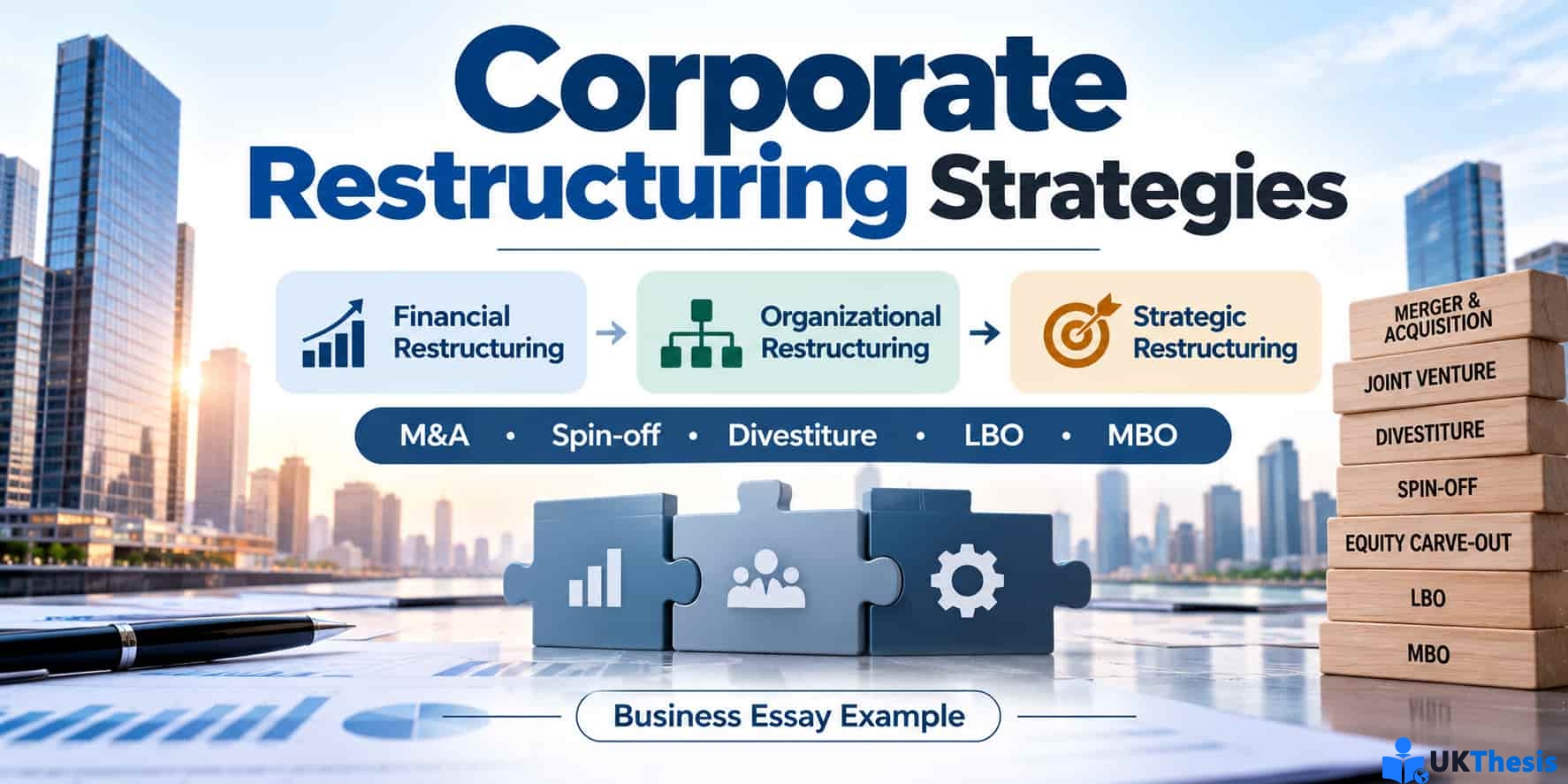
下面这篇Corporate Restructuring essay范文保留了原文关于Financial Restructuring、Organizational Restructuring、Joint Venture、Spin-off、Divestiture、Equity Carve-out、Leveraged Buyout和Management Buyout等核心知识,同时重新整理结构与论证逻辑。阅读时可以特别注意一点:一篇高分Business Essay不能只回答“What is restructuring?”,还要继续分析“Why does it happen?”、“When might it create value?”以及“What risks can it create?”。
Corporate Restructuring Strategies: A Business Essay Example
Introduction
Corporate restructuring refers to the significant redesign of a company's financial, organizational, operational or ownership arrangements. A company may restructure in response to financial distress, declining profitability, technological change, competitive pressure or changes in corporate strategy. Restructuring may also occur when a financially healthy company decides to refocus its portfolio, improve efficiency or pursue new opportunities for growth.
Corporate restructuring therefore should not be understood simply as a response to business failure. It can be both a defensive and a proactive strategic process. Some firms restructure to survive; others restructure to improve competitiveness, release capital, simplify operations or reposition themselves for future growth.
This essay examines the purposes and major forms of corporate restructuring. It distinguishes financial restructuring from organizational and operational restructuring before discussing important restructuring strategies including mergers and acquisitions, joint ventures, divestitures, spin-offs, equity carve-outs, leveraged buyouts and management buyouts. It argues that restructuring can create value, but that value creation depends on strategic fit, financial discipline, implementation and the management of organizational change.
1. What Is Corporate Restructuring?
At its broadest level, corporate restructuring involves changing important elements of the way a company is financed, owned, organized or operated.
The objective is normally to create an organizational arrangement that is better suited to the company's economic circumstances and strategic objectives. This may involve reducing costs, disposing of underperforming businesses, changing the capital structure, reorganizing departments, acquiring new capabilities or separating businesses that may perform better independently.
For shareholders, restructuring is often discussed in terms of improving long-term value. However, shareholder value should not be treated as the only consideration. Major restructuring decisions can also affect employees, creditors, customers, suppliers and other stakeholders.
2. Why Do Companies Restructure?
There is no single reason for corporate restructuring. The motivation depends on the financial condition of the company, its competitive environment and its strategic priorities.
| Restructuring Driver | Possible Corporate Response |
|---|---|
| Financial distress | Debt restructuring, asset sales, cost reduction or refinancing. |
| Declining profitability | Divest underperforming operations and redesign the cost structure. |
| Strategic refocusing | Exit non-core businesses and allocate capital to priority markets. |
| Technology change | Redesign workflows, capabilities and organizational structures. |
| Growth | Acquisitions, joint ventures or organizational expansion. |
| Operational inefficiency | Delayering, outsourcing, process redesign or consolidation. |
A useful point for a Business Essay is that the same restructuring method can serve very different purposes. Selling a division, for example, may indicate financial distress in one company but disciplined portfolio management in another.
3. Financial Restructuring
Financial restructuring involves changing a company's financial arrangements, including its assets, liabilities, debt, equity or capital structure.
A financially distressed business may restructure because declining sales and insufficient cash flow make its existing financial obligations unsustainable. Management may attempt to reduce costs, refinance debt, sell assets, negotiate with creditors or obtain additional capital.
However, financial restructuring is not restricted to distressed companies. A financially healthy company may also reconsider how capital is allocated among business units, dispose of assets that no longer fit its strategy or alter its financing structure to support future investment.
When Might Financial Restructuring Be Needed?
Sales and profitability have declined significantly.
Debt servicing has become difficult.
Some assets or divisions generate inadequate returns.
The company needs capital for strategically important investments.
Duplicated activities are creating unnecessary costs.
The existing capital structure no longer matches the company's risk profile or strategy.
The underlying objective is not simply to “cut costs”. Financial restructuring should ideally improve the allocation of resources while maintaining the capabilities required for long-term competitiveness.
4. Organizational Restructuring
Organizational restructuring focuses on the way responsibilities, employees, departments and management authority are arranged within the company.
A structure that worked well when a business was small may become slow and complicated as the organization expands. Likewise, new technologies or changes in customer demand may require capabilities that the existing organizational structure was not designed to provide.
Common Reasons for Organizational Restructuring
New skills and capabilities are required.
Accountability for results is unclear.
Some departments are overstaffed while others lack resources.
Internal communication is fragmented or inefficient.
Technology is changing workflows and production processes.
Employee turnover or retention has become a significant issue.
Productivity has stagnated.
Too many management layers slow decision-making.
Organizational restructuring may therefore include regrouping business units, decentralization, delayering, outsourcing or redesigning responsibilities.
Delayering and Flatter Organizations
Traditional hierarchical organizations can develop multiple layers of middle management as they expand. While hierarchy can support control and specialization, too many layers may increase bureaucracy and slow communication between senior management and frontline employees.
Delayering removes one or more levels of management in an attempt to create a flatter organizational structure. Potential advantages include faster communication, reduced administrative cost and greater employee responsibility. However, delayering can also increase workloads and create uncertainty if responsibilities are not redesigned carefully.
5. Operational Restructuring
Operational restructuring focuses more directly on how work is performed. The objective may be to increase efficiency, improve customer service, eliminate duplicated processes or make greater use of technology.
Common approaches include process redesign, outsourcing, automation and integrated information systems. The original idea of Enterprise Resource Planning remains relevant here: integrated systems can connect information from finance, operations, supply chains, human resources and other functions, allowing management to coordinate activities more effectively.
The important point is that technology itself does not guarantee successful restructuring. Introducing a new system without redesigning processes, responsibilities and employee capabilities may simply digitize an inefficient process.
6. Major Corporate Restructuring Strategies
Corporate restructuring can involve a wide range of transactions and strategic actions. The following table provides a useful overview.
| Strategy | What Happens? | Main Objective | Key Risk |
|---|---|---|---|
| Merger | Businesses combine. | Scale or synergy. | Integration failure. |
| Acquisition | One firm acquires another. | Growth or capabilities. | Overpayment. |
| Joint Venture | Firms create a jointly owned venture. | Share resources and risk. | Governance conflict. |
| Divestiture | Business/assets are sold. | Refocus or raise cash. | Loss of capabilities. |
| Spin-off | A business becomes independent. | Strategic focus/value separation. | Standalone risk. |
| Equity Carve-out | Part of a subsidiary is offered to investors. | Raise capital. | Governance complexity. |
| LBO | Acquisition uses substantial debt financing. | Ownership/value creation. | High leverage. |
| MBO | Management acquires the business. | Ownership alignment. | Financing/conflicts. |
7. Joint Ventures
A Joint Venture (JV) is an arrangement in which two or more participants combine resources for a particular business activity while the participating companies continue to exist separately.
A classic historical example is the NUMMI joint venture between General Motors and Toyota. The collaboration allowed the companies to learn from one another in areas including manufacturing and management while operating within the US automobile market.
Joint ventures may provide several advantages:
Sharing financial risk;
Combining complementary capabilities;
Entering unfamiliar markets;
Accessing technology or specialist knowledge;
Learning from a strategic partner.
However, joint ventures can also create governance difficulties. Partners may disagree over strategic priorities, investment, intellectual property, management control or the distribution of benefits.
8. Divestitures
A divestiture occurs when a company sells a business, subsidiary, product line or group of assets to another party.
At first sight, selling part of a company can appear to represent failure. In reality, divestiture may be a deliberate strategic decision. A diversified company may decide that a particular division no longer fits its long-term direction, or management may believe that capital tied up in the business could generate a better return elsewhere.
Common Motives for Divestiture
Changing corporate strategy;
Exiting an unprofitable business;
Raising cash;
Reducing debt;
Responding to regulatory or antitrust requirements;
Focusing management attention on core businesses.
The Critical Thinking point here is simple: smaller does not automatically mean weaker. Selling a non-core business may increase strategic focus even though the company becomes smaller in terms of assets or revenue.
9. Spin-offs, Split-offs and Split-ups
Spin-off
In a spin-off, a parent company separates a business into an independent company and distributes shares in the new entity to its shareholders. The parent does not simply sell the division to an outside buyer.
A spin-off may allow two businesses with different strategies, investment requirements or growth prospects to operate independently.
Split-off
A split-off differs from a conventional spin-off because participating shareholders exchange shares in the parent company for shares in the separated subsidiary.
Split-up
In a split-up, the parent company is divided into separate businesses and ultimately ceases to exist as the original corporate entity.
Business Essay小提醒:
Spin-off、Split-off和Split-up长得特别像,我第一次看到这三个词放在一起时也觉得像出题老师故意为难人。最简单的方法不是死背定义,而是问:原来的Parent Company还在不在?股东拿到新公司股份的方式是什么?把这两个问题搞清楚,区别就容易很多。
10. Equity Carve-out
An equity carve-out occurs when a parent company offers part of a subsidiary's equity to outside investors, commonly through a public offering, while typically retaining a controlling interest.
This can raise capital while allowing the parent company to retain strategic influence over the subsidiary. It may also create a separate market valuation for the subsidiary.
However, an equity carve-out introduces additional governance and reporting considerations because the subsidiary now has outside shareholders whose interests may not always be identical to those of the parent.
11. Leveraged Buyout (LBO)
A Leveraged Buyout is an acquisition in which a substantial proportion of the purchase price is financed through debt.
Leverage can increase potential returns to equity investors if the acquired business performs successfully. At the same time, high debt levels increase financial risk because the company must generate sufficient cash flow to meet interest and repayment obligations.
Therefore, an LBO should not simply be described as “buying a company with borrowed money”. A stronger Finance or Business Essay would consider:
Cash-flow stability;
Debt capacity;
Purchase valuation;
Interest costs;
Operational improvement;
Exit strategy.
12. Management Buyout (MBO)
A Management Buyout occurs when members of the existing management team acquire a significant ownership interest in the company or business they manage.
An MBO may align management incentives more closely with ownership because managers have a direct financial interest in future performance. Management also possesses detailed knowledge of the company's operations, employees and customers.
However, that information advantage creates a potential conflict of interest. Existing managers may know more about the true value and prospects of the business than outside shareholders or sellers. Fair valuation, financing arrangements and governance therefore become important considerations.
13. Outsourcing, Decentralization and Process Redesign
Not every restructuring requires an acquisition or disposal. Companies can substantially restructure themselves internally.
Outsourcing
Outsourcing transfers selected activities to external providers. It may allow the company to focus on core capabilities and convert some fixed costs into more flexible arrangements. However, excessive outsourcing may reduce internal knowledge or create dependence on suppliers.
Decentralization
Decentralization moves decision-making authority closer to business units, regional teams or frontline managers. This can improve responsiveness but may make coordination and control more difficult.
Business Process Redesign
Process redesign examines how work flows through the organization and asks whether existing procedures actually create value. The objective is not simply to make individual employees work faster, but to eliminate unnecessary steps, duplication and delays.
14. Corporate Restructuring and Employees
The financial case for restructuring may look attractive on a spreadsheet, but restructuring also has a human dimension.
Downsizing, business disposals, mergers and delayering can create uncertainty for employees. Even workers who remain with the company may experience changes in responsibilities, reporting relationships, workload and organizational culture.
Possible consequences include:
Lower morale;
Loss of experienced employees;
Reduced trust in management;
Higher workload for remaining staff;
Cultural conflict following mergers;
Resistance to new structures or technologies.
This is why communication, retraining, career-transition assistance and change management can become important parts of a restructuring programme.
15. How Should a Corporate Restructuring Strategy Be Evaluated?
这一部分是新版最值得注意的地方。如果Essay题目要求 evaluate corporate restructuring strategies,千万不要写完八种Restructuring以后就直接Conclusion。真正的Evaluation应该回答:这次重组到底有没有创造价值?
| Evaluation Dimension | Questions to Ask |
|---|---|
| Strategic Fit | Why is restructuring necessary? Does it support long-term strategy? |
| Financial Impact | What happens to cash flow, debt, cost of capital, profitability and shareholder value? |
| Operational Impact | Will efficiency, capabilities or decision-making actually improve? |
| Human Impact | How will employees, leadership, culture and retention be affected? |
| Execution Risk | Can management implement the restructuring successfully? |
16. Critical Discussion: Does Restructuring Automatically Create Value?
No. This is perhaps the most important conclusion for a Corporate Restructuring Essay.
A merger may promise synergy but fail because integration is poorly managed. Downsizing may reduce payroll costs but simultaneously remove valuable knowledge and damage morale. An LBO may improve management discipline but create excessive financial risk. A divestiture may release capital but remove capabilities that later prove strategically important.
The outcome therefore depends not merely on the type of restructuring selected, but on the quality of the underlying strategic rationale and its execution.
A useful analytical framework is:
Strategic Rationale → Financial Feasibility → Implementation → Organizational Response → Long-term Value
If any part of this chain fails, restructuring may destroy rather than create value.
Conclusion
Corporate restructuring encompasses financial, organizational, operational and ownership changes designed to adapt a business to new economic or strategic circumstances. Financial restructuring can address capital allocation, debt and financial sustainability, while organizational restructuring changes responsibilities, management layers and internal structures. Operational restructuring focuses on processes, technology and the way work is performed.
Companies can also restructure through transactions such as mergers, acquisitions, joint ventures, divestitures, spin-offs, equity carve-outs, leveraged buyouts and management buyouts. Each strategy offers potential benefits, but each also creates distinct financial, strategic and organizational risks.
Consequently, corporate restructuring should not be treated as an automatic route to higher efficiency or shareholder value. Successful restructuring requires a clear strategic rationale, realistic financial assumptions, effective implementation and careful consideration of employees and other stakeholders. The strongest restructuring strategy is therefore not necessarily the most dramatic one, but the one that best addresses the company's underlying problem while preserving or developing the capabilities required for long-term competitiveness.
FAQ:Corporate Restructuring Essay常见问题
Corporate Restructuring是什么意思?
Corporate Restructuring是企业对财务、组织、运营、资产或所有权结构进行重大调整的过程,目的可能包括降低成本、改善财务状况、重新聚焦核心业务、提升效率或者支持未来增长。
Financial Restructuring和Organizational Restructuring有什么区别?
Financial Restructuring主要关注Debt、Equity、Assets、Liabilities以及Capital Structure;Organizational Restructuring则主要关注Departments、Management Layers、Responsibilities、Employees和Decision-making Structure。
Spin-off和Divestiture一样吗?
不完全一样。Divestiture通常指企业出售业务或资产,而Spin-off通常是将业务分离成为独立公司,并把新公司的股份分配给原母公司的股东。
Corporate Restructuring Essay怎样体现Critical Thinking?
不要只介绍不同Restructuring Strategy的定义。可以进一步分析Strategy为什么适合特定情境、可能创造什么价值、会产生哪些Financial和Human Risks,以及实施失败可能带来什么后果。
Corporate Restructuring属于Business还是Finance?
两者都可能涉及。如果重点是Corporate Strategy、Organization和Business Transformation,更接近Business Management;如果重点分析Debt Restructuring、Capital Structure、LBO和Valuation,则Finance属性会更强。因此最终分类需要结合具体Essay Question。
Business Essay写作建议
Corporate Restructuring这种题目知识点很多,很容易写成一本“小型企业管理词典”。如果Assessment要求Analysis或Evaluation,可以少介绍几个定义,把更多Word Count留给Strategic Fit、Financial Impact、Implementation Risk和Stakeholder Impact。
说明:本文作为Corporate Restructuring与Business Essay写作结构参考。不同大学和Module对理论、案例、Reference数量及Essay Structure的要求并不完全相同,应优先按照Assessment Brief、Learning Outcomes和Marking Criteria完成写作。如在Business Essay、Corporate Strategy或Financial Restructuring分析过程中遇到结构、Critical Analysis、References等问题,可以结合具体课程要求进行针对性的Academic Writing辅导。