Knowledge Management Assignment范文:Ernst & Young信息沟通与Decision Making案例

在Business Management课程里,Information、Knowledge和Communication经常被拆成三个概念来学,可真正进入公司以后,它们基本不会各过各的日子。Manager做Decision需要Information,Information经过员工经验、讨论和判断以后会逐渐形成Knowledge,而这些东西如果没有Communication,又很难从一个Department跑到另一个Department。
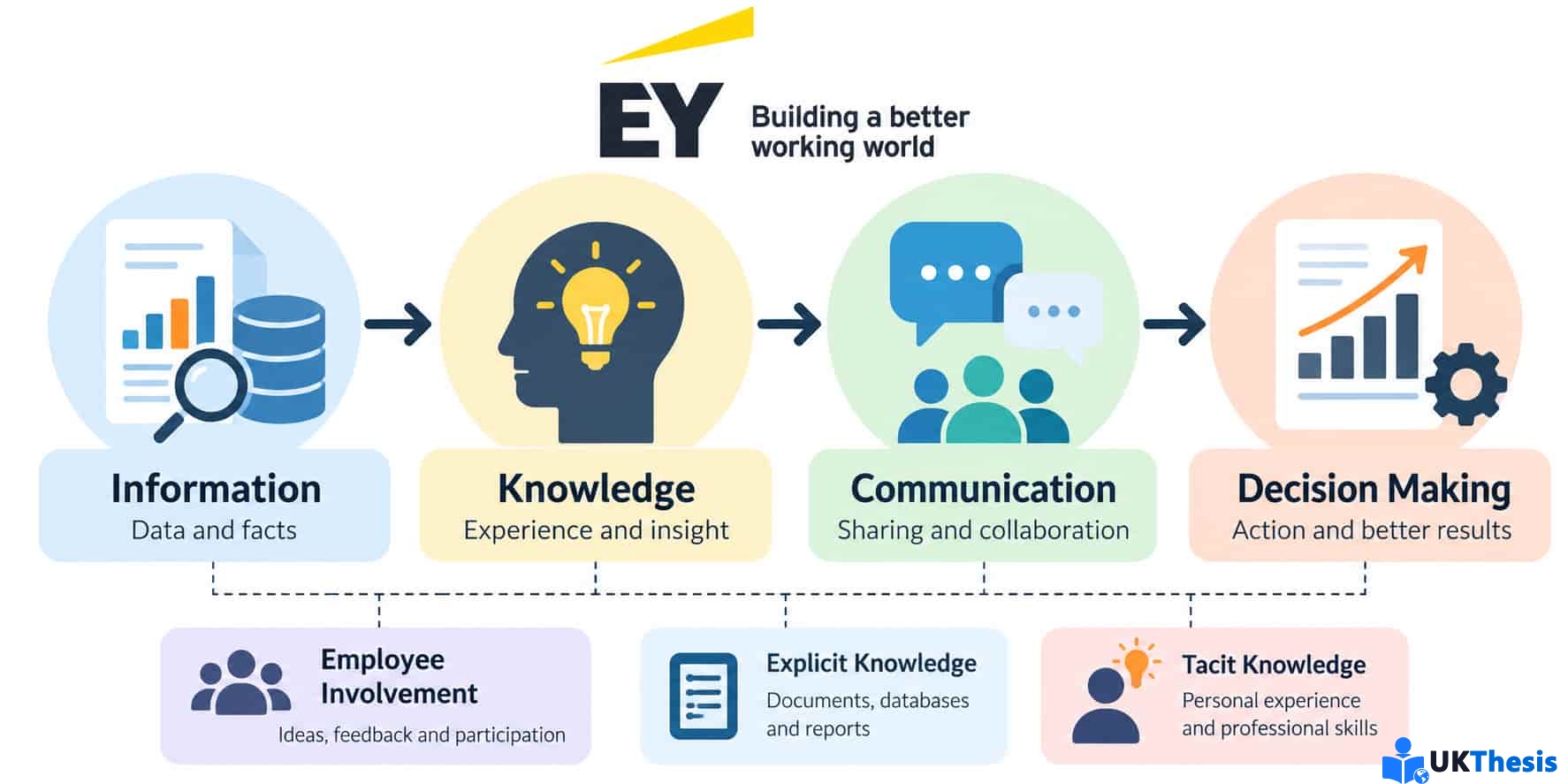
这篇Business Management assignment以Ernst & Young(E&Y)为案例,讨论Information、Knowledge Management和Business Communication怎样影响Decision Making、Employee Involvement以及Competitive Advantage。重点不是单纯介绍一家Professional Services Firm,而是回答一个更实用的问题:企业拥有大量信息之后,怎样把信息真正变成可以帮助管理者做决定的Knowledge?
案例分析逻辑:Information → Knowledge Sharing → Communication → Decision Making → Organisational Performance。Information很多并不代表企业一定聪明,真正困难的是信息能不能在正确时间到达正确的人手里。
| 核心概念 | 在企业中的作用 | E&Y案例应用 |
|---|---|---|
| Information | 提供Decision所需事实和数据 | 内部系统、客户信息与市场信息 |
| Knowledge | 把信息转化为经验和组织能力 | Professional Expertise与Knowledge Sharing |
| Communication | 让Information和Knowledge流动 | Meetings、Digital Platforms与Client Communication |
| Decision Making | 把Information转化为Management Action | 内部与外部信息支持管理判断 |
Information, Knowledge and Communication in Business
In the twenty-first century, firms compete in a complex environment shaped by technological development, information technology and the increasing importance of knowledge. Companies therefore need to search for new sources of competitive advantage and new ways of organising information.
Information has become a basic component of modern business. Organisations collect large quantities of data for purposes ranging from operational decisions to risk management. However, storing information is not the same as using information effectively.
The more important management question is whether relevant information can be identified, interpreted and communicated to people who need it.
In a large professional organisation such as Ernst & Young, Information、Knowledge和Communication之间的关系尤其明显。Professional Services很大程度上依赖员工的专业知识、项目经验、客户信息以及不同团队之间的协作。如果这些Knowledge只留在个人电脑或者某位员工脑子里,组织实际上并没有真正拥有这些知识。
Ernst & Young as a Knowledge-Based Organisation
E&Y operates across different offices, teams and professional service areas. A geographically distributed organisation therefore needs reliable information infrastructure as well as effective communication between employees and clients.
Information technology can support this process by connecting offices, organising business information and allowing employees to communicate across locations. Meetings and internal communication channels also provide opportunities for information to move between departments.
Communication applications make collaboration with clients and colleagues easier, but technology itself does not automatically create Competitive Advantage. The real advantage appears when employees can use information to solve problems, respond to clients and make better decisions.
这里特别容易写错:“公司用了Information System,所以获得Competitive Advantage”中间其实少了一大截逻辑。更完整的分析应该是:Technology improves information access → employees share knowledge faster → managers receive better information → decision quality may improve → organisational performance may benefit。
How Information and Knowledge Improve Decision Making
Managers often make decisions according to their understanding of events, people and organisational circumstances. Personal judgement remains important, but judgement without relevant information can easily become assumption.
For a decision to be effective, managers need information that is relevant, timely and reasonably accurate. This information may come from both internal and external sources.
Internal sources may include:
meetings with colleagues and employees;
operational performance information;
previous project experience;
internal knowledge systems;
feedback from different departments.
External sources may include clients, customers, competitors, market developments and wider changes in the business environment.
Managers at E&Y can therefore combine information collected internally with knowledge obtained from clients and the wider market. Communication with colleagues, junior staff and other executives can also help managers see a problem from different perspectives.
| Decision Stage | Information Requirement | Management Action |
|---|---|---|
| Define the Problem | 内部情况、员工反馈 | 明确真正需要解决的问题 |
| Collect Information | Internal + External Sources | 寻找相关Evidence |
| Evaluate Options | Knowledge + Experience | 比较不同解决方案 |
| Make Decision | Processed Information | 选择并执行方案 |
| Review | Results + Feedback | 判断Decision是否有效 |
The first stage of decision making is therefore to define the problem. Managers need to understand what actually exists within the organisation before searching for a solution. Meetings with colleagues can help clarify the situation, after which relevant information can be collected from inside and outside the organisation.
The information can then be processed and compared with organisational knowledge and previous experience before a final decision is made.
Employee Involvement and Personal Networking
Employee involvement can improve the amount and variety of information available to management. Employees working directly with clients, systems or operational processes may notice problems before senior managers do.
Personal networking therefore has an important role in Knowledge Sharing. Regular meetings and informal interaction can strengthen relationships between employees and make communication easier.
Management can also encourage employees to present creative or innovative ideas during meetings. When employees believe their experience is taken seriously, they may become more willing to participate in organisational activities and Decision Making.
However, Employee Involvement should not simply be described as “more participation is always better”. Too many communication channels can also create information overload, slow decisions or make responsibility unclear. Managers therefore need to balance participation with accountability.
| Employee Involvement Method | Possible Benefit | Possible Limitation |
|---|---|---|
| Regular Meetings | 促进Knowledge Sharing | 会议过多可能降低效率 |
| Employee Voice | 增加一线Information | 意见不一定都能执行 |
| Personal Networks | 知识传播更灵活 | 过度依赖个人关系 |
| Digital Collaboration | 跨Office快速沟通 | Information Overload |
Developing a Better Communication Process
A communication process should allow information to move efficiently between operational and strategic levels of an organisation. If communication passes through too many hierarchical layers, important details may be delayed, simplified or misunderstood.
For E&Y, an integrated workplace communication platform can support faster communication between employees, teams and management. The objective is not simply to introduce another piece of software. It is to reduce unnecessary communication barriers while preserving appropriate responsibility and information control.
A practical communication process can be understood as:
Problem Identified → Information Collected → Knowledge Shared → Discussion → Decision → Feedback → Organisational Learning
Recording important discussions and decisions can also contribute to organisational memory. Previous project information may help future decision makers understand which approaches worked, which failed and why.
This turns Communication into something more valuable than sending messages. Communication becomes part of the organisation’s Knowledge Management system.
What Role Does Knowledge Management Play?
Knowledge Management helps organisations identify, organise, share and use what employees and systems know.
A useful distinction is between Tacit Knowledge and Explicit Knowledge.
| Knowledge Type | Meaning | Example |
|---|---|---|
| Tacit Knowledge | 存在于个人经验、判断和技能中的知识 | Experienced consultant知道怎样处理复杂Client Situation |
| Explicit Knowledge | 可以记录和储存的知识 | Databases、Manuals、Reports、Project Records |
For a professional services organisation, both types matter. Databases can store documents and previous project information, but they cannot completely replace the experience and judgement held by employees.
This is why Knowledge Management often combines technology-based networks with people-based networks. Technology helps employees find information; personal interaction helps them understand context.
E&Y provides a useful case because professional knowledge is closely connected with client service. Learning and Knowledge Sharing can help employees connect individual expertise with broader organisational capabilities.
Knowledge Management and Competitive Advantage
Knowledge about customers, competitors, internal processes and previous decisions can influence how organisations compete. However, simply possessing more information than competitors does not automatically create an advantage.
Competitive Advantage is more likely to emerge when the organisation can:
find relevant knowledge quickly;
share it between employees and teams;
apply it to client or business problems;
learn from previous decisions;
retain useful organisational knowledge when employees or projects change.
The strategic value of Knowledge Management therefore lies in application. Information stored but never used has very limited business value.
Conclusion
Information, Knowledge and Communication are closely connected with effective Decision Making. Managers need relevant information, but they also need organisational knowledge and communication channels that allow information to move between employees, departments and management levels.
The Ernst & Young case illustrates how a knowledge-intensive organisation can combine professional expertise, internal information systems, employee networks and client communication. Employee participation can increase the information available to managers, while Knowledge Management can help preserve and distribute both Tacit and Explicit Knowledge.
The main lesson is fairly simple: collecting more data is not the same as knowing more. An organisation gains value when information can be understood, shared and turned into action. That is where Business Communication、Knowledge Management和Decision Making真正连接起来。
学姐的写作提醒:Knowledge Management这种题最怕写成“信息很重要、沟通很重要、知识也很重要”,三句话转来转去,老师看到第三页可能已经开始怀疑人生。写的时候给每个概念安排一个工作:Information提供Evidence,Communication负责流动,Knowledge负责积累和理解,Decision Making负责把它变成Action。这样一篇Business Assignment马上就顺了。
FAQ
Q1:这篇属于Business essay还是Management Assignment?
更准确地说属于Business/Management Assignment,并以Ernst & Young作为Knowledge Management case study。Business Essay可以作为辅助分类。
Q2:Knowledge Management和Information Management一样吗?
不完全一样。Information Management更关注信息的收集、组织、储存和获取;Knowledge Management还涉及员工经验、专业判断、Knowledge Sharing以及这些知识怎样被组织利用。
Q3:Tacit Knowledge和Explicit Knowledge有什么区别?
Tacit Knowledge通常存在于个人经验和技能中,不容易完全写下来;Explicit Knowledge则更容易通过文件、数据库、报告和Manual记录与传播。
Q4:为什么Knowledge Management会影响Decision Making?
因为Manager做决定不只需要Data,还需要理解Data意味着什么。过去经验、专业知识、员工反馈和外部信息结合以后,才能形成更完整的判断。
Q5:Employee Involvement一定能改善Decision Making吗?
不一定。员工参与可以增加Information和不同观点,但参与过多也可能造成沟通成本、Information Overload或责任模糊,因此需要根据Decision类型设计参与程度。
Q6:Business Communication Assignment怎样写出Critical Analysis?
不要只写“communication improves performance”。继续分析为什么、通过什么Mechanism、在什么情况下有效,以及可能产生哪些Limitations。
Q7:Knowledge Management Assignment不知道怎么搭结构怎么办?
可以先按“Concept → Company Evidence → Decision Impact → Limitation”的顺序搭框架。如果在Business Essay、Case Study、Critical Analysis或Assignment Structure上卡住,也可以通过UKThesis的Essay辅导梳理题目和论证思路。
相关阅读
如果正在写Business或Management课程作业,可以继续阅读:
International Business谈判技巧:Negotiation Skills与跨文化沟通方法
Assignment怎么写?拆题、Critical Thinking与Reference写作指南
Assignment Brief怎么看?Task Words、Rubric与Learning Outcomes详解