国际贸易Economics Essay范文|伊朗与欧盟贸易、FDI及石油经济分析

文章导读:本文是一篇International Economics essay案例,原研究时间范围主要集中在2001—2012年,讨论伊朗与欧盟之间的贸易关系,并延伸到Foreign Direct Investment(FDI)、石油经济、国际制裁以及伊朗与意大利之间的双边贸易。由于本文属于历史经济案例,文中的经济数据、贸易结构和政策背景应结合当时的研究时期理解,并不代表当前经济和国际关系状况。
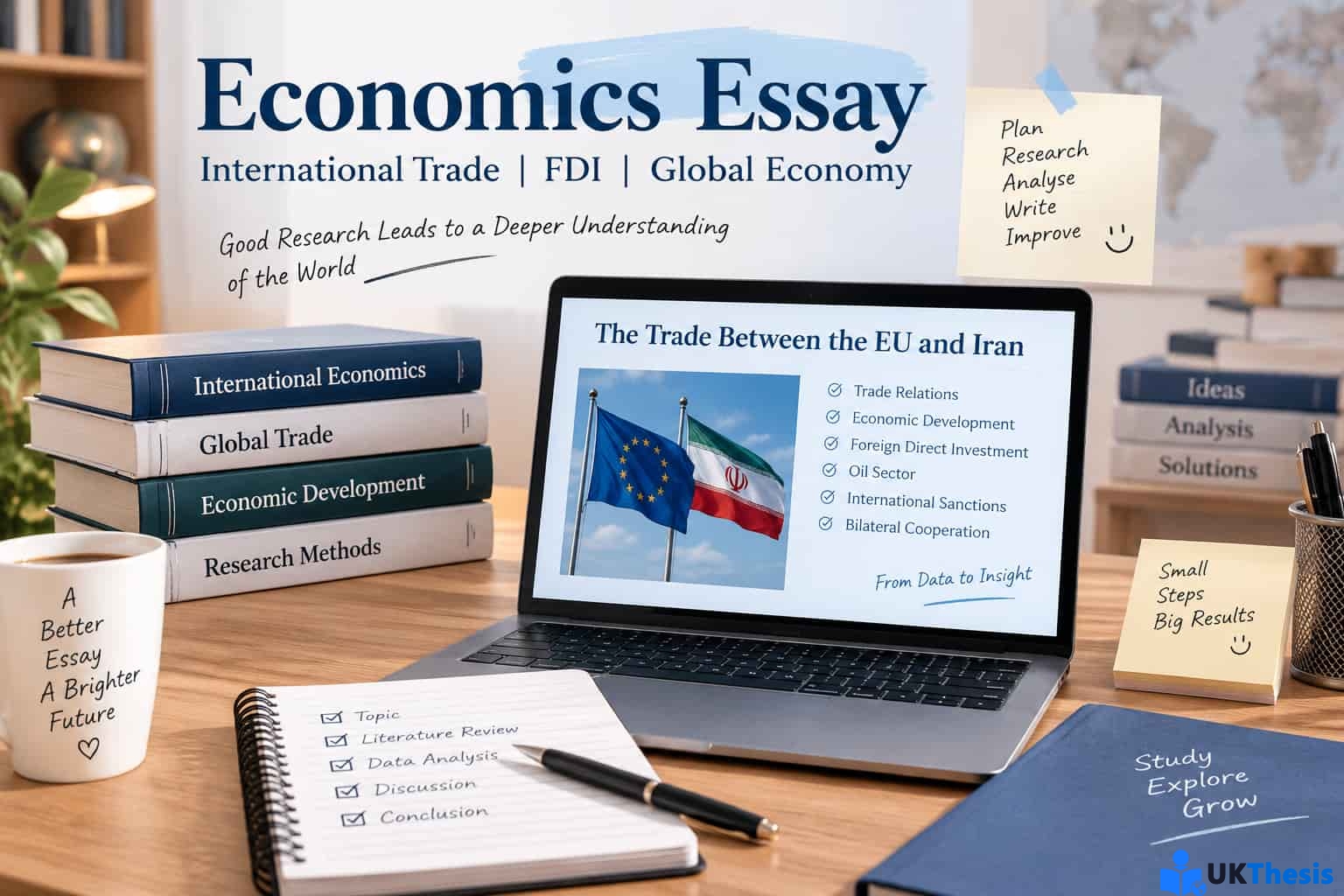
从Economics Essay写作角度来看,这篇文章比较有参考价值的一点,是它没有只分析单一的贸易数字,而是把International Trade、Foreign Direct Investment、Oil Economy以及Political and Economic Factors放在同一个分析框架中。对于学习International Economics、Development Economics或International Business的留学生来说,可以重点观察文章如何从Research Problem逐步扩展到国家背景、贸易关系、FDI和能源经济。
| 文章部分 | 主要分析内容 |
|---|---|
| Research Problem | 确定伊朗、欧盟贸易及经济发展的研究范围 |
| Economic Performance | GDP、通胀、石油收入及宏观经济背景 |
| Iran–EU Trade | 国际贸易、贸易伙伴与贸易政策影响 |
| FDI | 外国直接投资的作用、障碍和投资环境 |
| Oil Economy | 能源、政府收入及经济增长之间的关系 |
| Iran–Italy Trade | 双边贸易作为具体案例进一步分析 |
The Trade Between the EU and Iran
The Islamic Republic of Iran is a country in the Middle East with substantial labour and natural resources. The region has long attracted international attention because of its geopolitical position, energy resources and relationship with major economies. During the period examined in this study, Iran’s political relationship with the United States and European countries strongly influenced its international trade and economic development.
Research Problem
The purpose of this research is to examine Iran from a geopolitical and economic perspective, with particular Reference to trade relations that influence its economy and development. The study focuses mainly on trade between the European Union and Iran, while also referring where necessary to Iran’s trade with other countries and the wider international economy.
The research mainly considers information and data from approximately 2001 to 2012. It discusses Iran’s trade flows, bilateral relationships, international agreements, the importance of the oil sector, foreign direct investment and the influence of sanctions and trade restrictions on the Iranian economy.
Information for the study was collected from economic journals, databases, online libraries and statistical materials concerning Iran. Geography, demographics, currency, economic development, GDP and a number of political and economic factors are also discussed in order to provide background for understanding Iran’s international trade relationships.
Iran: Economic and Political Background
Iran was historically known as Persia and has played an important role in the political and economic history of the Middle East. Following the Iranian Revolution of 1979, the country established a new political system in which religious and political institutions became closely connected.
During the following decades, Iran experienced war, political conflict, economic change and international sanctions. These factors influenced both domestic economic development and Iran’s relationship with major international trading partners.
Iran possesses substantial energy resources, especially oil and natural gas. The economy has therefore traditionally relied heavily on the hydrocarbon sector. Oil exports have provided an important source of foreign exchange and government revenue, while fluctuations in international oil prices have frequently affected fiscal policy, domestic demand and overall economic performance.
阅读提示:这一部分主要承担Economics Essay中的Background作用。写经济学案例时,背景不能无限扩展,真正需要保留的是与research Question有关的政治、贸易、能源和宏观经济信息。
Economic Performance of Iran
Iran experienced periods of relatively strong economic growth during the years covered by this research, particularly when international oil market conditions were favourable. Expansionary fiscal and monetary policies also supported domestic economic activity.
However, the Iranian economy was also affected by inflation, dependence on oil revenue, international financial pressures and structural inefficiencies. The global financial crisis and changing oil prices contributed to slower growth in 2008 and 2009.
The heavy dependence on hydrocarbon exports meant that changes in oil prices affected government income, fiscal expenditure and domestic investment. This relationship between oil revenue and national economic performance is an important theme throughout the study.
Trade Between Iran and EU Partners
Regional trade agreements and international trade relationships can increase trade by reducing barriers between participating economies. Countries normally seek to improve market access by lowering tariffs, developing bilateral agreements and participating in broader economic arrangements.
Iran’s relationship with European countries during the research period was influenced by both commercial interests and political developments. European economies were important partners in machinery, industrial equipment, energy and other sectors, while Iran remained important because of its oil and natural gas resources.
Trade relations were therefore not determined by economics alone. Political tensions, international sanctions, financial restrictions and concerns over Iran’s nuclear programme also affected trade flows and business confidence.
| 影响Iran–EU Trade的因素 | 可能产生的经济影响 |
|---|---|
| Oil and Gas Resources | 提高伊朗在能源贸易中的重要性 |
| European Machinery Exports | 支持伊朗工业和基础设施发展 |
| International Sanctions | 限制融资、投资及部分商品贸易 |
| Political Relations | 影响长期商业信心及双边合作 |
Foreign Direct Investment in Iran
Foreign Direct Investment(FDI)refers to investment made by a company or investor from one country into business activities located in another country. FDI may take the form of acquiring ownership in an existing company, establishing a new business, forming a joint venture or expanding production facilities.
FDI can provide a host economy with capital, employment, technology, management experience and access to international markets. For foreign companies, investment may provide access to local resources, labour, customers and strategic markets.
In the case of Iran, foreign direct investment has historically been connected with sectors such as oil and gas, vehicle manufacturing, mining, petrochemicals, pharmaceuticals and industrial production.
However, Iran has also faced significant obstacles in attracting foreign investment. These include complex operating requirements, political uncertainty, international sanctions, difficulties in financial transactions and concerns over the wider business environment.
Why Invest in Iran?
During the period covered by the original study, Iran attracted international interest because of its large domestic market, natural resources, young population, industrial base and strategic geographic location. The country also occupies an important position between the Middle East, Central Asia and major international transport routes.
The combination of oil, natural gas, minerals, industrial activity and a significant domestic consumer market created potential opportunities for foreign companies. At the same time, economic sanctions and regulatory complexity reduced some of these advantages.
History and Development of FDI
Foreign investment has played a role in Iran’s economic development for many decades, particularly in natural resources and industrial projects. Legislative efforts were introduced at different times to encourage and protect foreign investors.
Nevertheless, the level of foreign investment has fluctuated considerably. Political events, domestic regulations and international sanctions have repeatedly affected investor confidence and the volume of new investment entering the country.
Types and Sectors of FDI
The study distinguishes between different forms of foreign investment and notes that foreign companies could participate in Iran through direct investment, contractual arrangements, sales activities and investment projects subject to relevant regulations.
Important sectors included vehicle manufacturing, food and pharmaceuticals, oil and gas, copper mining and petrochemicals. The concentration of investment in a relatively limited number of industries was both a strength and a weakness of the Iranian FDI environment.
The Oil Sector in Iran
The oil and gas sector is central to understanding Iran’s economy. Iran possesses very large hydrocarbon resources, and energy exports have historically provided an important share of national income and government revenue.
Oil, natural gas and electricity are important not only as export products but also as inputs into domestic production and consumption. Changes in energy demand therefore influence both industrial development and household welfare.
The Iranian economy’s dependence on oil creates a two-sided relationship. Moderate growth in oil revenue can support economic growth by providing foreign exchange, financing infrastructure and allowing imports of capital goods and technology.
However, excessive dependence on oil revenue can also create problems. Rapid increases in government income may lead to inefficient spending, inflation, rent-seeking activity and an expansion of sectors that do not necessarily improve long-term productive capacity.
Government Budget
Oil revenue has traditionally contributed significantly to Iranian government income. Because of this dependence, changes in international oil prices can directly affect government expenditure and fiscal policy.
When oil revenue increases moderately, additional government spending on infrastructure and productive investment may support economic activity. When revenue rises too quickly, however, inefficient allocation and excessive spending may reduce some of the positive effects.
Investment and Economic Growth
Higher oil revenue may increase government investment in infrastructure, technology and capital goods. These investments can reduce production costs and improve the environment for private-sector activity.
At the same time, rapid increases in imports and government expenditure can reduce the competitiveness of domestic producers. This illustrates why energy revenue alone does not guarantee long-term economic development.
Economics Essay写作提醒:讨论oil revenue时,不要只写“石油多,所以经济好”。更有分析价值的写法,是同时讨论Government Revenue、Investment、Imports、Inflation、Private Sector和Economic Growth之间的关系。
Trade Between Iran and Italy
Italy and Iran maintained important commercial relations during the historical period examined in this essay. Energy was a major element of the relationship, while Italian companies were also involved in machinery, industrial equipment, engineering and infrastructure.
Iran’s importance to Italy was closely related to crude oil and energy supply, while Italian exports to Iran included machinery, industrial equipment, transport products and other manufactured goods.
The relationship was nevertheless affected by wider political tensions between Iran, the European Union and the United States. Sanctions and restrictions on financial transactions created additional uncertainty for companies engaged in bilateral trade.
Exchange Between Iran and Italy
Trade between Iran and Italy changed considerably from year to year. During parts of the period examined in the original study, crude oil and natural gas represented a large share of Italian imports from Iran.
Italian exports included industrial machinery, equipment for mining and construction, hydraulic systems, machinery for metallurgy and other engineering products.
The bilateral trade relationship therefore provides a useful case study for understanding how energy dependence, industrial exports, international sanctions and political relations can interact within international economics.
Italian Business in Iran
Italian companies had a long history of commercial engagement in Iran, particularly in energy, engineering and industrial projects. Italian firms were attracted by Iran’s natural resources, large market and demand for industrial technology.
However, international sanctions and political uncertainty created significant challenges. This illustrates one of the central themes of the essay: international trade decisions are often determined by a combination of market opportunities and political risk.
What Can We Learn From This Economics Essay?
这篇旧Economics Essay最值得借鉴的地方,并不是里面某一个已经过时的贸易数字,而是它的分析路线。
文章先提出Research Problem,然后加入国家背景,再讨论Economic Performance、International Trade、FDI、Oil Sector以及Italy–Iran Trade。也就是说,它试图从宏观经济背景逐步走向具体的双边贸易案例。
| 写作步骤 | 可以借鉴的思路 |
|---|---|
| 提出Research Problem | 先确定真正要分析的经济问题 |
| 提供Background | 只保留与研究问题有关的经济和政治背景 |
| 加入Economic Data | 数据不能单独堆积,要解释其经济意义 |
| 讨论FDI和Trade | 把投资、贸易与政策环境联系起来 |
| 使用Country Case | 通过Italy–Iran关系进一步具体化分析 |
Economics Essay写作常见问题
Q:这篇属于Dissertation还是Economics Essay?
从原文题目和主体结构来看,更准确地说属于Economics Essay或International Trade Case Study。虽然篇幅较长,也带有Research Problem,但核心内容仍然围绕国际贸易、FDI和宏观经济问题展开。
Q:十多年前的经济数据还能作为Essay参考吗?
可以用于观察文章结构、研究问题和案例分析方式,但如果正在完成当前课程作业,需要重新查找最新经济数据和学术资料,不能把历史数字直接当成今天的经济状况。
Q:International Trade Essay最常见的问题是什么?
最常见的问题是写了大量国家背景和统计数字,却没有真正回答Research Question。数据只是Evidence,真正的分析要解释Trade、FDI、Policy和Economic Development之间为什么存在这种关系。
Q:经济学Essay是否需要大量公式?
不一定。是否需要模型、公式或统计分析取决于assignment Brief和课程要求。像本文这种International Trade Case Study,更重要的是Research Question、Economic Logic、Data和Evidence之间能够互相对应。
如果在Economics essay选题、结构、数据分析或英文表达方面遇到困难,可以先根据Assignment Brief、评分标准和导师要求确定真正的问题,再进行针对性的论文辅导或论文代写相关咨询。比起单纯增加字数,把经济逻辑和Evidence解释清楚通常更重要。
本站相关阅读:
经济学Essay:东亚经济体成功经验分析
Economics Essay:FDI对东道国经济的影响
国际贸易Essay:RTAs对WTO多边贸易体制的影响