Expository Essay范文:Clarity in English Prose与英文写作清晰度分析

Expository essay有时候会被翻译成“说明文”,结果不少同学第一反应就是:那是不是把资料整理一下、解释清楚就行?大方向没错,但大学里的Expository Writing并不是资料搬运。真正难的是,你能不能把一个复杂问题解释得让Reader看懂,同时又不把内容写得过分简单。
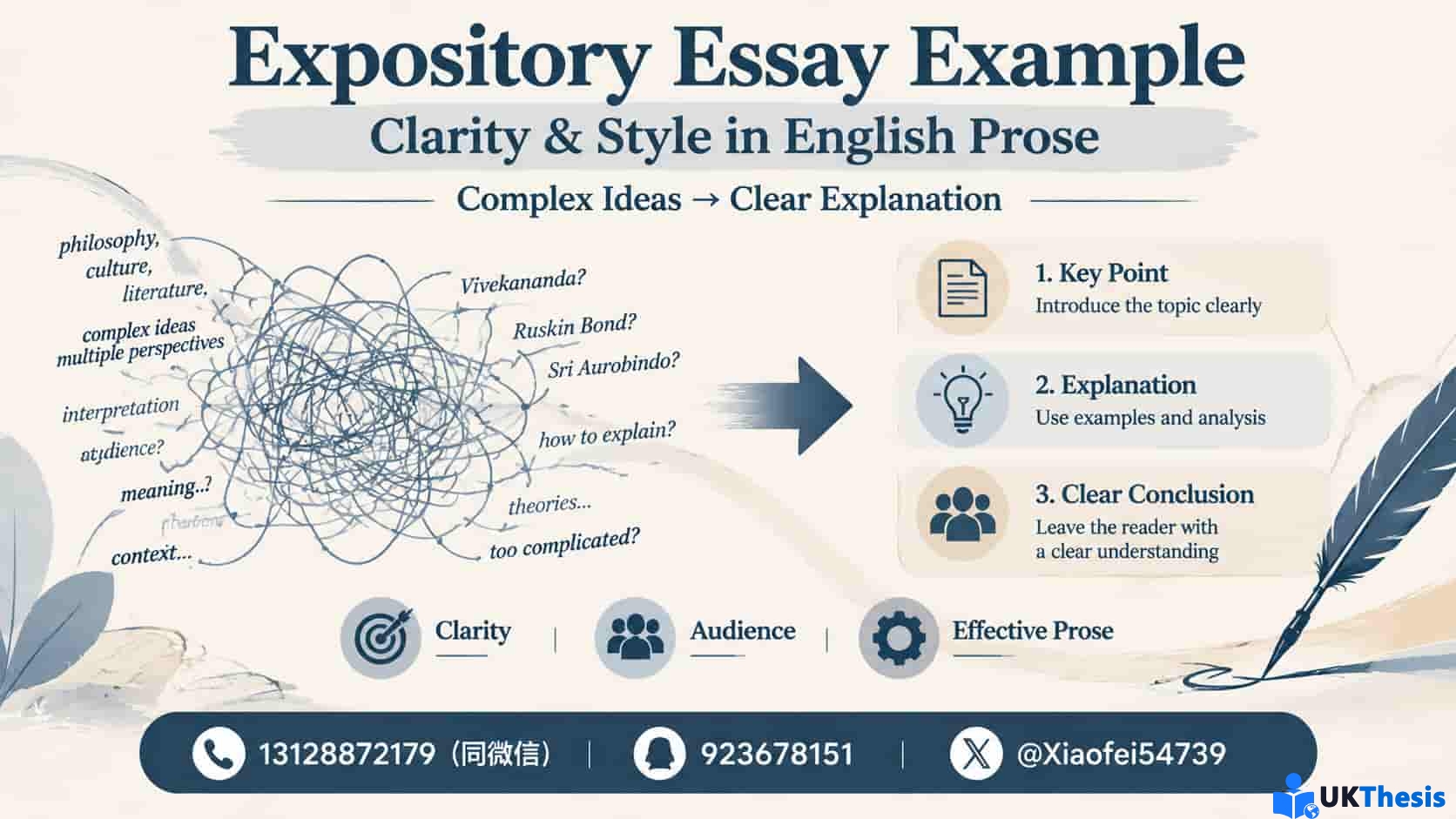
下面这篇Essay讨论的恰好就是这个问题:Clarity in English Prose。文章通过Vivekananda、Ruskin Bond、Sri Aurobindo等人的写作,讨论clarity、literary style、audience以及interpretation之间的关系。这个Sample比较特别,它不是解释某个Science Concept,而是在解释“什么样的English Prose才真正清楚有效”。
What Is an Expository Essay?
An expository essay explains, clarifies or explores a subject using organised information and evidence. Its purpose is usually not to tell a personal story or persuade the reader through emotion, but to help the reader understand a topic more clearly.
The exact structure depends on the assignment. A short university essay may contain an introduction, several body paragraphs and a conclusion, while a longer assignment may require more sections.
The important point is not whether the essay contains exactly five paragraphs. The important point is whether every section contributes to a clear explanation of the subject.
| Section | Main Function |
|---|---|
| Introduction | Introduce the topic and establish the central focus |
| Body Paragraphs | Explain ideas using evidence, examples and analysis |
| Examples | Make abstract concepts easier to understand |
| Conclusion | Bring the explanation together without introducing a new argument |
学姐的小提醒:Expository Essay最容易犯的错误不是“不会写高级词”,而是自己明明懂了,写出来Reader却看不懂。说明性写作有点像给同学讲题——你不能只证明自己知道答案,还得让对方知道你是怎么走到这个答案的。
Expository Essay Example: Culture and Language — A Need for Clarity in English Prose
There may be difficult passages in an essay, treatise or narrative. Difficulty itself is not necessarily a weakness. Some subjects require complex ideas and specialised vocabulary.
The problem begins when complexity no longer serves the subject and instead prevents the reader from understanding it.
The modern reader should not be taken for granted. Writing succeeds only when communication between writer and reader remains possible.
Clarity, Literature and the Modern Reader
The boundary between literary prose and journalistic prose is not always as rigid as it once appeared.
Journalism generally values direct communication, while modern literary prose can also achieve artistic quality without depending on unnecessary verbosity.
A writer does not have to choose between clarity and beauty.
Ruskin Bond offers a useful example. His prose can be accessible to ordinary readers while retaining lyricism and a distinctive literary voice. Simplicity in this sense is not the absence of artistry. It is the ability to make artistry appear natural.
| Writing Feature | Why It Matters |
|---|---|
| Clarity | Allows the reader to follow the writer's meaning |
| Precision | Reduces ambiguity |
| Style | Gives prose an individual voice |
| Audience Awareness | Determines how much explanation is necessary |
Explaining Difficult Texts
Clarity becomes particularly important when a writer is interpreting philosophical, literary or religious texts.
A commentator may be explaining the Gita, the Upanishads, the Quran, the Bible, Vivekananda, Rumi or Sri Aurobindo. These texts can contain ideas that are difficult for readers unfamiliar with their philosophical or historical contexts.
The task of the commentator is therefore not to make the interpretation more complicated than the text being interpreted.
Notes and explanations should support the reader rather than overwhelm the main discussion.
An interpretation that requires another interpretation has probably lost sight of its audience.
这一点放到大学Essay里也特别实用:有时候我们为了显得Academic,句子越写越长,最后一个sentence里面塞三层从句、四个概念。老师不是看不懂,而是会问一句:为什么不直接说?Academic Writing需要准确,不等于故意难懂。
Vivekananda: Force and Directness in Prose
Vivekananda's English prose demonstrates how direct language can still possess considerable rhetorical force.
His writing frequently communicates a strong personality behind the words. The prose can be forceful without depending on excessive ornamentation.
This becomes particularly noticeable when he writes about hypocrisy, morality or social behaviour. Parallel phrases and clauses create rhythm, while direct vocabulary gives the prose emotional energy.
His descriptive writing can be very different in tone.
When describing the Himalayas, the prose becomes quieter and more visual. Snow-covered peaks, mountain roads, forests, mornings and evenings create a recognisable landscape without requiring a large number of decorative images.
The description works because the details are selective.
| Technique | Effect |
|---|---|
| Direct vocabulary | Creates force and immediacy |
| Parallel structure | Adds rhythm and rhetorical emphasis |
| Selective imagery | Produces a clear visual impression without overcrowding the prose |
| Personal voice | Allows personality to remain visible behind the language |
Clarity Does Not Mean Writing Without Style
A common misunderstanding is that clear prose must be plain to the point of becoming dull.
That is not necessarily true.
Clarity concerns whether readers can follow the writer's meaning. Style concerns how that meaning is expressed. The two can exist together.
A sentence may be lyrical and still be clear. It may contain metaphor without becoming confusing. Likewise, a short sentence can still be vague if the writer has not decided exactly what he or she wants to say.
Good prose therefore requires judgement rather than a mechanical rule that every sentence must be short.
Sri Aurobindo and the Problem of Complex Ideas
Sri Aurobindo provides another useful example because his writing deals with philosophical and spiritual ideas that are not always simple.
The difficulty of the subject does not remove the writer's responsibility to communicate.
Later letters attributed to Sri Aurobindo show a style that can be comparatively relaxed and explanatory even when discussing difficult philosophical distinctions.
This leads to an important principle of expository prose: the complexity of the language should come from the complexity of the idea when necessary, not from the writer's desire to appear sophisticated.
这句话可以记一下:Complex idea ≠ deliberately complicated sentence. 我见过不少Essay,本来观点很聪明,结果作者为了“学术感”硬套词,反而把最好的观点藏起来了。
Writing for the Target Audience
Every sentence exists within a relationship between writer and reader.
This becomes particularly important in interpretation and translation. If the explanation becomes considerably more difficult than the original material, the explanatory purpose begins to fail.
The writer therefore needs to consider the knowledge already possessed by the target audience.
A specialist journal can reasonably assume more background knowledge than an introductory university essay. A book review written for general readers needs a different level of explanation from a doctoral discussion of literary theory.
Clarity is therefore contextual rather than absolute.
| Audience | Likely Writing Choice |
|---|---|
| General Reader | Explain specialised terms and provide context |
| University Student | Combine academic terminology with clear explanation |
| Specialist Reader | More disciplinary terminology may be assumed |
| Book Review Reader | Summarise efficiently before evaluating |
Book Reviews and the Art of Explanation
Book reviewing provides a practical test of clarity.
A reviewer needs to communicate the content and style of a book efficiently enough for readers who may not have read the original work.
If the review becomes an abstruse thesis that loses contact with the book itself, the reviewer has failed one of the basic expectations of the audience.
This does not mean that book reviews cannot contain sophisticated analysis. It means that analysis should illuminate the book rather than hide it.
The same principle applies to university essays. Theory should help explain the subject; the subject should not disappear underneath the theory.
Can Difficult Ideas Be Explained Clearly?
The answer is generally yes, although clarity does not always mean simplicity.
Some philosophical, scientific and literary ideas genuinely require technical vocabulary and careful qualification.
What matters is whether each layer of complexity contributes something necessary.
One useful way to test an expository paragraph is to imagine explaining the same point to a classmate.
There would be a beginning to the explanation, a development of the idea and a point at which the explanation reaches a logical conclusion.
If the explanation suddenly ends in the middle of the second point, the listener will naturally have questions. An expository essay works in much the same way: the argument or explanation needs to feel complete.
What Can We Learn from This Expository Essay?
| Writing Problem | Better Approach |
|---|---|
| Trying to sound academic | Prioritise precision before complicated vocabulary |
| Too much explanation | Keep only details that help the reader understand the central idea |
| Theory overwhelms the topic | Use theory to illuminate the subject |
| Reader gets lost | Check paragraph order and transitions |
| Writing becomes too plain | Keep voice and imagery where they improve meaning |
我自己特别喜欢这篇Sample里一个很朴素的观点:如果你的任务是解释,那么Reader最后应该比阅读之前更明白,而不是更糊涂。
这听起来像废话,但写Essay的时候特别容易忘。很多同学一看到Critical Thinking、Academic Vocabulary、Theory,马上把句子武装到牙齿。其实真正成熟的Academic Writing往往是:概念复杂,但表达没有故意为难Reader。
FAQ
Expository Essay是什么?
Expository Essay主要用于解释或阐明一个主题,通过evidence、examples和logical organisation帮助Reader理解问题。它通常比Argumentative Essay更强调explanation,而不是要求Reader接受一个强争议性立场。
Expository Essay一定是五段式吗?
不是。Five-paragraph structure可以作为初学者理解Essay Structure的方法,但大学Assignment应该根据word count、question和evidence决定实际段落数量。
Expository Essay和Informative Essay有什么区别?
两者经常存在重叠。Informative Essay强调提供和组织信息,而Expository Essay通常进一步强调解释concept、relationship或process。具体名称还要看学校和课程的Assignment Brief。
Academic Writing是不是词越难越好?
不是。Academic Writing更重视precision、evidence和logical reasoning。专业术语在必要时应该使用,但为了显得“高级”而替换本来清楚的表达,反而可能降低可读性。
Expository Essay资料很多但不知道怎么组织怎么办?
先确定文章究竟需要解释什么,再把Evidence按照几个明确的问题分组。如果资料很多、Outline比较乱,可以通过Essay写作辅导先整理Thesis、Paragraph Structure与Evidence,再进入正文写作。
相关文章阅读
所以,如果一个观点本来两句话就能解释清楚,我不会建议为了“Academic”硬写成六句话。真正好的Expository Writing不是把简单的问题写复杂,而是有能力把复杂的问题解释清楚。