
Fashion Marketing看起来是一个挺“时髦”的题目,但真正写起Marketing assignment,你会发现老师并不是让你聊“哪件衣服比较好看”。真正值得分析的是:一个服装品牌为什么能够卖得比别人贵?消费者为什么记住某一个品牌?价格、产品、渠道、Brand Image和Target Market之间到底是什么关系?
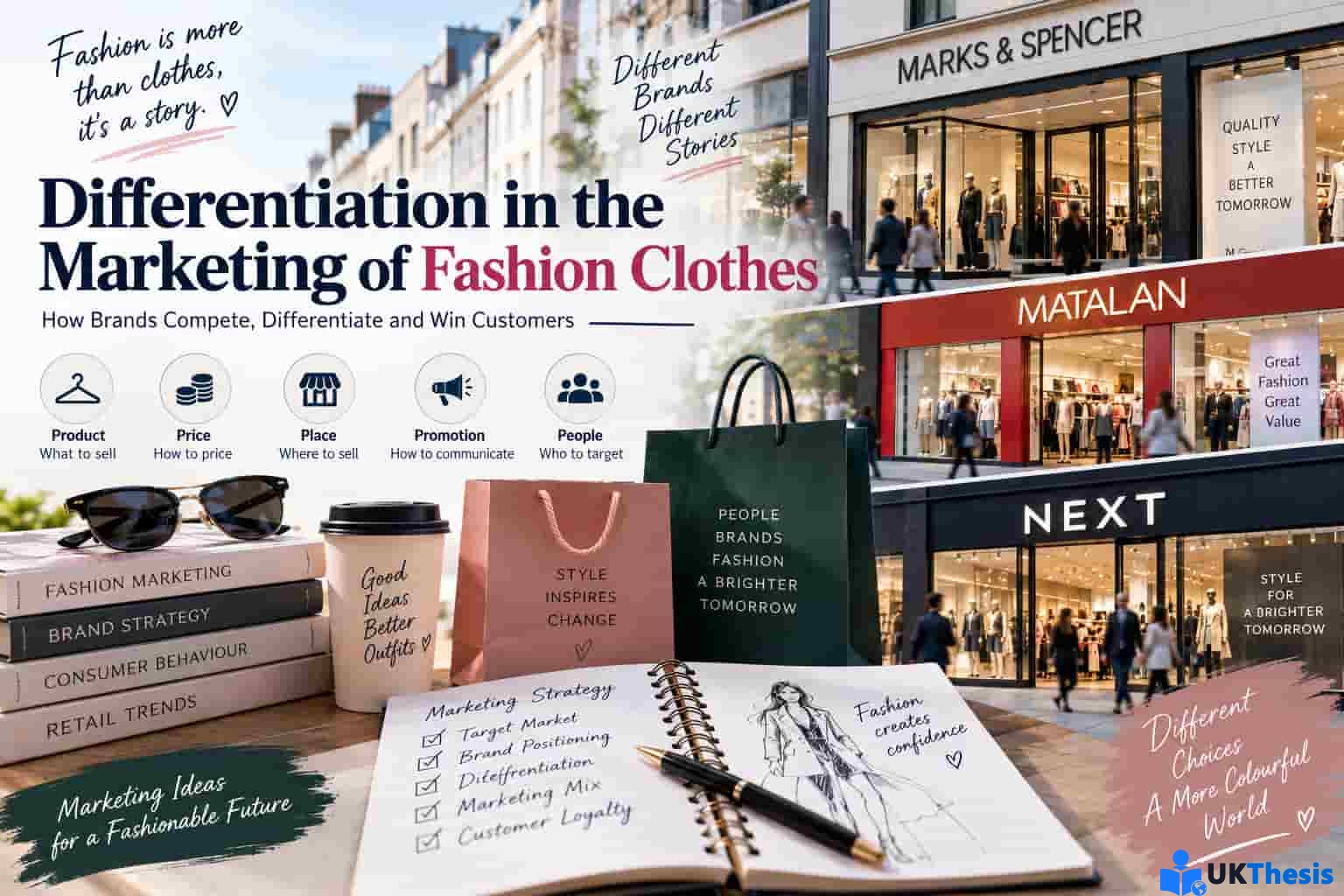
这篇Fashion Marketing essay范文以英国服装零售市场为背景,原题为Differentiation in the Marketing of Fashion Clothes,重点比较Marks & Spencer、Matalan和Next等零售商在Branding、Reputation、Differentiation及Marketing Mix方面的不同策略,并讨论新进入者怎样在成熟的Fashion Retail Market中建立自己的竞争位置。
阅读提示:本案例所使用的部分市场资料来自2000年代中期,因此更适合作为经典Marketing Strategy、Brand Differentiation与Fashion Marketing Case Study范文阅读,而不能直接作为2026年英国服装市场现状数据使用。学习重点是它的分析方法,而不是把历史数字照搬进现在的Assignment。
The UK Fashion Retail Market
The UK clothing market had become essentially mature following major changes in the profile of clothing retailing during the 1990s. Purchasing gradually shifted away from traditional channels such as department stores, independent clothing shops and variety stores towards discounters, supermarkets and sports outlets.
This reflected broader changes in consumer lifestyles, including the casualisation of clothing, pressure from lower-priced imported products and the development of out-of-town retail centres. Shopping for clothing and footwear increasingly became part of a broader leisure experience. Instead of visiting a particular high-street shop for a particular product, consumers could spend several hours browsing a variety of stores in larger retail locations.
For a Marketing essay, this background is useful because it explains an important point: Differentiation does not happen in isolation. When distribution channels, consumer lifestyles, competitor prices and product sourcing all change at the same time, retailers must reconsider what actually makes their Brand different.
| Market Change | Marketing Impact |
|---|---|
| Growth of supermarkets and discounters | Greater price competition and wider distribution |
| Cheaper imported clothing | Downward pressure on retail prices |
| More casual lifestyles | Higher demand for casualwear and sports-inspired fashion |
| Out-of-town retail centres | Shopping increasingly becomes a leisure experience |
Changes in Consumer Behaviour
Mainstream women’s clothing was strongly populated by private labels from variety stores and clothing specialists, while premium ranges remained more closely associated with department stores and established fashion brands.
At the same time, discount retailers increased their share of consumer purchasing. Supermarket groups also expanded into clothing by developing their own branded collections. This increased competition because fashion products were no longer available only through specialist clothing retailers.
The consumer increasingly began to regard some clothing and footwear as relatively short-life products rather than long-term investments. Quality still mattered, but fashion style, price and the ability to respond quickly to trends became increasingly important purchasing considerations.
This change is particularly useful when analysing Fashion Marketing. A customer buying a winter coat expected to last for years may judge Quality very differently from someone buying an inexpensive seasonal fashion item. That means Product Strategy, Price Strategy and Positioning should always be considered together.
Price Competition and Global Sourcing
Clothing sales became increasingly influenced by discounting and intense retail competition. The growing involvement of supermarkets and discounters placed pressure on prices, while the globalisation of product supply encouraged retailers to source production from lower-cost regions.
This shift created an obvious cost advantage, but it also introduced a different Marketing issue: ethics.
Moving production overseas may reduce costs, but concerns about wages, labour conditions and supplier practices can influence Brand Reputation. This means sourcing is not simply an Operations decision. Once customers associate production practices with a Brand, Supply Chain decisions also become part of Marketing.
写Marketing case study时可以注意:不要把“低成本采购”只分析成价格优势。还可以继续讨论Cost、Brand Reputation、Ethical Marketing和Customer Perception之间的冲突,这样就从Description进入Analysis了。
Marketing Strengths and Weaknesses of Key Players
The competitive positions of major retailers can be assessed through branding, reputation, differentiation and different elements of the Marketing Mix.
Marks & Spencer: Quality and Reputation
Marks & Spencer historically held a strong position in the UK clothing market and developed a reputation for reasonably priced, reliable and well-fitting clothing.
However, differentiation can become a problem when the qualities traditionally associated with a Brand no longer match changing customer expectations. As competition in the apparel sector intensified, Marks & Spencer faced pressure to make its clothing offer appear more relevant to contemporary customers.
Its strength came from an established Brand, widespread consumer recognition and an association with quality. Its weakness was that a strong historical identity could become restrictive if customers began to associate the same identity with an older or less fashionable image.
| Area | Marks & Spencer Analysis |
|---|---|
| Brand Strength | High recognition and long-established reputation |
| Positioning | Quality and reasonable value |
| Potential Weakness | Brand image can become less attractive when customer tastes change |
| Differentiation | Design, quality, fit and established trust |
Matalan: Price Differentiation
Matalan developed a different competitive position. Lower-cost locations and direct overseas sourcing helped the company compete strongly on price.
Its Marketing Mix was also supported by a membership model. Customer information could be used for direct marketing and more targeted communication. In other words, low price was not the only feature of the strategy; Customer Data and Direct Marketing also supported the retail model.
However, the same Bargain Image that attracts price-sensitive consumers can also become a limitation. In Fashion Marketing, customers do not always choose the cheapest product. Brand Image, social identity and perceived fashionability may become equally important.
This creates a useful Marketing question:
Can a Brand become so strongly associated with low prices that the low-price image begins to restrict its ability to move into more fashionable or premium segments?
That is the kind of question that makes a Marketing Assignment interesting. Simply writing “Matalan is cheap” is Description. Discussing how price positioning may both attract customers and restrict Brand Perception is Analysis.
Next: Style, Quality and Brand Consistency
Next represented a different position within the UK clothing mid-market. It offered fashionable but moderately priced clothing for men, women and children and aimed to combine individual styling, quality and value for money.
Instead of positioning itself as an extreme trendsetter, Next differentiated itself through clothing that was fashionable but still practical and accessible to a broad group of customers.
An important element of the strategy was Brand consistency. Rather than continuously adding unrelated clothing brands, the company concentrated on strengthening the Next identity. Product development, larger stores and growth in home shopping all supported this broader Marketing Mix.
| Retailer | Main Differentiation | Possible Risk |
|---|---|---|
| Marks & Spencer | Quality, fit, reputation | Traditional image may become less relevant |
| Matalan | Low price and value | Bargain positioning may limit Brand Image |
| Next | Style, quality and value balance | Needs to keep pace with changing fashion trends |
Brand Differentiation and Marketing Mix
The comparison shows why Brand Differentiation cannot be analysed separately from the Marketing Mix.
A Brand claiming to offer premium quality needs Product, Price, Place and Promotion decisions that support that Positioning. Likewise, a retailer competing primarily on low prices requires a cost structure and distribution model capable of delivering those prices consistently.
| 4Ps | Fashion Marketing Question |
|---|---|
| Product | What makes the clothing distinctive in design, quality or Brand identity? |
| Price | Does the price support Value, Premium or Discount Positioning? |
| Place | Where does the Target Market expect to buy the product? |
| Promotion | How is the desired Brand Image communicated? |
写到这里就能看出为什么我经常跟同学说:4Ps真的不是背四个单词。Product说Premium,Price天天打五折,Promotion又拼命强调Luxury——这几个P自己先打起来了,老师还怎么相信你的Positioning?
真正不错的Marketing Essay,需要继续判断这些策略是否彼此一致。
Recommendations for a New Fashion Retailer
For a new organisation entering a mature clothing market, competing directly with large established retailers can be difficult. Established firms usually possess stronger Brand Recognition, larger buying power, established distribution networks and considerable Marketing resources.
For this reason, a new entrant may benefit from concentrating on a clearly defined niche instead of attempting to compete across the whole market.
Brand can become an important source of Differentiation. If price and basic product quality can easily be imitated, a distinctive Brand Identity, specific Target Market, recognisable Design Style or clearly communicated Value Proposition may provide a stronger basis for long-term Positioning.
The ability to respond quickly to changing fashion pReferences is also important. Large organisations may benefit from scale, while smaller entrants can sometimes benefit from flexibility.
Ethical sourcing represents another potential area of differentiation. If consumers care about production conditions and supply-chain responsibility, an organisation may potentially build part of its Brand around those values. However, the positioning needs to be supported by actual business practices rather than Promotion alone.
| Recommendation | Reason |
|---|---|
| Choose a defined niche | Avoid direct competition with large retailers across every segment |
| Develop a distinctive Brand | Creates reasons to choose the retailer beyond basic price competition |
| React quickly to fashion change | Smaller firms may use flexibility as a competitive advantage |
| Connect ethics with real practice | Supports Brand Reputation when claims can be demonstrated |
| Align the Marketing Mix | Product, Price, Place and Promotion should reinforce the same Positioning |
这篇Fashion Marketing Essay范文值得学什么?
如果只是拿它当“英国服装行业介绍”看,其实有点可惜。
它比较值得参考的是一条很完整的分析路线:
Market Change → Consumer Behaviour → Competition → Brand Positioning → Marketing Mix → Differentiation → Recommendations
这条逻辑特别适合Marketing Assignment和Business Case Study。
比如Assignment Brief让你:
Assess the marketing strengths and weaknesses of major competitors and recommend an entry strategy.
那就不要从公司历史写起,一写800词才终于出现Marketing。
更有效的方式是先明确Evaluation Criteria:
Branding、Reputation、Differentiation、Target Market、Product、Price、Place、Promotion。
然后让几个品牌都用同一套标准去比较。这样文章自然就会有Comparison,而不是三篇独立公司介绍硬拼在一起。
如果在Marketing Essay或Business Assignment中卡在题目理解、案例选择、Marketing Mix结构、Critical Analysis或英文Draft修改等环节,可以通过论文写作辅导先把Assignment Brief和分析路线梳理清楚。范文真正有用的地方不是整段照搬,而是帮助自己理解老师究竟希望看到怎样的Analysis。
Conclusion
The UK fashion retail case demonstrates that differentiation can arise from several different sources. Marks & Spencer historically relied heavily on reputation, quality and fit; Matalan competed strongly through value and price; while Next developed a position based on style, quality, accessibility and consistent Brand identity.
No single differentiation strategy is automatically superior. Its effectiveness depends on the Target Market, competitive environment and whether different elements of the Marketing Mix support the desired Brand Positioning.
For a new entrant, attempting to imitate a large established retailer may be difficult because the new business does not possess the same buying power, distribution reach or Brand Recognition. A more realistic strategy may therefore involve developing a clearly defined niche, building a distinctive Brand and responding quickly to changes in customer preferences.
The broader lesson for a Fashion Marketing Assignment is simple: Differentiation is not just about looking different. It is about giving the customer a clear and credible reason to choose one Brand rather than another.
FAQ:Fashion Marketing Essay常见问题
1. Fashion Marketing属于Marketing Essay还是Business Assignment?
两种都可以。Fashion Marketing属于Marketing学科,但很多大学课程会以Assignment或Coursework形式布置,因此后台可以使用Marketing Essay和Marketing Assignment相关Tag。
2. 这篇文章属于Case Study吗?
属于比较型Marketing Case Study,因为正文以Marks & Spencer、Matalan和Next等真实零售品牌为案例进行比较。
3. Brand Differentiation是什么意思?
简单说,就是消费者为什么认为一个Brand与竞争者不同。差异可能来自Product、Price、Design、Service、Brand Image、Distribution或其他因素。
4. Fashion Marketing Essay一定要写4Ps吗?
不一定,要看Assignment Brief。但如果题目涉及Marketing Strategy、Marketing Mix或Competitive Positioning,4Ps通常可以作为很实用的分析框架。
5. 可以加入PESTEL吗?
只有当题目要求分析Macro Environment时才有必要。不要为了显得理论多就同时塞进PESTEL、SWOT、Porter、STP和7Ps。
6. 怎样让Fashion Marketing Case Study更有Critical Analysis?
不要只描述各品牌做了什么。继续分析为什么这样做、对哪个Target Market有效、有什么局限,以及不同Marketing Decisions之间是否一致。