Healthcare HRM Assignment范文|Training and Development & Employee Retention - UKThesis

Healthcare Human Resource Management有一个很现实的问题:医院、诊所以及其他Healthcare Organizations需要的不只是“有人来上班”,而是员工必须具备适合岗位的专业技能,并且能够随着技术、设备和工作流程变化持续学习。
所以在Healthcare HRM中,Training and Development(培训与发展)并不是员工入职时上一两节课这么简单。一个设计合理的培训体系可能同时影响Employee Performance、Job Satisfaction、Employee Retention以及组织整体效率。
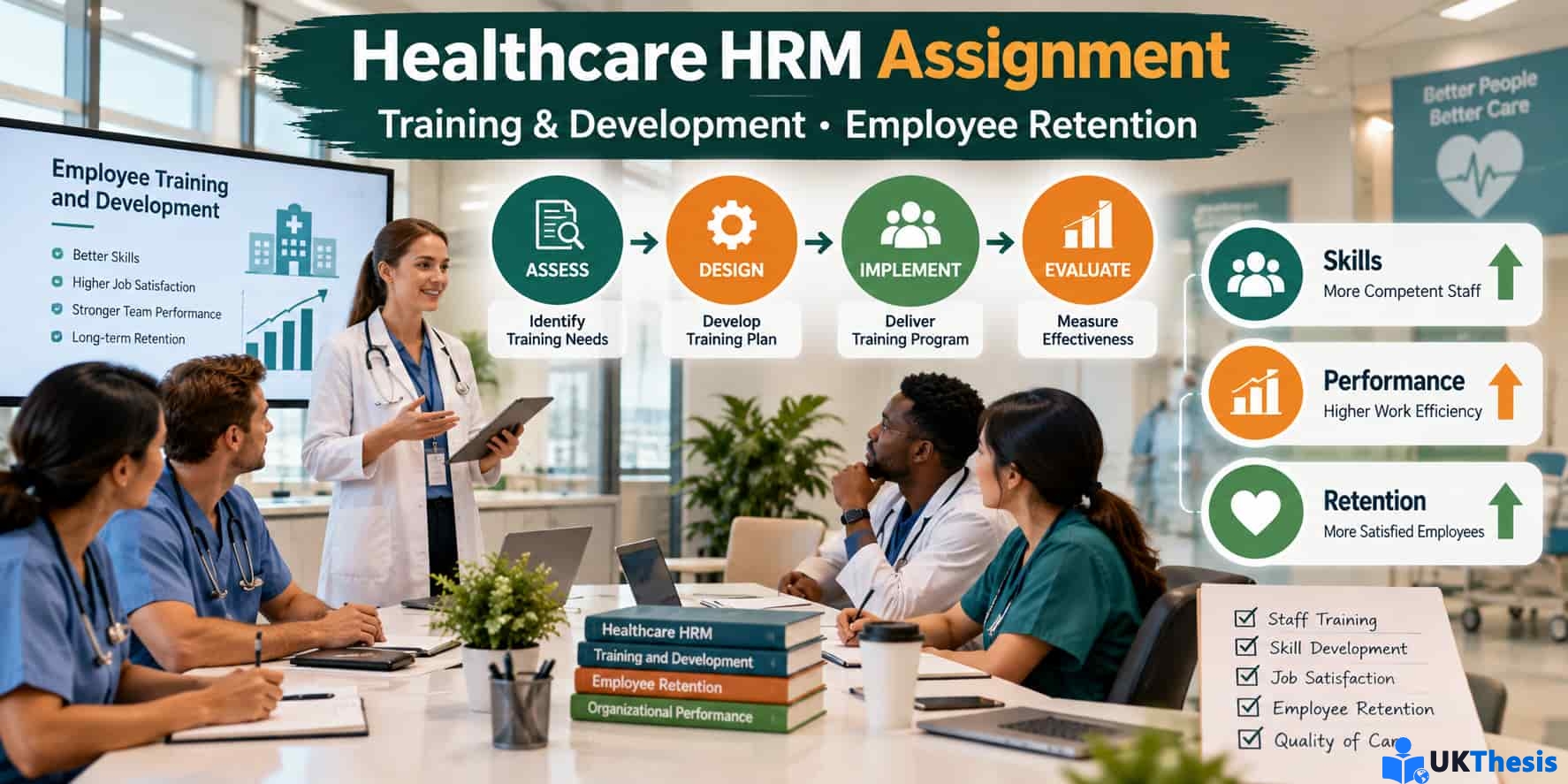
下面这篇Healthcare HRM Assignment范文以Employee Training and Development为核心,讨论医疗机构为什么需要员工培训,并按照Training Needs Assessment → Design → Implementation → Evaluation的流程分析有效培训计划如何形成。
范文定位:本文适合Healthcare HRM、Human Resource Management、Training and Development以及Employee Retention相关assignment学习参考。重点是把员工培训与组织绩效连接起来,而不是简单罗列“培训的好处”。
Training and Development in Healthcare Organizations
The healthcare industry is a continuously developing field that requires a wide range of skills and training. The development of an effective training programme is therefore important for employee skills, retention and organisational stability.
An effective training and development programme can create benefits for both employers and employees. Training may contribute to employee retention, job satisfaction and efficiency, while also supporting the introduction of new strategies, equipment and working practices.
Employees who receive appropriate training and development may be better equipped to help the organisation achieve its objectives. Properly trained employees can become more productive, more confident in their responsibilities and less dependent on continuous supervision.
这也是Healthcare HRM和普通办公室HRM稍有不同的地方。医疗环境中的技能要求、设备、流程以及服务质量之间联系得非常紧密,因此Training并不能只理解为Employee Benefit,它同时也是Organizational Capability的一部分。
Why Is Employee Training Important in Healthcare HRM?
| HRM Area | Potential Training Impact | Organizational Value |
|---|---|---|
| Employee Skills | Develop job-related knowledge and abilities | Improved work capability |
| Employee Retention | Employees perceive investment in development | Potentially lower turnover |
| Job Satisfaction | Greater confidence and development opportunities | More engaged workforce |
| New Technology | Employees learn new equipment and procedures | Smoother implementation |
| Productivity | Employees require less repeated direction | Improved efficiency |
The Employee Training Process
Effective training requires an organised process rather than simply arranging a course and asking employees to attend.
A useful training process can be divided into four stages:
1. Training Needs Assessment
2. Training Design
3. Implementation
4. Evaluation
这四步看起来很基础,但写HRM Assignment时非常好用,因为它形成了一条完整逻辑:
What is missing? → What should we teach? → How do we deliver it? → Did it actually work?
1. Training Needs Assessment
A Training Needs Assessment helps a healthcare organisation identify the gap between existing employee skills and the skills required for expected performance.
It can therefore help management determine whether training is actually required and identify the specific areas in which employees need development.
This stage is important because organisations should not assume that every performance problem is automatically a training problem.
Critical Thinking:如果员工绩效低是因为设备不足、Staffing不足或者工作流程本身设计有问题,那么给员工再安排十次Training也未必能解决问题。因此Needs Assessment的意义,就是先找到Performance Gap真正来自哪里。
2. Training Design
The design phase begins once the organisation has established that training is necessary and has identified the specific area requiring improvement.
This stage involves developing learning activities and identifying the resources needed to meet expected performance standards.
Training methods may include written materials, videos, demonstrations, classroom sessions, one-to-one instruction and practical workplace training.
The appropriate method should depend on the learning objective rather than simply choosing the cheapest or easiest training format.
3. Training Implementation
The implementation stage is where the planned training is delivered to employees.
A healthcare organisation may use internal specialists, supervisors or external trainers to teach employees the skills required for their roles and to develop existing knowledge.
Employees then participate in the planned training activities.
Implementation sounds straightforward, but HR managers still need to consider scheduling, employee participation, training resources and whether employees have sufficient opportunity to apply what they have learned.
4. Training Evaluation
The evaluation phase determines whether the training programme has successfully addressed the needs identified during the assessment stage.
The organisation should ask:
Did employees develop the intended skills?
Did employee performance improve?
Were the needs identified during the assessment stage addressed?
Did the training create meaningful organisational benefits?
Results can be evaluated through employee performance and the broader outcomes achieved by the organisation.
| Stage | Main Question | HRM Purpose |
|---|---|---|
| Assessment | What skills are missing? | Identify the performance gap |
| Design | What should employees learn? | Create appropriate learning activities |
| Implementation | How will training be delivered? | Transfer knowledge and skills |
| Evaluation | Did the training work? | Measure training effectiveness |
Training and Employee Retention
Training and development can contribute to a more satisfied employee who may be more likely to remain with the organisation and perform productively.
When an organisation invests time and resources in employee development, employees may perceive that the organisation takes both their work and professional development seriously.
This can contribute to motivation and organisational loyalty.
From the employer's perspective, effective training may also reduce some of the costs associated with repeatedly recruiting, selecting and onboarding replacement employees.
Having motivated, multi-skilled and appropriately trained employees can therefore become an important organisational resource.
Is Training Always Worth the Investment?
这里需要对原来的观点稍微增加一点Critical Analysis。
原文强调Training可以提高Retention、Productivity并降低Replacement Cost,这个逻辑是成立的,但Assignment如果只写Training的优点,会比较像Description。
Training itself also requires resources. Organisations may need to pay trainers, allocate employee time, purchase learning materials and temporarily remove staff from normal duties.
There is also no guarantee that every trained employee will remain with the organisation.
Therefore, the more appropriate HRM question is not:
“Is training good?”
but:
“Does this particular training programme address an identified performance need and create sufficient value for employees and the organisation?”
这句话放进Healthcare HRM essay里,Critical Thinking的味道就出来了。
Training, Job Satisfaction and Organizational Performance
The relationship between Training and Development and organisational performance is not necessarily direct.
Training first influences employee knowledge, skills and confidence. These improvements may subsequently affect work performance, job satisfaction and the employee's ability to adapt to new responsibilities.
At the organisational level, the potential benefits may include improved efficiency, stronger employee capability and reduced dependence on repeated supervision.
因此可以把原文逻辑整理成:
Training & Development → Employee Skills → Performance & Confidence → Job Satisfaction → Retention → Organizational Performance
但写Essay时也不要把这条链条写成绝对因果。Employee Retention还可能受到Pay、Leadership、Workload、Career Opportunities以及Organizational Culture等其他因素影响。
Healthcare HRM Assignment常见问题
What is Training and Development in HRM?
Training and Development refers to organised activities designed to improve employee knowledge, skills and capabilities. Training often focuses on current job requirements, while development may also support broader and longer-term employee growth.
What is a Training Needs Assessment?
A Training Needs Assessment identifies differences between existing employee capabilities and the skills or performance required by the organisation. It helps determine whether training is necessary and what the training should address.
What are the four stages of the training process?
A basic training process can be organised into Assessment, Design, Implementation and Evaluation. Assessment identifies the need, Design develops the programme, Implementation delivers it, and Evaluation examines whether it achieved the intended outcome.
How can training affect Employee Retention?
Training may improve employees' skills, confidence and perceptions of organisational investment in their development. These factors may contribute to job satisfaction and retention, although employee turnover is also influenced by other HRM factors.
Healthcare HRM和普通HRM Essay有什么区别?
HRM基本理论可以相同,但Healthcare背景会改变理论应用方式。写作时应该把Training、Recruitment、Retention或Performance Management放回医疗机构的工作环境,而不是写完一篇通用HRM文章以后只在标题加上Healthcare。
HRM Assignment不知道怎么把Theory和案例连接怎么办?
HRM作业最常见的问题之一,就是理论写了一大段,实际分析却只有两句话。处理Healthcare HRM、Training and Development、Employee Retention等题目时,可以先从Assessment Brief判断需要使用哪些HRM Concepts,再把每个理论对应到具体Workplace Situation。UKThesis可围绕已有题目和Draft提供结构梳理、案例分析、语言润色及Assignment写作辅导。
Conclusion
Training and Development is an important component of Human Resource Management in healthcare organisations. An effective programme begins by identifying actual performance needs rather than assuming that training is automatically the solution.
The process can then move through Training Needs Assessment, Design, Implementation and Evaluation.
When training is appropriately designed and delivered, employees may develop stronger skills, require less repeated supervision and become better prepared to contribute to organisational objectives.
Training and development may also contribute to job satisfaction and employee retention because employees can recognise that the organisation is investing in their capabilities.
However, training should not be viewed as an automatic solution to every HR problem. Its effectiveness depends on whether the programme addresses a genuine need and whether the knowledge and skills acquired can be transferred into workplace performance.
For Healthcare HRM, the real value of Training and Development therefore lies not simply in providing more courses, but in developing the right capabilities for employees and the organisation.