Learning Organization Literature Review范文|Senge五项修炼与企业案例分析

Learning Organization(学习型组织)是Business Management、Organisational Behaviour和Human Resource Management课程中很常见的研究主题。
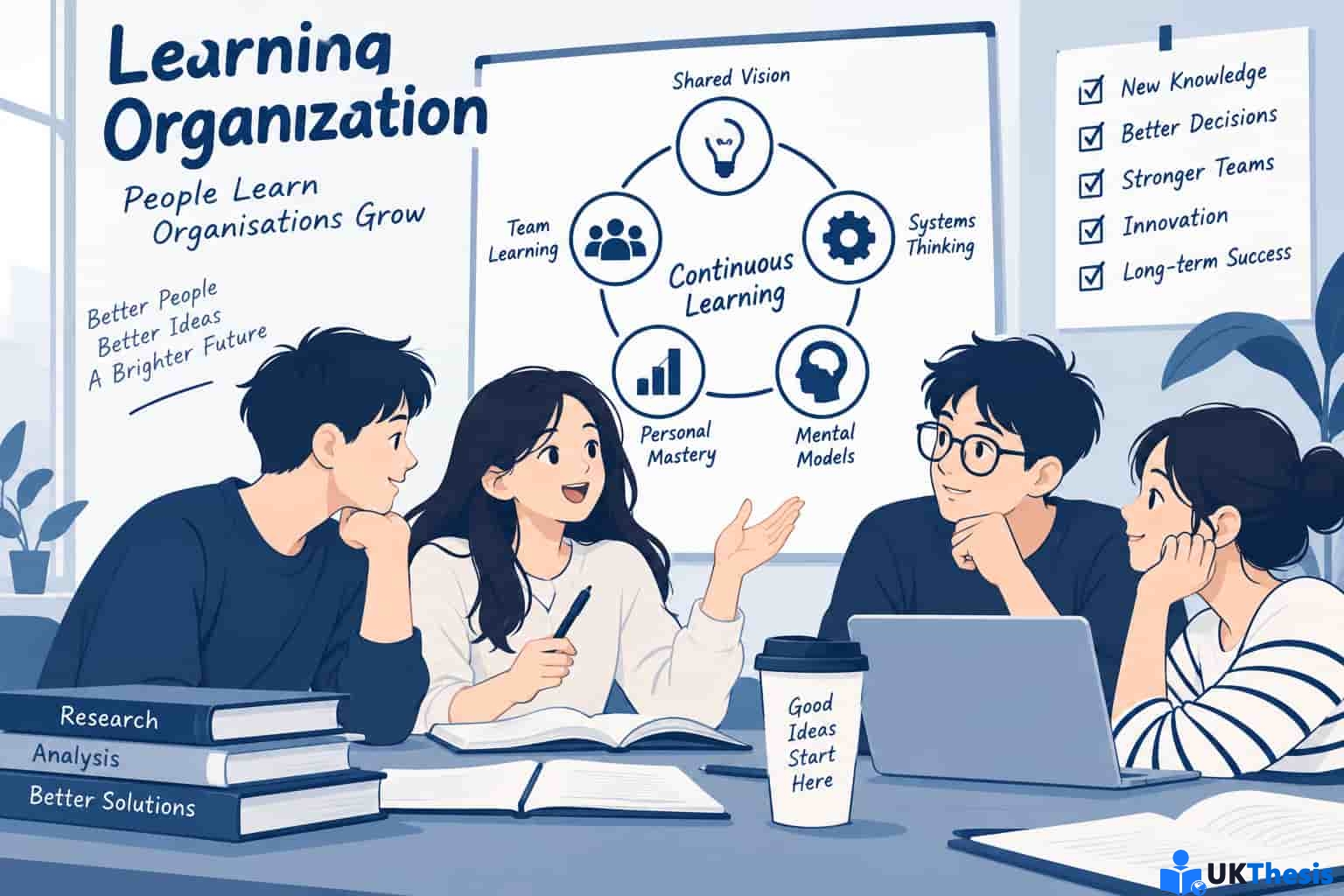
简单来说,学习型组织并不是“公司多给员工上课”这么简单。真正的重点,是组织能不能持续学习、修正自己的做法,并把个人经验变成团队和组织可以共同使用的知识。
我第一次看到这个概念时也觉得有点抽象:公司又不是学生,怎么“学习”?后来读到Peter Senge、Chris Argyris和Donald Schön这些理论以后才发现,组织学习其实就藏在每天的会议、沟通、错误反馈、培训和决策里。
范文类型:literature review / Business Management assignment
核心主题:Learning Organization / Organisational Learning
主要理论:Senge Five Disciplines、Single-loop / Double-loop Learning、Reflective Learning
案例方向:Southwest Airlines、Google、3M
Introduction:什么是Learning Organization?
A learning organization can be understood as an organisation that continually develops its ability to create and adapt to its future.
For such an organisation, simply surviving is not enough. Adaptive learning is necessary because organisations must respond to changes in markets, technology and customer behaviour. However, a learning organisation also requires generative learning: the ability to question assumptions, develop new ideas and create different possibilities rather than merely reacting to existing problems.
In a learning organisation, people continue to expand their capability, new ways of thinking are encouraged, collective goals are developed and members learn to understand the organisation as an interconnected whole.
Four Levels of Learning
Organisational learning can occur at different levels. The original framework can be organised into four stages:
| Level | Learning focus |
|---|---|
| Level 1 | Learning facts, knowledge and procedures where only minor change is required. |
| Level 2 | Developing new job skills that can be transferred into unfamiliar situations. |
| Level 3 | Learning through experimentation, adaptation, success and failure. |
| Level 4 | Learning how to learn, challenging assumptions and creating new ways of thinking. |
前两个层次更像是“遇到问题以后学会怎么处理”,而后两个层次已经开始涉及创新、反思和重新设计组织未来。
Characteristics of a Learning Organization
A learning organisation usually contains several connected characteristics.
Learning culture:组织愿意接受学习、试错和改进,而不是员工一犯错就先想着“这锅谁背”。
Processes:组织内部需要能够跨部门交流,而不是Finance只知道Finance,Marketing永远不知道Operations发生了什么。
Tools and techniques:Problem solving、creative thinking、training、feedback等工具能够帮助个人和团队学习。
Skills and motivation:员工既需要具备学习能力,也需要有动力去改变已有的工作方式。
Senge's Five Disciplines
Peter Senge对Learning Organization理论影响很大。他提出的Five Disciplines至今仍然是组织学习研究中很常见的理论框架。
| Discipline | Core idea |
|---|---|
| Systems Thinking | See relationships and patterns rather than treating every problem as an isolated event. |
| Personal Mastery | Continuous personal learning and development. |
| Mental Models | Question deeply held assumptions that influence organisational behaviour. |
| Shared Vision | Develop goals that employees genuinely understand and support. |
| Team Learning | Enable teams to learn collectively rather than relying only on individual expertise. |
其中最容易被学生写成“理论介绍”的就是Systems Thinking。其实这个概念真正有意思的地方,是提醒我们:一个企业问题通常不是单独出现的。
比如员工离职率变高,看起来是HR问题,但它可能同时与工作量、领导方式、奖励制度、企业文化甚至客户压力有关。Learning Organization真正关注的是这些因素之间的联系。
Mental Models and Shared Vision
Mental models refer to deeply held assumptions that influence how individuals interpret situations and make decisions.
These assumptions can become barriers to organisational learning when employees or managers continue using familiar practices simply because “we have always done it this way”.
Reflection and openness are therefore important because they allow individuals to question whether existing assumptions still make sense.
Shared vision is different from management simply announcing a corporate slogan. A meaningful shared vision requires employees to understand and identify with the organisation's direction.
这也是很多公司墙上贴着“创新、卓越、客户第一”,员工却完全没感觉的原因——那只是标语,不一定是Shared Vision。
Team Learning
Modern organisations depend heavily on teamwork. If individual employees learn but teams do not share what they know, organisational learning remains limited.
Team learning therefore focuses on developing the collective ability to solve problems, discuss assumptions and work toward shared goals.
From a Literature Review perspective, this also connects Senge's theory with later discussions about Knowledge Sharing, Psychological Safety and Organisational Culture.
Founders of Organisational Learning Theory
The literature on Learning Organization and Organisational Learning is commonly associated with several influential scholars, including Peter Senge, Chris Argyris and Donald Schön.
Although their approaches are not identical, they all question the idea that organisational learning simply means providing more training.
Peter Senge
Senge brought several existing ideas together into a coherent framework for understanding organisations as learning systems.
His work emphasises that organisational change requires individuals to change how they think, communicate and interpret problems.
This is one reason Systems Thinking became particularly influential: it encourages managers to stop blaming isolated individuals or events and instead examine patterns, feedback loops and relationships within the organisation.
Chris Argyris:Single-loop与Double-loop Learning
Chris Argyris made an important distinction between single-loop and double-loop learning.
Single-loop learning occurs when an organisation identifies a problem and corrects it without questioning the underlying assumptions.
Double-loop learning goes further by asking whether the rule, goal or assumption itself should be changed.
简单理解:
Single-loop:考试没考好,下次多复习两小时。
Double-loop:先问问自己,是不是一直用错了复习方法?
这个理论对Organisation Learning特别重要,因为企业有时候非常善于“解决问题”,却不一定善于思考为什么同样的问题总会重新出现。
Donald Schön:Reflection in Action
Donald Schön's work connects learning with reflection and practice.
Instead of separating thinking from action, Schön emphasised that professionals can learn while they are acting by reflecting on what is happening, adjusting their approach and using experience to guide later decisions.
This idea is particularly useful in organisations where employees frequently face complex situations that cannot be solved simply by following a standard procedure.
From Knowledge Transfer to Knowledge Creation
Earlier approaches to learning often treated knowledge as something transferred from one person to another. More recent perspectives increasingly regard learners as active participants who construct knowledge through experience, discussion and interaction.
| Traditional view | Learning-organisation view |
|---|---|
| Knowledge is transferred. | Knowledge is also created through interaction. |
| Learners receive knowledge. | Learners actively interpret and create knowledge. |
| Learning follows one standard method. | Individuals and teams may learn in different ways. |
case study 1:Southwest Airlines
Southwest Airlines has often been discussed in management literature as an example of an organisation with a strong employee-oriented culture.
The case is useful for Learning Organization analysis because communication, employee participation and organisational culture have historically played important roles in the company's management approach.
Several themes are particularly relevant:
communication between management and employees;
employee training;
encouraging staff to contribute ideas;
recognition and rewards;
a relatively strong organisational identity.
From a Learning Organization perspective, the interesting question is not simply whether Southwest was successful, but whether its culture allowed employees to exchange knowledge and act on feedback.
Case Study 2:Google and Innovation Culture
Google has frequently appeared in organisational-learning discussions because of its historical emphasis on innovation, knowledge sharing and employee autonomy.
The company provides a useful example of how learning can be connected with product experimentation and technical collaboration.
Engineers working in knowledge-intensive organisations often depend on feedback from colleagues, shared technical knowledge and the ability to experiment with new ideas.
不过写Google案例时要小心,不要变成“Google福利有多好”的介绍。Learning Organization真正需要分析的是:这些制度有没有让员工更容易学习、分享知识和创新。
Case Study 3:3M and Continuous Learning
3M is another frequently discussed example because innovation and continuous improvement have long played important roles in its organisational identity.
A learning environment involves more than formal classroom training. Employees may learn through daily work, collaboration, professional development and cross-functional communication.
In this kind of organisation, employees have responsibility for personal development, managers reinforce learning behaviour and the company creates systems that allow knowledge to move between different functions.
三个案例可以怎样比较?
| Company | Learning focus |
|---|---|
| Southwest Airlines | Culture, communication, employee participation |
| Innovation, experimentation, knowledge sharing | |
| 3M | Continuous learning, innovation, cross-functional knowledge exchange |
这张表实际上比简单说“这三家公司都是学习型组织”更有价值,因为不同组织的Learning Mechanism并不完全一样。
Critical Discussion:Learning Organization并不是万能公式
The concept of a learning organisation is attractive because it connects learning with innovation, employee development and organisational adaptability.
However, simply introducing training programmes or encouraging employees to communicate does not automatically create a learning organisation.
Several tensions may remain:
employees may not feel safe admitting mistakes;
managers may support learning in theory but prioritise short-term performance;
knowledge may remain inside individual teams;
employees may lack time to reflect or experiment;
a strong organisational culture can sometimes become resistant to external ideas.
所以真正的Critical Analysis不能停留在“Learning Organization很好”。还应该继续问:学习是否真的改善Performance?组织是不是只奖励成功而不允许失败?员工有没有时间学习?管理层是否真正愿意接受来自下属的反馈?
Conclusion
The literature suggests that a Learning Organization is not simply an organisation that provides employee training. It is an organisation in which learning becomes connected with daily work, communication, reflection, teamwork and organisational change.
Senge's Five Disciplines provide one influential framework, while Argyris and Schön offer additional insights into questioning assumptions and learning through reflection.
The cases of Southwest Airlines, Google and 3M also show that organisational learning can take different forms. In some organisations the emphasis may be culture and communication, while in others innovation, experimentation or continuous professional development may play a stronger role.
From a Literature Review perspective, the most useful conclusion is that Learning Organization should not be treated as a single checklist. Its effectiveness depends on how leadership, culture, systems, employee behaviour and knowledge sharing interact.
FAQ
Q:这篇属于Literature Review还是Case Study?
A:主体属于Learning Organization Literature Review,但后半部分加入Southwest Airlines、Google和3M案例,因此也带有Business Case Study分析特征。
Q:Learning Organization和Organisational Learning一样吗?
A:两者高度相关,但不完全一样。Organisational Learning更强调组织“如何学习”的过程,而Learning Organization更常用于描述具备持续学习能力的组织形态。
Q:Senge五项修炼一定都要写吗?
A:不一定。应根据research Question选择相关理论。如果研究Team Learning或Knowledge Sharing,可以重点讨论其中几个维度,而不是机械把五个全部介绍一遍。
Q:这类主题适合Dissertation吗?
A:适合,但最好进一步缩小范围,例如Leadership and Organisational Learning、Knowledge Sharing、Psychological Safety、Learning Culture或Organisational Innovation。
相关阅读
如果还不熟悉Literature Review基本结构,可以阅读:Literature Review怎么写?文献综述格式与写作指南。
如果想继续了解Knowledge Management和Knowledge Sharing,也可以阅读站内Knowledge Management Literature Review相关范文。
对于已经有Business Management、Organisational Behaviour或HRM论文初稿的同学,也可以通过Literature Review结构梳理、Critical Analysis、语言修改和dissertation写作辅导,把已有材料整理得更清楚,而不是单纯增加引用数量。
```