Management Information Systems Assignment范文|Economic Impact of MIS - UKThesis

Information Systems到底能给企业省多少钱?这个问题乍一看像Economics,真正写进Business assignment以后,却会发现它同时牵涉Management Information Systems(MIS)、Business Process、Transaction Cost、Agency Cost以及企业决策。
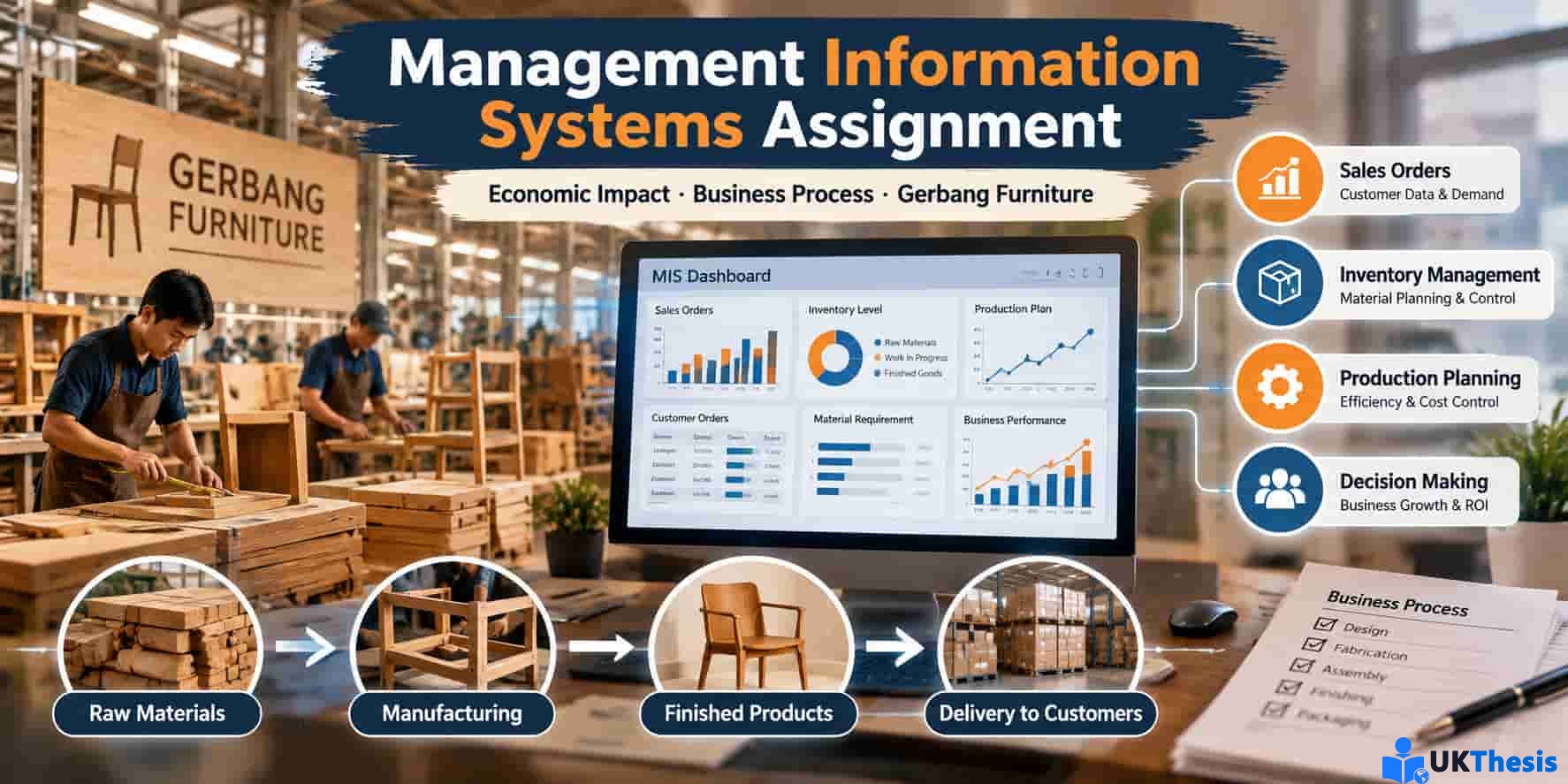
下面这篇Management Information Systems Assignment范文以Gerbang Furniture Sdn. Bhd.(GF)为案例,讨论Information Systems如何影响企业的销售订单、客户信用管理、库存、生产计划以及管理成本。与单纯介绍MIS概念不同,这个案例比较值得看的地方,是把理论放进了一家家具制造企业的实际业务流程中。
范文定位:本文更适合作为Management Information Systems / Information Systems Assignment案例学习,其中包含Economic Impact of Information Systems、Business Process、Transaction Cost Theory和Agency Cost Theory等知识点。
Assignment Question
Explain the economic impact of information systems in the context of Gerbang Furniture, and critically discuss the core activities in the information system development process.
1. Economic Impact of Information Systems
Information system technology can be viewed as a factor of production that may substitute for some forms of traditional capital and labour. As investment in computer technology increases, the amount of manual labour required to manage information may decrease.
For this reason, greater adoption of information technology may reduce the amount of routine administrative work performed by middle managers and clerical workers, particularly where information systems can automate data processing, reporting and coordination activities.
这里有个很容易写歪的地方:Information Systems的经济影响并不等于一句“用了电脑,所以少雇几个人”。如果只这么写,分析就有点像把MIS理解成高级Excel。真正需要讨论的是:技术怎样改变企业处理信息、协调员工和进行交易的成本结构。
2. Business Process and Information Systems
A business process can be understood as a logically related set of activities that determines how specific business tasks are performed. It describes how an organisation coordinates work activities and information in order to produce products or services of value.
The quality of products or services delivered to customers depends partly on the level of coordination within the organisation. A well-designed business process may become a source of competitive advantage because it allows a company to perform activities more efficiently and consistently.
Information technology is frequently used to support this coordination.
| Concept | Meaning | Gerbang Furniture Example |
|---|---|---|
| Core Process | Activities directly involved in producing products | Design, fabrication, assembly, finishing and packaging |
| Support Process | Activities enabling core processes to operate | Sales orders, credit checks, production scheduling and purchasing |
| Information System | Connects and processes business information | Sales, inventory, demand and production information |
3. Core Processes at Gerbang Furniture
Business processes can generally be divided into core processes and support processes.
The core processes are the operational activities required to produce products or services for customers. For Gerbang Furniture Sdn. Bhd. (GF), as a furniture manufacturing company, the core activities involve producing furniture.
More specifically, these activities include:
Product design
Fabrication
Assembly
Finishing
Packaging
These activities need to work together in order to fulfil customer requirements for furniture sales orders.
4. Support Processes
Another category is the support process. These are activities that enable the core processes to operate effectively.
Examples at Gerbang Furniture include sales order processing, customer credit control checks, production scheduling, materials requirement planning and material purchasing.
These processes may not physically manufacture the furniture, but without them the manufacturing process can quickly run into trouble. A production line with no materials, an order with incorrect customer information, or goods shipped to a customer with seriously overdue payments can all create costs for the company.
Before widespread use of information technology, much of this information was processed manually and therefore required considerably more human intervention.
5. Transaction Cost Theory and Information Technology
According to transaction cost theory, firms and individuals seek to economise on transaction costs just as they attempt to reduce other production and operating costs.
Information technology affects both the cost and quality of information and therefore changes the economics of information processing.
Traditionally, firms could attempt to reduce transaction costs through vertical integration: becoming larger, hiring more employees, or owning suppliers and distributors. Information systems provide another possibility by making coordination and information exchange more efficient.
理解这个理论的小技巧:不要只写“IT reduces costs”。继续问一句:它到底减少了什么成本?如果能具体回答搜索信息、处理订单、协调供应商、管理库存或监督员工的成本,理论才真正落到案例上。
6. Sales Information System at Gerbang Furniture
In the context of Gerbang Furniture, a Sales Information System can help consolidate customer sales orders more efficiently.
Information relating to product design, order quantity and purchase history can be collected and analysed more quickly. Customer pReferences and special-order requests can also be monitored, potentially improving customer service.
Before delivery, the customer service team can perform a customer credit check to identify overdue payments. This helps the company control accounts receivable and reduces the possibility that long-overdue balances accumulate and negatively affect cash flow.
| Information | Business Use | Potential Economic Impact |
|---|---|---|
| Sales Orders | Analyse quantity and product demand | More efficient order processing |
| Customer History | Understand purchasing patterns | Better demand forecasting |
| Credit Records | Check overdue payments | Improved cash-flow control |
| Inventory Data | Plan material requirements | Lower unnecessary inventory costs |
7. Historical Sales Data and Demand Forecasting
Another important use of sales data is the analysis of historical customer orders.
By understanding historical patterns and trends, future sales demand can be estimated. Expected demand can then provide a guideline for material requirement forecasting.
This can help the factory avoid purchasing excessive quantities of raw materials or buying materials that are not currently required.
Over-purchasing creates several problems. Raw materials occupy warehouse space, while company working capital becomes tied up in slow-moving inventory and work-in-progress (WIP).
Under-purchasing creates the opposite problem. If demand increases unexpectedly, insufficient materials may lead to shortages and production delays.
The objective is therefore not simply to keep inventory as low as possible. The company needs to find a balance between inventory cost and continuity of supply.
8. Connecting Upstream and Downstream Information
Apart from demand management, MIS can connect sales information from upstream and downstream activities and provide managers with a more complete view of the business.
Information from different parts of the organisation can be combined to improve understanding of the company's current position and future requirements.
For example, historical customer orders at Gerbang Furniture can be used to estimate expected business growth. This information can then be connected with factory production capacity when managers discuss future investment decisions.
With more appropriate information available, managers can evaluate investment requirements, expansion risks and potential returns more systematically.
9. Agency Cost Theory and MIS
Agency cost theory provides another way of understanding the economic impact of information systems.
In a business organisation, owners or principals employ managers and employees—agents—to perform work and achieve organisational objectives. As a company grows in size and complexity, the cost of coordinating and monitoring employees may also increase.
Information technology can reduce some of these internal management costs by making information easier to collect, process and communicate.
Employee payroll, performance information, duties, roles and responsibilities can be coordinated more efficiently through information systems, potentially allowing managers to supervise a larger number of activities without an equivalent increase in administrative staff.
10. From Manual Information to Integrated MIS
As a company becomes larger and more complex, relying entirely on manual information processing becomes increasingly difficult.
Manual systems can create risks including data-entry errors, inconsistent information, slow reporting and delays in decision-making.
An integrated MIS can help reduce these problems by allowing relevant information to move between business functions more efficiently.
| Manual Process Risk | MIS Response | Business Result |
|---|---|---|
| Repeated data entry | Integrated information | Reduced duplication and errors |
| Slow information flow | Faster information sharing | Quicker decision-making |
| Poor inventory visibility | Demand and inventory data | Better material planning |
| High coordination workload | Automated reporting and control | Potentially lower administrative costs |
11. Critical Discussion: Does MIS Automatically Reduce Costs?
There is one point worth adding when evaluating the economic impact of information systems: installing an information system does not automatically create an economic benefit.
The company must still consider implementation costs, employee training, data quality, system maintenance and whether managers actually use the information effectively.
For example, a demand forecasting system can produce calculations very quickly, but poor sales data will still produce unreliable forecasts. Likewise, an integrated inventory system is useful only when purchasing, production and sales information is updated correctly.
So a stronger Assignment conclusion is not simply:
“MIS saves money.”
而应该进一步说明:
MIS can reduce transaction and coordination costs when reliable information is integrated into well-designed business processes and used effectively for decision-making.
这个区别看起来只多了一句话,实际上已经从Description走到了Critical Analysis。
12. FAQ
Is this an Economics essay?
Not exactly. Although the topic discusses the economic impact of information systems, its main academic field is Management Information Systems and Business Management. Therefore, it is more accurately classified as an MIS Assignment or Information Systems case study.
What is the economic impact of information systems?
Information systems can affect transaction costs, coordination costs, labour requirements, information quality, inventory management and decision-making. The actual economic impact depends on how effectively the system is implemented and used.
What is Transaction Cost Theory in MIS?
In this context, Transaction Cost Theory helps explain how information technology may reduce the costs associated with searching, coordinating, exchanging and processing information between different business activities.
What is Agency Cost Theory?
Agency Cost Theory considers the costs involved when owners rely on managers and employees to perform organisational tasks. Information systems may help reduce some monitoring and coordination costs by improving information visibility.
为什么MIS Assignment不能只写Information Technology的优点?
因为Assignment通常要求Analysis而不仅是Description。写“系统可以提高效率”只是第一步,还应该解释提高了哪一种效率、影响了什么Business Process、降低了什么成本,以及可能产生哪些Implementation Risk。
Information Systems Assignment写作遇到困难怎么办?
如果Assessment Brief涉及MIS、Business Process、Transaction Cost、ERP或Information Systems Case Study,最重要的是先确定题目要求的是理论解释还是案例应用。UKThesis可围绕已有题目和Draft提供Assignment结构梳理、案例分析、语言润色及写作辅导,让理论和企业案例之间的连接更清楚。
Conclusion
As Gerbang Furniture grows larger and more complex, manual information processing alone becomes increasingly difficult. Data-entry errors, slow information flows and fragmented records can affect both operational efficiency and management decisions.
Management Information Systems can connect sales, customer, inventory and production information, helping the company forecast demand, manage materials, monitor customer credit and evaluate future production capacity.
From an economic perspective, the value of information systems can also be understood through Transaction Cost Theory and Agency Cost Theory. Information technology may reduce certain transaction, coordination and administrative costs while improving the availability of information for decision-making.
However, the value of MIS does not come from technology alone. Its economic benefit depends on reliable data, appropriate business processes and managers who can turn information into useful decisions. In the Gerbang Furniture case, this connection between information, process and decision-making is the key to understanding the real economic impact of an information system.