Pharmaceutical Industry Analysis范文|Blockbuster Drugs & Patent Expiry - UKThesis

为什么一款药物在专利保护期内能够成为全球“Blockbuster Drug”,而一旦失去市场独占优势,销售表现可能迅速发生变化?
这个问题背后,其实连接着Pharmaceutical Industry最典型的一条商业逻辑:
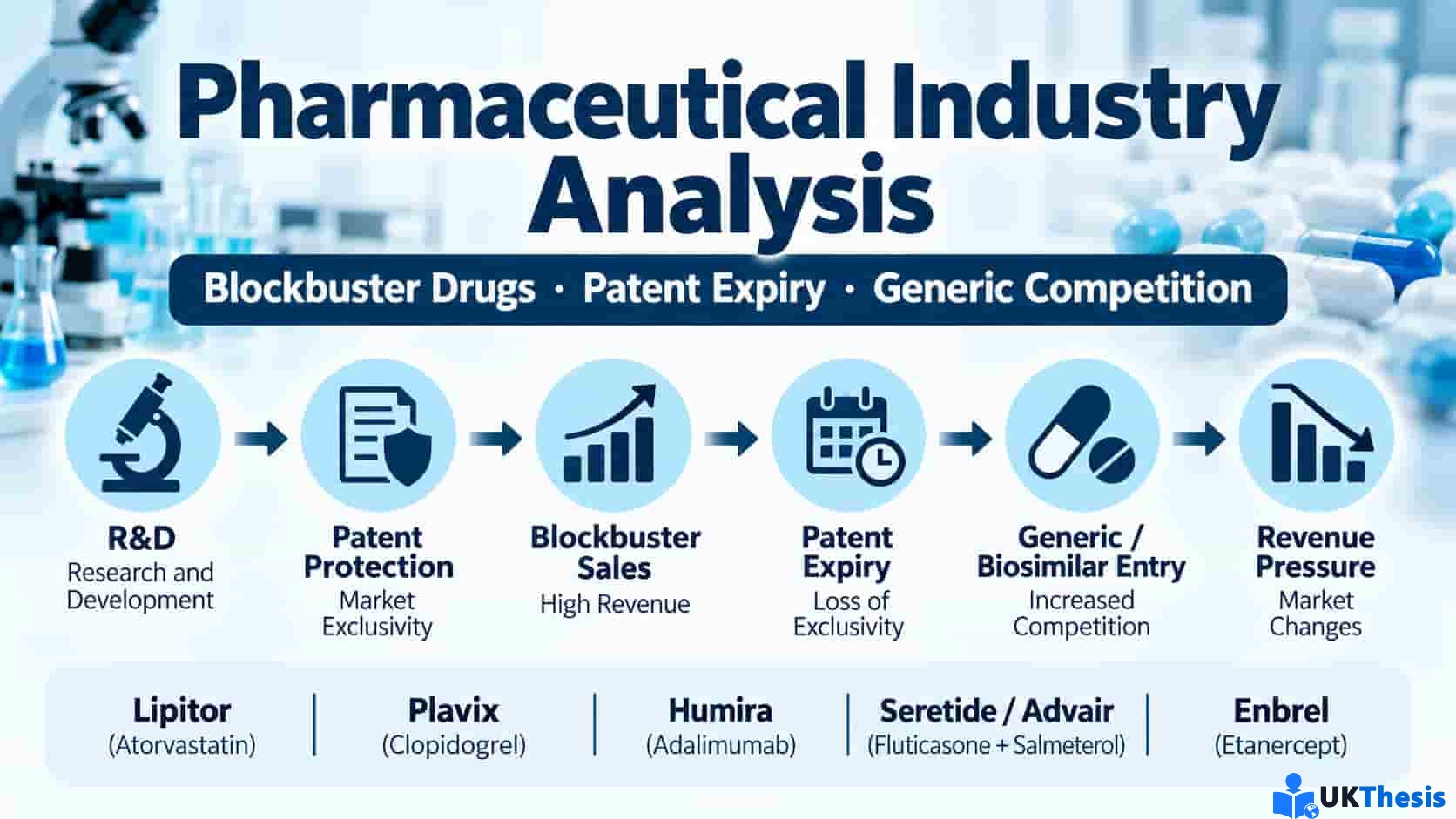
R&D Investment → Patent & Exclusivity → Market Position → Blockbuster Sales → Loss of Exclusivity → Generic / Biosimilar Competition
下面这篇Pharmaceutical Industry Assignment范文,以Lipitor、Plavix、Humira、Seretide以及Enbrel为历史案例,分析Innovator Drugs与Generic Drugs之间的区别,并进一步讨论Patent Protection、Patent Expiry、Generic Competition以及Blockbuster Drug Business Model。
需要特别说明的是,原案例写作时间较早,因此部分药品的Patent Status以及市场竞争情况已经发生变化。新版保留原案例研究价值,但不再把旧数据当作当前市场状态。
范文定位:本文适合作为Pharmaceutical Industry、Business Strategy、Business assignment及Intellectual Property相关essay或case study学习参考。重点是分析药品生命周期背后的商业逻辑,而不是提供用药或医疗建议。
Abstract
The pharmaceutical industry combines scientific innovation, long development cycles, substantial investment, regulatory requirements and intellectual property protection.
This Assignment examines the difference between innovator and generic pharmaceutical products and uses five historically successful medicines—Lipitor, Plavix, Humira, Seretide and Enbrel—to explore the relationship between patent protection, market exclusivity and competition.
Rather than treating historical sales rankings as current market data, the cases are used to demonstrate a broader strategic question: how does the competitive position of a pharmaceutical product change throughout its commercial life cycle?
Objectives of the Study
To distinguish between innovator and generic pharmaceutical products;
To understand the difference between a drug, generic name, brand and manufacturer;
To examine the role of patents and regulatory exclusivity;
To analyse selected historical blockbuster drug cases;
To examine what happens when market exclusivity is lost;
To understand the role of generic and biosimilar competition;
To understand the role of regulatory authorities such as the FDA.
What Is the Pharmaceutical Industry?
The pharmaceutical industry includes organisations involved in researching, developing, manufacturing and marketing medicines and other pharmaceutical products.
Compared with many industries, pharmaceutical businesses face a distinctive combination of high R&D costs, scientific uncertainty, regulatory requirements and intellectual property issues.
A successful pharmaceutical product may require years of research and development before commercialisation. At the same time, many research programmes do not ultimately result in an approved medicine.
This risk helps explain why Patent Strategy and Market Exclusivity play such an important role in pharmaceutical business models.
Innovator Drugs vs Generic Drugs
The original essay divided pharmaceutical businesses into Innovator Companies and Generic Companies. That basic distinction remains useful, although the modern pharmaceutical market is more complicated because many businesses operate across multiple categories.
| Area | Innovator Product | Generic Product |
|---|---|---|
| Development | Original research and development programme | Developed to meet regulatory requirements for a generic version of a Reference product |
| Investment Risk | Potentially very high | Generally does not replicate the originator's full discovery programme |
| Competition | May benefit from patents and regulatory exclusivity | Usually competes strongly on price once permitted to enter |
| Commercial Strategy | Recover investment and build market position | Compete after relevant regulatory and IP barriers are addressed |
因此,不能再简单写成“创新药企负责做难事,仿制药企比较轻松”。
更准确的Business Analysis应该关注两种模式承担的Research Risk、Regulatory Burden、Market Entry Timing以及Competitive Strategy有什么不同。
Drug, Generic Name, Brand and Company
讨论Pharmaceutical Business时,经常需要区分几个概念。
| Term | Meaning |
|---|---|
| Generic / Active Ingredient Name | The recognised name of the active pharmaceutical ingredient |
| Brand Name | The commercial name under which a particular medicine is marketed |
| Company | The organisation involved in developing, manufacturing or marketing the product |
例如:
Lipitor是Brand Name,而atorvastatin是其active ingredient/generic name。
这个区别看起来很基础,但在分析Generic Competition时非常重要,因为Patent Expiry以后,消费者可能继续认识Brand,但市场上会出现围绕相同active ingredient的其他获批产品。
Patent Protection and Regulatory Exclusivity
这里是原文最需要升级的部分。
A pharmaceutical patent and regulatory exclusivity are related to market protection, but they are not the same thing.
A patent is an intellectual property right that may cover, for example, a drug substance, formulation, method of use or other patentable innovation.
Regulatory exclusivity, by contrast, is a form of marketing protection created under applicable regulatory law.
Therefore, it is too simplistic to say:
“A new medicine receives a 20-year monopoly after approval.”
The actual competitive position can depend on when patents were filed, the type of patent, regulatory exclusivity, litigation, patent challenges and the regulatory approval of competing products.
The Pharmaceutical Product Life Cycle
| Business Stage | Market Situation | Business Impact |
|---|---|---|
| Drug Development | High R&D cost and uncertainty | Large investment before commercial return |
| Protected Market | Direct generic competition may be limited by IP and exclusivity | Opportunity to recover investment and build market share |
| Loss of Exclusivity | Competitors may become able to enter subject to regulatory requirements | Price and market-share pressure increases |
| Post-Exclusivity Market | Multiple generic or biosimilar alternatives may compete | Originator revenues may experience substantial erosion |
R&D Investment → Patent / Exclusivity → Commercial Growth → Loss of Exclusivity → Generic or Biosimilar Entry → Competitive Pressure
What Is a Blockbuster Drug?
The term “Blockbuster Drug” is commonly used in pharmaceutical business analysis to describe a medicine that generates exceptionally high commercial sales.
For Business Assignment purposes, the more interesting question is not simply which product sold the most.
Instead, we should ask:
Why did the product become commercially successful?
How important was market exclusivity?
What happened when competitors were able to enter?
Was the product a small-molecule drug facing generics, or a biologic facing biosimilars?
Case 1: Lipitor — A Classic Patent Cliff Example
Brand: Lipitor
Active Ingredient: Atorvastatin
Company: Pfizer
Lipitor became one of the most commercially successful medicines in pharmaceutical history and provides a particularly clear example of what is often described as a Patent Cliff.
The historical case originally focused on the strong sales generated during the product's protected commercial period.
In the United States, Lipitor lost exclusivity in November 2011, followed by increasing multi-source generic competition.
From a Business Strategy perspective, Lipitor demonstrates an important pattern:
Strong Brand + Protected Market → High Revenue → Loss of Exclusivity → Generic Entry → Revenue Pressure
This does not mean that the Brand immediately disappears. Instead, the competitive economics of the market change dramatically.
Case 2: Plavix — Generic Competition after Loss of Exclusivity
Brand: Plavix
Active Ingredient: Clopidogrel
Companies historically associated with the brand: Sanofi and Bristol Myers Squibb
The original Assignment described Plavix as another major blockbuster pharmaceutical product.
However, the old statement that its patent “will expire by 2016” should no longer appear in a current page.
In the United States, Plavix lost exclusivity in May 2012, while generic competition also affected other major markets.
This case illustrates why Loss of Exclusivity can influence not only an individual product but also wider corporate alliances and portfolio strategy.
The important Business lesson is therefore not simply:
“Patent expired, sales went down.”
A better conclusion is:
Loss of exclusivity can alter pricing power, competitive structure, alliance economics and the strategic importance of a product within a pharmaceutical portfolio.
Case 3: Humira — From Blockbuster Biologic to Biosimilar Competition
Brand: Humira
Active Ingredient: Adalimumab
Company: AbbVie
Humira is particularly useful because it demonstrates why the pharmaceutical industry should not treat Generic Drugs and Biosimilars as identical concepts.
The original article described Humira as still having intact patent protection. That was historically relevant when the essay was written, but it is no longer an appropriate description of the current competitive environment.
Multiple adalimumab biosimilars have since been approved in the United States, creating a new competitive phase around Humira.
Therefore, Humira provides a useful modern extension of the original essay:
| Small-Molecule Model | Biologic Model |
|---|---|
| Originator Drug | Reference Biological Product |
| Generic Competition | Biosimilar Competition |
这也是新版比原文更值得保留的一点:原文章节可以从传统Generic Competition自然延伸到今天更加重要的Biosimilar Competition。
Case 4: Seretide / Advair — Inhaler Competition
Brand: Seretide / Advair
Active Ingredients: Fluticasone Propionate and Salmeterol
Company: GSK
The original article used Seretide as an example of a commercially important respiratory medicine facing increasing competition.
In the United States, FDA approved the first generic referencing Advair Diskus in January 2019.
This is an interesting case because drug-device combinations such as inhalers can create greater technical and regulatory complexity than a simple oral tablet.
For Business Analysis, this means competitive entry is not determined by one factor alone. Patent position, regulatory approval and the complexity of the delivery system can all influence timing.
Case 5: Enbrel — Biologics and a More Complex Competitive Path
Brand: Enbrel
Active Ingredient: Etanercept
Company: Amgen
The original article described Enbrel as a rapidly growing biopharmaceutical product.
That wording should now be treated as historical rather than as a statement about the current market.
FDA has approved biosimilars referencing Enbrel, illustrating that the competitive environment for biologics can also evolve.
However, biologic competition can be more complex than simply saying:
“Patent expired → Generic immediately enters.”
Regulatory approval, patent litigation, commercial launch timing and market access can all influence actual competition.
Enbrel therefore gives this Assignment an important Critical Thinking point: the lifecycle of a biologic may not follow exactly the same commercial pattern as a conventional small-molecule drug.
Comparison of the Five Historical Cases
| Product | Type of Case | Main Business Lesson |
|---|---|---|
| Lipitor | Small-molecule blockbuster | Classic Patent Cliff and generic competition |
| Plavix | Small-molecule blockbuster | Loss of exclusivity changes product and alliance economics |
| Humira | Biologic blockbuster | Transition from protected market to biosimilar competition |
| Seretide / Advair | Drug-device respiratory product | Generic entry can involve regulatory and device complexity |
| Enbrel | Biologic | Approved biosimilars do not necessarily mean a simple generic-style market transition |
Generic Drugs vs Biosimilars
这是新版很值得增加的一小节。
原文把竞争基本都统一写成Generic Competition,但Humira和Enbrel属于Biological Products,因此更准确的概念是Biosimilar Competition。
Generics generally refer to versions of conventional small-molecule medicines that meet applicable regulatory requirements.
Biosimilars, by contrast, are biological products demonstrated to be highly similar to an approved reference biological product, with no clinically meaningful differences in safety, purity and potency under the applicable regulatory standard.
所以Business Essay里最好不要把:
Generic = Biosimilar
直接画等号。
Role of the FDA
The U.S. Food and Drug Administration plays a major role in regulating pharmaceutical products in the United States.
A pharmaceutical company cannot simply launch a new prescription medicine merely because it has developed the product or owns relevant intellectual property.
Regulatory approval and intellectual property protection are separate parts of the commercial environment.
Generic drugs also require regulatory approval before marketing.
This distinction is important:
Patent Protection ≠ FDA Approval ≠ Regulatory Exclusivity
These concepts can interact, but they should not be treated as the same thing.
Why Does Patent Expiry Matter to Pharmaceutical Strategy?
Patent Expiry or, more broadly, Loss of Exclusivity represents a strategic turning point because it may change the competitive structure around a product.
Before competitive entry, an originator may enjoy a stronger commercial position.
After entry by generic or biosimilar competitors, the business may face:
Price pressure;
Market-share erosion;
Reduced brand revenue;
Greater payer and purchaser choice;
Changes in marketing strategy;
Pressure to replace lost revenue through new products.
What Is the Patent Cliff?
A Patent Cliff describes the potentially sharp commercial decline that can occur when a major pharmaceutical product loses important market protection and faces new competition.
Lipitor provides a classic historical example.
However, not every product follows exactly the same curve.
The size and speed of revenue erosion can depend on:
Type of medicine;
Number of competitors;
Regulatory pathway;
Patent disputes;
Pricing;
Payer behaviour;
Brand loyalty;
Whether the product is a small molecule or biologic.
Critical Analysis: Are Patents Good or Bad for Competition?
如果写到这里仅仅得出“Patent很好,因为保护创新”,文章会有点薄。
Patent Protection具有明显的双重效果。
| Potential Benefit | Potential Trade-off |
|---|---|
| Can support incentives for pharmaceutical innovation | Temporarily limits direct generic competition |
| Provides an opportunity to recover large R&D investment | May support stronger pricing power during protected periods |
| Encourages firms to invest in uncertain research | Access and affordability can become policy concerns |
Therefore, the pharmaceutical patent system can be understood as an attempt to balance two competing goals:
Innovation Incentive ↔ Competition and Access
这才是Pharmaceutical Business真正值得分析的地方。
Results of the Analysis
The original essay concluded that blockbuster drug sales often decline significantly once patent protection and exclusivity are lost.
The historical cases continue to support the broader strategic idea, but the updated analysis requires more nuance.
First, the exact competitive outcome depends on the product.
Second, Patent Expiry and Loss of Exclusivity are not necessarily one simple event.
Third, small-molecule generics and biologic biosimilars can create different competitive dynamics.
Fourth, pharmaceutical companies therefore need to plan well before major products lose market protection.
Strategic Responses to Loss of Exclusivity
A pharmaceutical company facing an approaching Patent Cliff may respond through several strategies:
Developing new medicines through R&D;
Expanding into new indications where supported by evidence and approval;
Improving formulations or delivery systems;
Managing product portfolios;
Acquiring or licensing new assets;
Competing in generics or biosimilars where appropriate;
Strengthening pipelines before existing blockbuster revenues decline.
因此,Patent Expiry不是法务部门自己的事情。
它会直接影响:
R&D Strategy、Corporate Strategy、Pricing、Portfolio Management以及Future Revenue。
FAQ:Pharmaceutical Industry Assignment常见问题
What is a Blockbuster Drug?
A Blockbuster Drug is generally a pharmaceutical product that achieves exceptionally high commercial sales. In Business Analysis, blockbuster products are useful for studying R&D investment, market protection and the effects of competition.
What happens when a pharmaceutical patent expires?
Patent expiry may remove one barrier to competition, but actual market entry can also depend on other patents, regulatory exclusivities, litigation and regulatory approval. Therefore, patent expiry does not always mean that generic competition begins immediately.
What is the difference between a Generic and a Biosimilar?
Generic medicines generally concern conventional small-molecule reference drugs, while Biosimilars are highly similar versions of approved biological reference products. Their regulatory and competitive environments are not identical.
What is a Patent Cliff?
A Patent Cliff refers to the significant commercial pressure that may follow loss of exclusivity for an important pharmaceutical product, particularly when new competitors enter the market.
为什么Humira不能继续写“Patent Still Intact”?
因为这属于原文章写作时期的历史状态。今天分析Humira时,更适合讨论其从长期市场保护逐步进入多款Biosimilar竞争环境的过程。
Pharmaceutical Industry Essay怎么避免写成药品百科?
不要把重点放在每种药治疗什么疾病,而应该围绕R&D、Patent、Exclusivity、Market Competition、Generic或Biosimilar Entry以及Revenue Impact进行Business Analysis。UKThesis可围绕已有Assessment Brief或Draft提供Pharmaceutical Business Assignment结构梳理、案例分析、语言润色及Essay写作辅导。
Conclusion
The five historical blockbuster drug cases demonstrate the important relationship between pharmaceutical innovation, intellectual property and market competition.
Innovator pharmaceutical companies may invest heavily in research and development, while patents and regulatory exclusivities can provide periods of commercial protection that help support the economics of innovation.
However, protected market positions are not permanent.
Lipitor and Plavix demonstrate how loss of exclusivity can expose major branded products to strong generic competition. Seretide/Advair illustrates how regulatory and product complexity can influence competitive entry. Humira and Enbrel show why biological products require additional consideration of biosimilar competition.
Patent expiry should therefore be understood not merely as a legal date but as a major strategic turning point in the pharmaceutical product life cycle.
For pharmaceutical companies, the challenge is to use periods of commercial strength to fund future innovation while preparing for the competitive pressure that eventually follows successful products.