PFI Finance Essay范文:英国Private Finance Initiative合同、风险与优缺点分析

Private Finance Initiative(PFI)是英国公共基础设施融资中一个很有代表性、同时也极具争议的话题。对于Finance、Public Finance、Infrastructure Finance或者Public-Private Partnership相关课程来说,它很适合拿来做essay或assignment分析,因为它从来不是简单的“私人资本参与公共项目”这么一句话就能讲完。
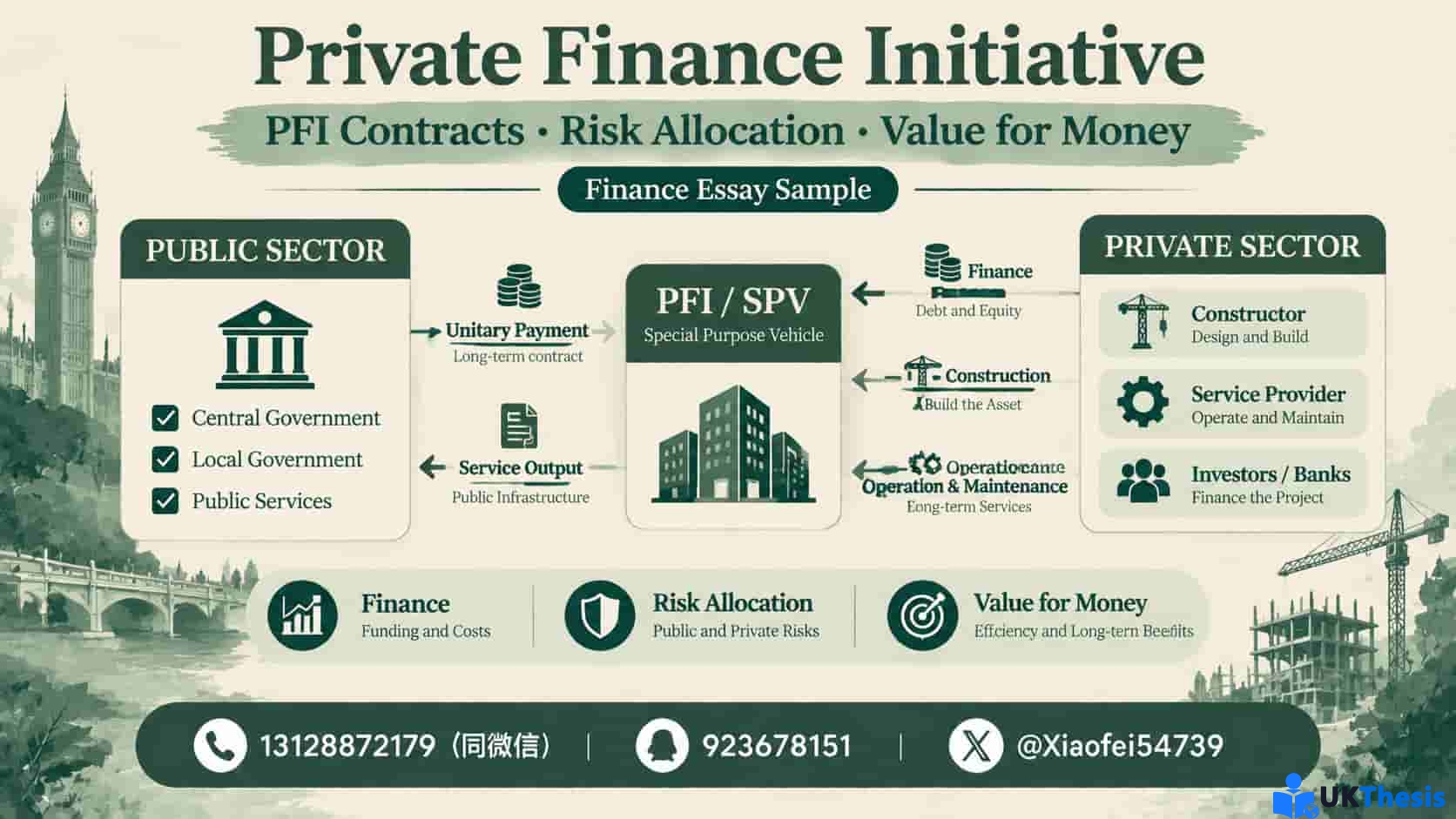
PFI涉及融资成本、风险分配、公共财政、长期合同、SPV、政府责任以及Value for Money等问题。写这种Finance Essay时,真正能拉开差距的地方也不是把PFI定义抄一遍,而是回答一个更实际的问题:PFI究竟把什么风险转移给了私人部门,又让公共部门承担了什么长期成本?
需要先说明一个时间背景:英国政府在2018年宣布不再将PF2用于新的政府项目,但此前已经签订的PFI和PF2合同并没有因此自动终止。因此,PFI今天仍然具有合同管理、公共财政以及历史政策研究价值。
What Is the Private Finance Initiative?
A strong and controversial effort to reform the financing of major investment programmes was the Private Finance Initiative (PFI). Under a typical PFI arrangement, private-sector participants finance, construct and often maintain or operate a public asset, while the public authority makes long-term payments according to the contract.
One simple way of understanding the arrangement is to imagine combining the financing, construction and long-term maintenance of a property into one long contract rather than paying separately for every stage.
PFI was first introduced in the UK in 1992 and expanded considerably after 1997. It was subsequently used across public infrastructure including schools, hospitals, roads, prisons, housing and other facilities.
| PFI Element | Basic Function |
|---|---|
| Public Authority | Specifies the public infrastructure or service required |
| Private Sector | Finances, designs, builds and/or operates the asset |
| SPV | Special Purpose Vehicle established to deliver and manage the project |
| Long-term Payment | Public authority pays according to contractual performance and service arrangements |
| Risk Allocation | Selected construction, financing, operational and performance risks are allocated between parties |
Strengths and Weaknesses of PFI
One argument in favour of PFI is that private capital can facilitate infrastructure projects without requiring the public sector to provide the entire upfront investment immediately. Projects involving health, education, transport and other infrastructure can therefore be financed over a longer period.
Efficiency: One of the assumptions behind PFI is that private-sector management, procurement and technical expertise may improve project efficiency compared with conventional public procurement.
Delivery: Payment mechanisms can be connected with project delivery and performance. Fixed-price and performance-related arrangements may create financial consequences for contractors when agreed standards are not met.
Competitive effectiveness: Competitive tendering may encourage bidders to introduce different technologies, construction methods and management approaches.
But this is only half of the argument. PFI became controversial precisely because transferring responsibility does not automatically mean reducing the total economic cost.
| Potential Strength | Potential Weakness |
|---|---|
| Private capital provides upfront financing | Private borrowing may cost more than government borrowing |
| Long-term project planning | Long contracts can become inflexible |
| Risk transferred to contractors | Poorly allocated risk can ultimately return to the public sector |
| Performance incentives | Contract monitoring can be complicated and expensive |
| Private-sector expertise | Value for money is not guaranteed simply because delivery is private |
Debt rates and financing costs: A recurring criticism of PFI has been that private-sector borrowing may be more expensive than direct government borrowing. This creates an important Finance Essay question: whether gains from risk transfer and operational efficiency are sufficient to compensate for the higher cost of capital.
Inflexibility and Value for Money: Many PFI agreements operate for decades. A contract that appears appropriate when signed may become difficult to change when technology, service requirements or public priorities change.
Management costs: Complex agreements can involve substantial spending on financial advisers, lawyers, consultants and contract management.
学姐提醒:写PFI Essay最容易掉进去的坑,就是左边写五条Advantages,右边写五条Disadvantages,然后结束。老师真正想看的通常不是你会不会列清单,而是你能不能解释:某个所谓的“优势”,在什么情况下反而会变成成本。
Management Structure of a PFI Project
A traditional PFI project normally involves several parties rather than a simple relationship between “government” and “a private company”.
Authority: The public authority may be an NHS trust, local authority or government department requiring the construction, maintenance or operation of a hospital, school, road or other public facility.
Constructor: The construction company is responsible for building the asset according to the project requirements.
Service Provider: One or more organisations may provide hard facilities management such as maintenance and soft services such as cleaning or catering during the contract period.
Special Purpose Vehicle (SPV): A private project company is commonly formed to manage and execute the project. Investors and other private-sector participants may hold interests in the SPV.
Lenders: Banks or bondholders can provide a substantial proportion of the funding required to finance construction.
Management: The SPV may employ specialist managers or obtain management expertise from participating firms.
Key Contracts in a PFI Structure
The contractual structure is one of the most useful parts of PFI to analyse because it shows how financing and risk are connected.
| Agreement | Purpose |
|---|---|
| Project Agreement | Defines the project, performance requirements, payment mechanism and allocation of responsibilities between the authority and SPV |
| Construction Contract | Defines what must be constructed, where, when and at what agreed cost |
| Facilities Management Agreement | Controls maintenance and other operational services |
| Credit / Loan Agreement | Sets financing terms, repayment requirements and lender protections |
The Project Agreement is particularly important because it determines not only what will be built and how the asset will operate, but also which risks remain with the public authority and which are transferred to the private project company.
Risk Categories and Risk Allocation
Risk allocation is at the heart of a PFI contract. One useful analytical framework divides project risks into three levels: macro, meso and micro risks.
| Risk Level | Meaning | Examples |
|---|---|---|
| Macro | Risks external to the individual project | Political, legal, financial, social and environmental changes |
| Meso | Risks occurring within the overall project process | Project demand, implementation and operational risk |
| Micro | Risks arising from stakeholder relationships | Procurement, contractual responsibilities and conflicts between participants |
The objective should not simply be to transfer as much risk as possible to the private sector. Risk needs to be allocated to the party that is best able to manage it.
If a contractor controls construction cost and scheduling, transferring construction risk may create an incentive to control delays and overruns. By contrast, attempting to transfer risks that the private party cannot realistically control may simply increase the price demanded by investors and lenders.
这一点很适合拿来写Critical Analysis:“Risk transfer”听起来当然很好,但风险不会因为合同里写了transfer就凭空消失。私人企业如果承担更大的不可控风险,也可能把风险价格计入融资和投标成本。这个地方就比简单写“PFI transfers risk to the private sector”有分析深度得多。
Why Did PFI Become Controversial in the UK?
PFI became controversial because long-term repayments, financing costs and contractual inflexibility raised questions about whether some projects actually provided Value for Money.
Critics also argued that public authorities and NHS trusts could remain responsible for substantial long-term payment commitments even where the quality or flexibility of infrastructure was disappointing.
Historical cases involving Carillion and major hospital projects illustrated another problem: transferring project delivery to private companies does not remove the consequences for the public sector if a major contractor experiences financial difficulty.
London transport projects also became important examples in debates over the cost and complexity of long-term public-private arrangements. These historical cases should be understood within the policy environment in which the agreements were originally made rather than treated as evidence of current UK procurement policy.
PFI and Sustainability
Another interesting extension of the PFI debate concerns sustainable development. Infrastructure finance is not only about whether a project can be financed; it also concerns the environmental, social and financial consequences created over the lifetime of an asset.
Sustainability can therefore be considered through three broad dimensions:
| Dimension | PFI Question |
|---|---|
| Environmental | Does the infrastructure encourage efficient use of energy and environmental resources? |
| Social | Does the project improve access to hospitals, schools, housing or other community services? |
| Financial | Are long-term payment commitments financially sustainable for the public authority? |
PFI-type arrangements have therefore been discussed beyond traditional economic infrastructure and in relation to environmental and social infrastructure. This changes the analytical question from simply “Can private finance build the asset?” to “Does the financing and governance model create sustainable public value over the life of the project?”
How to Analyse PFI in a Finance Essay
如果这道题真的出现在Finance Assignment里,我不建议按照“Definition—Advantages—Disadvantages—Conclusion”四步走到底。这样能交作业,但很容易写成说明书。
比较好的方法是先提出一个可以讨论的核心问题,例如:
To what extent does risk transfer under PFI justify the higher cost and long-term contractual commitments associated with private finance?
接下来再围绕三个问题展开:
1. Financing: Does private finance provide benefits that justify its financing cost?
2. Risk: Which risks are genuinely transferred and which ultimately remain with the public sector?
3. Value for Money: Do efficiency and performance benefits outweigh long-term contractual costs and inflexibility?
这样写,PFI就不再是一堆Advantages和Disadvantages,而会变成一篇真正有Argument的Finance Essay。
FAQ
Is PFI a Finance Essay or an Economics Essay?
It can appear in both areas, but a paper focusing on financing structure, SPV, borrowing costs, contracts and risk allocation is more naturally classified as a Finance or Public Finance Essay. If the question focuses on fiscal policy, efficiency or wider economic effects, it may move closer to Economics.
Is PFI the same as PPP?
PFI is associated with the wider Public-Private Partnership framework, but the two terms should not automatically be treated as identical in every context. PPP is the broader concept, while PFI refers to a particular model historically used extensively in the UK.
What is the most important issue in a PFI Essay?
Risk allocation and Value for Money are two of the strongest analytical themes because they connect financing costs, project performance, contracts and public-sector responsibility.
Can historical PFI failures still be used in an Assignment?
Yes. Cases involving infrastructure projects, contractors and long-term agreements can be useful evidence, but dates and policy context should be clearly identified. Historical examples should not be presented as if they describe current UK policy.
How should I structure a PFI Finance Assignment?
Start with the specific Assignment Question rather than trying to explain everything about PFI. A focused paper may examine financing cost, risk allocation, Value for Money or sustainability. 如果题目比较复杂,可以先做Essay结构分析和Outline,再决定哪些PFI案例真正值得放进正文,通常比一开始就堆很多资料更省时间。
Conclusion
The Private Finance Initiative illustrates both the attraction and difficulty of combining private finance with public infrastructure provision. Private capital, specialist management and contractual risk allocation can create potential benefits, but these advantages must be considered alongside financing costs, long-term commitments, contractual complexity and the possibility that some risks ultimately remain with the public sector.
The strongest evaluation of PFI therefore does not ask whether private finance is simply “good” or “bad”. It asks whether the particular financing structure, risk allocation and contractual arrangements create sufficient long-term public value to justify their cost.
相关文章阅读
如果正在准备Finance或Business相关Assignment,还可以继续阅读本站关于Essay Samples以及Finance、Risk Management、case study等相关范文和写作分析。不同题目的重点并不一样,建议先根据Assignment Brief判断老师到底要求Description、Evaluation还是Critical Analysis,再决定文章结构。