Reflective Essay Outline怎么写?Structure、Thesis与Reflection Example
Reflective essay看起来像是在“写自己的经历”,真正开始写以后却经常比普通Essay更容易乱。原因也不复杂:脑子里的经历通常不是按照Introduction、Body、Conclusion发生的。一个场景、一句话、一种情绪突然冒出来,写着写着就容易变成日记。
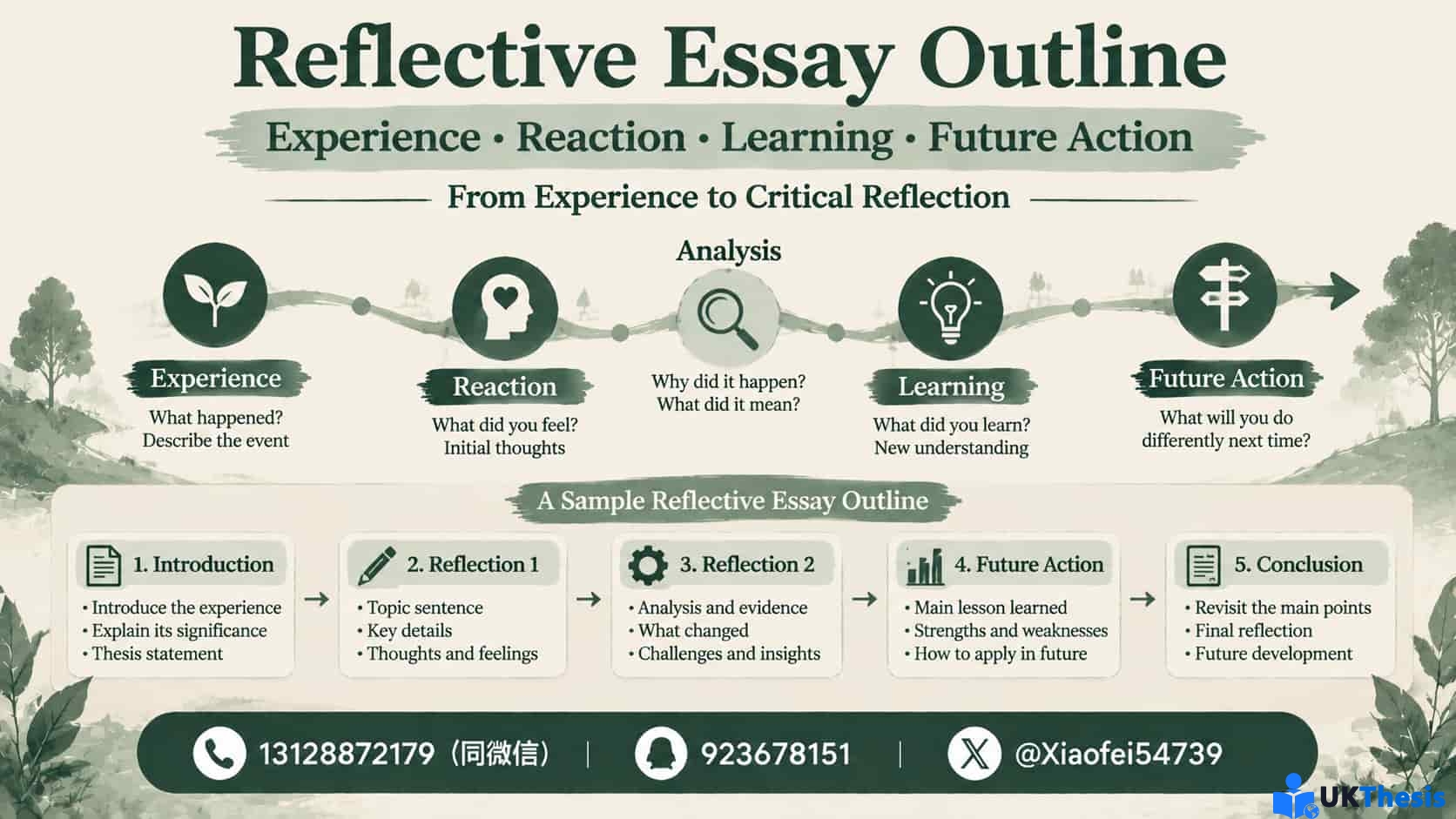
所以Reflective Writing真正需要整理的不是“我经历过什么”,而是Experience → Reaction → Analysis → Learning之间的关系。一个好用的Reflective Essay Outline,就是先把这些东西摆到正确的位置,再开始写完整正文。
What Is a Reflective Essay?
A reflective essay is a form of writing in which the writer looks back on an experience, event or learning process and considers its meaning from a present point of view.
The important word here is not only experience, but reflection.
If the essay simply explains what happened first, what happened next and how the story ended, it remains mostly descriptive. Reflection begins when the writer considers questions such as: Why did I react in this way? What assumptions did I have at the time? What changed afterwards? What would I do differently now?
Personal experience therefore provides the material, but analysis gives the essay its academic value.
| 部分 | 需要回答的问题 |
|---|---|
| Experience | What happened? |
| Reaction | What did I think or feel? |
| Analysis | Why did I respond in that way? |
| Learning | What did I learn? |
| Future Action | What would I do differently next time? |
How to Build a Reflective Essay Outline
1. Choose a Focused Experience
The first step is choosing an experience worth reflecting on. The topic should not be so broad that the essay becomes a summary of an entire semester or an entire stage of life.
Instead of writing about “my university experience”, for example, it may be more useful to focus on one group project, presentation, placement experience or situation in which your thinking changed.
2. Reconstruct the Important Details
Before writing, remember the details that actually matter. What happened? Who was involved? What did you notice? What were you expecting at the time?
You do not need to put every detail into the final essay. The purpose of this stage is to recover enough context to understand your later reaction.
3. Chart Things Out
A simple chart can help separate an event from your interpretation of it. This was one of the most useful habits I picked up when dealing with reflective assignments: if everything stays in your head, “what happened” and “what I now think about what happened” very quickly become mixed together.
| Event | My Reaction | What I Learned |
|---|---|---|
| Group member challenged my idea | I became defensive | I was treating disagreement as criticism |
| Team changed the original plan | I felt frustrated | Flexibility can improve collaborative work |
| Final presentation succeeded | I reconsidered my earlier assumptions | Constructive disagreement can improve decisions |
4. Identify the Most Important Learning Point
Ask yourself what changed because of the experience. The answer may become the central idea of the essay.
This is more useful than simply saying that an experience was “good”, “difficult” or “interesting”. Try to identify something more precise: a change in understanding, a weakness you recognised, an assumption that was challenged or a skill you need to develop.
一个很实用的检查:如果把Experience拿掉以后,你的Reflection仍然只剩下“communication is important”“teamwork is important”这种任何人都能写的话,那Reflection还没有真正落到你自己的学习变化上。
5. Ask Yourself Questions
The following questions can help move from description toward reflection:
What did I notice?
What did I feel at the time?
Why did I react in that way?
What assumptions was I making?
Did the experience meet my expectations?
What was the strongest or weakest part of my response?
What did I learn from the experience?
Would I respond differently now?
6. Check the Assignment Requirements
There is no single word count that applies to every reflective essay. Before creating the outline, check the Assignment Brief, required word count, marking criteria and whether the lecturer expects academic literature or a particular reflective model.
7. Organise the Structure
A simple reflective essay can still use an Introduction, Main Body and Conclusion, although the exact structure should follow the assignment requirements.
8. Revise the Reflection
When the first draft is finished, do not only proofread Grammar. Check whether the essay actually reflects.
If half of the paper explains what happened and only the final paragraph explains what you learned, the balance probably needs adjusting.
Reflective Essay Structure: Description vs Reflection
| Too Descriptive | More Reflective |
|---|---|
| We had a disagreement during the meeting. | The disagreement revealed that I tended to interpret challenges to my ideas as personal criticism. |
| I felt nervous during the presentation. | My nervousness was partly connected to insufficient preparation and my fear of being questioned. |
| The placement was difficult. | The placement challenged my assumption that theoretical knowledge would transfer directly into practice. |
| I learned teamwork is important. | I learned that effective teamwork requires active negotiation rather than simply dividing tasks. |
我自己判断Reflection有没有写进去,经常就看一句话:“然后呢?”
“I was nervous.” 然后呢?为什么紧张?这个Reaction暴露了什么?后来发生了什么变化?下次怎么处理?
连续追两三次,Reflection通常就出来了。
Self Reflection Essay Example Outline
The following outline can be used as a planning example. It should be adapted to the actual Assignment Brief rather than treated as a fixed template.
I. Introduction
A. Identify and briefly explain the experience or subject
B. Explain why the experience is significant
C. Briefly indicate your initial reaction
D. State the central reflection / thesis
II. Body Paragraph 1 — Experience and Initial Reaction
A. Topic sentence
B. Relevant details of the experience
C. Thoughts and feelings at the time
D. Why this reaction mattered
III. Body Paragraph 2 — Analysis
A. Topic sentence
B. Examine your assumptions or behaviour
C. Connect the experience with relevant evidence, theory or course learning if required
D. Explain what changed in your understanding
IV. Body Paragraph 3 — Learning and Future Action
A. Topic sentence
B. Identify the main lesson
C. Explain strengths and weaknesses
D. State what you would do differently in a similar situation
V. Conclusion
A. Return to the central reflection
B. Summarise the most important learning
C. Explain how the experience has influenced your future thinking or behaviour
How to Write a Reflective Essay Introduction
The introduction identifies the experience or subject and gives the reader enough context to understand why it matters. It can also introduce your initial expectations and the main lesson that emerged from the experience.
A reflective introduction does not need to tell the whole story. Its job is to establish the focus of the reflection.
For example, instead of opening with a long chronological account of a group project, you could identify the specific moment that challenged your understanding of teamwork and then explain why that moment became significant.
How to Organise the Body Paragraphs
The body develops the main points that support the central reflection. Each paragraph should have a clear purpose rather than simply continuing the story.
A useful paragraph may move through:
Experience → Reaction → Interpretation → Learning → Future Action
Not every paragraph must mechanically contain all five stages. The important thing is that description eventually leads somewhere.
If the assignment requires academic evidence or a reflective model, theory can be used to examine the experience rather than replacing the personal reflection.
How to End a Reflective Essay
The conclusion returns to the main learning point and explains what the experience means now.
It should not suddenly introduce a completely new event. Instead, it can revisit the central reflection, summarise the most important development and explain how the learning may affect future behaviour.
For example, if the essay concerns teamwork, the conclusion should go beyond “I learned teamwork is important.” It could explain how your understanding of collaboration changed and what specific behaviour you intend to change in future group work.
Reflective Essay写完以后检查什么?
| 检查项 | 问自己 |
|---|---|
| Focus | 我到底在反思哪一次Experience? |
| Balance | Description是不是占了太多篇幅? |
| Analysis | 有没有解释Why,而不仅是What? |
| Learning | 具体学到了什么,而不是一句空泛感想? |
| Future Action | 这次Reflection会不会改变下一次行动? |
FAQ
Reflective Essay可以使用第一人称“I”吗?
通常可以,特别是任务要求你分析自己的experience、reaction和learning时。不过最终仍应查看Assignment Brief和Module要求,不要机械套用“Academic Writing不能出现I”的规则。
Reflective Essay和普通Essay有什么区别?
普通Academic Essay通常围绕Question、Argument和Evidence展开;Reflective Essay则把个人Experience与Analysis、Learning联系起来。有些Reflective Assignment同样需要Academic Literature,所以“个人反思”并不意味着完全不需要学术分析。
Reflective Essay需要Thesis Statement吗?
取决于课程要求。如果使用Thesis,它更适合表达这次Experience带来的核心认识或变化,而不是像Argumentative Essay一样简单表达支持或反对。
Reflective Essay需要Reference吗?
不一定。Personal Reflection可能主要依赖个人经验,但很多大学Reflective Assignment会要求结合Theory、Professional Standards或Academic Literature,应以Brief为准。
Reflective Essay总是写成流水账怎么办?
可以先把Experience和Reflection分开列。每写一个事件,就继续追问:Why did this matter? Why did I react this way? What changed? What would I do differently? 如果Experience、Theory和Learning一直整理不清,也可以先通过Reflective Essay写作辅导梳理Outline和Reflection逻辑,再进入完整Draft。
相关文章阅读
如果现在卡在第一段,可以继续阅读站内Reflective Essay Introduction相关范例;如果已经知道自己要反思什么,但不知道怎样把材料安排进段落,可以参考Essay Outline写作指南。普通Academic Essay与Reflective Writing的结构逻辑并不完全相同,所以使用模板前最好先确认自己的Assignment Type。
最后还是那句话:Reflective Essay不是把一件事重新讲一遍。真正值得写的是当时的你怎么理解这件事,现在的你为什么不再完全这样理解,以及下一次你准备怎么做。只要这条线能看清楚,Reflection就不会只剩下一篇日记。