Risk Response Strategies范文|Positive & Negative Project Risk - UKThesis

做Project Management assignment时,有一个地方特别容易把人绕晕:
Risk为什么还分Positive和Negative?Positive的东西怎么还能叫“风险”?
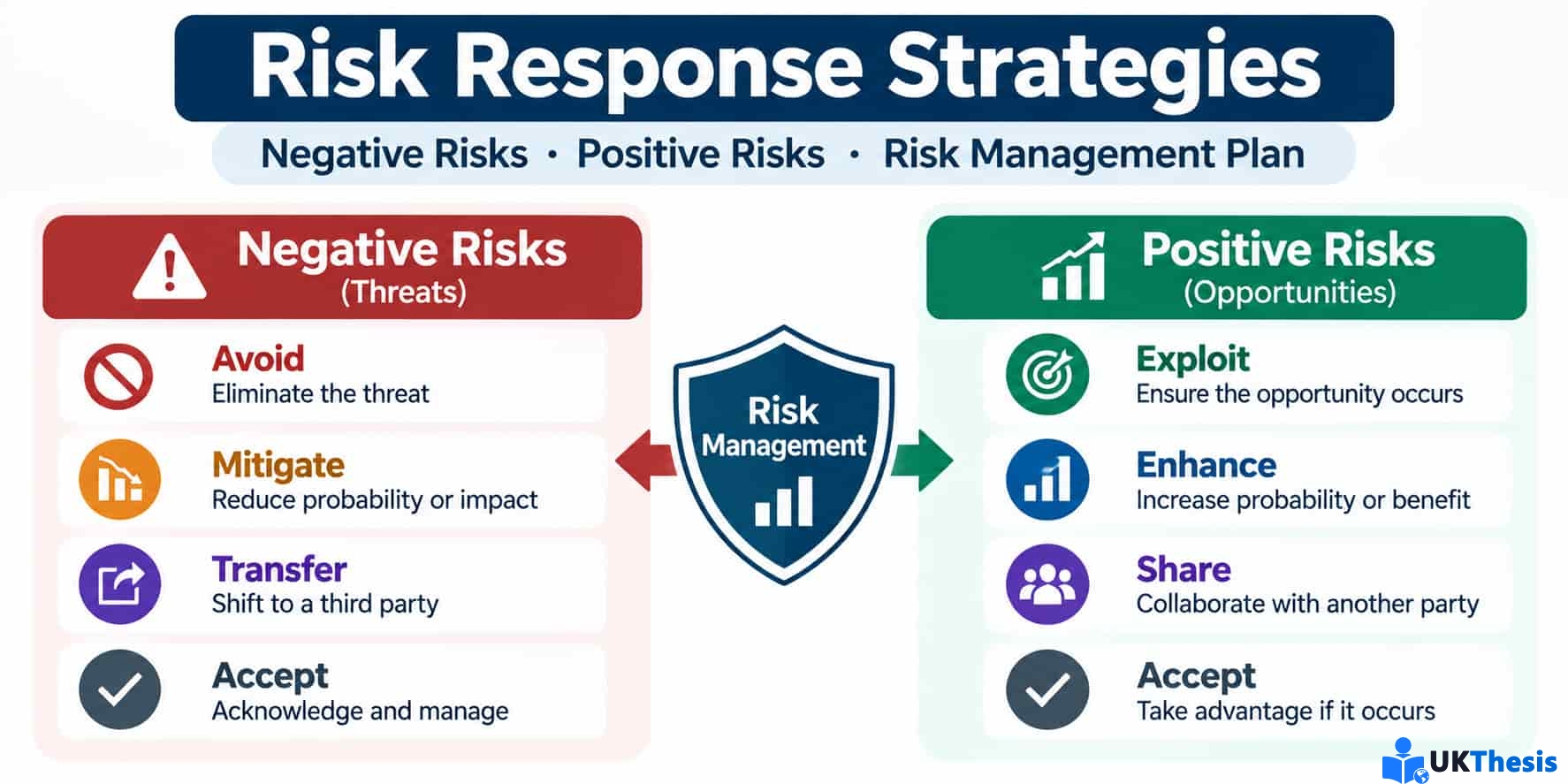
其实在Project Management语境里,Risk并不只是“坏事”。不确定性可能给项目带来负面影响,也可能带来额外机会。因此,Project Risk通常可以从两个方向理解:
Negative Risk = Threat(威胁)
可能对Project Objectives产生不利影响。
Positive Risk = Opportunity(机会)
如果发生,可能对Project Objectives产生积极影响。
这篇Risk Management Assignment范文重点讨论两类风险应该采用什么Response Strategy,并进一步解释Risk Management Plan在项目中的作用。
What Is a Negative Risk?
A negative project risk is an uncertain event or condition that may have an adverse effect on project objectives if it occurs.
For example, a construction project may face bad weather, a software project may lose a key developer, or a project may experience unexpected material price increases.
这些风险之所以是Negative Risk,不是因为事情听起来“倒霉”,而是因为它们可能对Cost、Schedule、Scope、Quality或者其他Project Objectives产生负面影响。
Four Negative Risk Response Strategies
常见的Negative Risk Response Strategies包括:
Avoid · Mitigate · Transfer · Accept
| Strategy | Meaning | Example |
|---|---|---|
| Avoid | Eliminate the threat or remove its cause | Move an outdoor project activity to an indoor location to eliminate weather exposure |
| Mitigate | Reduce the probability and/or impact of the threat | Cross-train another employee before a key team member potentially leaves |
| Transfer | Shift ownership or consequences of the threat to another party | Use an appropriate specialist contractor or insurance arrangement for a particular risk |
| Accept | Acknowledge the threat without attempting to eliminate it | Maintain a contingency reserve for possible material price increases |
1. Avoid
Avoidance aims to remove the threat so that it can no longer affect the project.
For example, imagine an outdoor event is planned during a period when severe weather is a significant threat. Moving the activity indoors may remove the particular weather exposure.
这里的关键不是“雨来了以后撑伞”,而是:
让这个Threat不再能够影响项目。
2. Mitigate
Mitigation does not necessarily remove a threat completely. Instead, it reduces the probability of the threat occurring and/or reduces its potential impact.
For example, if a project depends heavily on one specialist employee, the team could arrange knowledge transfer and cross-training in advance.
If that employee later leaves, the project may still experience disruption, but the impact could be lower.
3. Transfer
Transfer involves shifting responsibility for managing a threat, or specified consequences associated with it, to a third party that may be better positioned to manage the exposure.
For example, a project team may contract a specialist supplier to perform work outside the team's expertise.
不过这里要注意:
Transfer不等于“风险从宇宙中消失了”。
The project may still be affected if the supplier fails. What changes is the allocation of responsibility and exposure.
4. Accept
Acceptance means recognising that a threat exists and deciding not to pursue another response such as Avoid, Transfer or Mitigate.
Acceptance may be passive or active.
For example, if material prices may increase, a project could actively accept the risk by establishing an appropriate contingency reserve.
学姐提醒:所以写Assignment时不要简单写“Accept = 什么都不做”。Passive Acceptance可能没有特别行动,但Active Acceptance完全可以提前准备Contingency Plan。
What Is a Positive Risk?
A positive risk is an uncertain event or condition that could have a beneficial effect on project objectives.
For example, a supplier may unexpectedly be able to deliver earlier, a highly skilled resource may become available, or new technology may allow the project to finish faster than originally planned.
既然这是Opportunity,项目经理的思路当然不能还是“怎么把它消灭掉”。
常见Positive Risk Response Strategies包括:
Exploit · Enhance · Share · Accept
Four Positive Risk Response Strategies
| Strategy | Meaning | Example |
|---|---|---|
| Exploit | Take action to ensure the opportunity occurs | Assign an unexpectedly available senior specialist to critical work to capture a schedule advantage |
| Enhance | Increase the probability and/or positive impact of the opportunity | Add resources to increase the chance of completing early and gaining an additional benefit |
| Share | Work with another party better able to capture the opportunity | Partner with a specialist organisation to jointly pursue a business opportunity |
| Accept | Take advantage of the opportunity if it occurs without actively pursuing it | Use an unexpected supplier discount if it becomes available, without changing the project specifically to create it |
1. Exploit
Exploit is one of the strongest responses to a positive risk because the project team takes action intended to make the opportunity happen.
Suppose an experienced specialist unexpectedly becomes available earlier than expected. The project manager could reorganise work so that this specialist immediately joins a critical activity and helps shorten the schedule.
The objective is not merely to increase the probability of the opportunity—it is to actively capture it.
2. Enhance
Enhancement aims to increase either the probability that an opportunity will occur or the positive impact if it does occur.
For example, if early completion could generate an additional commercial benefit, management might strengthen resources around critical activities to increase the likelihood of achieving the earlier completion date.
3. Share
Sometimes an organisation identifies an opportunity but cannot fully capture it alone.
In that situation, it may collaborate with another organisation that has complementary capabilities.
For example, two businesses may jointly pursue a contract when neither has all of the expertise or resources required individually.
4. Accept
Acceptance can also apply to opportunities.
The project acknowledges that a beneficial event may occur but does not spend additional resources trying to make it happen.
If the opportunity occurs, the project can still take advantage of it.
Negative vs Positive Risk:一张表记清楚
| Negative Risk / Threat | Positive Risk / Opportunity |
|---|---|
| Avoid — eliminate the threat | Exploit — make the opportunity happen |
| Mitigate — reduce probability/impact | Enhance — increase probability/impact |
| Transfer — allocate threat to a suitable third party | Share — allocate opportunity to/with a suitable partner |
| Accept | Accept |
Threat → Avoid / Mitigate / Transfer / Accept
Opportunity → Exploit / Enhance / Share / Accept
What Is the Purpose of a Risk Management Plan?
A Risk Management Plan describes how risk management activities will be structured and performed within a project.
因此它不能只理解成“出事以后照着做的应急说明书”。
A useful Risk Management Plan provides a framework for identifying, analysing, responding to and monitoring project risks.
Depending on the project and organisation, it may establish areas such as:
Risk management approach and Methodology;
Roles and responsibilities;
Risk categories;
Assessment approach;
Response planning;
Monitoring and reporting;
Escalation and communication arrangements.
How Does the Plan Help Manage Project Risk?
The Risk Management Plan helps move the project away from purely reactive decision-making.
Instead of waiting until a threat becomes an issue, the project can identify uncertainty earlier, assess its significance and select an appropriate response.
Likewise, positive risks can be identified before opportunities disappear.
| Stage | Purpose |
|---|---|
| Identify | Determine relevant threats and opportunities |
| Analyse | Understand probability, impact and significance |
| Respond | Select and implement appropriate strategies |
| Monitor | Track risks and evaluate whether responses remain effective |
Risk Response Plan里还应该写什么?
仅仅写一句“Mitigate this risk”是不够的。
A practical response should answer questions such as:
What response will be taken?
Who owns the risk?
Who is responsible for implementing the response?
When should the response be implemented?
What resources or budget are required?
What trigger indicates that a contingency response should begin?
How will the risk be monitored?
也就是说,Risk Response不是一个动词选择题,而应该最后落到Action、Owner、Trigger和Monitoring。
Risk Owner为什么重要?
A Risk Owner is responsible for monitoring a particular risk and ensuring that an appropriate response is selected and implemented.
这点在很多学生作业里特别容易漏。
大家会写十几条Risk,Probability、Impact也算得很漂亮,最后却没有任何人负责。
现实项目里,“所有人都负责”的另一种翻译经常就是——最后没人负责。
Critical Analysis:是不是所有Risk都必须处理?
No.
Risk Management并不意味着看到Risk就疯狂花钱消灭。
A response should be proportionate to the significance of the risk and the resources required to manage it.
For a low-impact threat, Acceptance may be more sensible than spending substantial resources attempting to eliminate it.
Similarly, an opportunity may exist but exploiting it could require resources that are more valuable elsewhere.
因此一个成熟的Risk Management Assignment不应该只回答:
“Which response is possible?”
还应该进一步问:
“Which response is proportionate and appropriate for this project?”
FAQ:Risk Management Assignment常见问题
What are the four responses to negative project risks?
Common responses to threats are Avoid, Mitigate, Transfer and Accept.
What are the four responses to positive project risks?
Common responses to opportunities are Exploit, Enhance, Share and Accept.
What is the difference between Mitigate and Avoid?
Avoid aims to eliminate the threat, while Mitigate reduces its probability and/or potential impact without necessarily removing it completely.
What is the difference between Exploit and Enhance?
Exploit involves acting to ensure that an important opportunity occurs, while Enhance seeks to increase the probability and/or positive impact of an opportunity.
Can Acceptance be used for both positive and negative risks?
Yes. A project can accept either a threat or an opportunity when active intervention is not considered appropriate or cost-effective.
Risk Management Plan和Risk Register一样吗?
No. Risk Management Plan describes how risk management will be performed, while a Risk Register records identified risks and related information. 两者有关联,但不是同一个文件。
Risk Management Assignment怎么避免只背定义?
每种Strategy最好配一个具体Project Scenario,并解释为什么它属于Threat或Opportunity、为什么选择这个Response,以及该Response怎样改变Probability或Impact。UKThesis可围绕已有Assessment Brief或Draft提供Project Management Assignment结构梳理、Risk Analysis、语言润色及Essay写作辅导。
Conclusion
Project Risk Management should address both threats and opportunities.
Negative risks can be managed through strategies such as Avoid, Mitigate, Transfer and Accept, while positive risks can be addressed through Exploit, Enhance, Share and Accept.
The correct strategy depends on the nature of the uncertainty, its potential impact on project objectives and the resources available to the project.
A Risk Management Plan provides the wider framework for identifying, analysing, responding to and monitoring these uncertainties. Effective risk management therefore involves more than reacting when something goes wrong—it also involves preparing for threats before they become issues and recognising opportunities before they disappear.