国际贸易Essay范文:Tariffs、Comparative Advantage与WTO贸易争端分析

Tariffs是International Trade essay里最常见、也最容易写成“优点缺点大合集”的题目之一。真正写到大学Economics assignment里,老师通常不只是想看“关税保护国内产业”“关税提高进口价格”这些基础结论,而是想知道:Tariffs到底改变了什么?谁获益?谁承担成本?它是否改变了Comparative Advantage、Trade Flows和Welfare?
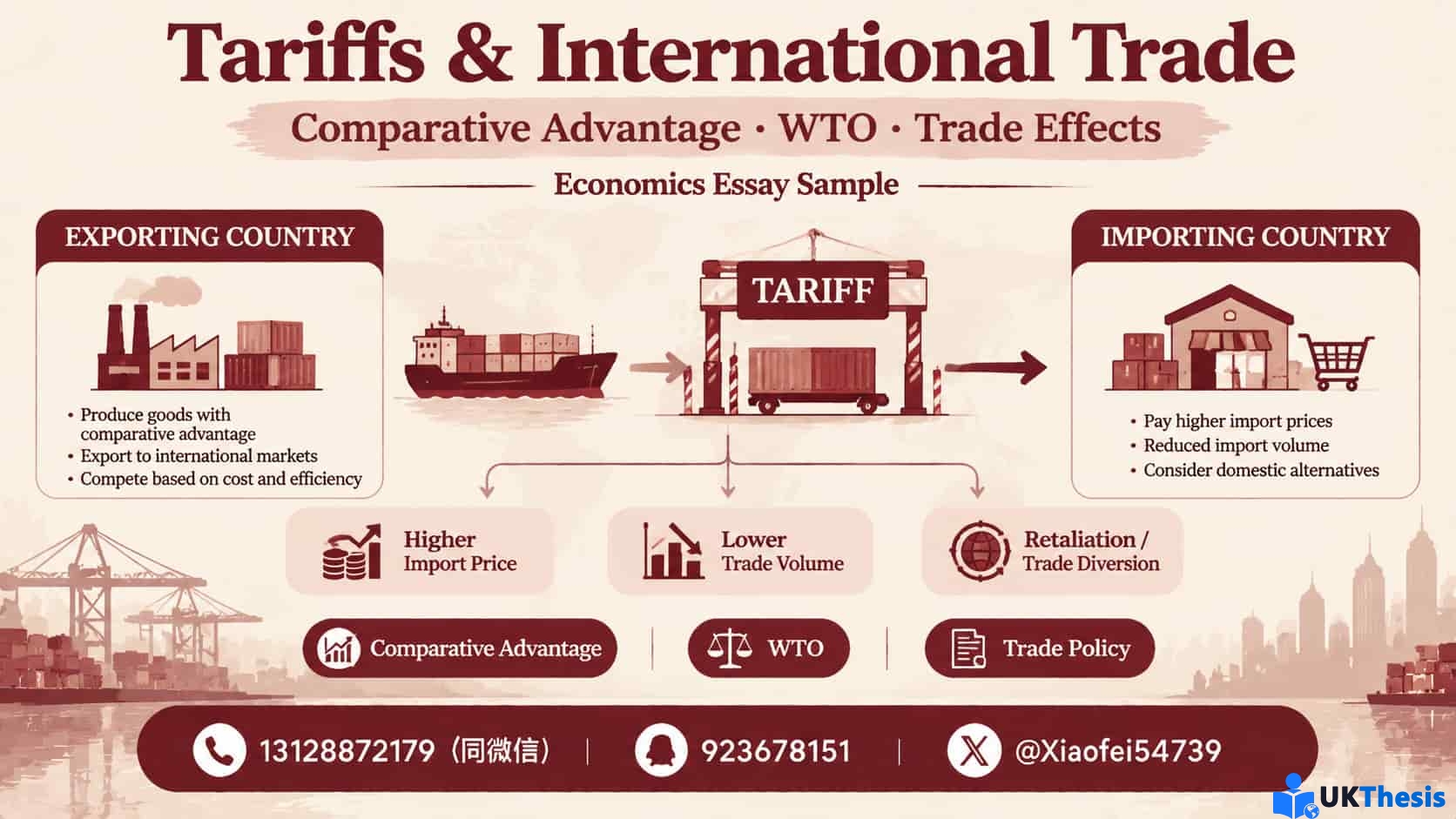
这篇文章围绕Comparative Advantage、Tariffs、Trade Creation与Trade Diversion展开,并结合美国贸易政策、WTO Airbus-Boeing争端以及Scotch Whisky案例,讨论关税如何影响International Trade。
Comparative Advantage and International Trade
Comparative advantage is one of the fundamental ideas in international trade theory. It explains why countries may benefit from specialising in goods and services that they can produce at relatively lower opportunity cost, even when one country is more productive in several industries.
Adam Smith's work on specialisation and absolute advantage helped establish the foundations of classical trade theory, while David Ricardo later developed the principle of comparative advantage.
The key point is not simply that one country produces more efficiently. Comparative advantage focuses on relative opportunity cost.
| Concept | Main Idea |
|---|---|
| Absolute Advantage | A country can produce a good using fewer resources than another country. |
| Comparative Advantage | A country has a lower opportunity cost in producing one good relative to another. |
| Specialisation | Countries concentrate production in areas where they have relative advantage. |
| Trade Gain | Specialisation and exchange can increase total consumption possibilities. |
Comparative advantage can also be examined through revealed comparative advantage, which looks at actual export performance in particular industries. Wage structures, productivity, capital-labour ratios and natural-resource endowments may all help explain why countries specialise in different products.
学姐提醒:Comparative Advantage千万别只写成“哪个国家更厉害”。真正要比较的是Opportunity Cost。这个概念一旦写错,后面Tariff、Protectionism和Trade Welfare基本都会跟着跑偏。
How Can Tariffs Restrict International Trade?
A tariff is a tax imposed on imported goods. Governments may use tariffs for several purposes, including raising revenue, protecting domestic industries, responding to trade practices or influencing negotiations.
However, tariffs can alter international trade by raising the domestic price of imported goods and changing the relative competitiveness of domestic and foreign producers.
| Tariff Effect | Possible Outcome |
|---|---|
| Higher import price | Consumers may reduce demand for imported goods |
| Protection for domestic producers | Domestic production may increase |
| Lower import volume | Trade flows may decline or shift to other suppliers |
| Government revenue | Tariff payments may generate public revenue |
| Retaliation | Trading partners may respond with tariffs of their own |
The effect of a tariff may also depend on the size of the importing country. A small country generally has little influence over world prices, while a very large importer may potentially affect international prices. Even in that case, gains are not automatic because retaliation, supply-chain adjustments and welfare losses can offset potential benefits.
Trade Creation and Trade Diversion
Changes in tariffs can also alter where countries buy goods from.
Trade creation occurs when lower trade barriers allow imports from a more efficient producer to replace higher-cost domestic production.
Trade diversion occurs when trade shifts away from a lower-cost external supplier toward a higher-cost supplier because of preferential tariff treatment.
This distinction is particularly useful when analysing customs unions, free-trade agreements and regional markets.
Tariffs, Supply Chains and Intra-Firm Trade
Modern international trade is not simply a finished product crossing one border. Multinational firms often divide production across several countries, meaning that components, intermediate goods and final products may cross borders multiple times.
Tariffs can therefore influence offshoring, outsourcing, sourcing decisions and intra-firm trade.
A company facing higher tariffs on imported intermediate goods may respond by changing suppliers, moving production, absorbing part of the cost or passing the cost on through higher prices.
这个地方很适合做Critical Analysis:Tariff表面上是“保护本国产业”,但如果本国企业本身依赖海外零部件,进口关税也可能提高这些企业自己的生产成本。所以不要把“domestic producer”想象成完全与国际供应链分开的公司。
US Tariffs and the 2018 Trade Conflict
In 2018, the United States introduced several important tariff measures. These included tariffs on steel and aluminium and additional tariffs on selected imports from China.
Trading partners responded with retaliatory measures, creating a broader trade conflict.
The economic effect was therefore not limited to the imported products directly subject to tariffs. Firms faced changes in input costs, export conditions and supply chains, while consumers could also experience higher prices.
| Group | Possible Effect of Tariffs |
|---|---|
| Domestic producers competing with imports | May receive temporary protection from foreign competition |
| Importing firms | May face higher costs |
| Consumers | May face higher prices or reduced product choice |
| Exporters | May be affected by retaliatory tariffs |
| Global supply chains | May shift production and sourcing toward other countries |
Research on the 2018–2019 trade conflict found that higher tariffs significantly affected trade flows and encouraged some trade diversion toward alternative suppliers. WTO research also noted that tariff-inclusive import prices reflected substantial pass-through of the higher tariffs.
Tariffs and Economic Welfare
One reason tariffs remain controversial is that the gains and losses are distributed differently.
Domestic producers in protected industries may benefit from reduced foreign competition, while consumers and firms purchasing imported goods may face higher prices.
Economists therefore often distinguish between producer surplus, consumer surplus, government tariff revenue and deadweight welfare loss.
The important point for an International Trade Essay is that a tariff can redistribute income without necessarily increasing total economic welfare.
The WTO Airbus-Boeing Dispute
The Airbus-Boeing dispute provides a useful example of how tariffs can emerge from a wider disagreement over government subsidies.
The United States challenged support provided by European governments to Airbus, while the European Union separately challenged US support for Boeing.
In 2019, the WTO authorised the United States to impose countermeasures on EU products following findings relating to subsidies for Airbus. In 2020, the WTO also authorised the European Union to impose countermeasures against the United States in the Boeing dispute.
This example is important because tariffs here were not simply introduced to protect a domestic industry from ordinary imports. They were used as authorised countermeasures within a long-running international trade dispute.
| Dispute | Main Issue |
|---|---|
| US vs EU / Airbus | EU and member-state support for Airbus |
| EU vs US / Boeing | US federal, state and other support for Boeing |
| Trade consequence | WTO-authorised countermeasures and tariffs on selected products |
Case Example: Scotch Whisky Tariffs
Scotch whisky became one of the products affected by the wider Airbus-Boeing tariff dispute.
For exporters, this provided a clear example of how a dispute originating in one industry can affect businesses in a completely different sector.
A whisky producer had no direct role in aircraft subsidies, yet tariffs imposed as part of the broader trade dispute could still affect prices, exports and market competitiveness.
This makes Scotch whisky particularly useful as a case example because it shows that the impact of trade retaliation can spread far beyond the industry at the centre of the original dispute.
时间背景:这里讨论的是2019年以来的历史关税案例。到2026年,英国政府已经宣布英国威士忌进入美国恢复零关税,因此不要把2019年的Whisky Tariff写成当前仍未变化的政策。
Do Tariffs Protect Domestic Industries?
Tariffs can provide protection, but the answer depends on how protection is defined.
A tariff may reduce competition from foreign imports and support prices received by domestic producers. This can give a protected industry time to adjust or expand.
However, protection may also reduce competitive pressure and allow inefficient production to continue. Downstream companies using imported inputs may face higher costs, while retaliatory measures can hurt domestic exporters.
The strongest evaluation therefore avoids saying that tariffs are always beneficial or always harmful. The result depends on the industry, market structure, supply chain, duration of protection and response of trading partners.
How to Structure a Tariffs and International Trade Essay
| Section | Possible Focus |
|---|---|
| Introduction | Define the trade issue and establish the central argument |
| Theory | Comparative advantage and gains from trade |
| Tariff Mechanism | Prices, imports, domestic production and welfare |
| Trade Response | Retaliation, trade diversion and supply-chain adjustment |
| Case Evidence | 2018 tariffs, WTO dispute or specific products |
| Evaluation | Who gains, who loses and whether protection improves welfare |
| Conclusion | Return to the central trade-off rather than simply repeating advantages and disadvantages |
我自己看International Trade Essay,最喜欢做一个特别简单的检查:每出现一个Tariff,就问自己三个问题——Price怎么变?Quantity怎么变?谁承担Cost?
如果能把这三个问题解释清楚,再往后讨论Retaliation、Comparative Advantage和Welfare,文章基本就不会写成新闻摘要。
FAQ
Tariffs属于Economics还是Finance?
以Comparative Advantage、Trade Flows、Consumer Welfare、Protectionism和WTO为核心的题目更适合归入Economics,尤其是International Trade。如果重点讨论企业成本、汇率、盈利或投资,则可能与Finance产生更多交叉。
Comparative Advantage和Absolute Advantage一样吗?
不一样。Absolute Advantage强调谁生产效率更高;Comparative Advantage强调相对Opportunity Cost。
Tariffs一定减少国际贸易吗?
通常会抑制被征税商品的进口,但实际结果取决于需求弹性、替代供应商、汇率、供应链以及其他国家是否采取报复措施。
Trade Creation和Trade Diversion有什么区别?
Trade Creation意味着贸易转向更有效率的生产者;Trade Diversion则可能因为优惠关税而从原本成本更低的供应商转向成本更高的供应商。
WTO可以直接禁止一个国家征Tariff吗?
WTO体系对成员关税承诺、补贴和贸易措施设有规则,但具体争端通常需要经过争端解决程序。某些情况下,WTO可以授权成员采取反制措施。
Scotch Whisky案例现在还能写吗?
可以,而且很适合说明Trade Retaliation如何影响原始争端之外的行业。但应明确它是历史案例,并说明2026年的关税状态已经发生变化。
International Trade Essay不知道怎么收资料怎么办?
先把资料按Theory → Tariff Mechanism → Trade Effect → Case → Evaluation分类。Comparative Advantage、2018 Tariffs、WTO和Whisky全部堆在一个段落里,很容易变成资料拼贴;需要时可以先做Economics Essay结构与论证梳理,再进入完整正文。
Conclusion
Tariffs can protect selected domestic industries and generate government revenue, but they can also raise prices, disrupt supply chains, reduce imports and trigger retaliation.
The theory of comparative advantage suggests that international specialisation can increase overall gains from trade, while tariffs alter the incentives that shape that specialisation.
The impact of tariffs therefore cannot be evaluated only by asking whether domestic producers receive protection. A complete analysis also considers consumers, importing firms, exporters, government revenue, international retaliation and overall economic welfare.
The US tariff measures introduced in 2018, the Airbus-Boeing dispute and the Scotch whisky case all show that modern trade policy is closely connected with global supply chains and international institutions. A strong International Trade Essay should therefore connect economic theory with specific trade mechanisms and real cases rather than simply listing the advantages and disadvantages of tariffs.
相关文章阅读
如果正在准备Economics或Business相关Assignment,可以继续阅读站内Macroeconomics、Economics Essay、International Trade及Essay Samples相关内容。处理Trade Policy题目时,建议先确认老师究竟要求Explain、Compare还是Evaluate,再决定理论和案例各占多少篇幅。