英国History Essay范文:Victorian Education与Social Class教育差异

History essay最怕写成“历史事件流水账”:1837发生什么,1870发生什么,1880又发生什么,年份记得很努力,Argument却一直没出现。这篇Victorian Education范文比较适合拿来观察另一种写法——把social class作为主线,再看19世纪英国教育制度的变化怎样影响不同家庭的儿童。
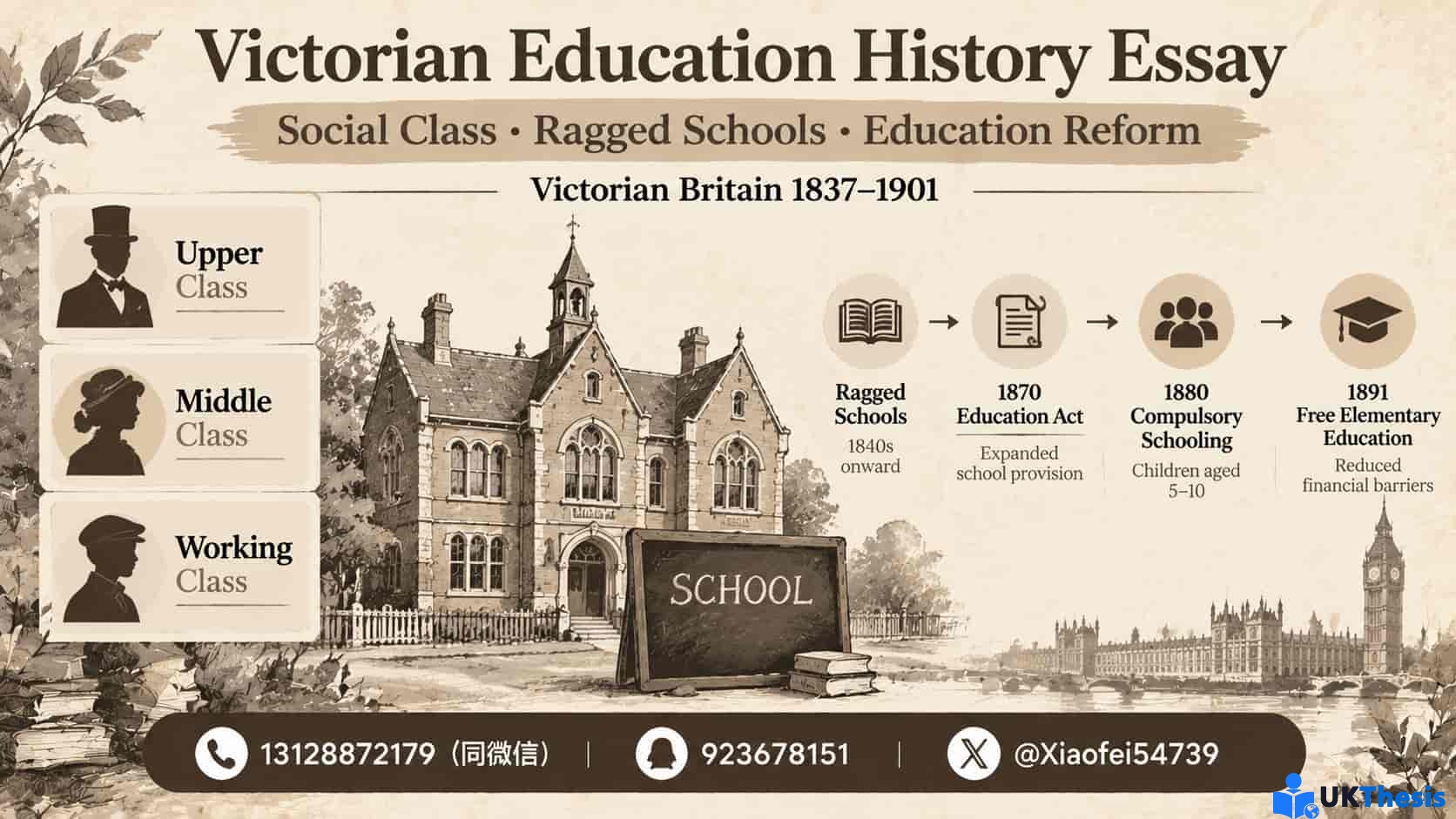
Victorian Britain的教育并不是从一开始就人人平等。Upper class、middle class与working class儿童能够获得的教育资源差别很大。随着Ragged Schools的发展以及1870、1880、1891年前后的教育改革,国家对儿童教育的参与逐渐增强,但“有学校可以上”和“获得同样的教育机会”并不是完全相同的一件事。
History Essay Example: Education and Social Class in Victorian Britain
Victorian society was strongly influenced by social class. The upper class, middle class and working class differed not only in wealth and occupation, but also in the educational opportunities available to their children.
Children from wealthy families generally had greater access to formal education. Boys from affluent households might attend established schools or receive private tuition, while girls from wealthy families were often educated at home. Middle-class families increasingly regarded education as important for professional and commercial advancement.
The experience of working-class children could be very different. For poor households, a child's time also had economic value. Children might work, help on farms, perform domestic duties or contribute income to the family. School attendance therefore involved more than simply deciding whether education was worthwhile.
| Social Group | Typical Educational Access | Main Limitation |
|---|---|---|
| Upper Class | Private tutors, established schools, home education | Gender expectations still shaped education |
| Middle Class | Growing access to formal schooling | Education differed according to income and gender |
| Working Class | Sunday schools, charity schools, Ragged Schools and later board schools | Poverty, child labour, fees and family dependence on children's work |
Working-Class Children and the Cost of Schooling
For many working-class families, education competed directly with economic necessity.
Poor families might need children to help at home or earn money. In industrial towns, children could contribute to family income through paid work; in rural areas they could help with agricultural labour. Sending a child to school could therefore involve both school costs and the loss of useful labour or wages.
This is important when analysing Victorian education. Low attendance cannot simply be interpreted as parents believing education was unimportant. Poverty shaped the choices families were able to make.
学姐提醒一下:History Essay写到这里,如果只说“poor children could not attend school”,还是Description。继续问一句Why?——fees、child labour、family income、location、gender——文章马上就开始有分析味道了。
Ragged Schools and Education for Poor Children
During the nineteenth century, Ragged Schools became one response to the educational needs of very poor children.
These schools were often supported by charitable or religious organisations and attempted to reach children who had limited access to conventional schooling. They could provide basic reading, writing and arithmetic, while some also offered food, clothing or practical training.
Ragged Schools were therefore more than classrooms. Their existence reflected a broader Victorian problem: large numbers of poor children lived in circumstances where education could not easily be separated from poverty, welfare and employment.
The movement expanded during the nineteenth century, particularly in industrial and urban communities. Its importance also demonstrates that before the development of a more systematic national education structure, educational provision depended heavily on voluntary and charitable activity.
| Feature of Ragged Schools | Historical Significance |
|---|---|
| Basic literacy and numeracy | Provided education to children with limited alternatives |
| Charitable support | Shows the importance of voluntary provision before wider state intervention |
| Food and clothing in some schools | Connected education with wider problems of poverty |
| Practical skills | Linked schooling with children's future employment |
The 1870 Education Act
A major change came with the Elementary Education Act of 1870. The legislation marked an important expansion of state involvement in elementary education in England and Wales.
The Act created locally elected school boards that could establish and manage schools in areas where existing provision was inadequate. Voluntary schools continued to operate, so the reform did not immediately replace the earlier educational system with one completely controlled by the state.
This distinction matters. The 1870 Act represented a major institutional change, but it did not instantly create free and compulsory education for every Victorian child.
The significance of the Act lies partly in the direction of change: education was increasingly becoming a matter of national and public responsibility rather than depending entirely on families, churches and charitable organisations.
From School Provision to Compulsory Attendance
The next major development concerned attendance.
By 1880, legislation made school attendance compulsory for children between the ages of five and ten. This represented another important shift because the question was no longer simply whether schools existed. Increasingly, the state also expected children to attend them.
The relationship between compulsory education and child labour was particularly important for working-class families. A child in school was a child who could not spend the same hours earning wages or working for the household.
As a result, education reform could create tension between long-term social goals and the immediate economic needs of poor families.
| Period / Reform | Main Development | Why It Matters |
|---|---|---|
| 1840s onward | Expansion of Ragged Schools | Improved provision for some poor children |
| 1870 | Elementary Education Act | Expanded organised school provision through school boards |
| 1880 | Compulsory attendance for ages 5–10 | Strengthened state expectations that children attend school |
| 1891 | Elementary education became effectively free for many pupils | Reduced an important financial barrier to attendance |
| 1893–1899 | Compulsory attendance age increased | Extended children's time in formal education |
What Was a Victorian School Day Like?
Victorian schooling could also feel very different from the modern classroom.
Children might walk considerable distances to school, sometimes arriving in wet or cold clothes. Heating and classroom comfort varied greatly. Pupils were expected to behave formally and show considerable respect toward teachers.
Reading, writing and arithmetic—the familiar “three Rs”—formed the core of much elementary education. Other subjects could include geography, history, religious instruction, drill, needlework, drawing and music.
Books and other learning materials were far less individually available than students might expect today. Discipline could also be strict, with corporal punishment and public humiliation forming part of the experience in some schools.
By the end of the nineteenth century, however, the educational landscape had changed substantially from that of the early Victorian period. More children attended school, public provision had expanded and the range of subjects and facilities available in some schools had increased.
这里写History Essay有个很好用的小技巧:不要为了“有画面感”堆一整段Victorian classroom细节。选两三个detail以后,马上解释这些细节说明了什么。历史Essay不是穿越小说,场景最后还是得回到Argument。
Did Education Reform Remove Social-Class Inequality?
The expansion of Victorian education was substantial, but it should not automatically be described as the disappearance of educational inequality.
Upper- and middle-class children generally continued to possess educational advantages connected to family wealth, social expectations and access to different forms of schooling. Working-class children benefited from expanding elementary education, yet poverty continued to shape attendance and educational opportunity.
Gender also intersected with class. Boys and girls could be prepared for different social roles, and the educational expectations placed upon them were not identical.
The more useful historical conclusion is therefore not that Victorian reform suddenly created educational equality. Rather, the nineteenth century saw a gradual transformation in the relationship between childhood, social class and the state.
Education increasingly came to be regarded as something that should reach children across social classes, while legislation progressively strengthened school provision, attendance and affordability.
How to Turn This into a Strong History Essay
| 比较弱的写法 | 可以继续分析 |
|---|---|
| Poor children had less education. | Why did poverty limit school attendance and educational choice? |
| Ragged Schools helped poor children. | What does their existence reveal about the limits of pre-1870 educational provision? |
| The 1870 Act improved education. | What changed in 1870, and what remained unresolved? |
| Education became compulsory. | How did compulsory attendance affect families dependent on child labour? |
| Victorian schools were strict. | What can discipline and curriculum reveal about Victorian ideas of childhood? |
我自己写History Essay的时候,最喜欢用一个很笨但很好使的检查方法:每写完一个历史事实,就问自己一句——“So what?”
1870年有Education Act,so what?Ragged Schools扩大,so what?Working-class children需要工作,so what?如果下一句话能够回答这个问题,文章通常就不会只剩下Chronology。
FAQ
History Essay和普通Essay有什么区别?
History Essay同样需要Introduction、Argument、Evidence和Conclusion,但Evidence通常需要放进明确的historical context中。除了说明发生了什么,还需要讨论原因、变化、连续性以及不同解释。
Victorian Education Essay可以只写1870 Education Act吗?
可以,但题目需要相应缩小。如果Essay Question讨论整个Victorian education的发展,只写1870会过窄;如果问题本身要求评价1870 Act的重要性,就可以把它作为核心,再比较改革前后的变化。
Ragged Schools为什么适合放进这篇Essay?
因为它能够连接poverty、social class、child labour和education provision。它不仅是一个学校类型,也可以帮助解释国家大规模介入教育以前,贫困儿童依赖哪些教育资源。
History Essay需要Counterargument吗?
不一定要像Argumentative Essay那样单独设置Counterargument段落,但应该处理不同interpretations。例如可以讨论1870 Act究竟是教育平等的重要转折,还是一个仍然保留大量阶级差异的有限改革。
历史资料很多,Essay不知道怎么组织怎么办?
不要按照资料找到的先后顺序写。先确定Essay Question和Central Argument,再把材料分成几个能够回答问题的主题。如果Victorian History assignment的时间线、Evidence和Argument比较乱,可以先通过History Essay写作辅导整理结构,再进入正文。
相关文章阅读
如果正在准备其他History Assignment,可以继续浏览站内Essay Samples与Academic Writing相关内容;如果还没有确定Essay Structure,则建议先把Introduction、Thesis、Evidence和Conclusion的功能理清,再处理具体历史材料。
这篇Victorian Education Essay真正值得学习的不是记住1870、1880、1891三个年份,而是把social class → poverty → child labour → school access → state reform串成一条解释链。年份只是Evidence,解释这些变化为什么重要,才是History Essay真正开始得分的地方。