Report on a Language Learner:澳洲英语类Assignment与Essay写作要求
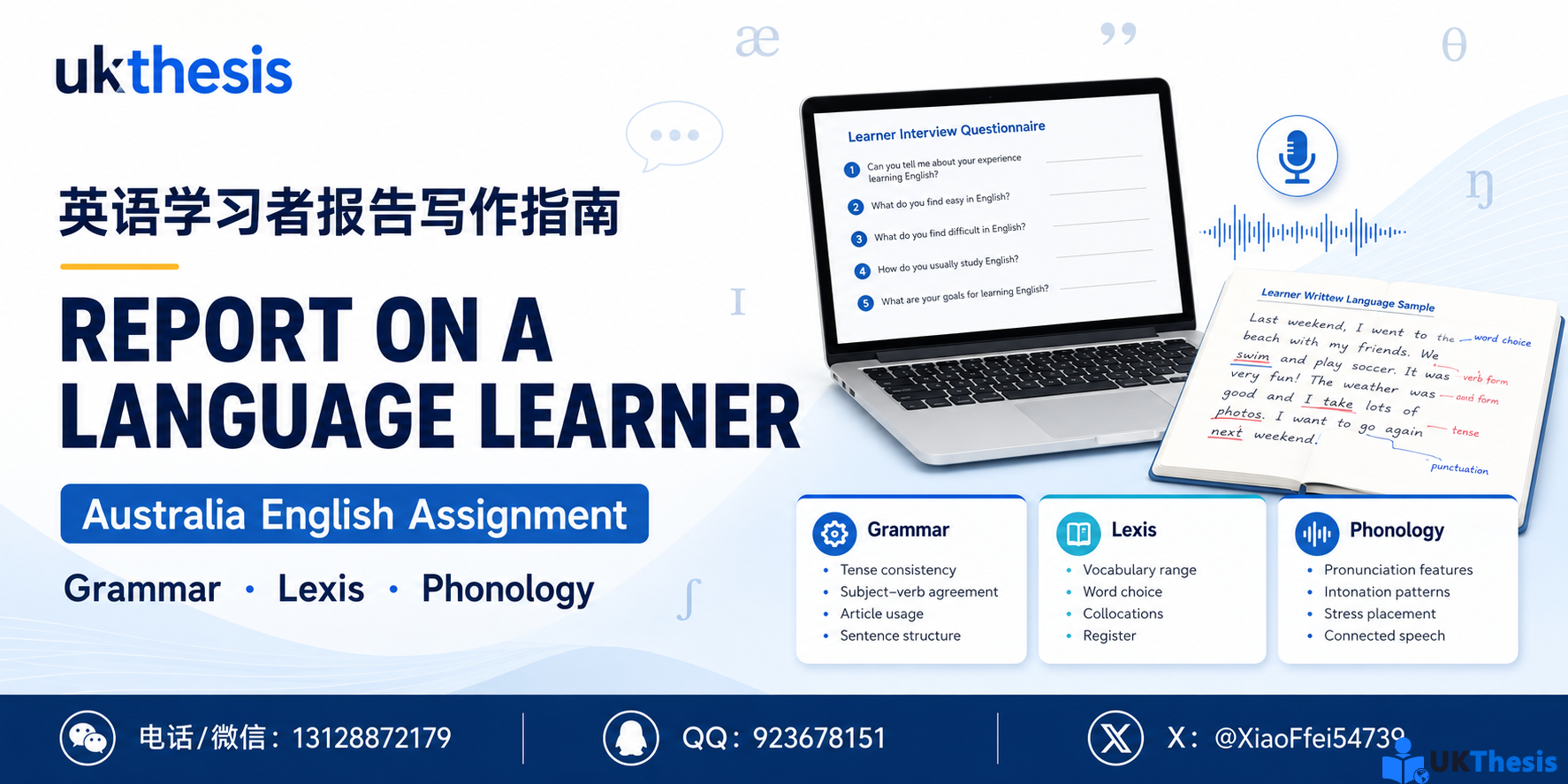
“Report on a Language Learner”是澳洲英语教育、Applied Linguistics及Second Language Acquisition课程中比较常见的Report assignment。学生需要选择一位真实的英语学习者,通过Questionnaire、Interview、Spoken Sample和Written Sample收集资料,再从Grammar、Lexis和Phonology三个方面分析其英语水平。它看起来像一篇普通人物报告,实际上同时考查数据收集、语言分析、二语习得理论和Academic Writing能力。
本文整理一份来自西澳地区的3000字英语课程作业要求,保留原题的研究任务、必写内容、Appendices及评分标准,并修正原页面中的乱码和格式问题。对于正在了解澳洲高中essay、英语Report写作、Literature and Language Assignment、Report代写或英语essay辅导的中国留学生来说,这份案例能够帮助你看清报告究竟需要收集什么数据、使用什么理论,以及怎样把对学习者的观察写成一篇结构完整的学术报告。
一、Assignment基本信息
项目
内容
作业题目 Report on a Language Learner
国家与地区 Australia,Western Australia
专业范围 Literature and Language
作业类型 High School Assignment / Language Report
写作语言 English
报告格式 Report
字数要求 约3000词
参考文献 约10篇
引用格式 原要求未指定,以学校最新要求为准
数据来源 Questionnaire、Interview、Spoken Sample、Written Sample
二、Report on a Language Learner作业概述
This assignment requires the student to collect and analyse data from an English language learner. The data may be obtained through an interview, questionnaire, spoken-language task and written-language task.
The report should describe the learner’s linguistic and cultural background, previous experience of learning English, present and future use of the language, learning strategies and attitude towards the learning environment.
The student must then evaluate the learner’s current linguistic proficiency by analysing the learner’s grammar, lexis and phonology. Based on the findings, a detailed learner profile should be developed, followed by realistic recommendations for the learner’s future language development and autonomy.
这份作业不能只写“学习者英语好不好”。老师真正想看的是:你能否用实际Language Data支持判断,并把分析结果与Second Language Learning理论联系起来。
三、作业的三项核心要求
1. Collect Data from a Learner收集学习者资料
Students should collect information through an interview or questionnaire and make appropriate observations concerning:
The learner’s linguistic background;
The learner’s cultural background;
Previous English-learning experience;
Current use of English;
Expected future use of English;
Learning strategies;
Attitude towards the learning environment。
数据收集之前,应先确定报告想回答什么问题。例如,这位学习者为什么在口语交流中比较流利,但书面语法错误较多?或者学习者记忆了很多Vocabulary,却不能在真实对话中自然使用?
有了明确问题,Questionnaire和Interview Questions才不会变成一组彼此无关的闲聊内容。
2. Evaluate Current Linguistic Proficiency评估当前英语水平
The report should demonstrate the student’s ability to evaluate the learner’s current linguistic proficiency.
The analysis must consider:
Grammatical competence;
Lexical competence;
Phonological competence;
Spoken English;
Written English。
The student should compile a detailed profile of the learner and make recommendations for future language development and learner autonomy.
3. Apply Appropriate Data-collection Methods使用合适方法
Class sessions may introduce methods for collecting data through questionnaires and interviews, together with approaches to describing learner language.
The report should show that the selected methods are suitable for eliciting evidence of grammar, lexis and phonology. A questionnaire alone is not sufficient because it mainly reveals what the learner says about their English, rather than how the learner actually uses English.
因此,比较完整的数据通常包括:
一份Background Questionnaire;
一次半结构化访谈;
一段录音并转写的Spoken Sample;
一份Written Sample;
一张Error Analysis Summary Table。
四、Learner Background学习者背景
The first section should describe the learner’s background where it is relevant to the learning of English.
Information may include:
Age;
Country or region of origin;
First language;
Other languages spoken;
Socio-economic background;
Educational experience;
Age at which English learning began;
Previous English courses;
Length of residence in an English-speaking environment;
Reasons for learning English。
背景资料不能只是人物简介。每一项资料都应与Language Learning产生联系。
例如,如果学习者的First Language与英语在语序或发音系统上存在明显差异,这种语言背景可能会影响其英语表达。学习者开始接触英语的年龄、学习方式及日常使用频率,也可能解释其口语、写作和发音表现。
为了保护隐私,可以为学习者使用Pseudonym,不必在正文中出现真实姓名。
五、Language-learning Needs语言学习需求
The report should identify both the learner’s current needs and expected future needs.
Current Needs
Current language-learning needs may include:
Participating in classroom discussions;
Understanding lectures;
Writing essays and reports;
Communicating with teachers and classmates;
Expanding academic vocabulary;
Improving grammatical accuracy;
Developing pronunciation and listening skills。
Future Needs
Future needs may relate to:
University study;
Employment;
Professional communication;
Immigration;
Social integration;
Further English-language examinations。
Needs Analysis应当具体。例如,“提高英语”过于宽泛,而“提高课堂讨论中的即时表达能力”或“减少Academic Writing中的时态和冠词错误”更容易转化为后续学习目标。
六、Language-learning Strategies语言学习策略
The report must discuss the learner’s strategies for learning English.
Language-learning strategies may include:
Memorising vocabulary;
Using flashcards or vocabulary apps;
Watching English-language videos;
Reading graded readers or news articles;
Practising with native or proficient speakers;
Keeping a learning diary;
Guessing meaning from context;
Asking for clarification;
Monitoring and correcting errors;
Planning study time;
Managing anxiety and motivation。
学生不能只列出学习者使用了哪些方法,还需要评价这些方法是否有效。
For example, a learner may memorise long vocabulary lists but rarely use new words in speaking or writing. The strategy may increase receptive vocabulary while making only a limited contribution to productive lexical competence.
如果学习者经常避免说复杂句,表面上看错误较少,但这也可能说明其Communication Strategy限制了语言发展。分析时应同时关注策略的作用和局限。
七、Analysis of Spoken and Written English口语与写作分析
This section forms the analytical core of the Language Learner Report. It should examine the learner’s productive skills through spoken and written samples.
The analysis should focus on grammatical, lexical and phonological competence.
7.1 Grammatical Competence语法能力
Grammatical analysis may examine:
Tense and aspect;
Subject–verb agreement;
Articles;
Prepositions;
Pronouns;
Singular and plural forms;
Word order;
Sentence structure;
Questions and negatives;
Use of subordinate clauses。
The report should provide examples from the learner’s actual spoken or written data.
For example:
Learner sample: “She go to university every day.”
Analysis: The learner omitted the third-person singular marker “-es” in the simple present tense.
不能只说“学习者语法较差”。应先引用原始语言样本,再判断错误属于哪一类、是否重复出现,以及它可能与First-language Transfer、Overgeneralisation或Developmental Error有什么关系。
7.2 Lexical Competence词汇能力
Lexical analysis may consider:
Vocabulary range;
Accuracy of word choice;
Repetition;
Collocation;
Word formation;
Formal and informal vocabulary;
Academic vocabulary;
Ability to paraphrase;
Use of formulaic expressions。
A learner may possess a reasonable vocabulary but repeatedly select words that are grammatically possible and pragmatically unnatural. Collocation is therefore an important part of lexical competence.
例如,“make a homework”能够被理解,但自然表达应为“do homework”。这类问题不能简单归入Grammar,它也涉及Collocational Knowledge。
7.3 Phonological Competence语音能力
Phonological analysis is mainly based on the spoken sample and may examine:
Individual consonants and vowels;
Word stress;
Sentence stress;
Rhythm;
Intonation;
Connected speech;
Final consonants;
Pausing and fluency;
Overall intelligibility。
The objective is not to criticise the learner for having a non-native accent. The analysis should consider whether particular features affect intelligibility or communication.
A learner may pronounce individual words accurately but use unnatural sentence stress. Another learner may speak fluently while consistently omitting final consonants, creating difficulty for listeners.
分析语音时,应引用录音转写或具体词语。只写“发音不好”不能构成Phonological Analysis。
7.4 Spoken English口语表现
The spoken sample should be long enough to show the learner’s natural language use. A short set of yes-or-no answers will not provide sufficient data.
Suitable speaking tasks may include:
Describing a picture;
Retelling a short story;
Discussing study or work experience;
Explaining a familiar process;
Expressing an opinion;
Participating in a semi-structured interview。
The analysis may consider fluency, accuracy, complexity, interaction and pronunciation.
7.5 Written English写作表现
The written task should be appropriate for the learner’s level and future needs.
Possible tasks include:
A personal narrative;
An opinion paragraph;
A short academic essay;
An email;
A description;
A summary of a short text;
A workplace-related document。
The written sample should be reproduced in the Appendix. The main text should select representative examples rather than correcting every sentence individually.
八、Evaluation of Findings研究发现评价
The report should evaluate the collected findings rather than presenting a list of language errors.
This part should answer questions such as:
What are the learner’s main strengths?
Which problems occur consistently?
Are errors more frequent in speaking or writing?
Does the learner prioritise fluency over accuracy?
How does the learner’s background influence performance?
Are current learning strategies appropriate?
What does the evidence suggest about the learner’s stage of development?
The evaluation should draw on theories introduced earlier in the report. Relevant areas may include:
Second Language Acquisition;
Interlanguage;
First-language Transfer;
Error Analysis;
Communicative Competence;
Motivation;
Language-learning Strategies;
Learner Autonomy;
Affective Factors。
理论不能与案例分析分开写。引用Interlanguage理论后,应解释这位学习者的哪些语言表现能够用该理论理解。
九、Recommendations for Future Language Development学习建议
Recommendations should be based on the evidence collected from the learner.
If the analysis identifies difficulties with articles, for example, the recommendation should explain what type of practice may help and how progress can be monitored.
Possible recommendations include:
Keeping a language-learning diary;
Recording and reviewing spoken English;
Using spaced repetition for vocabulary;
Learning words through collocations;
Completing focused grammar tasks;
Practising pronunciation through shadowing;
Taking part in regular conversations;
Reading texts related to future study or employment;
Setting measurable weekly goals;
Reviewing recurring errors in writing。
Recommendations should also promoteLearner Autonomy. The learner should gradually become able to identify needs, select resources, monitor progress and evaluate learning strategies without relying completely on a teacher.
不要把建议写成“多背单词、多练口语、多看英文电影”。这些建议没有错,但过于笼统。高分Report需要把建议与前面的具体发现一一对应。
十、Appendices附录要求
The following materials should be presented in the Appendices and referred to in the main text.
Appendix A: Spoken-language Data
This should include:
A transcript of the spoken sample;
Relevant transcription conventions;
A summary table of spoken-language analysis;
Access to an audio or digital copy where required。
Appendix B: Written-language Data
This should include:
The learner’s original written sample;
A coded or annotated version where appropriate;
A tabular summary of errors and language features。
Appendix C: Data-collection Documents
This may contain:
Questionnaire;
Interview questions;
Speaking-task instructions;
Written-task rubric;
Participant information and consent materials。
Appendix D: Background Information
Relevant supplementary background material may be included where it supports the analysis.
All appendices must be numbered or lettered and given clear titles. Any external sources used in the appendices should be Referenced in the normal way.
Appendices do not normally count towards the main word limit, but students should confirm this in the assignment brief.
十一、建议的Report Structure报告结构
一篇3000词左右的Report on a Language Learner可以采用以下结构:
章节
建议字数
Introduction 200–250
Learner Background 300–350
Language-learning Needs 250–300
Learning Strategies 350–400
Method of Data Collection 250–300
Analysis of Grammar 350–400
Analysis of Lexis 300–350
Analysis of Phonology 300–350
Evaluation and Discussion 350–400
Recommendations and Conclusion 250–300
字数只是写作安排参考,不需要为了凑字数机械平均。Grammar、Lexis和Phonology属于核心分析部分,应获得足够篇幅。
十二、Assessment Criteria评分标准
Coverage of Relevant Knowledge
The report should cover the key areas of language description and second-language learning, using appropriate terminology and concepts from academic literature.
Planning and Data Collection
The student should design and carry out suitable data-collection activities capable of eliciting useful spoken and written evidence.
Quality of Data Analysis
The analysis should be accurate, detailed and supported by examples from the collected data.
Depth of Discussion
Findings should be evaluated in sufficient depth and connected to relevant literature and Second Language Acquisition theory.
Coherence and Organisation
The report should have a logical structure, with clear sections, paragraphs and transitions.
Presentation and Academic English
The report should demonstrate appropriate academic style, accurate referencing, careful proofreading and consistent formatting.
十三、常见写作问题
第一,只介绍学习者背景,却没有深入分析语言样本。背景介绍只是分析基础,不是整篇Report的主体。
第二,使用自己编造的学习者错误,却没有在Appendix中提供Spoken Transcript或Written Sample。所有分析都应能追溯到原始数据。
第三,把Grammar、Lexis和Phonology混在一起,没有清晰分类。部分错误确实可能涉及多个方面,但报告仍需要说明主要分析角度。
第四,引用大量Second Language Acquisition理论,却没有把理论用于解释具体发现。理论与案例之间必须建立联系。
第五,Recommendations与分析结果不对应。如果前面主要发现是Academic Vocabulary不足,结尾却只建议练习发音,逻辑就会断开。
结语
Report on a Language Learner不是简单记录一个人如何学习英语,而是通过真实数据建立Learner Profile,再用Second Language Acquisition理论解释其语言表现。想把这篇3000词的English Assignment写扎实,关键在于准备有效的Questionnaire、Interview、Spoken Sample和Written Sample,并用实际例子分析Grammar、Lexis和Phonology。
不少中国留学生搜索国外高中essay、英语essay代写、report代写或英语类dissertation定制时,真正卡住的通常是数据不知道怎么收集、语言错误不会分类、理论不会应用。优客网ukthesis创立于1999年,长期提供英语Assignment辅导、Report结构指导、Language Learner案例分析、英文修改润色和参考文献检查。此类作业应以学习者的真实数据为基础,保留学生自己的观察和判断,最终才能形成一篇逻辑完整、有证据支持的Language Learner Report。